
Shoulder pain when lifting your arm: causes and what helps
What the arc of pain tells you
Raise your arm slowly out to the side and notice where the pain starts and where it stops. In clinic that map is often more useful than a pain score out of 10, because it says something about which tissue is being loaded and when.
Three patterns come up again and again. Pain that begins partway up, peaks somewhere around shoulder height and then eases as the arm carries on to vertical is the painful arc, and it points at the cuff tendons and the bursa travelling through the narrowing space beneath the bony roof of the shoulder (the acromion). Pain that only appears in the last part of the lift, right at the top, and sits over the small joint where the collarbone meets the shoulder blade, tends to come from that joint. Pain from the very first inch of movement, in every direction, with the arm running into a hard stop, is more the frozen shoulder picture.
Useful, but not proof. Hegedus and colleagues (2012) pooled the accuracy of the common shoulder examination tests and put the painful arc at 53% sensitivity and 76% specificity, which is a weak signal on its own. Their conclusion was that no single shoulder test can be relied on to make the diagnosis, and that combining tests helps only a little. Physios use several findings together, plus your history, and even then the label often matters less than the plan.
Which direction hurts, and what that adds
Lifting out to the side, straight in front, overhead and across the body all ask different things of the shoulder, so the direction that catches you narrows things down a little further.
- Out to the side, palm down. The classic cuff and bursa direction, and usually the first one to hurt. Turning the palm up often lets the same arm go higher with less pain.
- Straight in front. Usually a milder version of the same thing, which is why physios often start people lifting forward rather than sideways.
- All the way overhead. Adds the last part of the range, where the shoulder blade has to rotate and tilt, so it often hurts when the lower ranges do not.
- Across the body toward the opposite shoulder. This squeezes the joint on top of the shoulder rather than the cuff. Chronopoulos and colleagues (2004) found the cross body test the most sensitive of three clinical tests for long-standing problems at that joint, at 77%, and advised using them in combination rather than alone.
- Reaching behind your back, to a back pocket or a bra strap. Loads the muscle at the front of the cuff (subscapularis) and pulls on the back of the shoulder, and it is often the last movement to come back after a stiff shoulder.
Two more that patients often ask about. Lifting with the elbow bent shortens the lever, so a shoulder that hurts carrying a suitcase at arm's length may be fine with the same weight held close, and that is a useful way to keep using the arm. Lifting quickly, or catching something as it falls, loads the tendon far harder than the same movement done slowly.
Painful to lift, or unable to lift?
This distinction changes what happens next, so be honest about which one you have.
A shoulder that is painful to lift will usually still get there. Warm it up, use the other hand to help it up, or lie on your back and take gravity out, and the arm goes further than it did standing. That is pain limiting movement, and it responds to a graded program.
A shoulder that cannot lift is a different thing. If you can get the arm up with help but it drops or will not hold when you let go, that is weakness. If the arm will not go up even when someone else moves it for you, that is stiffness. OrthoInfo describes tears that happen suddenly, such as from a fall, as causing intense pain, sometimes with a snapping sensation and immediate weakness in the upper arm.
Weakness that started with an injury is the one to act on quickly. If the pain began with a fall, a pull or a sudden jolt, and the arm has been weak since so that you cannot lift it out to the side or hold it up, ask for an urgent appointment with your doctor within days rather than weeks. The BESS and BOA care pathway advises urgent referral for a rotator cuff tear caused by an injury (Kulkarni and colleagues, 2015), which is why this sits at a different level from the same weakness coming on slowly. That wording is in the warning signs below, alongside everything else that needs prompt attention.
What causes pain when you lift your arm?
Background, not a diagnosis. They are listed roughly in the order physios meet them in clinic.
Rotator cuff related shoulder pain
The ache sits over the top and the outer side of the shoulder, and reaching, lifting and overhead work bring it on. It usually builds over weeks, with no single moment that started it. Lewis (2016) uses this name for the whole group, including subacromial pain, cuff tendinopathy and partial tears, because they behave similarly and respond to similar treatment. The evidence for exercise here is good: Holmgren and colleagues (2012) found that a specific exercise strategy reduced the number of people who went on to have surgery, and the 2025 physical therapy guideline rates an active exercise program at grade A, its highest level of support, as the treatment to start with (Desmeules and colleagues, 2025). Start with the shoulder impingement program or the rotator cuff tendinopathy program; they cover the same ground under different names.
Frozen shoulder
Stiffness, not just pain, and it applies in every direction. The test a physio uses is whether the arm goes further when they move it for you: in frozen shoulder it does not, which separates it from a painful cuff. Outward turning with the elbow tucked at your side is typically the most restricted movement. The JOSPT clinical practice guideline puts stretching at the center of treatment, with the firmness of the stretch set by how irritable the shoulder is that week rather than by how far it will eventually need to go (Kelley and colleagues, 2013). The frozen shoulder program works to that principle.
The joint on top of the shoulder
The AC joint is the small joint where the outer end of the collarbone meets the flat bony roof of the shoulder blade. Pain from it sits in a spot you can put one finger on, right on top, rather than spreading down the outer arm. It tends to bite at the very end of an overhead lift and when you bring the arm across your chest, and heavy bench pressing and dips often aggravate it. OrthoInfo notes that the most common cause of an injury there is a fall directly onto the shoulder, and Lindborg and colleagues (2024) describe rehab aimed at the deltoid and trapezius, which attach around that joint, plus the muscles that steady the shoulder blade. The AC joint sprain program sets that out.
A cuff tear after a fall
Different story, and worth separating from the gradual kind. A sudden tear tends to bring intense pain at the moment it happens, and the arm is weak straight afterward rather than simply sore. This is the group the urgent referral advice is written for. If that describes you, the warning signs below tell you how fast to move.
A calcium deposit in the tendon
Calcium in a cuff tendon can turn a manageable shoulder into an unliftable one over a day or two. Merolla and colleagues (2016) place the worst symptoms in the phase where the deposit is being reabsorbed, and say movement may or may not be restricted alongside the pain. Kulkarni and colleagues (2015) note that an acute episode is severe enough to be mistaken for the pain of a tumor, and usually prompts an early specialist referral. It is the cause on this list that most often convinces people something has torn when nothing has, and the calcific tendinitis program explains what usually happens next.
What helps at home
NHS self-help for shoulder pain is short. Carry on using the shoulder gently, steer clear of whatever obviously aggravates it, and leave heavy gym equipment and improvised strenuous exercises alone for now. Painkillers such as paracetamol (acetaminophen) and ibuprofen, and heat or cold packs, are there to make movement possible rather than to fix the tendon. Check with a pharmacist before you start one if you take other medicines.
Height is the lever you have most control over. Whatever you reach for several times a day belongs at waist or chest height for the next few weeks, so you are not repeating a painful lift 30 times without noticing. If your job keeps the arms up for long stretches, split those stretches into shorter blocks with the hands back down in between, which is the kind of work adaptation the 2025 guideline supports (Desmeules and colleagues, 2025).
Keep the arm working inside the range that does not hurt. A shoulder that is protected completely gets stiff and weak, and then the lift you were avoiding is harder than it was. GRASP compared a single best practice advice session, with a booklet, a band and home exercises, against up to 6 supervised progressive exercise sessions, and found no difference in shoulder pain and function over 12 months (Hopewell and colleagues, 2021). That is a good argument for getting a plan once and then actually doing it.
Exercises for shoulder pain when lifting the arm
The usual order is to load the cuff without lifting the arm, train the shoulder blade muscles that let the arm travel, then rebuild the lift itself with the wall carrying some of the weight. On dosing, the review by Littlewood and colleagues (2015) found 3 sets better than 1 or 2, and some resistance better than none, though how much resistance is best is still unknown. The same review puts 12 weeks as the point by which most programs ought to have produced a clear change.
Some discomfort while you work is normal, so long as it fades soon after you stop and the shoulder feels no worse when you wake. What should stop you is a sharp pain, a catch, or an ache that climbs with every repetition. If you have high blood pressure, breathe steadily through every hold and never hold your breath. On the last two exercises, which take the arm higher, keep below any height where the shoulder pinches and lift that ceiling across weeks rather than within a single session.
After shoulder surgery, including a rotator cuff repair, or after a shoulder fracture or dislocation, follow your surgeon's or physio's plan, and do only the movements and range they have cleared. Many plans allow only passive movement at first, where the arm is moved for you and its muscles stay relaxed. The rotator cuff repair rehab program and the shoulder replacement rehab program describe the usual stages, and your own team's protocol overrides both. Those two pages also list the warning signs for the weeks after an operation: a wound that turns more red, hot, swollen or painful or starts to leak, an arm that swells instead of settling, or a fever all mean the same day rather than the next appointment, and an emergency department if you feel very unwell. Sudden breathlessness or chest pain means emergency services.
The shoulder blade exercise is done lying face down. If you are pregnant, ask your physio for a version that does not need you on your stomach, and check with your midwife or physio before you start any of these.
Exercises that can help
These five work the cuff and the shoulder blade muscles while keeping the arm below the height that usually hurts, then take it higher with the wall helping. Common starting points are 5 to 10 holds of 5 to 10 seconds for the static work, 2 to 3 sets of 10 to 15 slow repetitions for the band and shoulder blade work, and 10 to 15 slow slides or rolls for the two wall exercises. Each exercise page gives its own numbers and how often to do them, and your physio will adjust this.
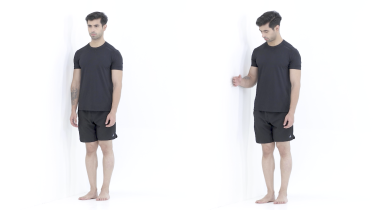 Isometric shoulder abduction
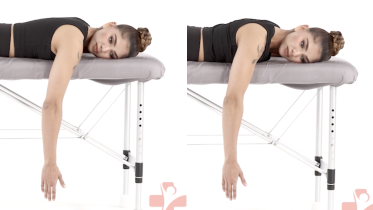 Prone scapular retraction
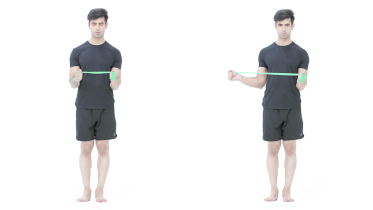 Shoulder external rotation with band
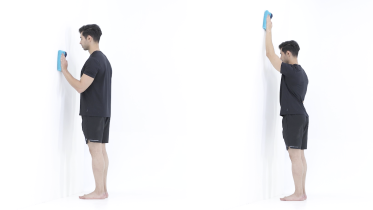 Wall slides with a towel
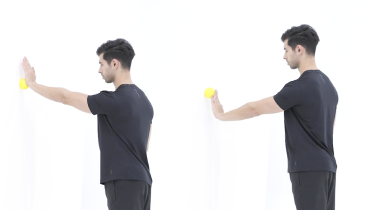 Wall ball shoulder flexion
If night pain is the part you most want gone, shoulder pain at night covers the positions and the gentler starting exercises for an irritable shoulder.
When to see a physio (physical therapist)
Book an assessment if the pain is getting worse, if it has not improved after 2 weeks of sensible self-care, or if moving the arm is very difficult, which is what the NHS advises. Do it sooner if the arm has been weak since an injury, because that changes the urgency, as the warning signs explain.
What a physio adds is a measurement rather than an opinion. They will compare how far the arm goes when you lift it against how far it goes when they lift it, test the strength of turning in and turning out against resistance, check whether your neck reproduces the pain, and then set a starting load your shoulder can handle. On timing, Kulkarni and colleagues (2015) allow physiotherapy an initial block of about 6 weeks, doubled when it is clearly working, before a specialist gets involved. If you have had shoulder surgery, your surgical team decides when any new exercise starts.
Related exercise programs
See a doctor promptly if
- Emergency: chest pain or tightness, which may spread to your arm, neck or jaw, or shoulder or arm pain that comes with shortness of breath, sweating or feeling sick. This can be a heart attack. Call emergency services straight away.
- Emergency: after a fall or a blow to the shoulder or collarbone, bone is sticking out through the skin, the shoulder swells up very quickly, you are bleeding heavily, or you find it hard to breathe, have chest pain or cough up blood. Call emergency services straight away.
- Emergency: the shoulder feels as if it has slipped out of place, looks a different shape or suddenly locks so you cannot move the arm, or the pain is severe after a fall or an injury. Go to an emergency department straight away, without driving yourself, and do not try to put the shoulder back in yourself.
- Emergency: your arm, hand or fingers turn cold, pale, blue or gray compared with the other side. Call emergency services or go to an emergency department straight away, and do not drive yourself. The blood supply to the arm may be blocked.
- Same day: sudden, very bad shoulder pain, or you suddenly cannot lift or move your arm at all. Get medical help the same day.
- Same day: after a fall or a blow to the shoulder, the shoulder is very swollen or bruised, or you cannot use your arm normally. Get it checked the same day, as the collarbone or the top of the arm may be broken.
- Same day: the shoulder is hot, red and swollen, or you have a fever or feel unwell. This can be a joint infection. Go to an emergency department the same day.
- Same day: pins and needles or numbness in the arm that does not go away, no feeling in part of the arm, or weakness that is getting worse. Get medical advice the same day. For pain spreading down the arm from your neck, ask for an urgent appointment with your doctor. If one side of your face or body suddenly goes numb or weak, or your speech becomes slurred or muddled, call emergency services, even if it goes away.
- Within a day or two: severe pain in both shoulders that has come on recently. Ask for an urgent appointment with your doctor.
- Within a day or two: new shoulder pain and you have had cancer, now or in the past, or you are losing weight without trying. See your doctor within a day or two and mention it. If you are being treated for cancer now, contact your cancer team the same day.
- Within a few days: the pain started after a fall, a pull or another injury, especially if the arm has been weak since, for example you cannot lift it out to the side or hold it up. This can be a broken bone or a torn tendon. Ask for an urgent appointment with your doctor, within days rather than weeks, because UK shoulder surgeons advise urgent referral for a rotator cuff tear caused by an injury.
- Within a few days: you are over 50 and have aching and stiffness in both shoulders, often in the neck or hips too, that is worst in the morning and lasts more than 45 minutes after you get up. See your doctor within a few days, as this can be an inflammatory condition (polymyalgia rheumatica) rather than a local shoulder problem. If you also get a new headache, pain or tenderness at your temples or on your scalp, or jaw pain when you eat or talk, get medical advice the same day, and if your vision changes, call emergency services.
- Within a few days: night pain is common with shoulder problems, but get checked within a few days if the pain is constant, no rest or change of position eases it at all, and it keeps getting worse. If you have had cancer, now or in the past, or are losing weight without trying, see your doctor sooner, within a day or two, and mention it. If you are being treated for cancer now, contact your cancer team the same day.
Common questions
Why does my shoulder hurt when I lift my arm above my head?
The space between the top of the arm bone and the bony roof above it narrows as the arm goes up, and the cuff tendons and the bursa have to travel through it. If those tissues are irritated, the part of the lift where the space is tightest is often where you feel it, which is why so many people describe pain building partway up and easing again once the arm is all the way vertical. That mechanical explanation is no longer taken as the whole story, and pain in the arc does not prove that anything is being pinched. Reaching overhead also asks the shoulder blade to rotate and tilt out of the way, so tired or poorly coordinated shoulder blade muscles can make the same lift hurt more at the end of a long day. The middle-of-the-lift pattern has a name, the painful arc, but as a test it is a weak one: in the meta-analysis by Hegedus and colleagues (2012) it showed up in roughly half the people who had the problem, so it describes your shoulder better than it diagnoses it.
Why can't I lift my arm all the way up?
There are three different reasons, and telling them apart matters. Pain can stop the lift, in which case the arm will usually go further if you are relaxed, warm or helping it up with the other hand. Stiffness can stop it, in which case it goes no further even when someone else lifts it for you, which is the frozen shoulder pattern. Or the muscle can be unable to do the job, which is weakness: the arm goes up easily when helped but drops or will not hold when you let go. Weakness that appeared after a fall or a sudden pull is the one that needs looking at within days rather than weeks, and it is on the warning signs list on this page.
Is it impingement, a rotator cuff problem or frozen shoulder?
Impingement and rotator cuff problems are now largely treated as the same thing. UK shoulder surgeons handle subacromial shoulder pain, rotator cuff tendinopathy and impingement as essentially one diagnosis, the Dutch guideline replaced the word impingement with subacromial pain syndrome, and Lewis (2016) groups them under rotator cuff related shoulder pain. Frozen shoulder is the one that stands apart, because it brings stiffness in every direction rather than pain in one arc, and turning the arm outward with the elbow at your side is usually the most limited movement. The practical news is that the first two lead to much the same exercise program, so you do not need the label settled before you start.
Why does my shoulder hurt when I lift my arm after a workout?
Usually because the load went up faster than the tendon adapted. Overhead pressing, bench work, dips, pull-ups and anything that puts the arm behind the body under load are the usual suspects, and the pain often shows up a day later rather than during the session. Tendons respond to a steady build and object to a sudden jump, so the fix is normally to trim the overhead and heavy pressing work for a few weeks, keep the pulling exercises you can do without pain, and add load back gradually. If the shoulder is sore for more than 24 hours after a session, the last session was too much for now. A physio can plan that build with you rather than setting a fixed date.
Why does my shoulder hurt when I lift my arm after sleeping?
A shoulder held in one position for hours stiffens up, and the first few lifts of the day are often the worst ones regardless of the cause. Lying on that side compresses the cuff tendons and the bursa all night, so you get out of bed with them already irritated. If it loosens off within 30 minutes of moving around, that fits an irritable tendon. If stiffness lasts well past that, involves both shoulders, and you are over 50, read the polymyalgia rheumatica warning sign on this page, because that pattern is worth a doctor's opinion.
What relieves shoulder pain when lifting the arm?
In the short term, lowering the height and the load: move what you reach for most down to waist or chest height, carry bags with the elbow bent and close to the body, and split heavy loads between both hands. Heat or cold packs and simple painkillers can make it easier to keep moving, and a pharmacist can tell you which ones fit with anything else you take. For anything longer than that, a progressive exercise program has the best evidence behind it, and the 2025 physical therapy guideline gives it the highest grade as the treatment to start with (Desmeules and colleagues, 2025). Give it around 12 weeks before you judge whether it is working (Littlewood and colleagues, 2015), because change in tendons is slow.
References
- Hegedus EJ, Goode AP, Cook CE, Michener L, Myer CA, Myer DM, Wright AA. Which physical examination tests provide clinicians with the most value when examining the shoulder? Update of a systematic review with meta-analysis of individual tests. British Journal of Sports Medicine. 2012;46(14):964-978. https://doi.org/10.1136/bjsports-2012-091066
- Chronopoulos E, Kim TK, Park HB, Ashenbrenner D, McFarland EG. Diagnostic value of physical tests for isolated chronic acromioclavicular lesions. American Journal of Sports Medicine. 2004;32(3):655-661. https://doi.org/10.1177/0363546503261723
- Lewis J. Rotator cuff related shoulder pain: assessment, management and uncertainties. Manual Therapy. 2016;23:57-68. https://doi.org/10.1016/j.math.2016.03.009
- Desmeules F, Roy JS, Lafrance S, et al. Rotator cuff tendinopathy diagnosis, nonsurgical medical care, and rehabilitation: a clinical practice guideline. Journal of Orthopaedic and Sports Physical Therapy. 2025;55(4):235-274. https://doi.org/10.2519/jospt.2025.13182
- Diercks R, Bron C, Dorrestijn O, et al. Guideline for diagnosis and treatment of subacromial pain syndrome: a multidisciplinary review by the Dutch Orthopaedic Association. Acta Orthopaedica. 2014;85(3):314-322. https://doi.org/10.3109/17453674.2014.920991
- Kulkarni R, Gibson J, Brownson P, Thomas M, Rangan A, Carr AJ, Rees JL. Subacromial shoulder pain. BESS/BOA Patient Care Pathways. Shoulder and Elbow. 2015;7(2):135-143. https://doi.org/10.1177/1758573215576456
- Holmgren T, Björnsson Hallgren H, Öberg B, Adolfsson L, Johansson K. Effect of specific exercise strategy on need for surgery in patients with subacromial impingement syndrome: randomised controlled study. BMJ. 2012;344:e787. https://doi.org/10.1136/bmj.e787
- Littlewood C, Malliaras P, Chance-Larsen K. Therapeutic exercise for rotator cuff tendinopathy: a systematic review of contextual factors and prescription parameters. International Journal of Rehabilitation Research. 2015;38(2):95-106. https://doi.org/10.1097/MRR.0000000000000113
- Hopewell S, Keene DJ, Marian IR, et al. Progressive exercise compared with best practice advice, with or without corticosteroid injection, for the treatment of patients with rotator cuff disorders (GRASP): a multicentre, pragmatic, 2 x 2 factorial, randomised controlled trial. The Lancet. 2021;398(10298):416-428. https://doi.org/10.1016/S0140-6736(21)00846-1
- Kelley MJ, Shaffer MA, Kuhn JE, et al. Shoulder pain and mobility deficits: adhesive capsulitis. Clinical practice guidelines linked to the International Classification of Functioning, Disability, and Health from the Orthopaedic Section of the American Physical Therapy Association. Journal of Orthopaedic and Sports Physical Therapy. 2013;43(5):A1-A31. https://doi.org/10.2519/jospt.2013.0302
- Merolla G, Singh S, Paladini P, Porcellini G. Calcific tendinitis of the rotator cuff: state of the art in diagnosis and treatment. Journal of Orthopaedics and Traumatology. 2016;17(1):7-14. https://doi.org/10.1007/s10195-015-0367-6
- Lindborg CM, Smith RD, Reihl AM, Bacevich BM, Cote M, O'Donnell E, Mazzocca AD, Hutchinson I. Current concepts in management of acromioclavicular joint injury. Journal of Clinical Medicine. 2024;13(5):1413. https://doi.org/10.3390/jcm13051413
- American Academy of Orthopaedic Surgeons. Rotator cuff tears. OrthoInfo. https://www.orthoinfo.org/en/diseases--conditions/rotator-cuff-tears/
- American Academy of Orthopaedic Surgeons. Shoulder separation. OrthoInfo. https://www.orthoinfo.org/en/diseases--conditions/shoulder-separation/
- NHS. Shoulder pain. Page last reviewed 22 May 2023. https://www.nhs.uk/symptoms/shoulder-pain/
- NHS. Heart attack. Page last reviewed 31 March 2026. https://www.nhs.uk/conditions/heart-attack/
- NHS. Polymyalgia rheumatica. Page last reviewed 23 April 2023. https://www.nhs.uk/conditions/polymyalgia-rheumatica/
- NHS. Temporal arteritis. Page last reviewed 14 August 2023. https://www.nhs.uk/conditions/temporal-arteritis/
Written and checked by the PocketPhysio editorial team. Last updated 2026-09-30.
This page is general education, not a diagnosis or a personal treatment plan. See a physiotherapist or doctor for advice about your own situation.