
Part of Menopause and joints
A strength plan for the menopause years
What a week looks like
Six movements, one session, repeated 2 or 3 times a week. The same session each time, rather than an upper body day and a lower body day. You are training to hold on to tissue and function, not to compete, and doing the same six movements is what teaches them fastest.
Put a rest day between sessions. Any spacing suits the plan as long as two do not land back to back: Tuesday and Saturday for two, or Monday, Thursday and Saturday for three.
Allow about 30 to 40 minutes once you know the six movements. The early weeks take far less, because the sets are short and light. Let your breathing settle before the next set, usually 60 to 90 seconds, and take longer when you need it. Nobody is timing you.
The guideline behind the plan
The frequency is not invented for menopause. The WHO 2020 guidelines ask adults to do muscle-strengthening activities at moderate or greater intensity that involve all major muscle groups on 2 or more days a week. From age 65 they add varied multicomponent physical activity emphasizing functional balance and strength training at moderate or greater intensity on 3 or more days a week, to improve everyday function and prevent falls (Bull 2020).
For the bone side, the UK consensus statement recommends resistance and impact exercise to maximize bone strength, activities to improve strength and balance to reduce falls, and spinal extension exercise to improve posture and potentially reduce the risk of falls and vertebral fractures (Brooke-Wavell 2022). Those three aims are why the session ends with a back extension, and why impact and balance get a section of their own below.
The effect sizes are small, and worth stating plainly. In the Cochrane review of postmenopausal women, combination programs came out 3.2 percent ahead of the control groups for bone density at the spine, and lower limb resistance training 1.03 percent ahead at the hip (femoral neck). The reviewers call that a relatively small but possibly important effect, the number of fractures did not differ between the groups, and the reporting quality of the pooled trials was rated low (Howe 2011). Strength and everyday function are the steadier return, and worth the two sessions on their own: in the supervised LIFTMOR trial every functional measure improved, including sit to stand and functional reach (Watson 2018).
Starting from zero
None of the six movements assumes you have set foot in a gym. Each one has an easier version on its own page, and the opening weeks are about the pattern rather than the load.
Start lighter than feels sensible. A goblet squat can begin with nothing in your hands at a depth you can control with your heels flat. The shoulder press starts with a 500 ml bottle of water, about 0.5 kg (1.1 lb) in each hand. Use a low step for the step up and a light band for the row, and keep a counter or a stair rail within reach for anything you do standing.
Learn one thing well per session for the first two weeks. It sounds slow, and it is the reason people are still doing this in six months rather than nursing a sore shoulder in week three.
How to judge the effort
Finish each set with about 2 repetitions in reserve: you could have managed two more without the movement changing shape. That is enough to give the muscle a reason to keep what it has, without turning every session into a test of maximum effort.
Muscle soreness for a day or two after a new movement is ordinary and fades as the body gets used to it. Sharp pain inside a repetition means stop that exercise for today rather than push one more out. If a joint is more painful or swollen the next morning, the load was ahead of you, so take it down a step and build again instead of dropping the movement. Our guide to the pain monitoring model explains how physios make that call.
Back pain is in a different category from muscle soreness. One warning sign belongs here rather than at the foot of the page: back pain that comes on suddenly after lifting, bending, a cough or a sneeze, even without a fall, if you have low bone density (osteoporosis). Get medical advice the same day. This can be a sign of a broken bone in the spine (vertebral fracture). Stop the exercises until you have been checked.
How to make it harder
Change one thing at a time, and make each change small. Repetitions come first: climb to the top of the range on every set while the difficulty stays where it is. Add a set next. When both or all three sets feel comfortable, move to a harder version of the movement. Added weight is the last rung, not the first.
Every exercise page has its own ladder. Goblet squats get harder as the depth increases and then as the dumbbell does. The step up gets harder with a higher step. The band exercises get harder with a firmer band or a shorter grip, the glute bridge moves toward a single leg version when your physio says so, and the back extension on elbows builds from about a 5 second hold toward 10 seconds before it becomes the prone back extension. Our guide to exercise progression uses the same order on other programs.
Stay at a level until two sessions in a row feel comfortable, then move up. If a step costs you your technique, go back down a rung and hold there for two weeks. Nothing is lost by moving slowly, and quite a lot can be lost by moving fast.
Impact and balance work for bone
Read this part before you jump. If you have been told you have osteoporosis or osteopenia, or you have had a fracture in a bone of your spine, do not add impact or loaded forward bending on the strength of this page. Work from the osteoporosis program and your own physio or doctor instead. If you have had a fracture in your spine, check with your physio before you begin. The consensus states that people with vertebral fracture or multiple low trauma fractures should usually only exercise up to an impact equivalent to brisk walking, and the Royal Osteoporosis Society sets that group a target of 20 minutes of low-impact exercise on most days.
For everyone else, strength work alone does not cover what bone responds to, and the consensus pairs it with impact (Brooke-Wavell 2022). None of the six movements below is an impact exercise, so impact is an addition to agree with your physio or doctor first, and the Royal Osteoporosis Society asks you to talk to one of them before starting if you have had many broken bones or a spinal fracture, or are recovering from a broken bone. Once that is settled, the Society gives the amount: with no spinal fracture and no run of broken bones, build up to 50 moderate-impact exercises on most days of the week, spread through the day if you like, where moderate impact means you push off and land with a medium amount of force, as in a jog, a skip or a hop.
Balance belongs in the week too, and the consensus tells anyone at risk of falls to start with targeted strength and balance training rather than with impact. The Royal Osteoporosis Society says the same thing in plainer words: work on balance first if you are unsteady on your feet or have not exercised in a while. Our balance and falls prevention program is where those exercises sit.
Exercises that can help
The session runs in this order. Goblet squats often start with a light weight or none at all, at 2 to 3 sets of 8 to 12 a few days a week, and step ups at 2 to 3 sets of 8 to 12 on each leg. The band row with external rotation uses a light band, 2 to 3 sets of 8 to 12 slow repetitions on 3 or 4 days a week, and the seated shoulder press 2 to 3 sets of 8 to 12 slow presses with each arm, 2 to 3 times a week. The back extension on elbows is 1 to 3 sets of 5 to 10 lifts held for about 5 seconds, the glute bridge 2 to 3 sets of 10 to 12 with a short hold at the top, and every exercise page carries the technique notes, precautions and stop signs to read before your first session. Your physio will adjust this.
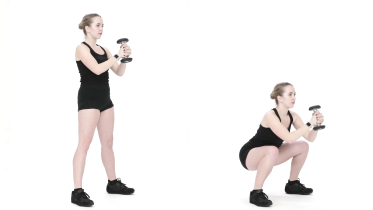 Goblet squat
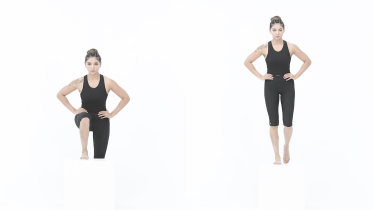 Step up
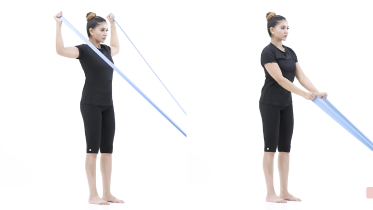 Band row with external rotation
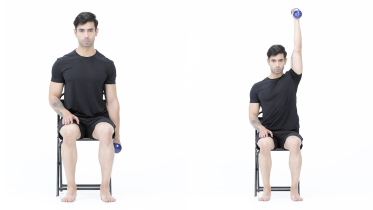 Seated dumbbell shoulder press
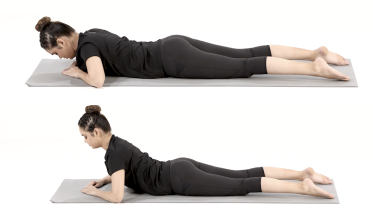 Back extension on elbows
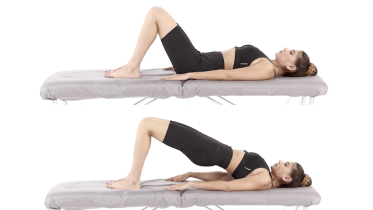 Glute bridge
Get the space ready before you start. Use a heavy chair or a firm step that will not slide, clear the floor around you, and wear flat shoes that fit well and grip the floor, not socks, tights or bare feet.
If you have high blood pressure, breathe steadily through every repetition and never hold your breath. With a heart condition or high blood pressure, check with your doctor before you start.
If you have had a hip or knee replacement, get the go-ahead from your surgeon or physio before you try goblet squats. A deep squat bends the hip well past a right angle, and many surgeons ask you to avoid that for the first months after some operations. After hip, knee or back surgery, start bridges and step ups only at the point your surgical team's protocol allows. If you are pregnant and past the first three months, check with your physio before exercising flat on your back.
Inspect the band for small splits and tug the anchor before every row. If your shoulder has dislocated or you have had shoulder surgery, check with your surgeon or physio before the band row with external rotation and the overhead press, because hands up beside the head is the position an unstable shoulder is most likely to object to. Arching backward can irritate spinal stenosis or a slipped vertebra (spondylolisthesis), so ask your physio before the back extension if you have either diagnosis.
Stop the session for chest pain or pressure, dizziness or feeling faint, a racing or irregular heartbeat, or being far more out of breath than the effort should cause. If chest pain, pressure or tightness does not ease quickly when you rest, spreads to your arm, neck, jaw, stomach or back, or comes with sweating, feeling sick, feeling light-headed or being short of breath, call emergency services straight away, as this can be a heart attack. If it eases quickly and none of these happen, get medical advice the same day, and do not exercise again until you have been checked.
Getting down to the floor and back up for the bridge and the back extension counts as part of the exercise. Roll onto your side and push up with your arms rather than twisting or curling straight up.
When to see a physio (physical therapist)
See a physio before session one if you have never lifted, if you have been told you have osteoporosis or osteopenia, if you have had a fracture in your spine, or if an old knee, hip, back or shoulder problem is likely to complain once you add load. Setting six starting loads properly takes one visit and saves months of guesswork. If one of the six does not suit your body, a physio will substitute something that trains the same muscles by another route.
Book a review if a niggle lasts more than a couple of sessions, if the numbers have not moved in a month, or if you want your everyday function measured rather than estimated. If you have had surgery in the past year, your surgical team's plan outranks this one. Questions about hormone treatment, bone medicine, calcium or vitamin D go to your doctor or menopause clinic. Never stop or change a prescribed medicine on your own. What is happening to muscle and bone in these years is set out on the muscle and bone loss page.
Related exercise programs
See a doctor promptly if
- Emergency: if chest pain, pressure or tightness does not ease quickly when you rest, spreads to your arm, neck, jaw, stomach or back, or comes with sweating, feeling sick, feeling light-headed or being short of breath, call emergency services straight away, as this can be a heart attack. If it eases quickly and none of these happen, get medical advice the same day, and do not exercise again until you have been checked.
- Emergency: you have just fallen and cannot get up, or you think you may have hurt your head, neck, back or hip. Stay where you are, keep warm and call emergency services, or get someone to call for you. If you got up and walked without trouble and only notice pain later, use the lines below.
- Emergency: you fell and cannot remember the fall or how it happened. Go to an emergency department straight away, and do not drive yourself. You may have blacked out or hit your head without knowing it.
- Emergency: after a knock to the head, being very drowsy or finding it hard to keep your eyes open, confusion, a fit (seizure), new weakness or numbness anywhere in your body, new trouble understanding, speaking, walking or keeping your balance, new problems seeing or hearing, clear fluid coming from your ears or nose, bleeding from your ears or bruising behind them, a black eye when your eye was not hit, a dent in your head or a wound with something stuck in it, or a change in behavior. Call emergency services straight away. These can be signs of an injury to the brain.
- Emergency: after a knock to the head, you were knocked out, even for a moment, you cannot remember what happened just before or after, you have had a headache ever since, or you are being sick (vomiting). The same applies, even if you feel fine, if you take medicine that thins your blood, other than aspirin on its own, have a bleeding or clotting condition, have had brain surgery in the past, or had been drinking alcohol or taking drugs when it happened. Go to an emergency department straight away, and do not drive yourself.
- Emergency: any sign of a stroke, even if it goes away. That means a face that droops on one side, an arm you cannot lift or keep up, slurred or muddled speech, weakness or numbness on one side of your body or face, sudden blurred vision, double vision or loss of sight, trouble swallowing, sudden dizziness with unsteadiness or falling over, a sudden severe headache, or a sudden fall where your legs give way but you do not black out (a drop attack). Call emergency services straight away.
- Emergency: you have had a fall or an injury and now have severe hip pain, or you cannot walk or put weight on the leg. Call emergency services or go to an emergency department. This can be a sign of a broken hip (hip fracture).
- Same day: dizziness or feeling faint during or after exercise, without any of the emergency signs above. Stop the exercises and get medical advice the same day. If you faint, it does not settle within a few minutes of sitting still, or you cannot stand or walk steadily, call emergency services.
- Same day: a calf or thigh that is newly swollen, warm, tender, red or darker than usual, has swollen veins that are sore to touch, or has a throbbing or cramping pain that does not fit your injury or condition, or that feels different from normal muscle soreness after exercise. This can be a sign of a blood clot (deep vein thrombosis), especially after surgery, an injury, time in a cast or boot, a long trip or a spell of being much less mobile than usual. Get medical advice the same day. If you are also short of breath or have chest pain, call emergency services.
- Same day: new hip or groin pain after a fall, even a small one, if you are older, have low bone density (osteoporosis) or have taken steroid tablets for a long time, even if you can still walk. Get medical advice the same day. A broken hip is not always obvious at first.
- Same day: back pain after a minor fall or strain if you are older, have low bone density (osteoporosis) or have taken steroid tablets for a long time. Get medical advice the same day.
- Same day: back pain that comes on suddenly after lifting, bending, a cough or a sneeze, even without a fall, if you have low bone density (osteoporosis). Get medical advice the same day. This can be a sign of a broken bone in the spine (vertebral fracture). Stop the exercises until you have been checked.
- Same day: severe pain that comes on suddenly or is getting worse quickly. Get medical advice the same day.
- Routine: you have lost height, or your upper back has become more rounded and you are starting to stoop, or you have back pain, or pain that wraps around to your ribs, with no clear cause. Book an appointment with your doctor. A broken bone in the spine can cause this, and it does not always cause the pain you would expect. If the pain came on suddenly, get medical advice the same day.
Common questions
How often should I strength train during the menopause?
On 2 or more days a week, working all the major muscle groups at moderate or greater intensity, which is what the WHO guidelines ask of adults (Bull 2020). For bone in particular, the UK consensus recommends muscle-strengthening exercise on two or three days of the week (Brooke-Wavell 2022). From 65 onward the WHO adds varied multicomponent activity emphasizing functional balance and strength training on 3 or more days a week, to improve everyday function and prevent falls. Leave at least one day between sessions so the muscle has time to respond. Your physio will adjust this.
How heavy should the weights be if I have never lifted?
Light enough that the first two or three weeks teach you the movement and nothing else. A 500 ml bottle of water weighs about 0.5 kg (1.1 lb) and is plenty for a first shoulder press, and the goblet squat can start with no weight at all. Once the pattern is automatic, the weight goes up only when the last repetition of a set stops feeling hard. One appointment with a physio settles all six starting loads for you, and your physio will adjust them as you go.
How do I know when to add weight?
Add weight last, not first. Work up to the top of the repetition range at your current difficulty, then add a set, then move to a harder version of the exercise, and only then put more load in your hands. A workable rhythm is two comfortable sessions at a level before you move up, and if your technique changes, step back down and stay there a while. Keep a note of the load and the repetitions after every session, because the next decision is far easier to make from two columns of numbers than from memory.
Is it safe to lift weights if I have been told I have thin bones?
For most people yes, with technique taught properly and a build-up that takes months rather than weeks, and the UK consensus recommends resistance and impact exercise to maximize bone strength in people with osteoporosis (Brooke-Wavell 2022). The same statement asks you to avoid postures that involve a high degree of spinal flexion, which is why nothing on this page curls the spine forward under load, and it says resistance exercise is ideally supervised, starting with lower loads until the technique is right. If you have had a fracture in your spine, check with your physio before you begin. Work from the osteoporosis program and your own clinician's advice rather than from this page alone.
How long until I notice a difference?
Strength moves first and bone moves last, so pick the right thing to watch. The clearest bone trial in this group ran for 8 months of supervised, twice weekly training at more than 85 percent of a one repetition maximum, heavier than anything described here, before the scans separated it from the comparison program (Watson 2018). That was a closely supervised gym program rather than a home plan, and the UK consensus asks for individual advice from a physiotherapist for both impact and resistance training, at least at the start of a new program (Brooke-Wavell 2022), so wanting to train that heavily is a reason to book a physio rather than to push the loads up on your own. The pooled effect on bone across trials is modest, at roughly 1 to 3 percent depending on the site and the type of program (Howe 2011). Strength is easier to see: the load and the repetitions you managed last month against this month, and the everyday jobs that used to be awkward, a low chair, a flight of stairs, a heavy shopping bag.
References
- Bull FC, Al-Ansari SS, Biddle S, et al. World Health Organization 2020 guidelines on physical activity and sedentary behaviour. British Journal of Sports Medicine. 2020;54(24):1451-1462. doi:10.1136/bjsports-2020-102955
- World Health Organization. WHO guidelines on physical activity and sedentary behaviour. 2020. https://www.who.int/publications/i/item/9789240015128
- Brooke-Wavell K, Skelton DA, Barker KL, et al. Strong, steady and straight: UK consensus statement on physical activity and exercise for osteoporosis. British Journal of Sports Medicine. 2022;56(15):837-846. doi:10.1136/bjsports-2021-104634
- Royal Osteoporosis Society. Impact exercise to help make your bones stronger. https://theros.org.uk/information-and-support/exercise/exercise-for-bones/impact-exercise-to-help-make-your-bones-stronger/
- Royal Osteoporosis Society. Exercise for bones. https://theros.org.uk/information-and-support/exercise/exercise-for-bones/
- Howe TE, Shea B, Dawson LJ, et al. Exercise for preventing and treating osteoporosis in postmenopausal women. Cochrane Database of Systematic Reviews. 2011;(7):CD000333. doi:10.1002/14651858.CD000333.pub2
- Watson SL, Weeks BK, Weis LJ, et al. High-intensity resistance and impact training improves bone mineral density and physical function in postmenopausal women with osteopenia and osteoporosis: the LIFTMOR randomized controlled trial. Journal of Bone and Mineral Research. 2018;33(2):211-220. doi:10.1002/jbmr.3284
- Bondarev D, Finni T, Kokko K, et al. Physical performance during the menopausal transition and the role of physical activity. Journals of Gerontology Series A. 2021;76(9):1587-1590. doi:10.1093/gerona/glaa292
- NHS. Menopause and perimenopause symptoms. Page last reviewed 19 May 2026. https://www.nhs.uk/conditions/menopause-and-perimenopause/symptoms/
- NHS. Osteoporosis. https://www.nhs.uk/conditions/osteoporosis/
- NHS. Deep vein thrombosis (DVT). https://www.nhs.uk/conditions/deep-vein-thrombosis-dvt/
- NHS. Symptoms of a stroke. https://www.nhs.uk/conditions/stroke/symptoms/
Written and checked by the PocketPhysio editorial team. Last updated 2026-10-01.
This page is general education, not a diagnosis or a personal treatment plan. See a physiotherapist or doctor for advice about your own situation.