
Menopause and joints
What this topic is about
Three things happen to the musculoskeletal system around the menopause, and they get bundled together in conversation even though the evidence behind each one is very different. Joints ache. Muscle mass falls. Bone thins. These pages take them one at a time, say how sure anyone is about each, and set out what movement can do.
They are written for women in perimenopause or after it who want to know what to do with their bodies, not what to take. Nothing here is a hormone decision, a supplement suggestion or a reason to delay seeing your own clinician.
The joints: an association, not a proven cause
Start with the honest version. Joint aching is common at this stage, and no study has shown that the hormone change produces it.
The largest pooled look at this covers 37 observational studies from 22 countries and 93,021 women. Muscle or joint pain was reported by 57% of perimenopausal women and 59% of postmenopausal women, against 40% of premenopausal women, which works out as a risk ratio of 1.35 during the transition and 1.40 after it (Kruse 2026). An older and much smaller review of 16 studies put the perimenopausal figure at 71%, with the odds 1.63 times those before the transition (Lu 2020). Both are pools of observational studies, both reported heterogeneity they could not explain, and neither claimed a cause: the 2026 authors asked for higher quality research to confirm and clarify the association.
So the aching is real and the count is large. What it means is unsettled. The page on joint pain in the menopause goes through the possibilities, including the ones that have nothing to do with hormones and are far more treatable than a hormone level.
How much muscle actually goes
Body composition is the better documented half. The Study of Women's Health Across the Nation scanned 1,246 women with DXA around their final menstrual period. Lean mass went from a yearly gain of about 0.2% before the transition to a yearly loss of about 0.2% during it, while fat mass gain accelerated from 1.0% a year to 1.7%. Both changes began roughly 2 years before the final period and carried on until about 1.5 years after it, a window of about 3.5 years (Greendale 2019).
Read that carefully before you panic about it. The losses are small percentages over a few years, not a collapse, and total body weight did not accelerate at all, which is why the change is easy to miss on the bathroom scale. The catch is that a DXA scanner weighs tissue and never tests it, so that study cannot tell you whether anybody got weaker. Strength is the thing you notice, and strength is the thing training raises.
Bone is the clearest of the three
This one is not in doubt. The NHS says estrogen is important for bone health and that levels fall after the menopause, which can lead to a rapid decrease in bone density. The Royal Osteoporosis Society describes changes happening more rapidly in the decade after periods stop, followed by a steady reduction into old age, and notes that an early menopause, before 45 and especially before 40, means that process runs for longer.
Exercise is part of the answer and not the whole of it. In the LIFTMOR trial, 101 postmenopausal women with low bone mass were randomized for 8 months to supervised high-intensity strength and impact training twice a week or to gentle home exercise. Spine density rose and hip density held in the trained group, while the home group lost a little at both sites, with one adverse event reported (Watson 2018). That program was closely supervised, so it is a reason to train properly rather than a routine to copy from a screen. The staged version on this site is the osteoporosis program.
Where hormone treatment fits, and where it does not
No hormone decision is made on these pages. Starting, stopping, choosing or dosing any hormone treatment is a prescription decision that needs your history, your family history and a conversation with a clinician who has both in front of them. That holds for its use as a bone medicine too, and which treatment fits you is a question for your own doctor or menopause clinic.
The evidence on hormones and musculoskeletal symptoms is thinner than most of what you will read online. On the shoulder, a retrospective study of 1,952 menopausal women with and without hormone therapy found a difference that did not reach statistical significance, and its authors called for larger prospective work (Reinke 2026). Where a page here has nothing solid to report, it says so rather than filling the gap.
How to use these pages
Every page opens with the answer, then works through what the research actually measured, then gets to the exercises and their doses. Warning signs sit near the bottom with how fast to act on each, because a hot swollen joint and a stiff achy one need very different responses.
Where a staged program already exists, the page sends you to it. Osteoporosis covers thin bones. Strength training for older adults is the graded whole-body build-up. Hand osteoarthritis is for thumbs and fingers, and frozen shoulder for a shoulder that has gone stiff as well as sore. If you would rather start from the body part that hurts, shoulder pain at night and hip pain at night both speak to this age group.
Exercises that can help
Start with one for getting out of a chair, one for the thighs and knees, one for the upper back and one for the calves. Sit to stand often begins at 2 to 3 sets of 5 to 10, the chair squat at 2 to 3 sets of 8 to 12, the seated band row at 2 to 3 sets of 10 to 15 pulls, and calf raises at 2 to 3 sets of 10 to 15 on both legs. Each exercise page carries its own numbers, precautions and stop signs, and those come first. Your physio will adjust this.
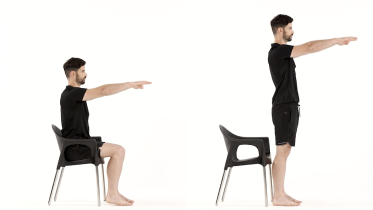 Sit to stand
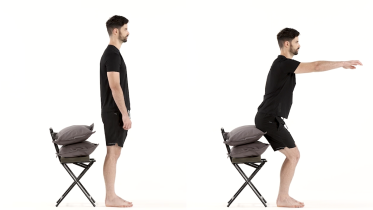 Chair squat
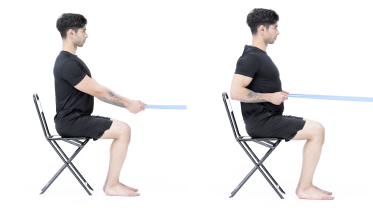 Seated row with band
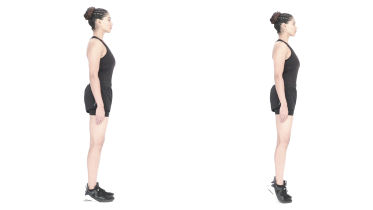 Calf raises
Read the precautions before the first set. If you have high blood pressure, breathe steadily through every repetition and never hold your breath. With a heart condition or high blood pressure, check with your doctor before you start. If you have had a hip replacement, get the go-ahead from your surgeon or physio before you try sit to stand and the chair squat. Standing up from a low seat and squatting down bend the hip past a right angle, and many surgeons ask you to avoid that for the first months after some operations.
If chest pain, pressure or tightness does not ease quickly when you rest, spreads to your arm, neck, jaw, stomach or back, or comes with sweating, feeling sick, feeling light-headed or being short of breath, call emergency services straight away, as this can be a heart attack. If it eases quickly and none of these happen, get medical advice the same day, and do not exercise again until you have been checked.
Keep a counter or a sturdy chair within reach for every repetition of the chair work if you have osteoporosis or feel shaky on your feet. Do the same if you have fallen in the past year, and ask your physio before you lower the seat height. Bands wear out where they fold, so look along the whole length for thin patches before you sit down to row, and get your surgeon's or physio's go-ahead first if you have had shoulder surgery or a fracture in your spine. Calf raises wait for the stage set by your surgeon's protocol after an Achilles repair or any ankle operation.
When to see a physio (physical therapist)
Book an appointment once an ache has run past about 6 weeks. Go sooner if one joint is behaving unlike the rest, if a job you used to do without thinking has become hard, or if a scan has already shown thin bones and nobody has told you what is safe to load. The same ache at 51 can be a tendon, a joint surface, an inflammatory condition or a load problem, and each of those gets a different program, which is why an assessment beats another month of searching.
Go sooner if any warning sign below applies. Take the hormone questions to your doctor or menopause clinic at the same time, and tell each of them what the other is doing, so you are not the only person holding the whole picture.
In this topic
- Exercise for hot, aching joints and stiffness in menopause
Why joints feel hot, achy and stiff around the menopause, what helps first thing, how to pace a bad day, and the stiffness that needs checking.
- Frozen shoulder and the menopause
Frozen shoulder is commonest between 40 and 60 and more common in women, but nobody has shown the menopause causes it. The evidence and what helps.
- Joint pain in the menopause
Why joints ache in perimenopause, what the research has and has not proved, which other causes look the same, and the exercise and warning signs.
- Muscle and bone loss around the menopause
What happens to muscle and bone around the menopause, how fast bone density falls, and what strength and impact exercise can and cannot do.
- The pelvic floor in menopause: what changes and what helps
What happens to the pelvic floor around the menopause, what pelvic floor muscle training does and does not do, and when to see a pelvic health physio.
- A strength plan for the menopause years
A week by week strength plan for women at the menopause: what to do, how often, how to progress, and how to start if you have never lifted.
Related exercise programs
See a doctor promptly if
- Emergency: if chest pain, pressure or tightness does not ease quickly when you rest, spreads to your arm, neck, jaw, stomach or back, or comes with sweating, feeling sick, feeling light-headed or being short of breath, call emergency services straight away, as this can be a heart attack. If it eases quickly and none of these happen, get medical advice the same day, and do not exercise again until you have been checked.
- Emergency: you have had a fall or an injury and now have severe hip pain, or you cannot walk or put weight on the leg. Call emergency services or go to an emergency department. This can be a sign of a broken hip (hip fracture).
- Same day: you feel dizzy, lightheaded or faint as you get up. Sit back down and wait for it to pass. If it does not pass within a minute or two, or it keeps happening, get medical advice the same day before you practice again. If you faint, or it does not settle within a few minutes of keeping still, call emergency services.
- Same day: a joint is hot, red and swollen, or you have joint pain with a high temperature or feel hot, cold or shivery. Get medical advice the same day, and go to an emergency department if you feel very unwell. This can be a sign of infection in the joint, which needs treatment quickly.
- Same day: a calf or thigh that is newly swollen, warm, tender, red or darker than usual, has swollen veins that are sore to touch, or has a throbbing or cramping pain that does not fit your injury or condition, or that feels different from normal muscle soreness after exercise. This can be a sign of a blood clot (deep vein thrombosis), especially after surgery, an injury, time in a cast or boot, a long trip or a spell of being much less mobile than usual. Get medical advice the same day. If you are also short of breath or have chest pain, call emergency services.
- Same day: back pain after a minor fall or strain if you are older, have low bone density (osteoporosis) or have taken steroid tablets for a long time. Get medical advice the same day.
- Same day: back pain that comes on suddenly after lifting, bending, a cough or a sneeze, even without a fall, if you have low bone density (osteoporosis). Get medical advice the same day. This can be a sign of a broken bone in the spine (vertebral fracture). Stop the exercises until you have been checked.
- Within a few days: you have not been diagnosed, and several joints in your hands, wrists or feet are painful, swollen and stiff, especially in the morning. This is not an emergency, but see your doctor within a few days, because early treatment can stop the condition getting worse and lower the risk of joint damage.
- Within a few days: you are over 50 and have aching and stiffness in both shoulders, often in the neck or hips too, that is worst in the morning and lasts more than 45 minutes after you get up. See your doctor within a few days, as this can be an inflammatory condition (polymyalgia rheumatica) rather than a local joint problem. If you also get a new headache, pain or tenderness at your temples or on your scalp, or jaw pain when you eat or talk, get medical advice the same day, and if your vision changes, call emergency services.
- Within a few days: the pain is there at night or at rest and keeps getting worse. See your doctor within a few days. If you have had cancer, now or in the past, or are losing weight without trying, see your doctor sooner, within a day or two, and mention it. This applies even if the pain is not getting worse. If you are being treated for cancer now, contact your cancer team the same day.
- Routine: you have lost height, or your upper back has become more rounded and you are starting to stoop, or you have back pain, or pain that wraps around to your ribs, with no clear cause. Book an appointment with your doctor. A broken bone in the spine can cause this, and it does not always cause the pain you would expect. If the pain came on suddenly, get medical advice the same day.
Common questions
Is joint pain a symptom of the menopause?
The NHS lists muscle aches and joint pains among the other symptoms of menopause and perimenopause, so it is recognized as something that happens at this stage. How often is easier to answer than why: the largest pooled estimate, from 37 observational studies in 93,021 women across 22 countries, found muscle or joint pain in 57% of perimenopausal women and 59% of postmenopausal women, against 40% before the transition (Kruse 2026). An older and much smaller meta-analysis of 16 studies put the perimenopausal figure at 71% (Lu 2020). Both sets of authors said the same thing about cause: their studies were observational, so they could not show what produces the pain. Calling it a symptom describes the company it keeps, not the mechanism.
What is the musculoskeletal syndrome of menopause?
It is a name somebody proposed, not a diagnosis a doctor can confirm with a test. A 2024 review in Climacteric put forward the term for the group of musculoskeletal signs and symptoms that go with estrogen loss at this stage of life (Wright 2024). No agreed criteria sit behind it, no test confirms it, and it has not been adopted into the guidelines used to diagnose or treat joint problems. Reading the phrase online does not mean you have been given a condition.
How much muscle do you lose around the menopause?
Less than the phrase suggests, and the best measurement of it comes from the Study of Women's Health Across the Nation. In 1,246 women scanned with DXA, lean mass changed from a small yearly gain before the transition to a yearly loss of about 0.2% during it, starting roughly 2 years before the final period and continuing for about 1.5 years afterward, while the rate of fat gain went from 1.0% a year to 1.7% (Greendale 2019). That study weighed tissue rather than testing strength, so it cannot tell you how much weaker anyone became. Resistance training is what physios use to push back on that side of it.
What exercise helps most during the menopause?
For bone, the NHS advice is to exercise regularly with a focus on weight-bearing exercise to build strength, naming walking, running or dancing, alongside resistance exercise such as using weights. For joints, the honest position is that no trial has tested exercise specifically for menopausal joint pain, so the programs on this site come from the evidence for the joint in question. The staged versions are linked from each page here. A Cochrane review of exercise for hot flushes and night sweats, which is a different symptom, found the evidence insufficient to say whether it works (Daley 2014).
Does HRT help joint pain?
That is a prescription question, and these pages do not answer it. What they do is report what the sources they opened found, and those sources do not settle it. A retrospective study of 1,952 menopausal women looked at frozen shoulder in those taking hormone therapy and those not, and the difference did not reach statistical significance (Reinke 2026). Take the question to your own doctor or menopause clinic, who can weigh it against your history.
References
- NHS. Menopause and perimenopause symptoms. Page last reviewed 19 May 2026. https://www.nhs.uk/conditions/menopause-and-perimenopause/symptoms/
- NHS. Things you can do to help menopause and perimenopause symptoms. Page last reviewed 19 May 2026. https://www.nhs.uk/conditions/menopause-and-perimenopause/things-you-can-do/
- NHS. Osteoporosis: causes. Page last reviewed 13 October 2022. https://www.nhs.uk/conditions/osteoporosis/causes/
- Kruse C, McKechnie T, Dworsky-Fried J, et al. Musculoskeletal manifestations of perimenopause: a systematic review and meta-analysis of 93,021 women. JBJS Open Access. 2026;11(1):e25.00254. https://doi.org/10.2106/JBJS.OA.25.00254
- Lu CB, Liu PF, Zhou YS, et al. Musculoskeletal pain during the menopausal transition: a systematic review and meta-analysis. Neural Plasticity. 2020;2020:8842110. https://doi.org/10.1155/2020/8842110
- Greendale GA, Sternfeld B, Huang MH, et al. Changes in body composition and weight during the menopause transition. JCI Insight. 2019;4(5):e124865. https://doi.org/10.1172/jci.insight.124865
- Wright VJ, Schwartzman JD, Itinoche R, Wittstein J. The musculoskeletal syndrome of menopause. Climacteric. 2024;27(5):466-472. https://doi.org/10.1080/13697137.2024.2380363
- Reinke EK, Ford AC, Wahl E, et al. A preliminary pilot study to address design issues related to research on potential association of hormone therapy and adhesive capsulitis. Climacteric. 2026;29(3):478-483. https://doi.org/10.1080/13697137.2026.2615391
- Daley A, Stokes-Lampard H, Thomas A, MacArthur C. Exercise for vasomotor menopausal symptoms. Cochrane Database of Systematic Reviews. 2014;(11):CD006108. https://doi.org/10.1002/14651858.CD006108.pub4
- Watson SL, Weeks BK, Weis LJ, et al. High-intensity resistance and impact training improves bone mineral density and physical function in postmenopausal women with osteopenia and osteoporosis: the LIFTMOR randomized controlled trial. Journal of Bone and Mineral Research. 2018;33(2):211-220. https://doi.org/10.1002/jbmr.3284
- Royal Osteoporosis Society. What's the menopause got to do with bone health? 22 March 2021. https://theros.org.uk/blog/whats-the-menopause-got-to-do-with-bone-health/
Written and checked by the PocketPhysio editorial team. Last updated 2026-10-01.
This page is general education, not a diagnosis or a personal treatment plan. See a physiotherapist or doctor for advice about your own situation.