Finger ladder
The finger ladder is a way to raise a stiff arm forward and overhead (shoulder flexion) by walking your fingertips up a ladder of small steps fixed to a wall, or simply up the wall itself. Your fingers climb one step at a time, so the wall takes some of the arm's weight and your shoulder muscles only have to help (active assisted range of motion). It is often used for a frozen shoulder and, once the surgeon allows the arm to help, after some shoulder operations.
How to do the finger ladder
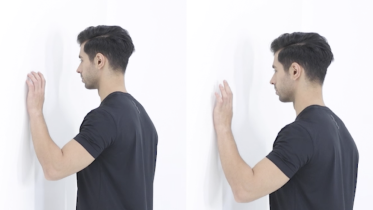
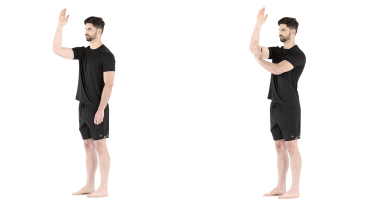
- Stand facing the wall or finger ladder, close enough to touch it with your fingertips, with your feet about shoulder width apart.
- Place the fingertips of the stiff arm on the wall, or on a low rung, at about waist to chest height.
- Walk your fingers up one small step at a time, letting the arm straighten and rise in front of you, until you reach the highest point that stays comfortable.
- At the top, step a little closer to the wall and hold for about 5 seconds, as the voice guide says. In the video the arm ends almost straight up beside the head.
- Walk or slide your fingers back down slowly to the start, then let the arm rest by your side.
What you should feel
A stretch in the shoulder and under the arm at the top of the climb, and light work at the front of the shoulder while the fingers walk. Some discomfort is common with a stiff shoulder, but it should ease once the arm is down.
Common mistakes
- Hitching the shoulder toward your ear, or leaning sideways, to reach a higher step.
- Leaning back from the waist or going up on tiptoe for the last step.
- Letting the arm drop away from the wall on the way down instead of walking back down.
- Pushing into sharp pain to beat the height you reached last time.
How often
The voice guide suggests starting with 5 climbs, each held for about 5 seconds at the top, and building up to 10 as pain allows. Many programs do this 1 to 3 times a day. Your physio will adjust this.
Stop and check with your physio if
- Sharp or catching pain in the shoulder as the fingers climb, or pain that keeps building with each climb.
- Pain, pins and needles or numbness spreading down your arm or into your hand.
- Pins and needles in your arm or hand that do not go away after you stop, or part of your arm or hand goes numb. Get medical advice the same day. If one side of your face or body suddenly goes numb or weak, or your speech becomes slurred or muddled, call emergency services, even if it goes away.
- A sudden pop or tearing feeling in the shoulder that brings sharp pain, new weakness or trouble lifting the arm. Stop and contact your surgical team the same day, or get medical advice the same day if you have not had surgery.
- The shoulder feels as if it has slipped out of place, looks a different shape or suddenly locks so you cannot move the arm, or your hand turns cold, pale or blue. Go to an emergency department straight away, without driving yourself, and do not try to put the shoulder back in yourself.
From the clinic
The video uses a plain wall, which does the same job at home as a wooden finger ladder. A strip of tape or a pencil mark at your highest point lets you see your progress over the weeks. Stepping in closer at the top, as the voice guide describes, lets the arm rise a little further without you having to arch your back.
After shoulder surgery, including a rotator cuff repair, or after a shoulder fracture or dislocation, follow your surgeon's or physio's plan, and do only the movements and range they have cleared. Many plans allow only passive movement at first, where the arm is moved for you and its muscles stay relaxed. Walking the fingers up still asks the shoulder muscles for some effort, so check that assisted movement is on your plan before you start.
Physios often give this for a frozen shoulder, going only as high as the shoulder tolerates on the day. Wall slides use a towel under the palm for a similar climb up the wall, and shoulder pulley flexion lets your other arm do the lifting instead.
Written and checked by the PocketPhysio editorial team. Last updated 2026-09-28.
This page is general education, not a diagnosis or a personal treatment plan. If you have pain, an injury or a health condition, see a physiotherapist or doctor before starting new exercises.