Finger ladder hold
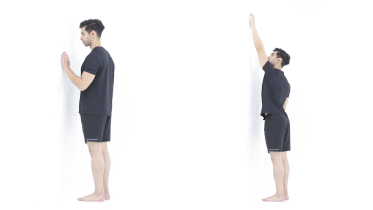
The finger ladder hold is a static version of the finger ladder. You stand close to a wall with the elbow bent, the forearm upright alongside the wall and the palm on it, and tap your fingers on the wall one by one while the arm stays in place. The shoulder holds the arm steady for the whole set, and only the fingers move.
How to do the finger ladder hold
- Stand facing a wall, close enough to touch it with your elbow bent, with your feet about shoulder width apart.
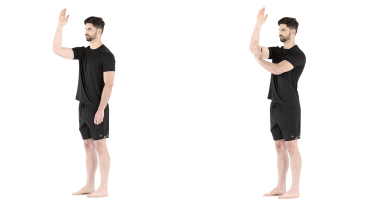
- Keep the upper arm close to your body, only a little forward, and bend the elbow so the forearm points up, parallel to the wall. Rest the palm flat on the wall. In the video the hand sits at about face height.
- Keeping the arm where it is, tap your fingers on the wall one at a time, in order along the hand.
- Carry on for the time or number of rounds your physio has set, with your shoulders relaxed and your body upright.
- Lower the arm to your side to rest.
What you should feel
Light, steady work at the front of the shoulder from holding the arm steady, and movement in the fingers and the back of the hand.
Common mistakes
- Letting the elbow drop or the hand slide down the wall as the shoulder tires.
- Hitching the shoulder up or leaning your body into the wall.
- Tapping several fingers together instead of one at a time.
- Holding your breath while you concentrate on the fingers.
How often
Many programs use 2 to 3 rounds of 30 to 60 seconds of tapping, once or twice a day. Your physio will adjust this.
Stop and check with your physio if
- Sharp or catching pain in the shoulder, or an ache that keeps building while you hold the arm up.
- Pain, pins and needles or numbness spreading down your arm or into your hand.
- Pins and needles in your arm or hand that do not go away after you stop, or part of your arm or hand goes numb. Get medical advice the same day. If one side of your face or body suddenly goes numb or weak, or your speech becomes slurred or muddled, call emergency services, even if it goes away.
- A sudden pop or tearing feeling in the shoulder that brings sharp pain, new weakness or trouble lifting the arm. Stop and contact your surgical team the same day, or get medical advice the same day if you have not had surgery.
From the clinic
It uses the same wall setup as the finger ladder, but the hand does not climb. The shoulder works on holding the arm still at one height rather than on gaining range, while the fingers keep busy. If holding the arm up is tiring, start lower on the wall and move the hand up over the weeks as your physio suggests.
After shoulder surgery, including a rotator cuff repair, or after a shoulder fracture or dislocation, follow your surgeon's or physio's plan, and do only the movements and range they have cleared. Many plans allow only passive movement at first, where the arm is moved for you and its muscles stay relaxed. Holding the arm steady against the wall asks the shoulder muscles to work on their own, so check that active movement is on your plan before you start. After a broken wrist, hand or forearm, or surgery on any of them such as a tendon repair, start only when your doctor, surgeon, physio or hand therapist says the bone or repair is ready for this, and follow their plan for how much to do.
Written and checked by the PocketPhysio editorial team. Last updated 2026-09-28.
This page is general education, not a diagnosis or a personal treatment plan. If you have pain, an injury or a health condition, see a physiotherapist or doctor before starting new exercises.