
Part of Frozen shoulder
How to sleep with a frozen shoulder: positions and pillows
Warning signs, and when to get help
What is the best sleeping position for a frozen shoulder?
There is no trial comparing sleeping positions for this condition, so what follows is what physios set up in clinic and what patients report back. The principle behind all of it is simple: the arm has to be held somewhere, or it will drift into the position the capsule tolerates least.
The first option is the good side with something to hug. Roll onto the pain-free shoulder and put a pillow, a folded duvet or a long cushion in front of your chest, then let the sore arm lie over it so the elbow and forearm are carried rather than hanging. The point is the support, not the hug. If the arm slides off in the night the shoulder rolls forward and the ache usually arrives with it, so make the bundle bigger than feels necessary.
The second is on your back with the sore elbow propped. Slide a pillow under that elbow and upper arm so the arm rests a little ahead of your body rather than settling back behind it. A flat arm on a mattress drops the shoulder backward, and that position is often the one people wake up sore in without knowing why.
From about 28 weeks of pregnancy the NHS advises going to sleep on your side rather than on your back, because it says sleeping on your back after that point can double the risk of stillbirth. So use the good-side set-up with a pillow to hug, and leave lying on your back until after the birth. The NHS also says not to worry if you wake up on your back: settle onto your side again and carry on.
Why is frozen shoulder worse at night?
Partly because nothing else is happening. Pain that was a background nuisance all day becomes the only thing in the room, which is not trivial and is not imagined. Beyond that, a few hours in one position is longer than the shoulder goes without moving at any other time of day, and the arm has usually ended up somewhere the capsule objects to.
Bad sleep in this condition is documented. Toprak and Erden compared 76 people with frozen shoulder against 72 healthy controls and found the frozen shoulder group scored significantly worse for sleep efficiency and sleep disturbance on the Pittsburgh Sleep Quality Index, along with higher pain and anxiety scores (Toprak and Erden, 2019). That tells you the problem is real and widespread. It does not tell you what to do about it, which is why the positions above come from practice rather than from a study.
The timing is worth knowing. Night pain tends to settle before the stiffness does, so a few weeks of better sleep often arrives while the arm still will not reach a high shelf. The three stages explains why those two things move apart, and how long frozen shoulder lasts covers the longer picture.
What should you do when the pain wakes you?
Change something small, then give it ten minutes. Rebuild the pillow under the arm, roll a little further back off the point of the shoulder, or swap sides and set up on your back instead. Night pain in a frozen shoulder is often positional, which is why a change of position is the first thing to try.
If it has not quietened, get out of bed rather than waiting it out. Put a light on before you stand, and sit on the edge of the bed for a moment first, because most falls at home happen in the dark and a sore shoulder is one arm less to catch yourself with. If you feel unsteady on your feet or have fallen in the past year, push up with the good arm and keep a hand on something solid for the first few steps. Let the arm hang and swing gently for a minute or two, walk to the kitchen and back, then set the pillows up again. Pendulum swings are the version of this you can do half asleep, and they ask nothing of the shoulder muscles.
Heat before bed suits some people. A warm shower loosens things enough that the arm settles more easily, and it costs nothing to test for a week. Wrap any heat pack in a towel, rest it on the shoulder rather than lying on it, and keep it to about 20 minutes, which is what the NHS advises for heat on a sore shoulder. Take it out of the bed before you fall asleep. Do not use heat on skin that has lost feeling or cannot feel heat properly, because it can scald or burn without you noticing.
Getting in and out of bed without stirring it up
This is the part people never think about and then do twenty times a week. Sitting on the edge of the bed and pushing up through the sore arm to swing your legs round loads the shoulder in exactly the direction it hates.
Lower yourself down onto the good side instead, with the good arm doing the work, then roll onto your back if that is where you want to be. Reverse it to get up: onto the good side first, legs off the edge, push up with the good arm. Keep the sore arm tucked across your front while you do it rather than letting it swing.
Dressing follows the same logic at the other end of the night. Put the sore arm into the sleeve first and take it out last.
Exercises that can help
Two gentle ones for the hour before bed, chosen because neither asks the shoulder muscles to lift a load. Common practice in the painful stage is a few minutes of gentle movement at a time, several times a day, with short holds or none at all. Each exercise page carries its own numbers, and your physio will adjust them.
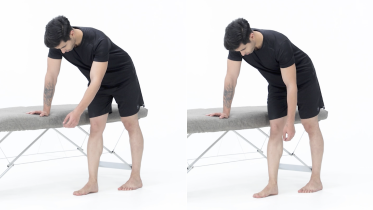 Pendulum exercise for the shoulder
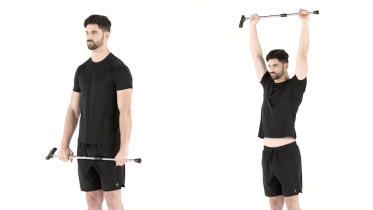 Shoulder flexion with a stick
When to see a physio or doctor
Tell your physio if sleep is the worst part, because it changes the plan. A shoulder that wakes you several times a night is an irritable shoulder, and the stretching should be gentle while that is true. Frozen shoulder exercises by stage sets out what gentle means, and the frozen shoulder program carries the videos.
If pain is still waking you most nights after a few weeks of good positioning, go back to your doctor. Night pain is one of the main reasons a steroid injection gets offered, and injections and other treatments explains what it does and does not do. Shoulder pain at night covers the other causes of a shoulder that hurts in bed. Anything in the list below needs acting on at the timing its own line gives.
Related exercise programs
Warning signs
Get emergency help now
- Chest pain or tightness, which may spread to your arm, neck or jaw, or shoulder or arm pain that comes with shortness of breath, sweating or feeling sick. This can be a heart attack. Call emergency services straight away.
- The shoulder feels as if it has slipped out of place, looks a different shape or suddenly locks so you cannot move the arm, or the pain is severe after a fall or an injury. Go to an emergency department straight away, without driving yourself, and do not try to put the shoulder back in yourself.
- Your arm, hand or fingers turn cold, pale, blue or gray compared with the other side. Call emergency services or go to an emergency department straight away, and do not drive yourself. The blood supply to the arm may be blocked.
- You have a fever or feel unwell, or the shoulder is hot, red and swollen. This can be a joint infection. Go to an emergency department straight away.
Get help today
- Sudden, very bad shoulder pain, or you suddenly cannot lift or move your arm at all. Get medical help the same day.
- The pain started after a fall, a pull or another injury, especially if the arm has been weak since, for example you cannot lift it out to the side or hold it up. This can be a broken bone or a torn tendon. Get medical advice the same day, and say how it happened and that the arm has been weak since, because UK shoulder surgeons advise urgent referral for a rotator cuff tear caused by an injury.
- Severe pain in both shoulders that has come on recently. Get medical advice the same day.
- You are over 50 and have aching and stiffness in both shoulders, often in the neck or hips too, that is worst in the morning and lasts more than 45 minutes after you get up. This can be an inflammatory condition (polymyalgia rheumatica) rather than frozen shoulder. If you also get a new headache, pain or tenderness at your temples or on your scalp, or jaw pain when you eat or talk, get medical advice the same day, and if your vision changes, call emergency services. Even without those extra signs, see your doctor within a few days about the aching and stiffness.
- Pins and needles or numbness in the arm that does not go away, no feeling in part of the arm, or weakness that is getting worse. Get medical advice the same day. For pain spreading down the arm from your neck, ask for an urgent appointment with your doctor. If one side of your face or body suddenly goes numb or weak, or your speech becomes slurred or muddled, call emergency services, even if it goes away.
- Pain at night or at rest that is constant, that no rest or change of position eases at all, and that keeps getting worse. If you are being treated for cancer now, contact your cancer team the same day.
Book an appointment
- Pain at night or at rest that is constant, that no rest or change of position eases at all, and that keeps getting worse. If you have had cancer, now or in the past, or are losing weight without trying, see your doctor sooner, within a day or two, and mention it. This applies even if the pain is not getting worse.
- Night pain is common with this condition, but get checked within a few days if the pain is constant, no rest or change of position eases it at all, and it keeps getting worse.
- New shoulder pain and you have had cancer, now or in the past, or you are losing weight without trying. See your doctor within a day or two and mention it.
Common questions
Can I sleep on the side with the frozen shoulder?
Some people can, most cannot, and it is worth testing rather than assuming. Lying on the sore shoulder presses the joint into the mattress and squashes it from the side, which is the position the capsule tolerates least while the shoulder is irritable. If you want to try it, build the pillows up so the arm is supported at the front and your body is rolled slightly back off the point of the shoulder. Give it ten minutes. If the ache builds, go back to the good side, and try again in a couple of months when things have calmed down.
Why does my frozen shoulder hurt so much at night?
Several ordinary things stack up. You hold one position for hours, the arm drifts into a position the capsule does not like, there is nothing to distract you from the ache, and rolling over does the shoulder no favors. That is what physios hear most often rather than something anyone has measured directly. Poor sleep is well documented in this condition: in a Turkish study of 148 people, the 76 with frozen shoulder scored significantly worse on sleep efficiency and sleep disturbance on a standard sleep questionnaire than the 72 controls (Toprak and Erden, 2019). One pattern needs checking rather than a new pillow, and the warning list on this page gives it.
What can I do at 3 a.m. when my shoulder wakes me?
Change one thing rather than lying there waiting. Push the hugging pillow further under the arm, roll a few degrees further back off the shoulder, or switch to lying on your back with the elbow propped. If the ache has not settled in about ten minutes, get up, let the arm hang and swing gently for a minute or two, then go back to bed. Put a light on before you stand, and sit on the edge of the bed for a moment first, because most falls at home happen in the dark and a sore shoulder is one arm less to catch yourself with. Lying still and hoping is the least effective of the options, and it is the one most people pick.
Will a steroid injection help me sleep?
It is one of the reasons an injection gets offered. A meta-analysis of 65 randomized studies found that a corticosteroid injection into the joint was the only treatment both statistically and clinically better than the alternatives in the short term for pain and function, used early and alongside a home exercise program (Challoumas and colleagues, 2020). The JOSPT guideline reaches the same practical conclusion for the first 4 to 6 weeks (Kelley and colleagues, 2013). It is a decision to make with your doctor, and if you have diabetes, say so first, because an injection into a joint can push blood sugar up for several days.
References
- Kelley MJ, Shaffer MA, Kuhn JE, et al. Shoulder pain and mobility deficits: adhesive capsulitis. Clinical practice guidelines linked to the International Classification of Functioning, Disability, and Health from the Orthopaedic Section of the American Physical Therapy Association. Journal of Orthopaedic and Sports Physical Therapy. 2013;43(5):A1-A31. https://doi.org/10.2519/jospt.2013.0302
- Toprak M, Erden M. Sleep quality, pain, anxiety, depression and quality of life in patients with frozen shoulder. Journal of Back and Musculoskeletal Rehabilitation. 2019;32(2):287-291. https://pubmed.ncbi.nlm.nih.gov/30347591/
- Challoumas D, Biddle M, McLean M, Millar NL. Comparison of treatments for frozen shoulder: a systematic review and meta-analysis. JAMA Network Open. 2020;3(12):e2029581. https://doi.org/10.1001/jamanetworkopen.2020.29581
- Choudhry MN, Malik RA, Charalambous CP. Blood glucose levels following intra-articular steroid injections in patients with diabetes: a systematic review. JBJS Reviews. 2016;4(3):e5. https://doi.org/10.2106/JBJS.RVW.O.00029
- NHS. 27 weeks pregnant: the best sleeping positions during pregnancy. Best Start in Life week by week guide. https://www.nhs.uk/best-start-in-life/pregnancy/week-by-week-guide-to-pregnancy/2nd-trimester/week-27/
Written and checked by the PocketPhysio editorial team. Last updated 2026-10-18.
This page is general education, not a diagnosis or a personal treatment plan. See a physiotherapist or doctor for advice about your own situation.