
Pain between the shoulder blades: causes, warning signs and exercises
The patterns that need urgent help
Read this part before anything else. Most pain between the shoulder blades comes from muscles and joints. Trouble in the chest and the upper abdomen also gets felt in this patch of back, though, so a small number of people searching this phrase need an ambulance rather than a stretch.
Call emergency services for chest pain, pressure or tightness that does not go away or spreads to your arm, neck, jaw, stomach or back, and for pain between the shoulder blades that arrives with sweating, feeling sick, feeling light-headed or being short of breath. The NHS lists each of those as a reason to call 999.
Do the same for a sudden, severe pain between the shoulder blades that feels sharp, stabbing, tearing or ripping. MedlinePlus describes that pain as starting below the breast bone and then moving under the shoulder blades or to the back. That is how a tear in the main blood vessel from the heart usually shows itself. The same page says these symptoms usually begin suddenly, although a slower start does not make it safe, so call emergency services rather than waiting to see what happens.
Breathing is the next thing to check. Sudden breathlessness, pain in the chest or upper back that is worse when you breathe in, coughing up blood, a very fast heartbeat or fainting can all point to a blood clot in the lungs, and the NHS asks you to call 999 even when your legs look completely normal. Severe pain under the ribs on the right or in the middle of the tummy that spreads through to the back, with sickness, a high temperature or yellowing of the skin or eyes, points at the gallbladder instead and also needs emergency assessment.
That list is short, and it is worth the minute it takes to learn. Nothing on it turns an ordinary sore upper back into something dangerous. The full set of warning signs sits at the bottom of the page, each with its own time frame, and everything in between assumes the urgent ones do not apply to you.
Why this spot picks up pain from so many places
The part of the spine between the base of your neck and the bottom of your ribs is the thoracic spine. Its 12 bones each meet a pair of ribs at small joints, so every breath moves them. The shoulder blades sit on top and glide over the back of the rib cage rather than locking on to it. The muscles that hold the shoulder blades in place lie on top of all that, and several of them run up to the neck.
The nerve supply explains the rest. Nerves carrying signals from the chest and the upper abdomen enter the spinal cord at the same levels as the nerves from the skin and muscles of the upper back, and the standard explanation for referred pain is that the brain cannot reliably tell the two apart. That is why a heart, a lung or a gallbladder can be felt as a patch of back pain, and why the warning signs above come first on this page.
What causes pain between the shoulder blades?
None of the patterns below is a diagnosis, and more than one often applies to the same person. Where you point tells you less here than it would at the knee or the ankle, because the same patch of skin reports trouble from the joints underneath it, the neck above it and the chest in front of it. An assessment is what sorts them out.
The joints and muscles of the upper back
This is the usual answer. You feel it as a band across the upper back, or to one side of the spine. It changes with position and movement, and it loosens once you get going.
Two authors make the case that research has left this region behind the neck and the lower back, and they called it the Cinderella region of the spine (Heneghan 2016). A review looking for studies of how adults recover from mid-back pain found none at all, and reported that new episodes in adults are less common than new episodes of neck or low back pain (Johansson 2017). The upper back pain program sets this out stage by stage.
Desk work, arm load and carrying
Work is the setting most people describe. A review of 52 studies covering 65 occupational groups put the one-year figure anywhere from 3% to 55%, with the medians clustered around 30%, and it listed high workload and intensity, ergonomic problems at the workstation, monotonous tasks and high mental pressure among the factors that went with it (Briggs 2009). Those are things that occur together, which is not the same as one causing the other.
In the clinic the story is usually a busy fortnight: more hours at a screen, a laptop used on a sofa, a heavy bag on one shoulder, or a weekend spent painting a ceiling. Muscles around the shoulder blade get sore because they have held a position far longer than they are used to. Sore is not the same as damaged.
If sitting also sets off your lower back, back pain when sitting takes that pattern further.
Pain sent down from the neck
The neck refers pain into this area often enough that a physio will examine it even when your neck feels fine. Cooper and colleagues (2007) built maps, level by level, of where patients felt pain that diagnostic blocks had confirmed came from one particular neck joint. Maps like those are why the neck gets checked when the sore patch is lower down. The American physical therapy guideline for neck pain sorts neck problems partly by whether the pain radiates, and that changes which treatment is offered (Blanpied 2017).
Two patterns sit behind most of it. Ache between the shoulder blades that changes when you turn or tip your head, with a stiff neck, usually belongs with the neck pain program. Pain that also travels down one arm, with pins and needles, numbness or weakness in the hand, points instead at an irritated nerve root and the cervical radiculopathy program.
A rib joint that has flared
Most ribs meet the spine at two small joints, and an irritated rib joint is one of the usual explanations for a sharp spot beside the shoulder blade. People describe it much the same way: one small point, often a couple of finger widths out from the spine, that catches when you breathe deeply, cough, sneeze or twist, and sometimes wraps around the ribs toward the front. It often starts after a bad cough or an awkward lift. No clinical test confirms it, so it stays a working explanation rather than a diagnosis.
The catch is that a chest infection, inflammation of the lining of the lungs and several other problems also hurt on breathing in. The NHS describes pleurisy as sharp chest pain when you breathe in, worse with coughing, sneezing or moving, that may spread to the shoulders and back. So pain on breathing is not a green light on its own. Check the warning signs below, particularly if it came on suddenly, you have a fever or a cough, or you are struggling for breath.
Pressure on the nerves and vessels at the base of the neck
The nerves and main blood vessels for the arm run from the neck, under the collarbone and on toward the armpit, and they can be squeezed anywhere along that route. Jones and colleagues (2019) set out where the narrow points sit, one of them under a small chest muscle. The arm symptoms are the main event, with tingling, numbness, aching or heaviness that worsens with the arms up or after repeated overhead work, but many people also describe an ache around the shoulder blade on the same side. The thoracic outlet syndrome program covers it, and the arm warning signs on this page apply: a cold, pale hand or a swollen, blue, heavy arm needs urgent assessment rather than exercises.
A rounded upper back
A back that sits rounded, whether that is simply how you are built or it has come on with changes in the bones over the years, gives the muscles between the shoulder blades a longer working day. Exercise here is aimed at pain, stiffness and how upright you can hold yourself, and how far it shifts the curve itself is uncertain. The kyphosis program explains what to expect from it. Get a doctor's opinion before any exercise if the rounding will not straighten out when you try, if your height has dropped, or if it arrived together with a sudden bout of back pain.
A shoulder blade that moves differently
Sometimes the shoulder blade on the sore side sits or travels differently from the other one as you lift your arm. Plenty of people without any pain have the same thing, so it is not an explanation by itself, and the scapular dyskinesis page is honest about what is known. Two versions of it do need a doctor rather than a program: an inner edge that lifts markedly clear of the rib cage, and a blade that started standing out at the same time as the arm went weak. Nerve damage can produce that combination, and it is assessed rather than exercised.
If you are pregnant
Back pain in pregnancy is assessed and managed differently, so this page gives no advice on it. Go to the pregnancy back and pelvic pain program instead, and your midwife, doctor or maternity physio leads what you do. If you are pregnant, check with your midwife or physio before you start. One thing to know now rather than later: the NHS lists a severe headache that simple painkillers do not shift, vision problems, pain just below the ribs, vomiting and sudden swelling of the face, hands or feet as signs of pre-eclampsia. Contact your maternity unit straight away if you get any of them, or get urgent medical help if you cannot reach them.
Why it feels like it needs to pop
The urge to crack the upper back is one of the most common things people describe here, and it is about stiffness, not about anything being out of place. Nothing in this part of the spine slips out and needs putting back in.
Cracking it does often give a few minutes of ease. When Southerst and colleagues (2015) searched the trials of non-drug treatments for this region, only two came through their quality appraisal, and the one testing manipulation of the upper back showed a pain reduction that reached statistical significance without reaching a size that patients would notice as meaningful. So it may well feel better for a while, and it is unlikely to be the thing that changes your week. Movement and strength work carry more of the load.
One caution, and it is not a small one. If you have low bone density (osteoporosis), have had a fracture in your spine, have taken steroid tablets for a long time, or have a condition that stiffens the spine such as ankylosing spondylitis, do not let anyone manipulate or crack your upper back, do not have someone press or stand on your back, and do not throw yourself back over a chair or a foam roller, until your doctor or physio has said it is safe for you. A fragile or stiffened spine can break under force that would not trouble anyone else, and the break is easy to miss at first. The same applies if you have had cancer, now or in the past, or any of the warning signs below apply to you.
What helps at home
Keep moving. Staying active, getting on with the day and not taking to bed for long stretches is what the NHS advises for back pain, and nothing about the upper back argues for a different approach. Rest as a plan tends to make the first movements harder, not easier.
Break up the static spells rather than perfecting the setup. A screen you have to twist to see, a laptop used low on your knees, or a chair that leaves you perching are worth fixing, because they force one position on you. Past that, getting up and moving every half hour buys you more than another accessory. Change the bag to a backpack or swap shoulders for a few weeks, and split a big carry into two trips.
Heat suits most people here. A heat pack wrapped in a towel is on the NHS list for stiffness and muscle spasm, and in the clinic it is what people reach for before a session more than after one. Some prefer ice when a flare is fresh. Either is reasonable, as long as it is wrapped and you do not leave it on for an hour.
Waking up sore is a complaint of its own. Try a night on your side with a pillow that keeps your head level rather than tipped up or down, and a pillow between your knees to stop you twisting. Front sleeping keeps the neck turned for hours and is the position most likely to leave the upper back complaining. There is no strong evidence naming one mattress or pillow for this area, so judge it by how you feel after a fortnight rather than by the claims on the box.
Painkillers are a question for a pharmacist or doctor rather than a physio, and the NHS pages on back pain set out the usual options. If pain is stopping you sleeping night after night, say so at your appointment instead of working around it.
Exercises for pain between the shoulder blades
There are six below. Three of them restore movement in a stiff upper back and open the front of the chest, and three build the muscles that hold the shoulder blades, which is the half people usually skip. Give the movement ones a week or so on their own, then add the strength work.
Check a few things first. Low bone density (osteoporosis) or a past fracture in the spine means asking your physio how far to turn before you try thread the needle, and asking again before the strength work. Bending the spine backward is encouraged in the UK consensus statement on exercise for osteoporosis, while positions that fold the spine a long way forward are the ones it says to leave out (Brooke-Wavell 2022), which is why the seated extension stays upright with nothing in your hands. Had an operation on your spine, chest or heart in the last few months? Your surgical team or physio gives the go-ahead before you start.
The arm exercises need their own check. Ask your physio before the pec stretch and the band pull-apart if your shoulder has dislocated, feels loose or has been operated on, since both take the arm out to the side and turn it back, and that is the position a loose shoulder likes least. Thread the needle loads the back of the shoulder as the arm reaches across your body, so it gets the same question. If you are pregnant, check with your midwife or physio before you start.
Exercises that can help
These six work the upper back and the muscles that hold the shoulder blades, and they need a chair, a wall, a band and a bit of floor. As a rough guide, the seated extension starts at 5 to 10 slow repetitions, the scapular squeeze at 10 to 15 squeezes held for about 5 seconds, thread the needle at 3 to 5 holds of 10 to 30 seconds on each side, the pec stretch at 20 to 30 seconds 2 to 3 times, wall angels at 1 to 3 sets of 8 to 12, and the band pull-apart at 2 to 3 sets of 10 to 15. The dose on each exercise page is the one to follow, and your physio will adjust it.
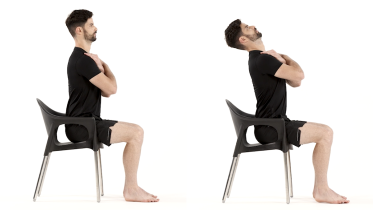 Seated thoracic extension
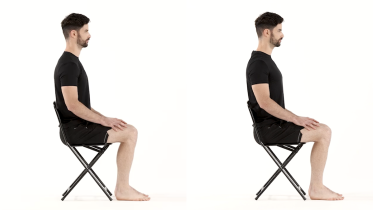 Scapular squeeze
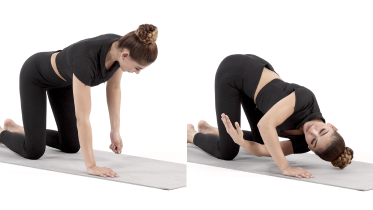 Thread the needle
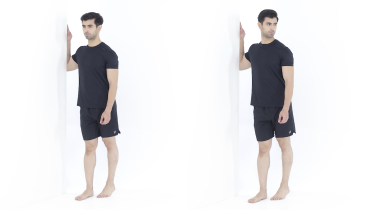 Pec stretch at a wall
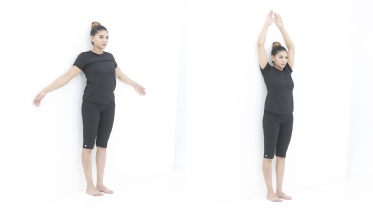 Wall angels
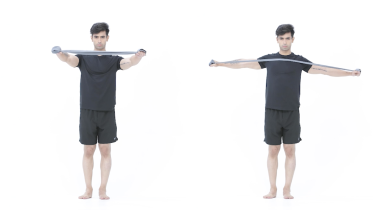 Band pull-apart
Expect tired muscles between the shoulder blades and a pull across the front of the chest. Judge the dose by the following morning: no worse means it was about right, and clearly worse means it was too much this week. Leave the session and go to the warning signs if a sharp pain appears around the ribs, if anything travels into an arm as pain, numbness or tingling, or if your legs feel weak or unsteady afterward. If you have high blood pressure, breathe steadily through every hold and never hold your breath.
If chest pain, pressure or tightness does not ease quickly when you rest, spreads to your arm, neck, jaw, stomach or back, or comes with sweating, feeling sick, feeling light-headed or being short of breath, call emergency services straight away, as this can be a heart attack. If it eases quickly and none of these happen, get medical advice the same day, and do not exercise again until you have been checked.
When to see a physio (physical therapist)
Book an appointment if the pain has not improved after a few weeks of keeping active and changing the obvious things, if it keeps returning every busy week, or if it is getting in the way of work or sleep. Arm symptoms bring that forward: tingling, numbness, weakness or an arm that tires quickly deserves an earlier look, and an arm or hand that is getting weaker needs medical advice the same day. One thing is specific to this part of the back. Pain coming from the top of the back rather than the lower back is on the NHS list of back pain worth taking to a GP, so book that first if nobody has looked at it yet.
An assessment covers more than the sore spot. Expect questions about your breathing, your general health, what you were doing when it started and whether anything other than movement changes it, along with an examination of your neck, upper back, ribs and shoulder blade. Screening for the rarer serious causes is part of that, and it works from an agreed international list of features, which its authors say works as a prompt for clinical reasoning rather than as a box-ticking exercise (Finucane 2020). Each warning sign below comes with its own time frame, and none of them waits for a routine appointment.
Related exercise programs
See a doctor promptly if
- Emergency: chest pain, pressure or tightness, which may spread to your arm, neck, jaw, stomach or back, or upper back pain that comes with shortness of breath, sweating, feeling sick or feeling light-headed. Call emergency services straight away, as this can be a heart attack. The same applies to sudden, severe pain in your chest or between your shoulder blades that feels sharp, tearing or ripping, as this can be a tear in the main blood vessel from the heart (aortic dissection).
- Emergency: you suddenly become short of breath, you get chest pain or pain in your upper back that may be worse when you breathe in, you cough up blood, your heart is beating very fast, or you faint. Call emergency services straight away, even if your leg looks normal. These can be signs of a blood clot in the lungs (pulmonary embolism).
- Emergency: you are struggling to breathe, for example you are gasping, choking or cannot get your words out, or your lips or skin turn very pale, blue or gray. Call emergency services straight away.
- Emergency: sudden, severe pain in your tummy, pain that spreads from your tummy to your back while you are being sick, a very high temperature or feeling hot, cold or shivery with tummy pain, or skin or whites of the eyes that turn yellow. Call emergency services or go to an emergency department straight away. These can be signs of a problem with gallstones. Pain in the middle of your tummy or under your ribs on the right that lasts longer than 30 minutes, without these signs, needs medical advice the same day.
- Emergency: new problems walking, for example your legs feel stiff, heavy or weak or you have become unsteady on your feet, or new numbness or pins and needles in a band around your chest or tummy, or below it. Call emergency services or go to an emergency department straight away. These can be signs of pressure on the spinal cord in the upper back.
- Emergency: numbness, tingling or altered feeling around or under your genitals, between your inner thighs, or around your bottom (anus), for example it feels different when you wipe after using the toilet. Call emergency services or go to an emergency department straight away. This can be a sign of pressure on the bundle of nerves at the base of the spine (cauda equina syndrome), which needs emergency treatment.
- Emergency: you find it hard to start peeing, cannot pee, cannot feel yourself peeing or cannot control when you pee, or you do not notice when you need to poo or cannot control when you poo, and this is not normal for you. The same applies to a new change in how your genitals feel during sex, or new trouble getting an erection or ejaculating. Call emergency services or go to an emergency department straight away. These can also be signs of cauda equina syndrome.
- Emergency: sciatica in both legs, or pain, tingling, numbness or weakness in both legs. The same applies if you lose feeling in one leg. Call emergency services or go to an emergency department straight away.
- Emergency: you have had cancer, now or in the past, and your back or neck pain feels like a tight band around your body, or comes with pain spreading down an arm or leg, weakness, numbness or pins and needles in your arms or legs, trouble walking, or trouble controlling your bladder or bowels. Call your cancer team's emergency number straight away, or go to an emergency department if you do not have one or cannot get through. This can be cancer pressing on the spinal cord (metastatic spinal cord compression), which needs treatment straight away.
- Emergency: back or leg pain that started after a serious accident, such as a car crash or a fall from a height, or back pain with chest pain. Call emergency services.
- Emergency: new neck or back pain after a fall, a knock or a jolt, even a minor one such as a trip or a sudden stop in a car, if you have a condition that stiffens the spine, such as ankylosing spondylitis. Call emergency services or go to an emergency department straight away, do not drive yourself, and tell the staff about your spine condition, so they keep your neck and back in their usual position. A stiff spine can break after a small injury, and the break is easy to miss at first. If the pain started straight after the injury, or you also have numbness, tingling or weakness in your arms or legs, keep still and call emergency services.
- Emergency: your arm, hand or fingers turn cold, pale, blue or gray compared with the other side. Call emergency services or go to an emergency department straight away, and do not drive yourself. The blood supply to the arm may be blocked.
- Urgent: you are pregnant or had a baby in the last few weeks and have a severe headache that does not go away with simple painkillers, problems with your vision such as blurring or flashing lights, pain just below your ribs, vomiting, or sudden swelling of your face, hands or feet. Contact your maternity unit straight away, or get urgent medical help if you cannot reach them. These can be signs of pre-eclampsia.
- Same day: your arm or hand swells, turns blue, dusky, red or darker than usual, or feels heavy, tight, warm or tender, or has a throbbing or cramping pain that feels different from normal muscle ache. The veins over your shoulder, chest or arm may stand out or be sore to touch, and it often starts after hard or repeated use of the arm. Stop the exercises and go to an emergency department the same day, and do not wait to see if it settles. This can be a blood clot in the main vein under the collarbone (venous thoracic outlet syndrome) or elsewhere in the arm, which needs treatment quickly. If you are also short of breath or have chest pain, call emergency services.
- Same day: an arm or hand that is getting weaker, or muscles in your hand that look thinner or flatter than on the other side. Get medical advice the same day.
- Same day: pins and needles in an arm together with your back, neck or arm pain, or an arm that feels heavy or weak, and nobody has checked it yet. Get medical advice the same day.
- Same day: sharp pain in your upper back or around your ribs that has been coming and going when you breathe in or cough, or back pain with a cough, a high temperature or yellow or green mucus. Get medical advice the same day. These can be signs of inflammation of the lining of the lungs (pleurisy) or a chest infection. If the pain came on suddenly, or you find it hard to breathe, call emergency services straight away.
- Same day: back pain after a minor fall or strain if you are older, have low bone density (osteoporosis) or have taken steroid tablets for a long time. Get medical advice the same day.
- Same day: back pain that comes on suddenly after lifting, bending, a cough or a sneeze, even without a fall, if you have low bone density (osteoporosis). Get medical advice the same day. This can be a sign of a broken bone in the spine (vertebral fracture). Stop the exercises until you have been checked.
- Same day: severe pain that comes on suddenly or is getting worse quickly. Get medical advice the same day.
- Same day: back or leg pain with a fever, or you feel hot, cold, shivery or generally unwell. Get medical advice the same day, and go to an emergency department if you feel very unwell.
- Same day: you have back pain and have lost weight without trying. Get medical advice the same day and mention the weight loss.
- Same day: new back pain and you have had cancer, now or in the past. Get medical advice the same day and mention your cancer history. If you are being treated for cancer now, contact your cancer team the same day.
- Within a day or two: a burning, tingling or painful patch of skin on one side of your back, chest or tummy, with or without a rash of blisters on the same side. See a pharmacist or doctor within a day or two, as treatment for shingles works best when it starts within 3 days of the rash appearing. If you are pregnant or have a severely weakened immune system, get medical advice the same day.
- Within a few days: upper back or shoulder pain together with a cough that has lasted more than 3 weeks, breathlessness that is getting worse, chest infections that keep coming back, or a hoarse voice, especially if you smoke or used to smoke. See your doctor within a few days and mention it. If you cough up a few spots or streaks of blood, get medical advice the same day. If it is more than that, or you also find it hard to breathe, have a very fast heartbeat or have pain in your chest or upper back, call emergency services.
- Within a few days: pain that is worse at night, or does not ease at all when you rest. See your doctor within a few days. If you have had cancer, now or in the past, or you have lost weight without trying, get medical advice the same day. If you are being treated for cancer now, contact your cancer team the same day.
- Routine: back pain that comes from the top of your back, between your shoulders, rather than your lower back, and has not been checked, or back pain that is worse when you sneeze, cough or poo, or comes with a lump or swelling, or a back that has changed shape. Book an appointment with your doctor, as the NHS advises, and have it checked before you start these exercises. If the pain came on suddenly, get medical advice the same day.
Common questions
Is pain between the shoulder blades a sign of a heart attack?
It can be, and that is why this page checks the emergency patterns before anything else: the NHS says to call 999 for sudden chest pain or discomfort that does not go away, for pain that spreads to your arm, neck, jaw, stomach or back, and for chest pain with sweating, sickness, light-headedness or breathlessness. Heart pain is usually felt in the chest as well, and it tends to arrive with effort or stress rather than with a particular movement of your arm or spine. That is a guide rather than a test, and the NHS 999 list has no exertion rule in it, so pain that fits the list is urgent whatever you were doing at the time. A tear in the main blood vessel from the heart is different again: MedlinePlus describes pain felt below the breast bone that then moves under the shoulder blades or to the back, and calls it sharp, stabbing, tearing or ripping. If you are weighing it up, call emergency services and let them decide.
Can the gallbladder, acid reflux or indigestion cause pain between the shoulder blades, especially after eating?
Gallstones can send pain through to the back. The NHS describes gallstone pain as severe and constant, lasting longer than 30 minutes and up to several hours, felt in the middle of the tummy or just under the ribs on the right, often with sickness, and it lists pain that spreads from the tummy to the back while you are being sick as a reason to call 999. Reflux is a weaker link than the internet suggests. The NHS page on heartburn and acid reflux describes a burning feeling in the middle of the chest, a sour taste, bloating and sickness, and does not list back pain among the symptoms, while the NHS chest pain page does name indigestion and heartburn as a cause of chest pain that can feel like burning. Pain that reliably arrives after meals, with none of the emergency signs on this page, is worth taking to a doctor rather than a physio.
Can pain between the shoulder blades come from the lungs or lung cancer, and why does it hurt when I breathe in or cough?
Pain that sharpens when you breathe in, cough or sneeze usually has a mechanical explanation, because the ribs move with every breath and a sore rib joint or muscle is loaded each time. Inflammation of the lining of the lungs is the other common reason: the NHS describes sharp chest pain when breathing in that is worse with coughing, sneezing or moving, and says it may spread to the shoulders and back. Lung cancer is a much rarer cause, and the NHS lists chest or shoulder pain alongside a cough that will not go away, breathlessness, coughing up blood, repeated chest infections, weight loss and tiredness, with a cough lasting longer than 3 weeks as the usual prompt to see a GP. Coughing up blood needs urgent advice, and struggling to breathe, or chest pain that fits the emergency patterns at the top of this page, needs an ambulance. Take a persistent cough or breathlessness to a doctor before you work on the upper back.
Is pain between the shoulder blades muscular, and why does it feel like it needs to pop?
In most people who have been checked, yes, it is put down to the muscles, joints and ribs of the upper back. The urge to pop it is very common and is usually about stiffness rather than anything being out of place: nothing in the upper back slips out and needs putting back. Cracking the area often brings a few minutes of relief, and a review of treatments without medicine for upper back and chest wall pain found that hands-on treatment of the spine gave a short-term reduction in pain that was statistically significant but too small to matter much to patients (Southerst 2015). That is a reason to use movement and strength work as the main plan and to treat the pop as a bonus rather than the fix. If you have low bone density, a past fracture in the spine, a long spell on steroid tablets, a condition that stiffens the spine, or cancer now or in the past, do not let anyone manipulate or crack your upper back until your doctor or physio has said it is safe for you.
Why do I wake up with pain between my shoulder blades?
A long spell in one position without moving is the usual reason, and the upper back is stiffest first thing for the same reason the lower back is. Sleeping on your front with your head turned, or curling up so the upper back stays rounded all night, gives the joints and muscles no variety for hours. A pillow that is too high or too flat changes the angle of the neck, and the muscles that run from the neck to the shoulder blade take the difference. Stiffness that eases within 15 to 30 minutes of getting up and moving is the ordinary pattern. Pain that wakes you in the night, is worse at night than in the day, or does not ease at all when you rest is different, and the warning signs on this page give the time frame for getting it checked.
What stretches and exercises help pain between the shoulder blades?
Movement for the upper back, a stretch for the front of the chest, and strength work for the muscles that hold the shoulder blades. The seated thoracic extension and thread the needle restore movement in a stiff upper back, the pec stretch at a wall opens the front, and the scapular squeeze, wall angels and band pull-apart build the muscles between and below the shoulder blades. There is very little trial evidence for any exercise program for this part of the spine, so treat these as a sensible starting point rather than a proven treatment. Doses are on each exercise page, and your physio will adjust them. If an exercise sends pain, numbness or tingling into your arm, leave it out and say so at your appointment.
References
- NHS. Back pain. https://www.nhs.uk/conditions/back-pain/
- NHS. Chest pain. https://www.nhs.uk/symptoms/chest-pain/
- NHS. Heart attack. https://www.nhs.uk/conditions/heart-attack/
- MedlinePlus. Aortic dissection. US National Library of Medicine. https://medlineplus.gov/ency/article/000181.htm
- NHS. Pulmonary embolism. https://www.nhs.uk/conditions/pulmonary-embolism/
- NHS. Pleurisy. https://www.nhs.uk/conditions/pleurisy/
- NHS. Gallstones: symptoms. https://www.nhs.uk/conditions/gallstones/symptoms/
- NHS. Heartburn and acid reflux. https://www.nhs.uk/conditions/heartburn-and-acid-reflux/
- NHS. Symptoms of lung cancer. https://www.nhs.uk/conditions/lung-cancer/symptoms/
- NHS. Shingles. https://www.nhs.uk/conditions/shingles/
- NHS. Pre-eclampsia. https://www.nhs.uk/conditions/pre-eclampsia/
- NHS. Osteoporosis. https://www.nhs.uk/conditions/osteoporosis/
- NHS. Ankylosing spondylitis. https://www.nhs.uk/conditions/ankylosing-spondylitis/
- Briggs AM, Bragge P, Smith AJ, Govil D, Straker LM. Prevalence and associated factors for thoracic spine pain in the adult working population: a literature review. Journal of Occupational Health. 2009;51(3):177-192. https://doi.org/10.1539/joh.K8007
- Johansson MS, Jensen Stochkendahl M, Hartvigsen J, Boyle E, Cassidy JD. Incidence and prognosis of mid-back pain in the general population: a systematic review. European Journal of Pain. 2017;21(1):20-28. https://doi.org/10.1002/ejp.884
- Heneghan NR, Rushton A. Understanding why the thoracic region is the 'Cinderella' region of the spine. Manual Therapy. 2016;21:274-276. https://doi.org/10.1016/j.math.2015.06.010
- Southerst D, Marchand AA, Côté P, et al. The effectiveness of noninvasive interventions for musculoskeletal thoracic spine and chest wall pain: a systematic review by the Ontario Protocol for Traffic Injury Management (OPTIMa) collaboration. Journal of Manipulative and Physiological Therapeutics. 2015;38(7):521-531. https://doi.org/10.1016/j.jmpt.2015.06.001
- Cooper G, Bailey B, Bogduk N. Cervical zygapophysial joint pain maps. Pain Medicine. 2007;8(4):344-353. https://doi.org/10.1111/j.1526-4637.2006.00201.x
- Blanpied PR, Gross AR, Elliott JM, et al. Neck pain: revision 2017. Clinical practice guidelines linked to the International Classification of Functioning, Disability and Health from the Orthopaedic Section of the American Physical Therapy Association. Journal of Orthopaedic and Sports Physical Therapy. 2017;47(7):A1-A83. https://doi.org/10.2519/jospt.2017.0302
- Jones MR, Prabhakar A, Viswanath O, et al. Thoracic outlet syndrome: a comprehensive review of pathophysiology, diagnosis, and treatment. Pain and Therapy. 2019;8(1):5-18. https://doi.org/10.1007/s40122-019-0124-2
- Brooke-Wavell K, Skelton DA, Barker KL, et al. Strong, steady and straight: UK consensus statement on physical activity and exercise for osteoporosis. British Journal of Sports Medicine. 2022;56(15):837-846. https://doi.org/10.1136/bjsports-2021-104634
- Finucane LM, Downie A, Mercer C, et al. International framework for red flags for potential serious spinal pathologies. Journal of Orthopaedic and Sports Physical Therapy. 2020;50(7):350-372. https://doi.org/10.2519/jospt.2020.9971
Written and checked by the PocketPhysio editorial team. Last updated 2026-10-02.
This page is general education, not a diagnosis or a personal treatment plan. See a physiotherapist or doctor for advice about your own situation.