
Back pain when sitting: why it happens and what helps
Why sitting is the position that hurts
A chair removes variety. Standing and walking give the lower back a constant stream of small changes in load and shape, and sitting replaces all of that with one position held for as long as the meeting lasts. Backs tolerate that well until something makes them sensitive, and then the stillness is the problem more than the shape.
Time is the other half of it. Twenty minutes in a chair is not the same demand as three hours in the same chair, and most people who describe pain when sitting are describing the second half of a long spell rather than the first few minutes.
Does sitting cause back pain?
Less directly than the internet suggests. A systematic review that set out to test the question against formal criteria for cause and effect concluded that occupational sitting is unlikely to be independently causing low back pain in the working populations studied (Roffey and colleagues, 2010). The reviewers did not find high-quality studies supporting the criteria they were testing.
That sits alongside what is known about back pain generally. A specific cause cannot be identified for nearly all people with low back pain, and only a small proportion have a serious cause such as a fracture, cancer or infection (Hartvigsen and colleagues, 2018). So a chair is worth adjusting, but it is rarely the whole explanation, and pinning everything on it tends to leave sleep, stress, workload and general activity untouched.
What causes back pain when sitting?
An examination is what separates these. The patterns below are what a physio weighs up, and more than one can apply to the same back.
Ordinary non-specific low back pain
Most sitting-related back pain falls here: a sore, stiff, aching lower back with no single structure identifiable as the source. It typically builds through a long sitting spell, eases within minutes of getting up and moving, and settles over a few weeks. The low back pain program covers it stage by stage.
An irritated nerve root
When a nerve root in the lower back is irritated, pain travels into the buttock and down one leg. The NHS describes a sharp, burning pain down the back of the leg, often into the foot and toes, with tingling, numbness or weakness, and says it can be worse when you move, sneeze or cough. Back pain may be there too, but it is usually not as bad as the leg pain. If that is what you get in a chair, follow the sciatica program rather than treating it as ordinary sitting stiffness, and mention the leg symptoms first at any appointment.
Tailbone pain
Pain right at the bottom of the spine, worse when you sit and worse again when you lean back or get up, is a different problem from lower back pain, and it is easy to confuse the two. The tailbone pain page explains what tends to cause it and how the seating advice differs, including wedge-shaped coccyx cushions rather than ring-shaped ones.
Wear-related disc changes
These are often blamed because they are often visible on a scan, and they are common in people with no symptoms at all. They may still be part of the picture when stiffness has built slowly over years and a long sit is now the thing that finds it. The degenerative disc disease page explains what the label means and does not mean.
The car, the desk and the couch
Long drives combine sitting with vibration, a fixed pedal position and a bag to lift out at the end, so they are harder on a sore back than the same time in an office chair. Stop and get out regularly on a long trip, put the seat where your hips and knees are comfortable rather than where it looks correct, and take a moment to stand and walk before you unload the car.
Desk work is about the length of the unbroken spell as well as the equipment. Fix whatever is clearly wrong first: a screen off to one side that makes you twist to read it, a seat that leaves your feet dangling, a desk that makes you perch on the edge or stretch for the keyboard. Those force one position on you, and a forced position is the hardest kind to vary. Past that, each further adjustment buys you less, and a well-set desk used for four hours without a break still leaves the back in one position for four hours.
The couch is the one people forget. An evening slumped in a soft seat after a day of sitting is more of the same, and it often explains why the pain is worst late on. Spending part of the evening on your feet often does more than anything you change at the desk.
Why standing up afterward is the worst part
The first few steps out of a chair are the sorest, and then it loosens off. That is start-up stiffness, and it turns up with several different causes, so on its own it points at none of them. The back has been still, and now it has to move, take load and change shape more or less at once.
Practical fixes are small. Get the movement started before you commit to it: shuffle to the front of the seat, push through the arms or your thighs, and take several steps before you judge how the back feels. If it locks, gives way, or the stiffness is still with you long after you have been up and moving, morning after morning, get it examined rather than working around it. Back pain that is worse after rest and eases once you get going is a pattern worth raising with a doctor, because it can point to inflammatory back pain rather than a mechanical problem.
What helps: breaks, changing position and support
Breaks and variety come first, though the evidence behind them is thin rather than strong. A review of dynamic sitting, which covers moving seats and similar approaches, found no evidence to support it as a stand-alone treatment for back pain (O'Sullivan and colleagues, 2012). A Cochrane review of workplace programs to increase standing or walking found no significant difference in the intensity of low back symptoms with sit-stand workstations compared with no intervention in the short term, on low-quality evidence, while noting that some changes to the physical work environment were suggestive of a benefit (Parry and colleagues, 2019). None of that makes moving pointless. It does mean treating a new desk as one small piece rather than the answer.
On posture, there is no agreed correct way to sit. In a survey of 544 Greek physiotherapists, almost all picked some version of an upright position, yet the authors noted the lack of strong evidence that any specific posture is linked to better health outcomes (Korakakis and colleagues, 2019). Other researchers have argued that the widely held belief connecting spinal pain to incorrect posture has limited scientific support (Slater and colleagues, 2019). Aim for comfort and change rather than one ideal shape held all day.
Back supports deserve the same realism. A Cochrane review found moderate evidence that lumbar supports are no better than no intervention or training for preventing back pain, and said it remains unclear whether they help in treating it (van Duijvenbode and colleagues, 2008). A rolled towel or a cushion behind your lower back may make an hour more comfortable, which is a fair reason to use one, but it is not a treatment. NICE is firmer about the rigid end of the range and says not to offer belts or corsets for low back pain, with or without sciatica.
What the guidelines do back is activity. The NHS line is to keep going with your usual daily activities and to avoid long periods in bed, with heat or ice packs wrapped in a towel while the pain is fresh, and an anti-inflammatory such as ibuprofen if it suits you rather than paracetamol on its own. The NHS advice for sciatica is blunter still about chairs: avoid sitting or lying down for long periods, and moving, even when it hurts, is not harmful.
NICE also encourages people to carry on with normal activities. The 2021 American clinical practice guideline puts active education ahead of passive handouts for acute back pain, with staying active and pacing among its examples (George and colleagues, 2021). Bending is a different trigger with a slightly different list behind it, and lower back pain when bending forward has its own page.
Exercises to break up sitting
Six exercises follow, chosen because they fit into a working day. Most can be done in a work chair, one is on hands and knees, one standing, and the last is simply walking. They will not undo a twelve-hour day, so treat them as prompts to change position rather than as the whole plan.
If you have had a hip replacement, get the go-ahead from your surgeon or physio before you try the hip flexor stretch. Some operations limit this kind of work for the first months, so the timing depends on your surgery. With low bone density (osteoporosis), ask your physio before taking the cat-camel to the end of its range in either direction. If a movement pushes pain, numbness or tingling further down your leg, leave it out and tell your physio, which is more useful information than pushing through it.
After recent back surgery, or if you have had a fracture in your spine, check with your physio before you add the bending and arching movements. Brisk walking is the one that raises your heart rate. With a heart condition or high blood pressure, check with your doctor before you start. If you are pregnant, check with your midwife or physio first, and the pregnancy back and pelvic pain program is the better place to start.
Exercises that can help
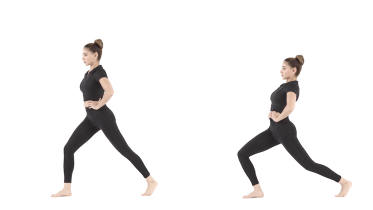
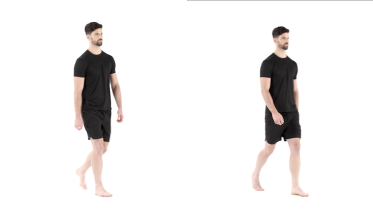
These six are about breaking up long sitting rather than training hard, so they suit short bursts through the day. The two seated ones usually start at 5 to 10 slow repetitions several times a day, the cat-camel at 5 to 10 slow cycles, and the hip flexor stretch at a hold of 20 to 30 seconds repeated 2 to 3 times on each side. Correct sitting posture is practiced for a few relaxed breaths at a time, and brisk walking often begins at 10 to 20 minutes on most days, adding time before speed. Each exercise page gives its own starting dose, and your physio will adjust this.
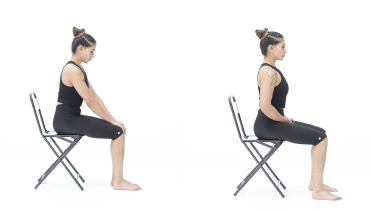 Correct sitting posture
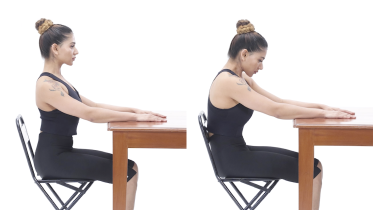 Seated pelvic tilt
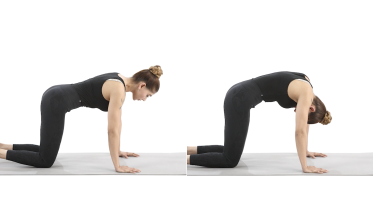 Cat-camel stretch
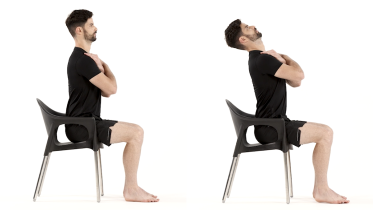 Seated thoracic extension
 Hip flexor stretch
 Brisk walking
Build the habit around something that already happens: a tilt and an extension every time you finish a call, a cat-camel before you sit down again after lunch, a walk that replaces part of the commute. Discomfort that settles by the next morning is usually acceptable. Pain that is clearly worse the next day means the dose was too much for now.
When to see a physio (physical therapist)
Get an appointment if the pain has not improved after a few weeks of sorting out the obvious things, if it is affecting your work or your sleep, or if it keeps returning every time you have a busy week. Leg symptoms, particularly below the knee, are worth getting seen sooner.
A physio will look at more than your chair. Expect questions about the shape of your day, your total activity, your sleep and what you have already tried, along with an examination of how your back moves and how your leg is working. That usually produces a more useful plan than any single ergonomic purchase. Serious causes are uncommon, and clinicians screen for them deliberately using an agreed international list of warning features (Finucane and colleagues, 2020). The signs below carry their own time frames and should not wait for a routine appointment.
Related exercise programs
See a doctor promptly if
- Emergency: numbness, tingling or altered feeling around or under your genitals, between your inner thighs, or around your bottom (anus), for example it feels different when you wipe after using the toilet. Call emergency services or go to an emergency department straight away. This can be a sign of pressure on the bundle of nerves at the base of the spine (cauda equina syndrome), which needs emergency treatment.
- Emergency: you find it hard to start peeing, cannot pee, cannot feel yourself peeing or cannot control when you pee, or you do not notice when you need to poo or cannot control when you poo, and this is not normal for you. The same applies to a new change in how your genitals feel during sex, or new trouble getting an erection or ejaculating. Call emergency services or go to an emergency department straight away. These can also be signs of cauda equina syndrome.
- Emergency: sciatica in both legs, or pain, tingling, numbness or weakness in both legs. The same applies if you lose feeling in one leg. Call emergency services or go to an emergency department straight away.
- Emergency: back or leg pain that started after a serious accident, such as a car crash or a fall from a height, or back pain with chest pain. Call emergency services.
- Emergency: you have had cancer, now or in the past, and your back or neck pain feels like a tight band around your body, or comes with pain spreading down an arm or leg, weakness, numbness or pins and needles in your arms or legs, trouble walking, or trouble controlling your bladder or bowels. Call your cancer team's emergency number straight away, or go to an emergency department if you do not have one or cannot get through. This can be cancer pressing on the spinal cord (metastatic spinal cord compression), which needs treatment straight away.
- Emergency: new neck or back pain after a fall, a knock or a jolt, even a minor one such as a trip or a sudden stop in a car, if you have a condition that stiffens the spine, such as ankylosing spondylitis. Call emergency services or go to an emergency department straight away, do not drive yourself, and tell the staff about your spine condition, so they keep your neck and back in their usual position. A stiff spine can break after a small injury, and the break is easy to miss at first. If the pain started straight after the injury, or you also have numbness, tingling or weakness in your arms or legs, keep still and call emergency services.
- Same day: a leg or foot that is getting weaker, for example your foot drags, catches on the ground or slaps down when you walk (foot drop). Get medical advice the same day. If the weakness is getting worse by the hour, go to an emergency department.
- Same day: back or leg pain with a fever, or you feel hot, cold, shivery or generally unwell. Get medical advice the same day, and go to an emergency department if you feel very unwell.
- Same day: you have back pain and have lost weight without trying. Get medical advice the same day and mention the weight loss.
- Same day: new back pain and you have had cancer, now or in the past. Get medical advice the same day and mention your cancer history. If you are being treated for cancer now, contact your cancer team the same day.
- Same day: back pain after a minor fall or strain if you are older, have low bone density (osteoporosis) or have taken steroid tablets for a long time. Get medical advice the same day.
- Same day: a calf or thigh that is newly swollen, warm, tender, red or darker than usual, has swollen veins that are sore to touch, or has a throbbing or cramping pain that does not fit your injury or condition, or that feels different from normal muscle soreness after exercise. This can be a sign of a blood clot (deep vein thrombosis), especially after surgery, an injury, time in a cast or boot, a long trip or a spell of being much less mobile than usual. Get medical advice the same day. If you are also short of breath or have chest pain, call emergency services.
- Same day: severe pain that comes on suddenly or is getting worse quickly. Get medical advice the same day.
- Within a few days: pain that is worse at night, or does not ease at all when you rest. See your doctor within a few days. If you have had cancer, now or in the past, or you have lost weight without trying, get medical advice the same day. If you are being treated for cancer now, contact your cancer team the same day.
- Within a week or two: back or buttock pain that started before the age of 45, has lasted more than three months, is worse after rest and in the morning, and eases when you move. This is not an emergency, but see your doctor in the next week or two and ask whether it could be inflammatory back pain (axial spondyloarthritis).
Common questions
Why does my lower back hurt when I sit but not when I stand or walk?
Sitting holds the lower back still in one position, usually a slightly rounded one, and takes away the constant small movements that standing and walking provide. For a back that is already sensitive, a position held without variation is often the harder ask. A sore tailbone behaves this way too, because sitting puts weight directly through it. The pattern is worth reporting, but it does not point at a single structure on its own. If leg ache or heaviness comes on when you walk and eases when you sit, that is the opposite pattern and a different one to get checked.
Can sitting all day cause back pain?
Not on its own, according to the best available review. Roffey and colleagues (2010) assessed the published evidence and concluded that occupational sitting is unlikely to be independently causing low back pain in the working populations studied. That is not permission to sit for twelve hours, and it does not mean sitting feels fine when your back is sore. It does mean that blaming the chair alone usually misses the point, and that total activity, sleep, stress and workload belong in the same conversation.
How should I sit with lower back pain?
In whatever position is comfortable, and then in a different one twenty minutes later, because there is no agreed correct sitting posture. Physiotherapists surveyed on this mostly pick some version of an upright position, yet strong evidence that any specific posture leads to better health outcomes is lacking (Korakakis and colleagues, 2019). Researchers have also argued that the popular link between spinal pain and incorrect posture has limited scientific support (Slater and colleagues, 2019). Practical things still help: feet supported, thighs and hips settled into the seat, screen at a height that does not pull you forward, and something behind the lower back if it feels better. Treat comfort and variety as the goal rather than one ideal shape.
Why does my back hurt going from sitting to standing?
Standing up asks a back that has been still to move, take load and change shape within a second or two, and a sore back often protests for the first few steps before loosening. Physios describe this as start-up stiffness, and it is common with several causes rather than a sign of any one of them. Getting up slowly, pushing through the chair arms, and taking a few steps before you judge how it feels usually takes the edge off. If it locks or gives way, or mornings stay stiff long after you have got going, get it examined.
How do I relieve back pain from sitting at a desk?
Change position before your back asks you to, rather than waiting for the ache and then jumping up. A break every 20 to 30 minutes, even for half a minute, usually suits a sore back better than one long break. Alternate tasks so some of them get done standing or walking, take phone calls on your feet, and keep the load off the very end of the day. A sit-stand desk may suit the way you work, but do not count on it to treat the pain: a Cochrane review found no significant difference in the intensity of low back symptoms between sit-stand workstations and no intervention in the short term, on low-quality evidence (Parry and colleagues, 2019).
What stretches and exercises help back pain from sitting?
The ones you will actually do at your desk, several times a day, plus something that gets you moving properly outside work. The seated pelvic tilt and seated thoracic extension take a minute and can be done in a work chair. The cat-camel restores gentle movement through the whole lower back, and the hip flexor stretch targets the muscles at the front of the hip that spend the day shortened. Walking is the one that does the most, because it changes the whole day rather than one position. None of them is a substitute for an assessment if the pain is not settling.
References
- National Institute for Health and Care Excellence. Low back pain and sciatica in over 16s: assessment and management (NG59). Published 2016, last updated July 2026. https://www.nice.org.uk/guidance/ng59
- National Institute for Health and Care Excellence. Spondyloarthritis in over 16s: diagnosis and management (NG65). Published February 2017. https://www.nice.org.uk/guidance/ng65
- NHS. Back pain. https://www.nhs.uk/conditions/back-pain/
- NHS. Sciatica. Page last reviewed 3 December 2024. https://www.nhs.uk/conditions/sciatica/
- Roffey DM, Wai EK, Bishop P, Kwon BK, Dagenais S. Causal assessment of occupational sitting and low back pain: results of a systematic review. The Spine Journal. 2010;10(3):252-261. https://pubmed.ncbi.nlm.nih.gov/20097618/
- Parry SP, Coenen P, Shrestha N, O'Sullivan PB, Maher CG, Straker LM. Workplace interventions for increasing standing or walking for decreasing musculoskeletal symptoms in sedentary workers. Cochrane Database of Systematic Reviews. 2019;(11):CD012487. https://doi.org/10.1002/14651858.CD012487.pub2
- O'Sullivan K, O'Keeffe M, O'Sullivan L, O'Sullivan P, Dankaerts W. The effect of dynamic sitting on the prevention and management of low back pain and low back discomfort: a systematic review. Ergonomics. 2012;55(8):898-908. https://doi.org/10.1080/00140139.2012.676674
- van Duijvenbode IC, Jellema P, van Poppel MN, van Tulder MW. Lumbar supports for prevention and treatment of low back pain. Cochrane Database of Systematic Reviews. 2008;(2):CD001823. https://doi.org/10.1002/14651858.CD001823.pub3
- Korakakis V, O'Sullivan K, O'Sullivan PB, et al. Physiotherapist perceptions of optimal sitting and standing posture. Musculoskeletal Science and Practice. 2019;39:24-31. https://doi.org/10.1016/j.msksp.2018.11.004
- Slater D, Korakakis V, O'Sullivan P, Nolan D, O'Sullivan K. "Sit up straight": time to re-evaluate. Journal of Orthopaedic and Sports Physical Therapy. 2019;49(8):562-564. https://doi.org/10.2519/jospt.2019.0610
- Hartvigsen J, Hancock MJ, Kongsted A, et al. What low back pain is and why we need to pay attention. The Lancet. 2018;391(10137):2356-2367. https://doi.org/10.1016/S0140-6736(18)30480-X
- George SZ, Fritz JM, Silfies SP, et al. Interventions for the management of acute and chronic low back pain: revision 2021. Journal of Orthopaedic and Sports Physical Therapy. 2021;51(11):CPG1-CPG60. https://doi.org/10.2519/jospt.2021.0304
- Finucane LM, Downie A, Mercer C, et al. International framework for red flags for potential serious spinal pathologies. Journal of Orthopaedic and Sports Physical Therapy. 2020;50(7):350-372. https://doi.org/10.2519/jospt.2020.9971
Written and checked by the PocketPhysio editorial team. Last updated 2026-09-30.
This page is general education, not a diagnosis or a personal treatment plan. See a physiotherapist or doctor for advice about your own situation.