
Sciatica pain when sitting: how to sit and how often to get up
Why a chair is the hardest place for an irritated nerve
Sitting does two things at once. The lower back rounds, and the hip bends toward a right angle, which together draw the nerve roots and the sciatic nerve tighter along their path. Add a screen that pulls your head forward and the rounding increases.
Physios use that on purpose. The slump test puts you in exactly this position, then straightens the knee and lifts the ankle to add more tension, and leg symptoms appearing there suggest a nerve that has become sensitive to being stretched. Its accuracy has only been tested in small samples, and in one study of 21 people it detected 91% of those with nerve-related pain while also coming up positive in some who had none (Urban and MacNeil, 2015). The authors said that sample was too small and too narrow for the numbers to be applied to everyone with back and leg pain. The clinical point stands regardless: a sensitized nerve dislikes the slumped seated position, which is why your chair finds your sciatica before anything else does.
Then there is time. An irritated nerve root tolerates a position far better when the position keeps changing, and a chair is the place where it changes least.
What sitting does to the disc, and what it does not
The idea that sitting doubles the pressure inside your discs has outlived the research behind it. A meta-analysis pooled seven studies that measured pressure inside living lumbar discs and found pressure higher in sitting than standing overall, with a standardized mean difference of 0.87 (Li and colleagues, 2022). Look closer and the picture breaks up. Studies published after 1990, using better transducers, found no significant difference between the two positions, and degenerated discs showed similar pressures sitting and standing. The authors concluded there were too few studies to settle the question.
So sitting is not quietly crushing your spine. What it does is hold an already irritated nerve root in its least favorite position for an hour at a time, which is a different problem with a different solution.
Sitting positions that usually help
There is no correct posture to aim for. In a survey of 544 physiotherapists, nearly all picked some upright version as the best way to sit, and the researchers noted the lack of strong evidence that any particular posture leads to better outcomes (Korakakis and colleagues, 2019). Use your leg as the test instead of a diagram.
Sit, wait two minutes, and notice what the leg does. Symptoms that stay the same or pull back toward your buttock mean the position is acceptable for now. Symptoms that travel further down the leg mean it is not, whatever it looks like from the outside.
At a desk
Get your hips level with or slightly above your knees, which usually means raising the chair and then sorting out your feet with a footrest or a stack of books. That small change stops the pelvis rolling backward and takes some of the rounding out of the lower back. A rolled towel or a small cushion in the curve of your back often makes an hour more comfortable, and it is worth using for that reason alone, though it is not a treatment. Put the screen straight in front of you at a height that does not pull your head down, because twisting to a side monitor locks the trunk into one rotated shape.
In the car
Cars are harder than offices because the seat sinks, the pedals fix your legs and you cannot get up. Raise the seat if it adjusts, or sit on a firm cushion to lift the back of your pelvis so your hips are not below your knees. Bring the seat forward so you are not stretching for the pedals, open the backrest a little instead of sitting bolt upright, and use the lumbar support if the car has one. Nobody has run a good trial on car seat setups for sciatica, so take that as a sensible starting point and let your leg judge it.
The stops matter more than the setup. Getting out every 30 to 45 minutes on a long drive and walking for a few minutes resets the position, which fits the NHS warning against staying seated for long stretches when you have sciatica.
On the sofa, and on a hard seat
A deep, soft sofa is the worst seat in most houses, because the cushion lets your pelvis sink well below your knees and the back is too far away to reach. Sitting forward on the front edge, or putting a firm cushion underneath you, usually beats sinking back. An evening spent there after a day at a desk is often what explains a leg that is at its worst by bedtime.
Hard seats and toilet seats concentrate pressure through the sitting bones and the buttock muscles just below the nerve. Pain that is much worse on a hard seat is worth mentioning at an appointment, since buttock pain and pain aggravated by sitting are two of the four features most often reported in piriformis syndrome (Hopayian and Danielyan, 2018), and the piriformis syndrome program covers that pattern. A soft cushion, or one with the middle cut out, is easy to try and costs nothing to test for a week.
The first steps after you stand up
Getting out of the chair is the moment most people describe as the worst, and then it eases within a minute or two of walking. The back and hip have been still, the nerve has been drawn tight, and now everything has to move and take weight in the same second.
Get out of the chair slowly. Shuffle to the front of the seat, push down through the chair arms or your thighs, come up without twisting, and give yourself several steps before you judge how the leg feels. If the leg is weaker rather than just sore, or your foot catches or slaps down as you walk, the warning signs below say how fast to act on it, and it is not something to work around.
How often to get up
More often than feels necessary, and before the leg complains rather than after. A change of position every 20 to 30 minutes suits most irritated nerves better than one long break at lunch, and it need only last 30 seconds. No trial has set that interval, so treat it as a practical starting point and shorten it if your leg says so.
Stack it onto things that already happen. Stand for phone calls, walk to fill your water glass, take the stairs to a different floor for the bathroom, and do one standing back extension every time you finish a task.
Keeping your usual routine going, and keeping out of long spells in a chair or in bed, is the NHS line on sciatica. A Cochrane review comparing bed rest with staying active found little or no difference in pain for sciatica, and small gains in pain and function in favor of staying active for acute back pain (Dahm and colleagues, 2010). Structured exercise has been compared with simply staying active too, and the difference was small, short-lived and based on low-quality evidence (Fernandez and colleagues, 2015). Both point the same way: what you do between the sitting spells counts for more than any single exercise.
Not everything sold for this is supported. NICE advises against belts, corsets and traction for low back pain with or without sciatica, so a support belt is not the answer to a painful commute.
If you are pregnant
Leg pain in pregnancy is assessed and managed differently, so it is not covered on this page. The pregnancy back and pelvic pain program is the right starting point, and your midwife or maternity physio leads the plan. If you are pregnant, check with your midwife or physio before you start.
Exercises to use between sitting spells
None of these is a treatment for sciatica on its own, and this page is not the place for the full program. They are movements that undo the seated position for a minute: one standing, one seated, one lying face down, one stretch and one walk. The sciatica program has the staged plan, and the lumbar disc herniation and spinal stenosis pages cover those diagnoses in full.
Your leg is the referee for every one of them. Anything that drives the pain, numbness or tingling further toward your foot gets dropped from the list, and the fact that it did so is worth reporting at your next appointment. Symptoms retreating up toward the buttock usually count in the movement's favor, with one exception: numbness or weakness in the leg that is deepening at the same time is not a good trade. Stop the exercises and get medical advice the same day.
Some groups need to ask first. If you have been told you have narrowing of the spinal canal (spinal stenosis) or a forward-slipped vertebra (spondylolisthesis), ask your physio before the standing back extension, because bending backward often aggravates both. Check with your physio before lying face down if you are pregnant, have had recent stomach or spine surgery, or have a heart or lung condition that makes lying flat on your front hard, and the same applies with spinal stenosis. Ask a physio to look at your leg before you start the nerve glide, since it is not for every stage, and get checked first if you have had back surgery recently.
If you have had a hip replacement, get the go-ahead from your surgeon or physio before you try the seated figure 4 stretch. With the ankle on the other knee and a lean forward, the hip bends past a right angle, and many surgeons ask you to avoid that for the first months after some operations. With osteoporosis or a past spinal fracture, keep your back long and lean only a little in that stretch, or stay upright and let the crossed leg do the work. With a heart or lung condition, high blood pressure, or a recent operation, ask your doctor or physio how much to walk and how fast before you start. If your balance is unsure, pick a route with a rail or a wall along it and use your walking aid if you have one.
Exercises that can help
These five are sitting-break movements rather than a training session, so they belong in the gaps of a working day. Typical starting doses are 3 to 5 holds of about 10 seconds for the standing back extension, 5 to 10 slow glides for the nerve glide, 2 to 5 minutes of prone lying, a 20 to 30 second hold repeated 2 to 3 times on each side for the seated figure 4, and 10 to 20 minutes of brisk walking on most days. Each exercise page carries its own numbers, and your physio will adjust this.
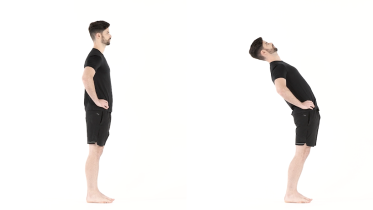 Standing back extension
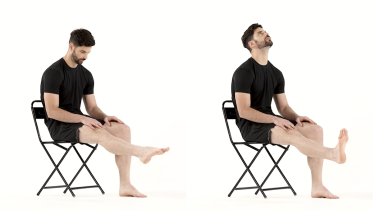 Seated sciatic nerve glide
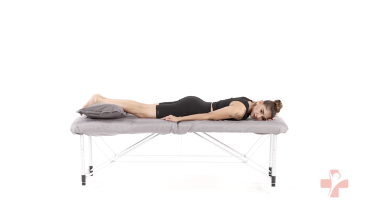 Prone lying
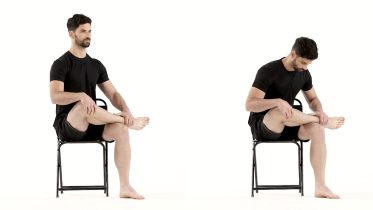 Seated figure 4 stretch
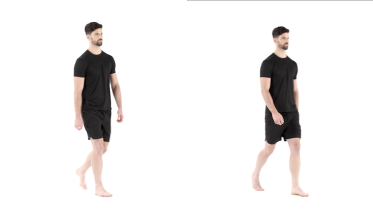 Brisk walking
Build them around the sitting rather than adding them to the end of the day. One back extension after each meeting, a nerve glide before you sit back down, a few minutes face down in the evening, and a walk that replaces part of the commute will do more than a single session you have to remember. If your job has you sitting all day but your back rather than your leg is the problem, back pain when sitting covers that pattern instead.
When to see a physio (physical therapist)
Book an appointment if the leg pain has not started to improve after a few weeks, if it is getting worse, or if it is stopping you working, sleeping or doing normal things. Sitting that has become impossible rather than uncomfortable is its own reason to be seen, because your job, your commute and your evenings all depend on it.
Expect the assessment to look past the chair. A physio will test the nerve, check power and sensation in your leg and foot, ask which positions ease it and which set it off, and want to know how you are sleeping and what you have tried already. It is uncommon for something serious to be behind sciatica, and clinicians look for it on purpose, guided by an international framework of warning features drawn up for spinal conditions (Finucane and colleagues, 2020). Each warning sign listed below has its own urgency, and none of them should wait in a queue for a routine appointment.
Related exercise programs
See a doctor promptly if
- Emergency: numbness, tingling or altered feeling around or under your genitals, between your inner thighs, or around your bottom (anus), for example it feels different when you wipe after using the toilet. Call emergency services or go to an emergency department straight away. This can be a sign of pressure on the bundle of nerves at the base of the spine (cauda equina syndrome), which needs emergency treatment.
- Emergency: you find it hard to start peeing, cannot pee, cannot feel yourself peeing or cannot control when you pee, or you do not notice when you need to poo or cannot control when you poo, and this is not normal for you. The same applies to a new change in how your genitals feel during sex, or new trouble getting an erection or ejaculating. Call emergency services or go to an emergency department straight away. These can also be signs of cauda equina syndrome.
- Emergency: sciatica in both legs, or pain, tingling, numbness or weakness in both legs. The same applies if you lose feeling in one leg. Call emergency services or go to an emergency department straight away.
- Emergency: back or leg pain that started after a serious accident, such as a car crash or a fall from a height, or back pain with chest pain. Call emergency services.
- Emergency: you have had cancer, now or in the past, and your back or neck pain feels like a tight band around your body, or comes with pain spreading down an arm or leg, weakness, numbness or pins and needles in your arms or legs, trouble walking, or trouble controlling your bladder or bowels. Call your cancer team's emergency number straight away, or go to an emergency department if you do not have one or cannot get through. This can be cancer pressing on the spinal cord (metastatic spinal cord compression), which needs treatment straight away.
- Emergency: new neck or back pain after a fall, a knock or a jolt, even a minor one such as a trip or a sudden stop in a car, if you have a condition that stiffens the spine, such as ankylosing spondylitis. Call emergency services or go to an emergency department straight away, do not drive yourself, and tell the staff about your spine condition, so they keep your neck and back in their usual position. A stiff spine can break after a small injury, and the break is easy to miss at first. If the pain started straight after the injury, or you also have numbness, tingling or weakness in your arms or legs, keep still and call emergency services.
- A leg or foot that is getting weaker, for example your foot drags, catches on the ground or slaps down when you walk (foot drop). Get medical advice the same day. If the weakness is getting worse by the hour, go to an emergency department.
- A calf or thigh that is newly swollen, warm, tender, red or darker than usual, has swollen veins that are sore to touch, or has a throbbing or cramping pain that does not fit your injury or condition, or that feels different from normal muscle soreness after exercise. This can be a sign of a blood clot (deep vein thrombosis), especially after surgery, an injury, time in a cast or boot, a long trip or a spell of being much less mobile than usual. Get medical advice the same day. If you are also short of breath or have chest pain, call emergency services.
- Back or leg pain with a fever, or you feel hot, cold, shivery or generally unwell. Get medical advice the same day, and go to an emergency department if you feel very unwell.
- New back or leg pain and you have had cancer, now or in the past, or you have lost weight without trying. Get medical advice the same day and mention it. If you are being treated for cancer now, contact your cancer team the same day.
- Back pain after a minor fall or strain if you are older, have low bone density (osteoporosis) or have taken steroid tablets for a long time. Get medical advice the same day.
- Pain that does not ease at all with rest or changing position, or is worse at night. See your doctor within a few days. Get medical advice the same day if you also feel unwell, have lost weight without trying, or have had cancer, now or in the past. If you are being treated for cancer now, contact your cancer team the same day.
- Severe pain that comes on suddenly or is getting worse quickly. Get medical advice the same day.
Common questions
Why does sciatica hurt more when sitting?
Two things happen at once in a chair. The lower back rounds, which narrows the space the nerve root passes through and loads the back of the disc, and the hip and knee positions draw the sciatic nerve and its roots tighter along their length. Physical therapists rely on that second effect deliberately: the slump test asks you to sit, round your back, drop your chin and straighten the knee, and reproducing your leg symptoms in that position points to a sensitized nerve. In one small study of 21 people with low back pain, the test picked up nerve-related pain in 91% of those who had it, although it also came up positive in some who did not (Urban and MacNeil, 2015). Sitting then adds the thing that irritates a sore nerve most, which is holding any one position for an hour without varying it.
Is sciatica worse sitting, standing, walking or lying down?
It depends on what is irritating the nerve, and the pattern is a clue worth bringing to an appointment. Nerve root pain from a disc problem is often at its worst sitting and bending, and eases when you stand up and walk about. Narrowing of the spinal canal behaves the other way round: leg pain, heaviness or numbness builds when you stand and walk and settles when you sit or lean forward over a trolley, which is the pattern described in a review of lumbar spinal stenosis (Katz and colleagues, 2022). Buttock pain and pain that is worse with sitting are two of the four features reported most often in piriformis syndrome (Hopayian and Danielyan, 2018). Nobody can diagnose you from this alone, but which position gives relief is one of the first questions a physio will ask.
What is the best sitting position for sciatica?
There is no agreed correct one, and the evidence for any particular posture is weak. When 544 physiotherapists were asked to pick the best sitting posture, almost all chose some upright version, and the authors pointed out that strong evidence linking any specific posture to better health outcomes is lacking (Korakakis and colleagues, 2019). A practical test beats a rule: settle into a position, give it two or three minutes, and see where the leg pain goes. Keep whatever leaves the leg the same or better, and drop whatever pushes the symptoms further down it. Then change position again before the leg starts complaining, because variety does more than any single shape held all day.
How should I sit in the car with sciatica?
Set the seat up so your hips are not lower than your knees, then plan the stops. A seat that sinks means the lower back is rounded before you have driven a mile, so raise the seat height if you can, or sit on a firm cushion or a folded towel to lift the back of your pelvis, and use the lumbar support or a small rolled towel if it feels better. Pull the seat close enough that you are not reaching for the pedals, and tilt the back slightly open rather than upright, since a completely vertical back usually gets held with effort. On a long drive, stop every 30 to 45 minutes and walk for a few minutes rather than pushing on to the destination. There is no good research comparing car seat setups for sciatica, so treat all of that as a starting point you adjust by how your leg responds.
Can sitting too long cause sciatica?
Sitting is much better at provoking existing sciatica than at causing it. Top of the NHS list of causes is a slipped disc, followed by a narrowed spinal canal, a vertebra that has slipped forward and injuries to the back, and a chair on its own does not produce any of them. The disc pressure story is weaker than it is usually told, too. A meta-analysis of seven studies measuring pressure inside living lumbar discs found higher pressure in sitting than standing overall, but studies published after 1990, using better measuring equipment, showed no significant difference, and the authors said there were too few studies to be confident either way (Li and colleagues, 2022). Long sitting still matters for how your leg feels today, which is reason enough to break it up.
How long does sciatica pain when sitting take to settle?
Most sciatica improves over a few weeks to a few months, and sitting tolerance usually returns in step with the leg pain rather than ahead of it. The longer-term figures are more sobering. When 609 British adults with back-related leg pain were followed for a year after seeing their family doctor, only a little over half had improved by the 12 month mark, counting a clear drop in disability as improvement, and expecting a long problem was among the things that made improvement less likely (Konstantinou and colleagues, 2018). A practical way to track progress is to time how long you can sit before the leg starts talking, and watch that number over weeks. If it is not growing after a few weeks of breaking up your sitting and staying active, see a physio or doctor rather than waiting it out.
References
- National Institute for Health and Care Excellence. Low back pain and sciatica in over 16s: assessment and management (NG59). Published 2016, last updated July 2026. https://www.nice.org.uk/guidance/ng59
- NHS. Sciatica. Page last reviewed 3 December 2024. https://www.nhs.uk/conditions/sciatica/
- NHS. Back pain. https://www.nhs.uk/conditions/back-pain/
- NHS. Slipped disc. Last reviewed 24 April 2024. https://www.nhs.uk/conditions/slipped-disc/
- NHS. Deep vein thrombosis (DVT). Page last reviewed 30 April 2026. https://www.nhs.uk/conditions/deep-vein-thrombosis-dvt/
- Li JQ, Kwong WH, Chan YL, Kawabata M. Comparison of in vivo intradiscal pressure between sitting and standing in human lumbar spine: a systematic review and meta-analysis. Life. 2022;12(3):457. https://doi.org/10.3390/life12030457
- Urban LM, MacNeil BJ. Diagnostic accuracy of the slump test for identifying neuropathic pain in the lower limb. Journal of Orthopaedic and Sports Physical Therapy. 2015;45(8):596-603. https://doi.org/10.2519/jospt.2015.5414
- Korakakis V, O'Sullivan K, O'Sullivan PB, et al. Physiotherapist perceptions of optimal sitting and standing posture. Musculoskeletal Science and Practice. 2019;39:24-31. https://doi.org/10.1016/j.msksp.2018.11.004
- Konstantinou K, Dunn KM, Ogollah R, Lewis M, van der Windt D, Hay EM. Prognosis of sciatica and back-related leg pain in primary care: the ATLAS cohort. The Spine Journal. 2018;18(6):1030-1040. https://doi.org/10.1016/j.spinee.2017.10.071
- Dahm KT, Brurberg KG, Jamtvedt G, Hagen KB. Advice to rest in bed versus advice to stay active for acute low-back pain and sciatica. Cochrane Database of Systematic Reviews. 2010;(6):CD007612. https://doi.org/10.1002/14651858.CD007612.pub2
- Fernandez M, Hartvigsen J, Ferreira ML, et al. Advice to stay active or structured exercise in the management of sciatica: a systematic review and meta-analysis. Spine. 2015;40(18):1457-1466. https://doi.org/10.1097/BRS.0000000000001036
- Hopayian K, Danielyan A. Four symptoms define the piriformis syndrome: an updated systematic review of its clinical features. European Journal of Orthopaedic Surgery and Traumatology. 2018;28(2):155-164. https://doi.org/10.1007/s00590-017-2031-8
- Katz JN, Zimmerman ZE, Mass H, Makhni MC. Diagnosis and management of lumbar spinal stenosis: a review. JAMA. 2022;327(17):1688-1699. https://doi.org/10.1001/jama.2022.5921
- Getting It Right First Time (GIRFT), NHS England. National suspected cauda equina syndrome (CES) pathway. February 2023, updated March 2026. https://gettingitrightfirsttime.co.uk/wp-content/uploads/2026/04/National-Suspected-Cauda-Equina-Pathway-March-2026.pdf
- Finucane LM, Downie A, Mercer C, et al. International framework for red flags for potential serious spinal pathologies. Journal of Orthopaedic and Sports Physical Therapy. 2020;50(7):350-372. https://doi.org/10.2519/jospt.2020.9971
Written and checked by the PocketPhysio editorial team. Last updated 2026-09-30.
This page is general education, not a diagnosis or a personal treatment plan. See a physiotherapist or doctor for advice about your own situation.