
Lower back pain when bending forward: causes, exercises and when to get help
Why bending forward is the movement that finds it
Bending is the most loaded thing most backs do in an ordinary day. Your trunk tips out over your hips, the muscles along your spine pay out slowly to control the descent, and the discs and small joints carry the load while that happens. Add a laundry basket or a child and the demand climbs again. A back that feels tolerable standing still can object as soon as you tip forward.
That is why bending is worth describing in detail when you get it looked at. How far you get, what stops you, and whether anything travels into your leg tell a physio far more than a number out of ten does.
Pain on the way down, or pain on the way back up
Notice which half of the movement hurts, because the two halves ask for different things. On the way down the back muscles lengthen while they work, holding you against gravity as the spine rounds. On the way up they have to haul your upper body back over your hips, which is the sharper moment for plenty of people. Some people get a catch at one point in the arc, with nothing on either side of it.
None of that settles a diagnosis on its own. It does change what a physio tests and which exercises they start you on, so say which part hurts rather than only that bending hurts.
What causes lower back pain when bending forward?
What follows are patterns, not verdicts. Only an examination can say which one fits you, and two of them often sit together in the same back.
Non-specific low back pain
This is the common one by a distance. A Lancet review found that a specific cause cannot be identified for nearly all people with low back pain, and that only a small proportion have a serious cause such as a fracture, cancer or infection (Hartvigsen and colleagues, 2018). Non-specific does not mean nothing is happening or that the pain is in your head. It means the pain comes from the general working parts of the back rather than from one thing anybody can point at, and it usually eases over a few weeks. The low back pain program is the place to start if that is the description you have been given.
Disc-related pain
The NHS lists problems bending or straightening your back among the symptoms of a slipped disc, alongside lower back pain, muscle weakness, and numbness or tingling in the legs or feet. If disc material irritates a nerve root, pain travels into the buttock and down one leg. The NHS describes that as a sharp, burning pain down the back of the leg with tingling, numbness or weakness, often including the foot and toes, and adds that it can be worse when you move, sneeze or cough. Pain that jumps when you cough or sneeze while bent over belongs in this family. The leg symptoms are the part to report, not the back pain, and the lumbar disc herniation and sciatica programs cover what comes next.
A scan is rarely the answer in the early weeks. In people with no back pain at all, disc bulges were found in 30% of 20-year-olds and 84% of 80-year-olds (Brinjikji and colleagues, 2015). NICE advises against routine imaging for low back pain, with or without sciatica, outside specialist care.
A muscle or ligament strain
A strain usually has a moment attached to it. You lifted awkwardly, twisted while holding something, or grabbed at a falling object, and it either hurt at once or stiffened up over the next few hours. It tends to be worse with movement, easier when you keep still, and it settles over days to a few weeks. Nothing on a scan confirms the label, so physios treat it much as they treat any new episode: move early, load gradually, and expect the range to come back before the last of the soreness does.
A back that prefers one direction
Some backs clearly dislike forward bending and feel better leaning back. Others are the reverse, and many notice no difference at all. Physios look for that pattern on purpose, because symptoms that pull back toward the spine as you move go with a better outlook: 21 of 23 studies in a review of back and neck pain reported that link (May and Aina, 2012).
Flexion intolerant is clinic shorthand for a back that keeps objecting to forward bending. It describes what you report on the day rather than anything a test confirms, so it is a starting point for treatment, not a label to carry around. A direction that eases things is a clue for choosing exercises, not proof that bending is damaging your back, and it often changes as the episode settles.
Leaning back does not suit everyone. If you have been told you have narrowing of the spinal canal (spinal stenosis) or a forward slip of one vertebra on another (spondylolisthesis), ask your physio before you try backward bending, because it often stirs both up. Say which direction helps and which does not when you are assessed, because it changes where the treatment starts.
Degenerative changes
Wear-related changes in the discs get blamed for bending pain more often than the evidence supports, for the reason already given: plenty of people have them and no pain at all. They can still be part of the picture, particularly when stiffness has built slowly over years. The degenerative disc disease page explains what the term does and does not mean on a report.
Bending to lift, to put your shoes on, and to brush your teeth
Lifting is the bend with load on it, so it is the one people ask about most. The standard advice to keep the back straight and bend the knees sounds firmer than the evidence behind it: a review with meta-analysis found low-quality evidence that greater bending of the lower back during lifting was not a risk factor for back pain starting or persisting, and did not separate people with back pain from people without it (Saraceni and colleagues, 2020). Those studies compared spine positions, not weights, so none of it is a reason to carry on lifting heavy or awkward loads while your back is sore.
While you are sore, work on what actually changes the demand: how heavy the load is, how often you lift it, and how close to your body you keep it. Leave the worst jobs until things have settled, then work back up to them in steps rather than testing the back on the heaviest one first.
Putting on shoes and socks is a deep bend with no load, and it often lands first thing in the morning when the back is at its stiffest. Sit down for it and bring the foot up toward you instead of taking your whole trunk to the floor. A long-handled shoehorn is an unglamorous but effective purchase for a few weeks.
Brushing your teeth or washing at a basin is a shallow bend held still for a minute or two, and that sustained version is often worse than a quick deep one. Rest your free hand on the counter to take some of your weight, or step closer and let your hips and knees bend a little so your lower back does less of the work.
What helps while it settles
The NHS advises staying active and trying to continue with your daily activities, and warns against staying in bed for long periods. It also suggests ice or heat packs wrapped in a towel and anti-inflammatory painkillers such as ibuprofen if they suit you, and says back pain often improves on its own within a few weeks. Paracetamol on its own is not recommended for back pain, although it may be used alongside another painkiller, so ask a pharmacist if you are not sure what to take. NICE takes the same line on activity, and suggests considering a group exercise program for a specific episode or flare-up.
Bend little and often rather than not at all. Break a big job into shorter spells, get the load close to you before you lift it, and change position regularly through the day. A single burst of gardening after a quiet month is the classic way to stir up a back that was on the mend, so add the bending back over a couple of weeks rather than in one afternoon.
Mild soreness during or after movement is usually acceptable if it has settled by the next morning and is not building week on week. Sharper pain, pain that travels further down the leg, or new numbness and tingling means that was too much for now. The guide to the pain monitoring model sets out how physios put numbers on that judgment.
For acute back pain, the 2021 American clinical practice guideline gives a grade B recommendation that physical therapists may use active education rather than passive strategies such as only handing over materials, and lists self-management, staying active and pacing among the examples (George and colleagues, 2021). Put plainly, knowing what to do with the next flare-up is part of the treatment. If it is sitting rather than bending that sets your back off, start with back pain when sitting.
Exercise for a back that hurts when you bend
For back pain lasting three months or more, a Cochrane review found moderate-certainty evidence that exercise probably reduces pain compared with no treatment, usual care or placebo, by an amount the reviewers counted as clinically important (Hayden and colleagues, 2021). The effect on daily function was smaller and did not reach that threshold, and results varied a lot between studies, so treat exercise as something you keep up over months rather than a quick fix. NICE lists several kinds of exercise without naming one as standard, which fits what happens in clinic: the program that gets done beats the program that looks best on paper.
The six below work on control of the pelvis and trunk first, then on the hip and thigh strength that bending under load actually needs. Start inside a comfortable range and stop short of anything that pushes pain further down your leg.
With low bone density (osteoporosis), ask your physio before any deep forward bending or end-range twisting, because most programs keep those limited. Ask your physio before the standing back extension if you have spinal stenosis or spondylolisthesis, since backward bending often stirs both up. After back surgery, your surgeon's protocol decides when bending and loading work like this can start. If you have high blood pressure, breathe steadily through every repetition and never hold your breath.
If you have had a hip or knee replacement, get the go-ahead from your surgeon or physio before you try sit to stand, the glute bridge or the squat. Some operations limit this kind of work for the first months, so the timing depends on your surgery. If you are pregnant and past the first three months, check with your physio before exercising flat on your back. That covers the pelvic tilt and the glute bridge, which are both done in that position here.
Exercises that can help
The first three often start at 1 to 3 sets of 6 to 12 slow repetitions or short holds, once or twice a day, and the standing back extension at 3 to 5 repetitions with a hold of about 10 seconds, several times a day. Sit to stand usually begins at 2 to 3 sets of 5 to 10, and the squat at 2 to 3 sets of 8 to 12 on a few days a week. Each exercise page gives its own starting dose, and your physio will adjust this.
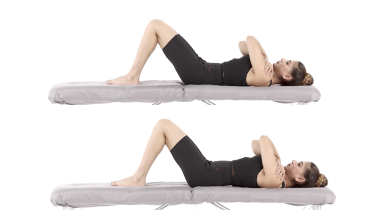 Pelvic tilt
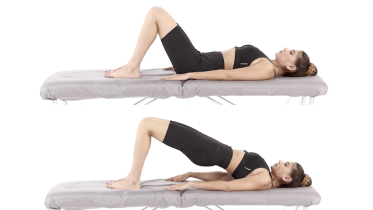 Glute bridge
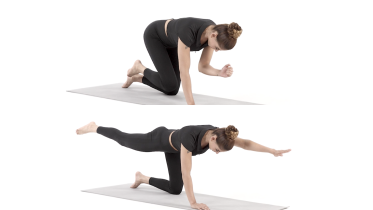 Bird dog
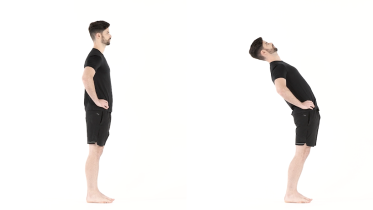 Standing back extension
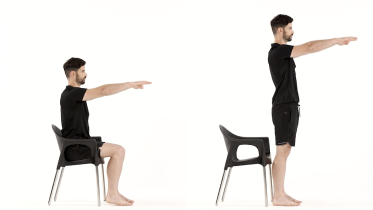 Sit to stand
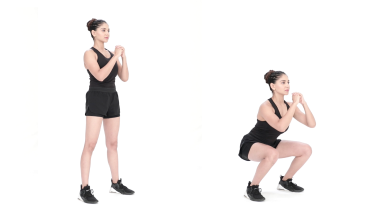 Squat
SquatThe pelvic tilt and the bird dog teach you to control your middle while something else moves, which is the skill a bend needs. The glute bridge and the squat build the buttock and thigh strength that lets your hips take a share of the load. Sit to stand rehearses the everyday version, up and down from a chair, many times a day.
When to see a physio (physical therapist)
Book an appointment if the pain has not improved after a few weeks of looking after it at home, if it is stopping you working, sleeping or doing what you normally do, or if it keeps coming back every few months. The NHS uses much the same threshold. Pain that travels below the knee, or pins and needles in one leg, is worth getting checked sooner, because it changes the examination. The NHS also lists back pain that gets worse when you sneeze, cough or open your bowels among its reasons to see a doctor.
One pattern is worth raising yourself: pain that started before you were 45, has gone on for more than three months, and is at its worst after rest rather than after effort. Ask your doctor whether it could be inflammatory back pain (axial spondyloarthritis), because that is looked into and treated differently.
A physio will watch you bend, test the movement in different directions, and check your leg for changes in power, reflexes and feeling. From that they can pick a direction to start in and a dose to start at, which is quicker than working through it alone. Serious causes are rare but they are looked for deliberately, using the same list of warning features clinicians work from internationally (Finucane and colleagues, 2020). The signs below come with their own time frames, and they do not wait for an appointment.
Related exercise programs
See a doctor promptly if
- Emergency: numbness, tingling or altered feeling around or under your genitals, between your inner thighs, or around your bottom (anus), for example it feels different when you wipe after using the toilet. Call emergency services or go to an emergency department straight away. This can be a sign of pressure on the bundle of nerves at the base of the spine (cauda equina syndrome), which needs emergency treatment.
- Emergency: you find it hard to start peeing, cannot pee, cannot feel yourself peeing or cannot control when you pee, or you do not notice when you need to poo or cannot control when you poo, and this is not normal for you. The same applies to a new change in how your genitals feel during sex, or new trouble getting an erection or ejaculating. Call emergency services or go to an emergency department straight away. These can also be signs of cauda equina syndrome.
- Emergency: sciatica in both legs, or pain, tingling, numbness or weakness in both legs. The same applies if you lose feeling in one leg. Call emergency services or go to an emergency department straight away.
- Emergency: back or leg pain that started after a serious accident, such as a car crash or a fall from a height, or back pain with chest pain. Call emergency services.
- Emergency: you have had cancer, now or in the past, and your back or neck pain feels like a tight band around your body, or comes with pain spreading down an arm or leg, weakness, numbness or pins and needles in your arms or legs, trouble walking, or trouble controlling your bladder or bowels. Call your cancer team's emergency number straight away, or go to an emergency department if you do not have one or cannot get through. This can be cancer pressing on the spinal cord (metastatic spinal cord compression), which needs treatment straight away.
- Emergency: new neck or back pain after a fall, a knock or a jolt, even a minor one such as a trip or a sudden stop in a car, if you have a condition that stiffens the spine, such as ankylosing spondylitis. Call emergency services or go to an emergency department straight away, do not drive yourself, and tell the staff about your spine condition, so they keep your neck and back in their usual position. A stiff spine can break after a small injury, and the break is easy to miss at first. If the pain started straight after the injury, or you also have numbness, tingling or weakness in your arms or legs, keep still and call emergency services.
- Same day: a leg or foot that is getting weaker, for example your foot drags, catches on the ground or slaps down when you walk (foot drop). Get medical advice the same day. If the weakness is getting worse by the hour, go to an emergency department.
- Same day: back or leg pain with a fever, or you feel hot, cold, shivery or generally unwell. Get medical advice the same day, and go to an emergency department if you feel very unwell.
- Same day: you have back pain and have lost weight without trying. Get medical advice the same day and mention the weight loss.
- Same day: new back pain and you have had cancer, now or in the past. Get medical advice the same day and mention your cancer history. If you are being treated for cancer now, contact your cancer team the same day.
- Same day: back pain after a minor fall or strain if you are older, have low bone density (osteoporosis) or have taken steroid tablets for a long time. Get medical advice the same day.
- Same day: severe pain that comes on suddenly or is getting worse quickly. Get medical advice the same day.
- Within a few days: pain that is worse at night, or does not ease at all when you rest. See your doctor within a few days. If you have had cancer, now or in the past, or you have lost weight without trying, get medical advice the same day. If you are being treated for cancer now, contact your cancer team the same day.
- Within a week or two: back or buttock pain that started before the age of 45, has lasted more than three months, is worse after rest and in the morning, and eases when you move. This is not an emergency, but see your doctor in the next week or two and ask whether it could be inflammatory back pain (axial spondyloarthritis).
Common questions
Why does my lower back hurt when I bend over?
Bending puts more load through the lower back than almost anything else you do in a normal day, so it is often the first movement to complain when a back is sore. For nearly everyone the cause is non-specific low back pain, where no single damaged structure can be identified (Hartvigsen and colleagues, 2018). Disc-related pain is the other common pattern, and the NHS lists problems bending or straightening your back among the symptoms of a slipped disc. What you feel matters more than how far you get: pain that stays in the back is treated differently from pain that runs into the buttock or down a leg.
Why does my lower back hurt when I bend over and stand back up?
Down and up are two different jobs for the same muscles. Going down, the muscles along your spine lengthen while they work, to control the descent. Coming back up, those same muscles have to lift the weight of your upper body from a bent position, which is why the return is often the sharper moment. A catch at one point in the range, with nothing on either side of it, is also common. None of this settles a diagnosis, but it is worth describing to a physio, because it changes what gets examined and which exercises come first.
Is it a muscle strain or a disc?
There is no home test that separates them reliably, and an examination is the honest answer. As a rough guide, a strain usually has a moment attached to it, hurts most with movement, eases when you are still and settles over days to a few weeks. Disc-related pain more often builds up without one clear trigger and can send pain, tingling or numbness into the buttock or down one leg, and the NHS says that kind of pain can be worse when you move, sneeze or cough. Scans do not settle it either way in the early stages. Disc bulges show up in 30% of 20-year-olds and 84% of 80-year-olds with no back pain at all (Brinjikji and colleagues, 2015), which is why NICE advises against routine imaging outside specialist care.
Why can't I bend over without back pain?
In a new episode, the back muscles tend to guard, the range shrinks and the first part of the bend feels blocked. That guarding is protective and it usually loosens as the pain settles, especially if you keep bending gently within a comfortable range rather than avoiding it. If the block has been there for weeks, is getting worse, or comes with leg symptoms, get it examined rather than waiting it out. A back that will not bend after a fall, or that comes with any of the warning signs on this page, needs checking sooner.
How do I fix lower back pain when bending over?
There is no single fix, but the approach with the most support behind it is to keep moving while you reduce the size of the bends for a few weeks. The NHS advises staying active and continuing with daily activities, and warns against staying in bed for long periods. Heat or ice packs wrapped in a towel can take the edge off in the meantime, and a pharmacist can tell you which painkiller suits you. Then rebuild: for pain lasting three months or more, exercise probably reduces pain compared with no treatment or usual care, though it does less for day to day function and results vary a lot between studies (Hayden and colleagues, 2021). A physio can tell you which bends to bring back first.
Why does my back hurt bending forward and backward?
Pain in both directions is common in a flare-up, when the back is sore and guarded through its whole range rather than in one direction. It is less useful for narrowing down a cause than pain in one direction only, so a physio will look at other things instead: how it started, what it does over the course of a day, and whether anything travels into the leg. If the pain in both directions is severe, came on suddenly, or is getting worse quickly, get medical advice the same day.
References
- National Institute for Health and Care Excellence. Low back pain and sciatica in over 16s: assessment and management (NG59). Published 2016, last updated July 2026. https://www.nice.org.uk/guidance/ng59
- National Institute for Health and Care Excellence. Spondyloarthritis in over 16s: diagnosis and management (NG65). Published February 2017. https://www.nice.org.uk/guidance/ng65
- NHS. Back pain. https://www.nhs.uk/conditions/back-pain/
- NHS. Slipped disc. Last reviewed 24 April 2024. https://www.nhs.uk/conditions/slipped-disc/
- NHS. Sciatica. Page last reviewed 3 December 2024. https://www.nhs.uk/conditions/sciatica/
- Hartvigsen J, Hancock MJ, Kongsted A, et al. What low back pain is and why we need to pay attention. The Lancet. 2018;391(10137):2356-2367. https://doi.org/10.1016/S0140-6736(18)30480-X
- George SZ, Fritz JM, Silfies SP, et al. Interventions for the management of acute and chronic low back pain: revision 2021. Journal of Orthopaedic and Sports Physical Therapy. 2021;51(11):CPG1-CPG60. https://doi.org/10.2519/jospt.2021.0304
- Hayden JA, Ellis J, Ogilvie R, Malmivaara A, van Tulder MW. Exercise therapy for chronic low back pain. Cochrane Database of Systematic Reviews. 2021;(9):CD009790. https://doi.org/10.1002/14651858.CD009790.pub2
- Saraceni N, Kent P, Ng L, Campbell A, Straker L, O'Sullivan P. To flex or not to flex? Is there a relationship between lumbar spine flexion during lifting and low back pain? A systematic review with meta-analysis. Journal of Orthopaedic and Sports Physical Therapy. 2020;50(3):121-130. https://doi.org/10.2519/jospt.2020.9218
- May S, Aina A. Centralization and directional preference: a systematic review. Manual Therapy. 2012;17(6):497-506. https://doi.org/10.1016/j.math.2012.05.003
- Brinjikji W, Luetmer PH, Comstock B, et al. Systematic literature review of imaging features of spinal degeneration in asymptomatic populations. American Journal of Neuroradiology. 2015;36(4):811-816. https://doi.org/10.3174/ajnr.A4173
- Finucane LM, Downie A, Mercer C, et al. International framework for red flags for potential serious spinal pathologies. Journal of Orthopaedic and Sports Physical Therapy. 2020;50(7):350-372. https://doi.org/10.2519/jospt.2020.9971
Written and checked by the PocketPhysio editorial team. Last updated 2026-09-30.
This page is general education, not a diagnosis or a personal treatment plan. See a physiotherapist or doctor for advice about your own situation.