
Lower back pain in the morning: why it happens and what helps
Why a back is stiffest in the first 15 minutes
Nothing moves for seven or eight hours. Joints sit in one position, muscles hold still, and the discs between the bones of the spine take on fluid overnight. That last point was the thinking behind a trial on early morning bending (Snook and colleagues, 1998). Getting up and walking squeezes the fluid out again over the first part of the day, which is why the trip to the bathroom often feels worse than the walk back. Most morning backs have loosened off well before breakfast.
How long the stiffness lasts is the single most useful thing you can tell a clinician. Loose again in 10 or 15 minutes is ordinary. Still gripping at half past nine, day after day, is a different conversation, and it is the one that leads toward inflammatory back pain.
What morning back pain usually points to
Nothing below is a diagnosis. These are the possibilities a physio weighs up, with the clues that usually sit beside each one.
Non-specific low back pain
For most people no single structure can be pinned down. That was the conclusion of a Lancet review, which also reported that only a small proportion of low back pain comes from a serious cause such as fracture, cancer or infection (Hartvigsen and colleagues, 2018). Morning stiffness in this group usually follows something: a heavy day in the garden, a long drive, a poor night, a week of sitting more than usual. It eases once you are up and about, and it varies from week to week. The low back pain program has the staged exercises for it.
Inflammatory back pain
A smaller group has back pain driven by inflammation rather than load, and it behaves backward. For ankylosing spondylitis, the NHS lists pain that gets better with exercise but does not improve or gets worse with rest, pain and stiffness that are worse in the morning and at night, waking regularly in the night because of the pain, and pain around the buttocks. The ASAS group settled on five features, at least four of which point to inflammatory back pain: onset before the age of 40, a gradual rather than sudden start, improvement with exercise, no improvement with rest, and pain at night that eases once you get up (Sieper and colleagues, 2009).
NICE NG65 turns that into a referral rule. If low back pain started before the age of 45 and has lasted longer than three months, it asks doctors to refer to a rheumatologist when four or more further features are present, among them onset before 35, waking during the second half of the night because of symptoms, buttock pain, improvement with movement, improvement within 48 hours of an anti-inflammatory, psoriasis, and a close relative with spondyloarthritis. With exactly three of them, NICE advises an HLA-B27 blood test and referral if it comes back positive.
You will see a 30 minute or a 60 minute rule quoted for morning stiffness. Neither NG65 nor the ASAS criteria set one, so treat any number you read as a rough prompt rather than a threshold. What the guidance actually uses is the age at onset, the three months, the night waking and how the pain responds to movement and to anti-inflammatories. If that picture fits, see your doctor and say so plainly, because the NHS notes that confirming this diagnosis can take years. The ankylosing spondylitis program sets out the daily exercise side once a rheumatology team is involved.
Age-related change in the discs and joints
Wear-related change in the spine also shows up as stiffness that is worst first thing and eases with movement. NICE says osteoarthritis can be diagnosed from the age of 45 without an X-ray when the joint hurts with use and morning stiffness either lasts no longer than 30 minutes or is absent, which is a useful contrast with the inflammatory picture above. That rule is written for joints in general rather than for the spine, and low back pain itself is assessed under separate guidance (NICE NG226; NICE NG59). Scan findings on their own settle very little: disc changes are common in people with no pain at all and become more common with age (Brinjikji and colleagues, 2015). The degenerative disc disease program covers what to do about it.
Pain that is not coming from your back
Some morning back pain has nothing to do with the spine. An infection in the kidney or urinary tract causes pain in the lower back or side along with a high temperature, feeling or being sick, burning or stinging when you pee, needing to pee more often and urgently, or pee that is dark or cloudy (NHS). A kidney stone usually starts in the side of the tummy or lower back, spreads toward the groin, comes in waves and can be severe at its peak (NHS). Neither is something to sort out at home, and the warning signs at the end of this page set out what to do and how fast.
If you are pregnant
Back and pelvic pain in pregnancy is assessed and treated differently, so it is not covered here. The pregnancy back and pelvic pain program is the place to start, and your midwife or maternity physio leads the plan. If you are pregnant, check with your midwife or physio before you start.
One thing on this page changes. From about 28 weeks the NHS advises going to sleep on your side rather than on your back, because going to sleep on your back in the last months is linked to a higher risk of stillbirth. So use the side position below, with a pillow between your knees, and leave lying on your back until after the birth. The NHS also says not to worry if you wake up on your back: settle onto your side again and carry on.
Does your mattress cause morning back pain?
Sometimes. There is less research behind this than most people assume. The best trial randomized 313 adults with long-standing non-specific low back pain, all of whom ached in bed and on rising, to a firm or a medium firm mattress, kept patients and assessors blind to which they had, and found the medium firm group better at 90 days for pain in bed and for disability (Kovacs and colleagues, 2003). Pain on rising went the same way across the trial, though at the 90 day assessment that particular difference was not clear cut. A review of 39 studies reached the same broad conclusion for non-specific low back pain, while noting that the findings disagree with each other (Caggiari and colleagues, 2021).
One study inside that review compared a normal bed with a deliberately sagging one and found the sagging version worse for sleep quality. Nobody has tested whether replacing an old bed reduces back pain, but a mattress that has collapsed in the middle is still worth dealing with before anything cleverer. Past medium firmness and a bed that still holds its shape, nothing here points to a particular brand, material or orthopedic label. Give any new mattress a few weeks before you judge it.
How much does your sleeping position matter?
Less than you would hope. A scoping review found only four studies that had examined sleep posture alongside waking spinal symptoms, and judged them too few and too weak to answer the question, though side lying looked protective across them (Cary and colleagues, 2019). The same researchers then videoed 53 people at home for two nights. The neck symptom group spent longer in awkward positions than the control group; the low back group did not differ from the controls (Cary and colleagues, 2021). No position has been shown to prevent morning back pain.
The sensible aim is to stop any joint sitting at the end of its range for eight hours. On your back, a pillow under the knees takes some pull off the lower back. On your side, a pillow between the knees stops the top leg dragging the pelvis round.
If you are more than about 28 weeks pregnant, use the side position rather than the back one. Face down holds the lower back arched for hours, and people who wake stiff often find it the hardest position to get away with, though nobody has tested that. Change one thing at a time and give it a week.
A slower start to the day
The first hour is when a sore back is least ready for load. In an 18 month randomized trial, 85 people with persistent or recurring low back pain were taught to control early morning bending. Pain intensity fell in that group and not in the group given sham exercises, with the reduction put at 33% (95% confidence interval 11 to 55%). Days in pain, disability and medication use fell as well (Snook and colleagues, 1998). That is one trial, and current guidance does not ask anybody to give up bending, so read it as a reason to put the deep forward bends later rather than a reason to fear them.
In practice, that means shifting the socks and shoes, the bed making and anything heavy a little further into the morning, and getting a few minutes of movement in before them. A warm shower first loosens some people off. Getting out of bed is easier on a stiff back if you bend your knees, roll onto your side and push up with your arm instead of sitting straight up, which is the method described on the log roll out of bed page. If it is bending forward or a long spell of sitting that sets your back off rather than the first hour of the day, lower back pain when bending forward and back pain when sitting cover those patterns.
Exercises for a stiff morning back
This is not a workout. The aim is to move the spine and hips through a comfortable range before you ask them to carry you about. Everything below is done lying down or on hands and knees, and the first three work on a mattress as well as on the floor, which matters more than it sounds: most people will do a routine that does not require getting to the floor first. None of this clashes with the point about early morning bending above, because a small movement done lying down is not the loaded forward bend the trial asked people to delay.
NICE advises staying as active as you can and offering exercise for low back pain, and the American Physical Therapy Association guideline reaches the same conclusion about exercise training for acute and chronic low back pain (NICE NG59; George and colleagues, 2021). Neither names one exercise as the right one. The one you will actually do every morning beats the one you admire.
A few groups should check before starting. If you have been told your spinal canal is narrowed (spinal stenosis), or that one bone has slipped forward on the one below (spondylolisthesis), ask your physio before you add backward bending, including the dipping half of the cat camel. With low bone density (osteoporosis), ask before the knee to chest stretch and the trunk rotation, since deep forward bending and end range twisting are usually kept off the list, and keep the rounding of the cat camel small. If you have had a fracture in your spine, check with your physio before you begin. After back surgery, the plan your surgeon or physio gave you comes first, so get their go-ahead before you add these movements.
If you have had a hip replacement, get the go-ahead from your surgeon or physio before you try the knee to chest stretch or the lower trunk rotation. Both take the hip well past a right angle or across the middle of your body, and many surgeons ask you to avoid that for the first months after some operations. If you are pregnant, check with your midwife or physio before you start. If you are pregnant and past the first three months, check with your physio before exercising flat on your back.
Exercises that can help
Work through them in order, starting on the bed or the floor within the first few minutes of being awake, and keep every movement inside a comfortable range while you are still stiff. Typical starting doses: 3 to 5 gentle holds of 15 to 30 seconds for the knee to chest stretch, 10 to 15 slow rolls to each side for the trunk rotation, 2 to 3 sets of 10 to 12 for the bridge, once or twice a day. Each exercise page carries its own numbers, and your physio will adjust this.
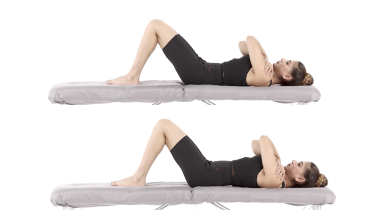 Pelvic tilt
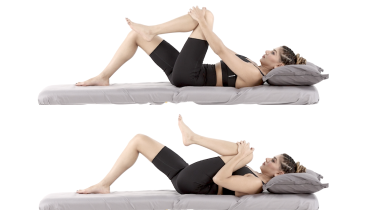 Knee to chest stretch
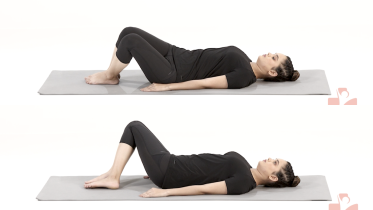 Lower trunk rotation
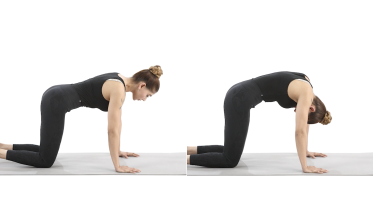 Cat-camel stretch
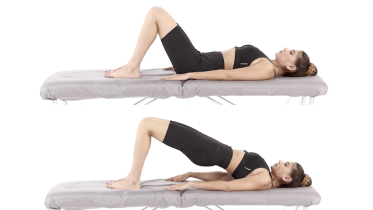 Glute bridge
Keep something going through the rest of the day as well. Walking is the simplest option, and in the WalkBack trial a progressive walking and education program guided by a physio pushed the next limiting episode of back pain further away than no treatment did (Pocovi and colleagues, 2024). The low back pain program stages the strength work that comes after this.
When to see a physio (physical therapist)
Book an appointment if the stiffness is still there after a few weeks of managing it at home, if it is stopping you doing normal things, or if you are worried about it or struggling to cope (NHS). Go sooner if the inflammatory pattern fits, because that one needs a doctor and probably a rheumatologist rather than more stretching.
Bring the timings with you. How long the stiffness lasts, whether it wakes you and at what hour, what it is like after 10 minutes of walking, and what happens if you take an anti-inflammatory are four answers that move an assessment along quickly. A physio will look at your hips as well as your back, since both are involved in rolling over, getting out of bed and standing up, and a stiff hip can make a morning feel like a back problem.
Related exercise programs
See a doctor promptly if
- Emergency: numbness, tingling or altered feeling around or under your genitals, between your inner thighs, or around your bottom (anus), for example it feels different when you wipe after using the toilet. Call emergency services or go to an emergency department straight away. This can be a sign of pressure on the bundle of nerves at the base of the spine (cauda equina syndrome), which needs emergency treatment.
- Emergency: you find it hard to start peeing, cannot pee, cannot feel yourself peeing or cannot control when you pee, or you do not notice when you need to poo or cannot control when you poo, and this is not normal for you. The same applies to a new change in how your genitals feel during sex, or new trouble getting an erection or ejaculating. Call emergency services or go to an emergency department straight away. These can also be signs of cauda equina syndrome.
- Emergency: sciatica in both legs, or pain, tingling, numbness or weakness in both legs. The same applies if you lose feeling in one leg. Call emergency services or go to an emergency department straight away.
- Emergency: back or leg pain that started after a serious accident, such as a car crash or a fall from a height, or back pain with chest pain. Call emergency services.
- Emergency: new neck or back pain after a fall, a knock or a jolt, even a minor one such as a trip or a sudden stop in a car, if you have a condition that stiffens the spine, such as ankylosing spondylitis. Call emergency services or go to an emergency department straight away, do not drive yourself, and tell the staff about your spine condition, so they keep your neck and back in their usual position. A stiff spine can break after a small injury, and the break is easy to miss at first. If the pain started straight after the injury, or you also have numbness, tingling or weakness in your arms or legs, keep still and call emergency services.
- Emergency: you have had cancer, now or in the past, and your back or neck pain feels like a tight band around your body, or comes with pain spreading down an arm or leg, weakness, numbness or pins and needles in your arms or legs, trouble walking, or trouble controlling your bladder or bowels. Call your cancer team's emergency number straight away, or go to an emergency department if you do not have one or cannot get through. This can be cancer pressing on the spinal cord (metastatic spinal cord compression), which needs treatment straight away.
- Same day: a leg or foot that is getting weaker, for example your foot drags, catches on the ground or slaps down when you walk (foot drop). Get medical advice the same day. If the weakness is getting worse by the hour, go to an emergency department.
- Same day: back pain after a minor fall or strain if you are older, have low bone density (osteoporosis) or have taken steroid tablets for a long time. Get medical advice the same day.
- Same day: back or leg pain with a fever, or you feel hot, cold, shivery or generally unwell. Get medical advice the same day, and go to an emergency department if you feel very unwell.
- Same day: you have back pain and have lost weight without trying. Get medical advice the same day and mention the weight loss.
- Same day: new back pain and you have had cancer, now or in the past. Get medical advice the same day and mention your cancer history. If you are being treated for cancer now, contact your cancer team the same day.
- Same day: severe pain that comes on suddenly or is getting worse quickly. Get medical advice the same day.
- Same day: back or side pain together with pain, burning or stinging when you pee, needing to pee more often or more urgently than usual, pee that looks dark or cloudy, or blood in your pee. Get medical advice the same day, for example an urgent appointment with your doctor. This can be an infection in the kidney or urinary tract rather than a problem with your back. If you are pregnant, contact your midwife or maternity unit the same day. If you become confused or drowsy, or have trouble speaking, call emergency services or go to an emergency department straight away.
- Same day: severe pain that comes in waves, starts in your side or lower back and spreads toward your lower tummy or groin, especially with feeling sick, being sick, needing to pee often or pee that looks cloudy. Get medical advice the same day, for example an urgent appointment with your doctor. This can be a kidney stone rather than a back problem. If the pain is severe and you also have a high temperature or feel hot, cold or shivery, go to an emergency department.
- Within a few days: pain that is worse at night, or does not ease at all when you rest. See your doctor within a few days. If you have had cancer, now or in the past, or you have lost weight without trying, get medical advice the same day. If you are being treated for cancer now, contact your cancer team the same day.
- Within 2 weeks: back or buttock pain that started before the age of 45, has lasted more than three months, is worse after rest and in the morning, and eases when you move. This is not an emergency, but see your doctor in the next week or two and ask whether it could be inflammatory back pain (axial spondyloarthritis).
Common questions
Why is my lower back pain worse in the morning and then goes away?
Because your back has been still for seven or eight hours and then gets moving. The discs between the bones of the spine hold more fluid after a night lying down, which was the reasoning behind a trial that taught people to control early morning bending (Snook and colleagues, 1998), and joints and muscles that have not moved feel tight for the first stretch of the day. Once you are up and walking, load comes and goes through the tissues again and the stiffness eases. Ordinary morning stiffness usually clears within 10 or 15 minutes. Stiffness that is still there well into the morning, day after day, is worth a conversation with a doctor.
Can a mattress cause lower back pain in the morning?
It can contribute, though the evidence is smaller than the marketing implies. The strongest trial randomized 313 adults with long-standing non-specific low back pain who ached in bed and on rising to a firm or a medium firm mattress, kept everyone blind to which they had, and found the medium firm group better at 90 days for pain in bed and disability (Kovacs and colleagues, 2003). Pain on rising favored the medium firm mattress across the study period, though the difference at the 90 day mark was not clear cut. A 2021 review of 39 studies came to the same broad conclusion for medium firmness, while pointing out that the findings disagree with each other, and one study in it found that a sagging bed made sleep quality worse (Caggiari and colleagues, 2021). So: deal with a bed that has collapsed in the middle, treat medium firm as a sensible default, and do not expect any brand or material to have earned a recommendation.
Does sleeping on my stomach cause lower back pain?
Nobody has shown that it does. A scoping review found only four studies that had looked at sleep posture alongside waking spinal symptoms at all, and concluded there was not enough good evidence to answer the question, although side lying came out as generally protective (Cary and colleagues, 2019). The same group then filmed 53 people over two nights, and for the group with low back symptoms there was no clear difference from the control group in time spent in awkward positions (Cary and colleagues, 2021). Lying face down does hold the lower back in an arched position for hours, so people who wake stiff often find it the least comfortable choice, but that is an observation rather than a tested rule. Test it on yourself if you like: alter one thing, live with it for a week and judge it on the first 15 minutes of the day, with a pillow under the knees on your back or between the knees on your side as the two easiest adjustments.
What stretches can I do in bed for morning back pain?
The first three exercises on this page work on a mattress: a pelvic tilt, a knee to chest stretch and a lower trunk rotation. All three are done lying on your back, all three move the lower back through a small comfortable range, and none of them asks you to get to the floor first, which is the main reason people skip morning exercises. Keep the movements small while you are still stiff and let the range grow over the first few minutes. Typical doses are 2 to 3 sets of 10 for the pelvic tilt, 3 to 5 holds of 15 to 30 seconds on each leg for the knee to chest, and 10 to 15 slow rolls to each side for the rotation, and your physio will adjust this.
Is morning back pain a sign of a kidney problem?
Usually not, and the clue is what comes with it. Kidney and urinary infections cause pain in the lower back or side along with a high temperature, feeling or being sick, burning or stinging when you pee, needing to pee more often and urgently, or pee that is dark or cloudy, and the NHS advice is to get urgent help rather than wait. A kidney stone tends to start in the side of the tummy or lower back, spread toward the groin, come in waves and be severe at its peak. Pain that is worse first thing, eases as you move and has no urinary symptoms with it is behaving like a back, not a kidney. The warning signs on this page list both, with how quickly to act.
Why does my back hurt in the morning until I pee or have a bowel movement?
There is no good research on this particular pattern, so an honest answer is that nobody knows. What matters is the direction of the link. Back pain that is worse when you cough, sneeze or open your bowels is on the NHS list of reasons to see a doctor, so mention it at the appointment rather than filing it away. Far more urgent is any change in the bladder or bowel themselves: trouble starting to pee, not being able to pee or control it, not noticing when you need to poo, or numbness around the genitals or bottom alongside back pain. Those are emergency signs, they are listed in full on this page, and they mean calling emergency services or going to an emergency department straight away.
References
- National Institute for Health and Care Excellence. Low back pain and sciatica in over 16s: assessment and management (NG59). Published 2016, last updated July 2026. https://www.nice.org.uk/guidance/ng59
- National Institute for Health and Care Excellence. Spondyloarthritis in over 16s: diagnosis and management (NG65). Published February 2017. https://www.nice.org.uk/guidance/ng65
- National Institute for Health and Care Excellence. Osteoarthritis in over 16s: diagnosis and management (NG226). 2022. https://www.nice.org.uk/guidance/ng226
- Sieper J, van der Heijde D, Landewe R, et al. New criteria for inflammatory back pain in patients with chronic back pain: a real patient exercise by experts from the Assessment of SpondyloArthritis international Society (ASAS). Annals of the Rheumatic Diseases. 2009;68(6):784-788. https://doi.org/10.1136/ard.2008.101501
- Hartvigsen J, Hancock MJ, Kongsted A, et al. What low back pain is and why we need to pay attention. The Lancet. 2018;391(10137):2356-2367. https://doi.org/10.1016/S0140-6736(18)30480-X
- George SZ, Fritz JM, Silfies SP, et al. Interventions for the management of acute and chronic low back pain: revision 2021. Clinical practice guidelines linked to the International Classification of Functioning, Disability and Health from the Academy of Orthopaedic Physical Therapy of the American Physical Therapy Association. Journal of Orthopaedic and Sports Physical Therapy. 2021;51(11):CPG1-CPG60. https://doi.org/10.2519/jospt.2021.0304
- Kovacs FM, Abraira V, Pena A, et al. Effect of firmness of mattress on chronic non-specific low-back pain: randomised, double-blind, controlled, multicentre trial. The Lancet. 2003;362(9396):1599-1604. https://doi.org/10.1016/S0140-6736(03)14792-7
- Caggiari G, Talesa GR, Toro G, Jannelli E, Monteleone G, Puddu L. What type of mattress should be chosen to avoid back pain and improve sleep quality? Review of the literature. Journal of Orthopaedics and Traumatology. 2021;22:51. https://doi.org/10.1186/s10195-021-00616-5
- Cary D, Briffa K, McKenna L. Identifying relationships between sleep posture and non-specific spinal symptoms in adults: a scoping review. BMJ Open. 2019;9(6):e027633. https://doi.org/10.1136/bmjopen-2018-027633
- Cary D, Jacques A, Briffa K. Examining relationships between sleep posture, waking spinal symptoms and quality of sleep: a cross sectional study. PLoS One. 2021;16(11):e0260582. https://doi.org/10.1371/journal.pone.0260582
- Snook SH, Webster BS, McGorry RW, Fogleman MT, McCann KB. The reduction of chronic, nonspecific low back pain through the control of early morning lumbar flexion: a randomized controlled trial. Spine. 1998;23(23):2601-2607. https://doi.org/10.1097/00007632-199812010-00015
- Brinjikji W, Luetmer PH, Comstock B, et al. Systematic literature review of imaging features of spinal degeneration in asymptomatic populations. American Journal of Neuroradiology. 2015;36(4):811-816. https://doi.org/10.3174/ajnr.A4173
- Pocovi NC, Lin CWC, French SD, et al. Effectiveness and cost-effectiveness of an individualised, progressive walking and education intervention for the prevention of low back pain recurrence in Australia (WalkBack): a randomised controlled trial. The Lancet. 2024;404(10448):134-144. https://doi.org/10.1016/S0140-6736(24)00755-4
- NHS. Back pain. https://www.nhs.uk/conditions/back-pain/
- NHS. Symptoms: Ankylosing spondylitis. Page last reviewed 5 January 2023. https://www.nhs.uk/conditions/ankylosing-spondylitis/symptoms/
- NHS. Diagnosis: Ankylosing spondylitis. Page last reviewed 5 January 2023. https://www.nhs.uk/conditions/ankylosing-spondylitis/diagnosis/
- NHS. Kidney infection. https://www.nhs.uk/conditions/kidney-infection/
- NHS. Kidney stones. https://www.nhs.uk/conditions/kidney-stones/
- NHS. 27 weeks pregnant: the best sleeping positions during pregnancy. Best Start in Life week by week guide. https://www.nhs.uk/best-start-in-life/pregnancy/week-by-week-guide-to-pregnancy/2nd-trimester/week-27/
Written and checked by the PocketPhysio editorial team. Last updated 2026-09-30.
This page is general education, not a diagnosis or a personal treatment plan. See a physiotherapist or doctor for advice about your own situation.