
Tailbone pain when sitting: what helps, and what to check
Warning signs, and when to get help
Why does my tailbone hurt when I sit?
Sit down and look at what your weight is resting on. The two bones you sit on take most of it, and the tailbone takes a share at the back, which is fine until the tailbone is sore. Then the thing you do for eight hours a day is the thing that hurts.
Leaning back is what tips the balance. A review of coccydynia puts it in one line: leaning back while in a seated position leads to increased pressure on the coccyx (Lirette and colleagues, 2014). That is why a dining chair is often survivable and a car seat, a sofa and an office chair tilted back are not, and why the advice to sit upright with your lower back supported, which the NHS gives, is doing something mechanical rather than being general posture advice.
Foye (2017) describes the classic picture as midline pain below the sacrum and above the anus, worse while sitting and during the move from sitting to standing. The NHS adds the rest of the pattern: a dull ache with occasional sharp pains, worse when you sit down or stand up, when you bend forward and when you have a poo. Women get this about five times as often as men (Lirette and colleagues, 2014).
So almost everything useful on this page is about sitting rather than about the bone. Our tailbone pain program carries the staged exercises and the medical treatments; this page is the sitting answer.
One group should jump ahead rather than read in order. If you are pregnant, or this started during or after a birth, go to tailbone pain when sitting in pregnancy and after giving birth first. The NHS lists pregnancy and childbirth first among the causes, that version has its own team and its own warning signs, and a cushion is only part of the answer for you.
How to sit with tailbone pain
Three changes, in the order they are worth making.
A wedge-shaped coccyx cushion first. The review describes modified wedge-shaped cushions, sold as coccygeal cushions, as relieving the pressure on the coccyx, and it specifically warns against the donut: a ring cushion can place pressure on the coccyx by isolating it and the bones you sit on (Lirette and colleagues, 2014). The NHS advises a specially designed coccyx cushion. Get the cut out or the groove at the back, under the tailbone, and sit far enough back to actually be over the gap, which is the mistake people make in the first week. Until one arrives, and for the chair you are in right now, a folded towel or a rolled jumper under the back of your sitting bones, with nothing at all under the tailbone itself, gets you through a morning.
Shorter spells second. The NHS says plainly not to sit for a long time, and that beats any seating position, because the pressure is cumulative. Nobody has published a number of minutes, so use your own: time how long you can sit before the ache starts, then set a timer a few minutes short of that and stand up when it goes off. A timer that gets you up before the ache builds works better than a timer that goes off once the day is already ruined.
Upright and supported third. Lower back supported, bottom back in the seat, feet flat. The NHS also suggests lying on your side to take pressure off the coccyx when you rest, which is a better recovery position than sitting back in an armchair.
What not to bother with is just as useful. There is no position that makes a sore tailbone comfortable for two hours, and hunting for one costs the day. The people who do best stop looking for the magic chair and start breaking the time up.
Those three are the seating half of what the NHS suggests. The other half is aimed at the pain rather than the seat: an ice pack or a heat pack, and an anti-inflammatory painkiller such as ibuprofen if a pharmacist says one suits you. Our tailbone pain program sets all of those out with the evidence behind them, including how long to leave an ice pack on and what has to go between it and your skin.
How to stand up without catching it
This is the one cue worth learning, and it is about sequence rather than strength.
Feet flat and underneath you first, about hip width apart, not stretched out in front. Then bend forward at the hips until your head is roughly over your toes. Weight into your feet. Push up through your legs. Straighten last. Done in that order, your weight has left the tailbone before the seat releases it.
The lean is the part that goes wrong, because there are two ways to get your head out over your toes and only one of them helps. Hinge at the hips, keep your lower back long and let your bottom stay where it is, and the weight rolls forward onto your thighs and the bones you sit on. Round your back and tuck your bottom under instead, which is what tired people do by the afternoon, and the pelvis rolls backward and drags the sore spot across the seat. Foye (2017) names the move from sitting to standing as a time this pain is worse, and standing straight up out of a slump is the version that earns it. One thing to be clear about: hinged forward is how you leave a chair, not how you sit in one. For the sitting itself, go back to upright with your lower back supported.
Sitting down is the same move in reverse, and it is the half nobody teaches. Back up until the seat touches the back of your legs, take hold of the armrests or your own thighs, hinge forward at the hips again, and lower yourself all the way down under control instead of dropping the last few inches. Landing on a sore coccyx from even a small height is the quickest way to lose a day you had been managing.
Getting out of bed belongs on the same list, because sitting straight up from lying puts your weight on the tailbone to do it. Roll onto your side first and push up from there, which is what an NHS pelvic health physiotherapy service advises for coccyx pain after childbirth, and the mechanics are the same whatever started yours (Royal Berkshire NHS Foundation Trust, 2025).
Give yourself something to push from, whether that is armrests, your own thighs or a desk. And raise the seat on a bad day, with a firm cushion or a higher chair, because a shorter push from a shallower position asks less of everything. The sit to stand exercise below is this move rehearsed deliberately, on the cushion and the kind of seat you actually use, rather than a different exercise that happens to look similar.
Tailbone pain when sitting in pregnancy and after giving birth
The NHS lists pregnancy and childbirth first among the causes of tailbone pain, and this is the part of the subject a general page usually skips. Nothing in this section replaces your own midwife, maternity team or doctor, and the whole point of it is to get you to them.
In pregnancy, sitting tolerance drops and the pelvis is carrying and moving differently, so a tailbone that was never a problem becomes one. Back and pelvic pain in pregnancy is assessed and treated as its own thing, with your maternity team leading, so start at our pregnancy back and pelvic pain program rather than working through this page. The NHS asks you to contact your GP or midwife urgently if you have back pain in the second or third trimester, because it can be a sign of early labor, and also if back pain comes with a fever, bleeding from your vagina, pain when you pee, or pain in one or more of your sides under your ribs. It says to call emergency services or go to an emergency department if you lose feeling in one or both legs, your bottom or your genitals.
Birth is a different mechanism. The coccyx is pushed backward as the baby's head passes, and a review notes that it is susceptible to internal injury during childbirth, especially during a difficult or instrumented delivery (Lirette and colleagues, 2014). It can also break. A published case report describes an intrapartum coccygeal fracture, confirmed on X-ray, CT and MRI, in a woman whose pain began immediately after delivery; the authors write that these fractures often go undetected due to nonspecific symptoms, and record that the correct diagnosis in their patient was made only after a year and a half (Alhubaishi and colleagues, 2025). One case report is not a frequency, and we are not telling you how likely this is. The mechanism is no curiosity, though. A break caused by the coccyx being forced backward during labor is one of the three recognized types in the classification used for these fractures, and difficult or repeated deliveries are named among their important causes (Zhang and Gao, 2025; Bain and colleagues, 2025). If you are pregnant and worried that being seen means an x-ray, it usually does not: MRI is the scan preferred in pregnancy for this injury (Zhang and Gao, 2025). We are telling you why new tailbone pain after a birth is worth naming to a clinician instead of filing under things that are normal now.
How soon depends on how bad it is. Tailbone pain that you can sit through on a cushion is worth raising at your next postnatal contact. Pain that is severe, that makes standing up or walking very hard, or that is getting worse rather than settling has its own same day line in the warning signs below, and it asks you to contact your midwife, maternity unit or GP that day rather than waiting for the check. If you cannot stand or walk at all, that line sends you further again.
Two more reasons to raise it rather than manage it. The muscles of the pelvic floor attach to the tailbone, and a review notes that pelvic floor rehabilitation can help coccydynia associated with pelvic floor muscle spasm (Lirette and colleagues, 2014). Treating a pelvic floor that is gripping, which can mean hands-on work, is a referral rather than something to sort out at home, and that is a different thing from the gentle lift and let go in the exercises below, which the NHS puts on its own list of things to try for tailbone pain. After a birth, ask your midwife, physio or doctor before you start the pelvic floor exercise below.
The second reason is that the warning signs on this page include the postnatal lines for heavy bleeding, infection and a wound that is not healing, because a reader whose complaint is a sore tailbone will not be looking for those under a heading about the coccyx. Those lines send you to your midwife, maternity unit or GP. The page carries a separate wound line for readers recovering from an operation, and that one names a surgical team or the ward instead; if your wound is a cesarean scar or the stitches from a tear or a cut, the midwife line is yours. Our postnatal core and pelvic floor program and the page on tight or weak pelvic floor muscles are the two to read next.
Why does my tailbone hurt when I sit with no injury, or after losing weight?
Two versions of this question come up constantly and almost nobody answers either with a source, so here they are separately.
With no injury at all
You do not need to have fallen on it. Four of the causes on the NHS list involve no injury of any kind: strain built up by long spells of sitting, which it illustrates with driving and cycling; posture; being either overweight or underweight; and a sacrococcygeal joint, the one where the tailbone meets the bottom of the spine, that is either unusually mobile or unusually stiff. The NHS adds that sometimes no cause is found at all.
The review of coccydynia fills in how that happens without an event. It describes minor trauma accumulating from repeated or long sitting on surfaces that are hard, narrow or simply uncomfortable, and it notes that examining the sacrococcygeal joint may show either hypermobility or hypomobility, against a normal range of movement of roughly 13 degrees (Lirette and colleagues, 2014). So a new chair, a new car, a new bike saddle or a stretch of unusually long days at a desk is a complete explanation on its own. The absence of a fall is not a reason to doubt yourself, and it is not a reason to delay having it looked at either.
After losing weight
This one has a real answer, and it has to be given with its hedge attached. The NHS names being underweight, not only being overweight, among the causes. The review goes further and says rapid weight loss may be a risk factor too, through what it calls "the loss of mechanical cushioning", and it introduces that claim with the word anecdotally (Lirette and colleagues, 2014). That word is the source's own and we are not going to quietly drop it: this is a mechanism that makes sense and has not been measured.
What it means for you is simple enough. The padding you used to sit on is thinner than it was, so the seat has to do that job instead, which makes a wedge cushion less optional for you than for most readers. None of this is an argument against losing weight, and the same review lists obesity among the factors associated with developing this problem in the first place, so the risk does not run in one direction.
Is it the tailbone, or something next to it?
Worth sorting early, because the seating advice is different for each.
Right in the middle, between the buttocks, with one spot that is tender to press: that is the tailbone, and this page fits. Pain at the bone you sit on, to one side, worse the longer you sit and worse on a hard chair, is more likely the hamstring tendon where it attaches there, and hip pain when sitting covers it. Pain to one side under the dimple low on your back points at the sacroiliac joint, and pain deep in one buttock that can travel down the leg is the piriformis syndrome pattern.
Pain across the lower back that happens to be worse in a chair is an ordinary back, and back pain when sitting is the page for it. If it travels from the back or buttock down the leg when you sit, that is a nerve rather than a bone, and sciatica pain when sitting is the better fit.
Two more that get missed. Pain felt inside, deep in the pelvis or at the back passage rather than on the bone itself, often described as an ache or a pressure that is worse the longer you sit, can come from the pelvic floor muscles themselves, including the levator ani, which is a referral to a pelvic health physio rather than something to work on from a page; our pelvic floor weakness program and the page on tight or weak pelvic floor muscles explain why a tight pelvic floor and a weak one are not opposites. And a small hole or tunnel at the top of your bottom, between the buttocks, that is painful, bleeding or leaking pus, is not coccydynia at all: that is a pilonidal sinus and it is on the same day line below, because the NHS says those symptoms can develop quickly, often over a few days.
One more belongs on a sorting list, not because it is likely but because it is the one that gets missed. The published list of things to separate from ordinary coccydynia includes infection, problems in the back passage such as piles, and, rarely, a tumor of the bone at the base of the spine such as a chordoma, which two 2025 reviews both list among the rare causes not to be missed (Bain and colleagues, 2025; Benditz and Thoma, 2025). What marks those out is the pattern rather than the place. Tailbone pain earns its name by changing with position, worst in a chair and easier once the weight is off it. Pain that carries on regardless of how you sit, stand or lie, pain that wakes you or never eases at rest, unplanned weight loss, bleeding from your bottom or a change in your bowel habit are a different story, and each of them has its own line in the warning signs below with its own timing. Act on the line rather than on this paragraph.
One pattern is not a sorting question but a safety one. Any numbness or altered feeling around the genitals or bottom, any new trouble with the bladder or bowels, or symptoms in both legs, is on the emergency list on this page whatever is happening at the tailbone, and it needs emergency services rather than an appointment.
The car, the desk and the toilet
The car is usually the worst seat anyone owns, because it is soft, reclined and vibrating, and you cannot get out of it. Cushion in the car, backrest as upright as the car allows, planned stops on long trips. The NHS names long spells of sitting while driving or cycling among the causes, so if driving is what started this, shorter drives for a few weeks do more than any adjustment.
Getting out is worth doing on purpose, because a car seat is low and a door frame makes people twist. Open the door wide, swing both legs out together rather than one at a time, get both feet flat on the ground, and only then hinge forward and push up, with a hand on the door frame or the seat. Turning your body while your weight is still on the tailbone is what catches it, and that is also why sliding across to the passenger side to get out is worse than it looks.
At the desk, ask for three things rather than explaining your anatomy: the cushion on the chair you actually use, permission to stand in meetings, and a higher surface for part of the day. Very few people need time off work for this. What they need is to stop sitting for two hours at a stretch. If you work from home, our pages on setting the desk up and on movement breaks cover the chair height and the timing in more detail than this page can, and the movement breaks one is the half that matters here.
On a plane or a coach, where you cannot choose the seat and cannot get up when you want to, two things help: put a folded jumper or a travel cushion under the back of your sitting bones rather than directly under the tailbone, and take the aisle seat if you have the choice so that standing up is a decision you can make rather than a negotiation. On a bike, the saddle is the adjustment that matters, and a few weeks off it beats experimenting while it is sore.
The toilet earns its own paragraph because the NHS says this pain can flare when you have a poo, and because straining makes everything here worse. If opening your bowels is painful, the NHS suggests a laxative that softens your poo and says to ask a pharmacist which one suits you; it also says most laxatives work within 3 days and should only be used for a short time. Constipation that is not settling with that, that keeps coming back, or that started with a new medicine is on the routine line below rather than something to keep treating yourself. Never stop or change a prescribed medicine on your own: if a medicine you are on is constipating you, that is a conversation with whoever prescribed it.
Two things people sitting with a sore tailbone do not raise unprompted, so this page raises them. Leaking of wind or poo, not reaching the toilet in time, not being able to get fully clean afterward, or no longer noticing when you need to go are all on the warning list below with a route, because there are treatments and because the pelvic floor muscles attach to the bone you are sitting on. Leaking urine deserves the same treatment, and the warning signs for the bladder side of it sit on our pelvic floor weakness program, which is where that complaint is answered properly. And if you are sitting far more than usual to avoid the pain, look at the skin over the tailbone itself: a discolored patch, or a sore or blister over that bony area, is the start of a pressure sore, which the NHS says forms on bony parts of the body including the tailbone, and the warning list carries two lines for it, one for the early patch and a same day one once it is hot, leaking or severely painful. Bleeding from the vagina after the menopause is on the list too, for the same reason: it needs checking on its own account and nobody arrives at a tailbone appointment intending to mention it.
What the evidence does and does not support
Honestly, the exercise evidence here is thin, and this page would be overselling if it said otherwise. The two things with the clearest support are not exercises at all: the wedge cushion and sitting less, both of which the NHS advises and the review above describes mechanically. The review states that conservative treatment is successful in 90% of cases (Lirette and colleagues, 2014), and that number needs its history attached. It is a sentence in a narrative review, not a figure pooled from trials, and the three papers the review cites for it are a 1963 case series and two surgical series of people who had their coccyx removed after conservative treatment had already failed them (Trollegaard and colleagues, 2010). None of the three set out to measure how often simple treatment works. The figure then travels. A 2025 review of tailbone fractures repeats it and credits two reviews and a systematic review for it (Zhang and Gao, 2025), and that systematic review contains no such number. What it does contain is a pooled result, and in adults whose coccyx pain had already become persistent, usual conservative care gave the smallest average improvement of the seven treatment groups it pooled, about 1.7 on a 10 point pain scale (Andersen and colleagues, 2022). So the honest version comes in two halves. Tailbone pain that started recently often settles over weeks or months whether or not anyone treats it (Bain and colleagues, 2025). Once it has been there for months, simple measures do much less, and that is the point to ask for more than a cushion rather than to keep waiting it out.
On how long it goes on for, the NHS says this pain may improve after a few weeks but can sometimes last longer, and it puts no figure on the longer version. The thing worth tracking is time rather than soreness: how many minutes you can sit before it starts, not how much it hurts when you press it. The tender spot tends to stay tender long after sitting has become manageable, which catches people out and makes them think nothing is changing. Our tailbone pain program answers the duration question properly, with what progress looks like week by week.
What the exercises below are for is the muscles and hips around the bone, and the breathing and pelvic floor work is aimed at letting go rather than gripping. That same program page sets out what the trials of physical therapy actually found, including how small and short they were, and it is the better read if you want the research rather than the practical answer.
If simple measures have not helped after a few weeks, the NHS describes the next steps: physiotherapy, in which the muscles around the coccyx can be worked on by hand, then a steroid and local anesthetic injection, which goes into the joint where the coccyx attaches to the bottom of the spine, and surgery to remove part or all of the coccyx kept for the cases where nothing else works.
It is worth knowing what the last rung of that ladder actually is, because a page that walks you up to it and then goes quiet is not much use. Coccygectomy means cutting out part or all of the tailbone. A 2025 review of coccydynia puts conservative treatment first, says injections and radiofrequency treatment can make a marked difference for many people, and holds surgery back for cases that will not settle and where x-rays taken sitting and standing have shown the coccyx itself to be unstable (Benditz and Thoma, 2025). In the meta-analysis that review cites, 84% of patients got pain relief and 76% went back to work, while the wound came apart in 5% and 3% needed a second operation. The evidence behind those figures is worth knowing too: the review's own table of surgical results holds cohort studies only, with no trial comparing the operation against anything, and success rates across them between 74% and 87%. Wound trouble is what surgeons watch for here, because the wound sits very close to the anus and infection there is common (Bain and colleagues, 2025); infection rates reported across surgical series run from under 3% to about 26% (Zhang and Gao, 2025). So if you have had the operation and the wound turns red, hot or swollen, starts to leak or opens up, or you get a fever, there is a line for that in the warning signs below and it sends you to your surgical team the same day rather than to a physio appointment. Pain can also carry on after the bone has gone, and pelvic floor physiotherapy is one of the things used for that (Bain and colleagues, 2025). None of this is a reason to refuse the operation, and for a small number of people it is the thing that finally works. It is a reason to arrive at that conversation knowing it is a real operation rather than a tidy full stop.
What this page will not give you is a recovery timetable after that operation, because the published series do not agree on one and surgeons set their own. How long you stay off sitting, how the wound is looked after, and when you drive and work again come from your surgeon, and their instructions beat anything here. Never stop or change a prescribed medicine on your own.
Before you start these exercises
While you exercise, stop straight away if you have any of these: chest pain or pressure, dizziness or feeling faint, a racing or irregular heartbeat, or being far more out of breath than the effort should cause. What to do next is in the warning signs below. If you have high blood pressure, breathe steadily through every hold and every repetition and never hold your breath. With a heart or lung condition, or blood pressure that is not under control, check with your doctor or physio before you start the sit to stand sets. That is the one exercise here that lifts your whole body weight over and over, and the other seven are breathing, pelvic floor work and gentle stretches.
Stop anything that brings on sharp tailbone pain. Do the lying work on a bed rather than the floor if the floor presses on the sore spot. Judge the pelvic floor exercise on the letting go rather than the squeeze, and if the lift makes the tailbone ache more, leave it out and ask a physio who works with the pelvic floor rather than squeezing harder. The same goes if your pain is felt inside, deep in the pelvis or at the back passage rather than on the bone: that one is a referral, for the reasons in is it the tailbone, or something next to it. After surgery on your bladder, prostate, womb or pelvic floor, start the pelvic floor exercise only when your surgical team says so.
Some stop signs belong to one exercise rather than to all of them. Stop a stretch that sends pain, numbness or tingling down a leg instead of working through it, and tell your physio, because that is a nerve being irritated rather than a muscle being stretched. Stop the pelvic floor exercise and tell your physio if you feel heaviness, dragging or bulging low down in the pelvis. And with the breathing, go back to normal breaths if your fingers or the skin around your mouth start to tingle or you feel spaced out, which means the breaths have become too fast or too deep rather than too slow.
Standing up is also the moment a drop in blood pressure shows itself, and this page has you doing it all day. Stop if you feel dizzy, lightheaded or faint as you get up. Sit back down and wait for it to pass. If it does not pass within a minute or two, or it keeps happening, get medical advice the same day before you practice again. If you faint, or it does not settle within a few minutes of keeping still, call emergency services.
If you have fallen in the past year, feel unsteady on your feet, or take medicines that make you dizzy, keep a hand on a kitchen counter or the back of a sturdy chair for the whole of the standing exercises, practice only when someone else is at home, and ask your doctor or physio about a falls check. The two standing ones here are sit to stand and the hip flexor stretch. For sit to stand, use a chair that will not slide, ideally with its back against a wall, and wear flat shoes that fit and grip the floor rather than socks, tights or bare feet.
If you are pregnant, check with your midwife or physio before you start, and plan the exercises done lying on your back with your physio and your maternity team, because those are the ones that need changing as pregnancy goes on. If you are pregnant and past the first three months, check with your physio before exercising flat on your back. If you have recently given birth, including by cesarean section, or you have a gap down the middle of your stomach muscles (diastasis recti), ask your physio, midwife or doctor first.
If you have low bone density (osteoporosis), ask your physio before the knee to chest stretch, the lower trunk rotation and the rounding part of the cat camel, because deep forward bending and twisting to the end of the range are usually limited; when you do get the go-ahead for the cat camel, keep the rounding small. If you have had a fracture in your spine, check with your physio before you begin, and after spinal surgery or surgery to remove the tailbone (coccygectomy) follow your surgeon's plan rather than this page.
The cat camel, the one exercise here done on hands and knees, carries gates of its own. If you have been told you have narrowing of the spinal canal (spinal stenosis) or a forward-slipped vertebra (spondylolisthesis), ask your physio before you add the arching half of the cat camel, because bending backward often aggravates both. After recent heart or chest surgery, get your surgeon's or surgical team's okay before the cat camel as well, because taking your weight through both arms on your hands and knees and then arching your chest open loads and stretches the healing breastbone. If the breastbone clicks, grinds, shifts or feels as if it is moving while you do it, stop, and contact your surgical team the same day. After a broken wrist, hand or forearm, or surgery on any of them, start the cat camel only when your doctor, surgeon, physio or hand therapist says the bone or the repair is ready to take weight through the arms.
If you have had a hip replacement, get the go-ahead from your surgeon or physio before you try the knee to chest stretch, the lower trunk rotation, the piriformis stretch, the hip flexor stretch or sit to stand. Pulling the knee in bends the hip well past a right angle, and many surgeons ask you to avoid that for the first months after some operations. Some operations limit this kind of work for the first months, so the timing depends on your surgery.
Where to start, because eight exercises on the first day is too many and nobody needs all eight at once. Start where the program starts, with the four done lying down: the diaphragmatic breathing, the pelvic floor exercise, the knee to chest stretch and the lower trunk rotation, at the lowest number in each range, once a day. Add the cat camel and the two hip stretches when those feel easy, usually after a week or two, and leave sit to stand until last, because it is the only one here that puts your weight through the sore spot.
There is a ceiling as well as a floor. Each number given with the list below was written for that exercise on its own, and they add up: all eight at the top of every range, twice a day wherever it says twice, is most of an evening. While sitting is still the hard part of the day, one session a day of the knee to chest stretch, the lower trunk rotation and the two hip stretches is enough, and so is one session of sit to stand. The breathing, the pelvic floor work and the cat camel are the three that can go more often, because none of the three puts your body weight through the tailbone, and the cat camel is the one to keep going on a bad day. Keep in mind that this page already has you standing up and sitting down more often than usual, so on a day of constant getting up it is the sit to stand set that gives way, not the breaks. If a day of sitting is worse after a session, cut back rather than stop: go back to the cat camel and the breathing at the lowest numbers, hold there until it settles, then build up again from that point. If your own physio has set you something different, do what they asked.
Exercises that can help
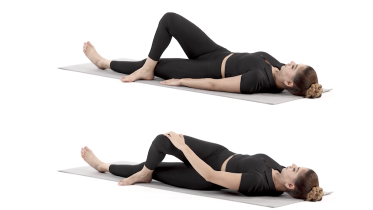
None of these treats the bone. They work on the muscles that attach to it and the hips either side, and they are chosen so that most of them keep your weight off the sore spot. They are the stage 1 and stage 2 movements of our tailbone pain program, with sit to stand brought forward from its stage 3, so if you move on to that program nothing changes under you. Read the section headed Before you start these exercises, which comes just above, before your first session, because several of the precautions in it change which of the eight are yours and where to begin. Diaphragmatic breathing often starts at 5 to 10 slow breaths, or a few minutes, 1 to 3 times a day, and the pelvic floor exercise lying down at 8 to 10 slow breaths, lifting on each breath out and relaxing on each breath in, three times a day. The knee to chest stretch is usually 3 to 5 gentle holds of 15 to 30 seconds on each leg, once or twice a day, and the lower trunk rotation 10 to 15 slow rolls to each side, once or twice a day, with a hold of 3 to 5 seconds at the end of each. The cat camel is often 5 to 10 slow cycles, 1 to 3 times a day, and it is the only one here with no weight on the tailbone at all, which makes it the one to keep on a bad day. The piriformis and hip flexor stretches are each held 20 to 30 seconds and repeated 2 to 3 times on each side, once or twice a day, and they are the two muscles stretched in the one small trial of stretching for this problem, which our tailbone pain program sets out. Sit to stand commonly begins at 2 to 3 sets of 5 to 10, once a day or on most days, with your cushion on the seat, because the seat you practice on should be the seat you actually sit on. Raising yourself on the cushion makes the push a little easier rather than harder, and that is a help rather than a cheat. Your physio will adjust all of this.
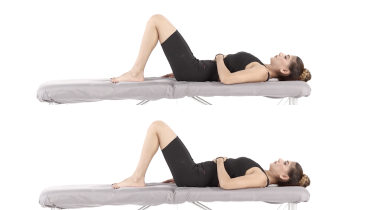 Diaphragmatic breathing
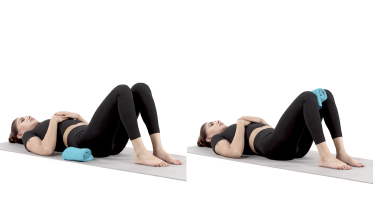 Pelvic floor exercise lying down
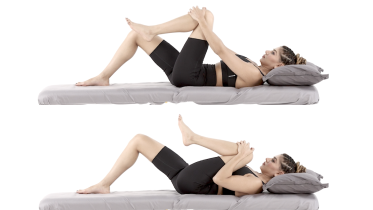 Knee to chest stretch
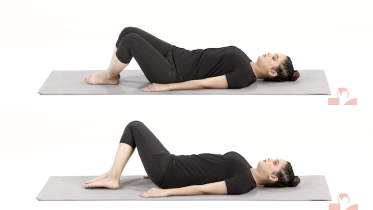 Lower trunk rotation
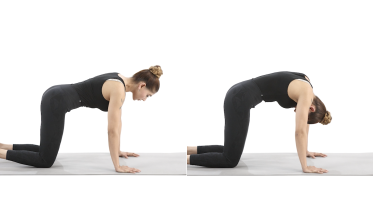 Cat-camel stretch
 Piriformis stretch
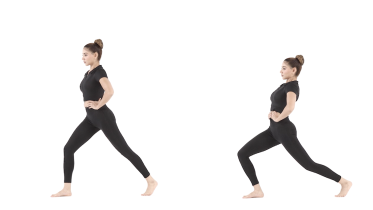 Hip flexor stretch
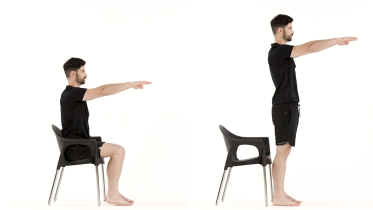 Sit to stand
When to see a physio or doctor
The NHS threshold is to see a doctor if tailbone pain has not improved after a few weeks of trying treatments at home, if it is affecting your daily activities, or if you have a high temperature with tailbone pain and pain somewhere else, such as your tummy or lower back. We are stricter than that last one on purpose: a temperature with tailbone, back or leg pain is on the same day line below whether or not anything else hurts, because a spinal or pelvic infection is the thing you cannot afford to sit on. We would add two more. Go sooner if this started with a fall onto your bottom and is getting worse rather than better in the days afterward, which is on the same day line below; and if that fall has left you unable to stand or unable to put weight on a leg, use the emergency line instead of the same day one, because a fall that catches the tailbone can break the hip as well. And go sooner if it started in pregnancy or after a birth, because that version has its own assessment and its own team.
Two things about that fall are worth knowing. A break at the tailbone that nobody identified at the time is how this pain ends up filed as nothing in particular for months, since the symptoms on their own point nowhere (Alhubaishi and colleagues, 2025), and a 2025 review describes the gap between the fall and the appointment as the usual story, because the pain seems a reasonable consequence of landing on your bottom and people only go once weeks have passed without it settling (Benditz and Thoma, 2025). That is why this page pushes harder on the fall than the NHS page does. The second thing is what to expect when you get there, so that a sensible assessment does not feel like a brush off: you may well not be sent for an x-ray of the tailbone itself. Imaging after a fall is aimed at what would change the treatment, so a scan is called for where the sacrum may be involved (Benditz and Thoma, 2025), the hip is checked when the signs point to it, and a break in the tailbone itself is largely managed the way a badly bruised one is, by keeping the weight off it (Zhang and Gao, 2025). Being assessed is still the point, and so is going back if it is not settling.
Take the sitting detail with you, because it is more useful than a pain score. How many minutes before it starts. Which seats are worst. What standing up costs you. Whether anything changes when you open your bowels, and whether anything travels into a leg.
A physio will check the tailbone and the tissues around it, look at the hips and the lower back, and watch you get into and out of a chair. Some physios who specialize in the pelvic floor work internally, and that is the right referral where pelvic floor muscle spasm is part of the picture rather than something to attempt at home.
Some signs should not wait: read the warning signs section on this page and act on the timing given for each line, because they are not all at the same level of urgency.
Related exercise programs
Warning signs
Get emergency help now
- Emergency: if chest pain, pressure or tightness does not ease quickly when you rest, spreads to your arm, neck, jaw, stomach or back, or comes with sweating, feeling sick, feeling light-headed or being short of breath, call emergency services straight away, as this can be a heart attack. If it eases quickly and none of these happen, get medical advice the same day, and do not exercise again until you have been checked.
- Emergency: numbness, tingling or altered feeling around or under your genitals, between your inner thighs, or around your bottom (anus), for example it feels different when you wipe after using the toilet. Call emergency services or go to an emergency department straight away, and do not drive yourself. This can be a sign of pressure on the bundle of nerves at the base of the spine (cauda equina syndrome), which needs emergency treatment.
- Emergency: you find it hard to start peeing, cannot pee, cannot feel yourself peeing or cannot control when you pee, or you do not notice when you need to poo or cannot control when you poo, and this is not normal for you. The same applies to a new change in how your genitals feel during sex, new trouble getting or keeping an erection, new trouble ejaculating, or new trouble reaching orgasm. Call emergency services or go to an emergency department straight away, and do not drive yourself. These can also be signs of cauda equina syndrome.
- Emergency: sciatica in both legs, or pain, tingling, numbness or weakness in both legs. The same applies if you lose feeling in one leg. Call emergency services or go to an emergency department straight away, and do not drive yourself.
- Emergency: back or leg pain that started after a serious accident, such as a car crash or a fall from a height, or back pain with chest pain. Call emergency services. If the pain started straight after the accident, keep still while you wait.
- Emergency: sudden, severe pain in your lower back or tummy that is not like your usual back pain, if you have been told you have a swelling of the main blood vessel in your tummy (abdominal aortic aneurysm), you are over 60, you smoke or used to smoke, or you have high blood pressure. The same applies if sudden, severe back or tummy pain comes with feeling faint or passing out, pale, sweaty or clammy skin, a racing heartbeat or being short of breath. Call emergency services straight away. This can be a sign of an aneurysm bursting, which needs treatment in hospital at once.
- Emergency: you have had a fall or an injury and now have severe hip pain, or you cannot walk or put weight on the leg. Call emergency services or go to an emergency department. This can be a sign of a broken hip (hip fracture).
- Emergency: back pain with a fever, or you feel hot, shivery or very unwell, and you also have new weakness, numbness or tingling in one or both legs, or new trouble with your bladder or bowels. Call emergency services or go to an emergency department straight away. This can be an infection pressing on the nerves in the spine (spinal epidural abscess), which needs emergency treatment.
- Emergency: you have had cancer, now or in the past, and your back or neck pain feels like a tight band around your body, or you have new or worsening pain spreading down an arm or leg, weakness, numbness, pins and needles or a loss of feeling in your arms or legs, trouble walking, or trouble controlling your bladder or bowels. Those symptoms count on their own, with or without back or neck pain. Call your cancer team's emergency number straight away, or go to an emergency department if you do not have one or cannot get through. This can be cancer pressing on the spinal cord (metastatic spinal cord compression), which needs treatment straight away.
- Emergency: new neck or back pain after a fall, a knock or a jolt, even a minor one such as a trip or a sudden stop in a car, if you have a condition that stiffens the spine, such as ankylosing spondylitis. Call emergency services or go to an emergency department straight away, do not drive yourself, and tell the staff about your spine condition, so they keep your neck and back in their usual position. A stiff spine can break after a small injury, and the break is easy to miss at first. If the pain started straight after the injury, or you also have numbness, tingling or weakness in your arms or legs, keep still and call emergency services.
- Emergency: leaking that starts suddenly in an older person who is also newly confused or agitated, very drowsy, or has trouble speaking. Call emergency services or go to an emergency department straight away. This can be a sign of a serious infection or another illness that needs urgent treatment.
Get help now, day or night
- Pelvic or pubic pain that came on in a single moment, for example during the birth, a fall or a wide step, with a crack, pop or tearing feeling over your pubic bone, or that has suddenly left you unable to stand, walk or put weight on one or both legs. Contact your maternity unit straight away, and ask them to check the joint at the front of your pelvis. While you wait, keep off it rather than walking it off: lie on your side with your knees together and a pillow between them, get help to move, and do not stand on one leg or let your legs come apart. If you cannot stand or walk at all, or you cannot get to a hospital safely, call emergency services. Separation of that joint (pubic symphysis diastasis) is uncommon, is not the same as the pelvic girdle pain this page is about, is confirmed on a scan rather than by how much it hurts, and is first treated with a pelvic support belt and side lying, so ask about a belt at that appointment (Stolarczyk 2021). Pain that has built up over days or weeks, even when it is severe, is the usual pattern of pelvic girdle pain.
- A high temperature or feeling hot and shivery, discharge from your vagina that smells unpleasant, flu-like symptoms, tummy or pelvic pain that is new or getting worse, or, after a cesarean, a new cough or feeling short of breath. Contact your midwife, maternity unit or GP straight away, the same day, and do not wait for your next check, as these can be signs of an infection. If you have a very high or very low temperature, shivering you cannot control, you are breathing very fast or finding it hard to breathe, you are confused or your speech is slurred, your skin, lips or tongue look blue, gray, pale or blotchy (on brown or black skin this can be easier to see on the palms of the hands or soles of the feet), or you have a rash that does not fade when you press it, call emergency services, as this can be sepsis.
- Your cesarean wound, or the stitches from a tear or a cut (episiotomy), become red, swollen, hot or more painful, ooze pus or fluid, smell unusual, or start to come apart. Contact your midwife or GP straight away, the same day. If you also have a high temperature, feel hot and shivery or feel unwell, use the infection and sepsis line on this page.
- You pass a blood clot the size of a 50p coin (about 3 cm across) or larger, you soak a maternity pad within an hour, your bleeding gets heavier instead of settling or is still heavy after the first week, or you feel breathless or faint doing everyday things such as walking to the toilet or getting dressed. Contact your midwife, maternity unit or GP straight away, the same day, and do not wait for your next check. If you are soaking a maternity pad within an hour, the bleeding suddenly becomes much heavier, or you feel faint, dizzy or breathless, or your heart is pounding, call emergency services or go to an emergency department straight away, and do not drive yourself.
Get help today
- Same day: severe pain at the tailbone after a fall onto your bottom or after giving birth, pain that makes it very hard to stand up or walk, or pain that keeps getting worse in the days afterward. Get medical advice the same day, for example at an urgent care center or emergency department, so a doctor can check for a broken bone. In the first weeks after a birth, get that same day advice from your midwife, maternity unit or GP instead. If you cannot stand, cannot walk, or cannot put weight on one leg, do not wait for an appointment: call emergency services or go to an emergency department straight away, because a fall that catches the tailbone can break the hip as well.
- Same day: if you are pregnant, back or tailbone pain in your second or third trimester, or back pain together with a high temperature, bleeding from your vagina, pain when you pee, or pain in one or more of your sides under your ribs. Contact your midwife, maternity unit or GP the same day, which is the urgent route the NHS gives, because back pain at that stage can be a sign of early labor. If you lose feeling in one or both legs, your bottom or your genitals, call emergency services or go to an emergency department straight away.
- Same day: tailbone, back or leg pain with a fever, or you feel hot, cold, shivery or generally unwell. Get medical advice the same day, and go to an emergency department if you feel very unwell. If you have a very high or very low temperature, shivering you cannot control, you are breathing very fast or finding it hard to breathe, you are confused or your speech is slurred, your skin, lips or tongue look blue, gray, pale or blotchy (on brown or black skin this can be easier to see on the palms of the hands or soles of the feet), or you have a rash that does not fade when you press it, call emergency services, as this can be sepsis.
- Same day: since an operation, the wound is red, hot, swollen, leaking fluid or opening up, you have a fever or feel hot and shivery, or the pain in that area is new or getting worse quickly. Contact your surgical team or the ward you went home from the same day rather than waiting for your physio appointment, and if you cannot reach them, go to an emergency department the same day. This can be an infection in the wound or deeper, around a repair or a new joint.
- Same day: a lump at the top of your bottom, between your buttocks, that is painful, bleeding or leaking pus. Get medical advice the same day, which is the urgent route the NHS gives for it. This can be an infected pilonidal sinus, a skin problem that needs its own treatment, and the NHS says these symptoms can develop quickly, often over a few days.
- Same day: a sore, a blister or broken skin over a bony area such as a heel, hip, bottom, tailbone or elbow that is hot, swollen, red or darker than usual, has pus coming from it, is severely painful or getting more painful, or comes with a high temperature. Get medical advice the same day, from your doctor, a nurse or NHS 111 in the UK. An infected pressure sore (pressure ulcer) needs treating, and skin you cannot feel well can break down without hurting (NHS). If you feel very unwell, or you have any of the sepsis signs listed above, call emergency services.
- Same day: back pain after a minor fall or strain if you are older, have low bone density (osteoporosis) or have taken steroid tablets for a long time. Get medical advice the same day. Until it has been checked, stop the exercises and keep away from lifting, bending forward and twisting, because those load a bone in the spine that may be broken.
- Same day: severe pain that comes on suddenly or is getting worse quickly. Get medical advice the same day.
- Same day: a leg or foot that is getting weaker, for example your foot drags, catches on the ground or slaps down when you walk (foot drop). Get medical advice the same day. If the weakness is getting worse by the hour, go to an emergency department.
- Same day: new back pain and you have had cancer, now or in the past. Get medical advice the same day and mention your cancer history. If you are being treated for cancer now, contact your cancer team the same day.
- Same day: you have back pain and have lost weight without trying. Get medical advice the same day and mention the weight loss.
- Same day: pain that is worse at night, or does not ease at all when you rest. If you have had cancer, now or in the past, or you have lost weight without trying, get medical advice the same day.
- Same day: leaking that starts suddenly or gets much worse over a few days in an older person, without any of the signs above. Get medical advice the same day, as this can be caused by a urine infection or a medicine.
Book an appointment
- Within a few days: pain that is worse at night, or does not ease at all when you rest. See your doctor within a few days.
- Within a few days: a patch of skin over a bony area, such as a heel, hip, bottom, tailbone or elbow, that is discolored and does not change color when you press it (usually red on white skin, purple or blue on brown or black skin), that feels warm, spongy or hard, or that is sore or itchy. Book an appointment with your doctor or nurse within a few days and keep the pressure off it until then. That is how a pressure sore (pressure ulcer) starts, and the risk is higher where you cannot feel well, where a splint or shoe rubs, or where you sit or lie in one position for long (NHS). Sitting still for long spells to keep the weight off a sore tailbone is one of the ways it happens. If it is already broken, weeping or painful, use the same day line above.
- Within a few days: any bleeding from your vagina after your menopause, including spotting or pink or brown discharge, even if it is only a small amount, only happened once, or came on during or after sex. Book an appointment with your doctor within a few days. Bleeding after the menopause is usually not serious, but it has to be checked, because it can be a sign of cancer, and cancer found early is easier to treat.
- Within a few days: blood in your poo, bleeding from your bottom, or a change in your poo or how often you need to go that is not normal for you. See your doctor within a few days and mention your tailbone pain. If your poo is black or dark red, or you have bloody diarrhea, get medical advice the same day. If you are bleeding non-stop from your bottom, or there is a lot of blood or you see large clots, call emergency services.
- Routine: poo or wind leaking out when you cannot stop it, not reaching the toilet in time, not being able to get fully clean after going to the toilet, streaks or stains of poo in your underwear, or finding that you no longer notice when you need to go, without any of the signs above. Book an appointment with your doctor, as there are treatments that help, and ask about a pelvic health physio or a continence service.
- Routine: constipation that is not getting better after you have changed your diet and fluids and tried treatment from a pharmacist, that keeps coming back, that is new and has lasted several weeks, or that started when you began a new medicine such as an opioid painkiller. Book an appointment with your doctor, and say if you are also straining, feel you never finish, have to press or splint to empty, are bloated most of the time, or feel tired all the time.
Common questions
Why does my tailbone hurt when sitting but not when standing?
Because standing takes the weight off it and sitting puts the weight on it. When you sit, the tailbone shares your body weight with the two bones you sit on, and leaning back shifts more of that share onto the tailbone, which is why a reclined car seat or a soft sofa is often worse than a dining chair (Lirette and colleagues, 2014). Foye (2017) describes the classic picture as midline pain below the sacrum and above the anus, worse while sitting and in the move from sitting to standing, which is close to a definition of this complaint. A sore tailbone usually behaves itself the moment you are upright and walking, so people walk into an appointment feeling fine and apologizing for wasting anybody's time. That pattern is the diagnosis rather than a reason to doubt it, and it is worth saying out loud. Standing is not a free pass for everybody, though. The same review lists long spells of standing among the things that set coccyx pain off, so an ache after an hour on your feet does not put you outside the picture.
What is the best cushion for tailbone pain?
A wedge-shaped one with a cut out or a groove at the back, and not a ring or donut. A review of coccydynia describes modified wedge-shaped cushions as relieving the pressure on the coccyx, and makes the specific point that donut cushions can put pressure on it instead, by isolating the coccyx and the bones you sit on (Lirette and colleagues, 2014). The NHS also advises a specially designed coccyx cushion. Two practical things go wrong with these. The cut out gets used at the front instead of the back, so the bone is sitting on foam rather than over the gap, and the cushion stays at the desk when the car seat and the sofa are where it was needed. Put it on the seat you actually use most, and check that a lap belt still sits low across your hips once the cushion has raised you.
How do I stop my tailbone from hurting when I sit?
Four things, in the order they are worth doing. Get a wedge cushion onto the seat you use most, with the cut out at the back and you sitting far enough back to be over it. Cut the length of each spell of sitting rather than hunting for a position that does not hurt, because the pressure is cumulative and the NHS says plainly not to sit for a long time. Sit upright with your lower back supported, since leaning back is what loads the coccyx (Lirette and colleagues, 2014). And change how you get up: feet flat underneath you, hinge forward at the hips until your head is roughly over your toes rather than rounding your back, then push through your legs, so the weight has left the tailbone before the seat releases it. Lower yourself the same way on the way down instead of dropping the last few inches. If straining on the toilet is part of your day, deal with that too, because the NHS says this pain can flare when you have a poo and suggests a poo-softening laxative from a pharmacist.
Can tailbone pain when sitting be caused by pregnancy or childbirth?
Yes, and the NHS lists pregnancy and childbirth first among the causes of tailbone pain. Two different things are going on. In pregnancy the tissues around the pelvis change and sitting tolerance drops, and in a birth the coccyx is pushed backward by the baby's head; a review notes it is susceptible to internal injury during childbirth, especially during a difficult or instrumented delivery (Lirette and colleagues, 2014). It can also be broken. A published case report describes an intrapartum coccygeal fracture confirmed on X-ray, CT and MRI, in which the authors say these fractures often go undetected because the symptoms are nonspecific, and the correct diagnosis in their patient was made only after a year and a half (Alhubaishi and colleagues, 2025). That is a single case and not a frequency, but it is the reason this page asks you to report tailbone pain after a birth to your midwife, maternity team or doctor rather than sitting on a cushion and waiting it out.
Why does my tailbone hurt when I sit with no injury?
Because most of the causes on the NHS list involve no injury. Long spells of sitting, which it illustrates with driving and cycling, posture, being either overweight or underweight, and a sacrococcygeal joint that is unusually mobile or unusually stiff are all on it, and the NHS says that sometimes no cause is found at all. The review of coccydynia describes the same thing as minor trauma that accumulates from repeated or long sitting on surfaces that are hard, narrow or just uncomfortable (Lirette and colleagues, 2014). In clinic the history is usually a new chair, a new car, a new saddle or a run of unusually long days rather than a single moment. Not having fallen on it changes nothing about what to do, and it is not a reason to put off being seen.
Why does my tailbone hurt when I sit after losing weight?
The honest answer is that there is a plausible mechanism and nobody has measured it. The NHS names being underweight among the causes of tailbone pain, alongside being overweight. The review of coccydynia says rapid weight loss may be a risk factor through what it calls the loss of mechanical cushioning, and it labels that claim anecdotal, which is the source's own word and worth keeping (Lirette and colleagues, 2014). The practical reading is that you have less padding between the bone and the chair than you used to, so the cushion now has to do that job and is less optional for you than for most people. It is not a reason to regret the weight loss, and the same review lists obesity among the factors associated with developing this problem in the first place.
References
- NHS. Tailbone (coccyx) pain. Page last reviewed 20 November 2025. https://www.nhs.uk/conditions/tailbone-coccyx-pain/
- Lirette LS, Chaiban G, Tolba R, Eissa H. Coccydynia: an overview of the anatomy, etiology, and treatment of coccyx pain. Ochsner Journal. 2014;14(1):84-87. https://pmc.ncbi.nlm.nih.gov/articles/PMC3963058/
- Foye PM. Coccydynia: tailbone pain. Physical Medicine and Rehabilitation Clinics of North America. 2017;28(3):539-549. https://doi.org/10.1016/j.pmr.2017.03.006
- Bain HL, Mabrouk A, Foye P. Coccyx pain. In: StatPearls. Treasure Island (FL): StatPearls Publishing; 2025. https://www.ncbi.nlm.nih.gov/books/NBK563139/
- Benditz A, Thoma R. Coccygodynia: diagnosis and treatment. Deutsches Arzteblatt International. 2025;122(23):638-644. https://doi.org/10.3238/arztebl.m2025.0154
- Zhang Y, Gao G. Progress in the diagnosis and treatment of fracture-dislocation of the coccyx. Experimental and Therapeutic Medicine. 2025;30(1):127. https://doi.org/10.3892/etm.2025.12877
- Andersen GO, Milosevic S, Jensen MM, Andersen MO, Simony A, Rasmussen MM, Carreon L. Coccydynia, the efficacy of available treatment options: a systematic review. Global Spine Journal. 2022;12(7):1611-1623. https://doi.org/10.1177/21925682211065389
- Alhubaishi L, Flayyih R, Adan H, Altabba AM, Flayyih R, Assker MM. Intrapartum coccygeal fracture in a young female: a case of prolonged postpartum coccygodynia. Cureus. 2025;17(1):e77233. https://doi.org/10.7759/cureus.77233
- NHS. Back pain in pregnancy. Page last reviewed 10 January 2024. https://www.nhs.uk/pregnancy/related-conditions/common-symptoms/back-pain/
- NHS. Pilonidal sinus. Page last reviewed 16 November 2023. https://www.nhs.uk/conditions/pilonidal-sinus/
- NHS. Pressure ulcers (pressure sores). Page last reviewed 6 July 2023. https://www.nhs.uk/conditions/pressure-sores/
- NHS. Bleeding from the bottom (rectal bleeding). Page last reviewed 12 April 2023. https://www.nhs.uk/symptoms/bleeding-from-the-bottom-rectal-bleeding/
- NHS. Bowel incontinence. Page last reviewed 15 August 2024. https://www.nhs.uk/conditions/bowel-incontinence/
- NHS. Constipation. Page last reviewed 26 October 2023. https://www.nhs.uk/conditions/constipation/
- NHS. Postmenopausal bleeding. Page last reviewed 24 September 2026. https://www.nhs.uk/conditions/post-menopausal-bleeding/
- NHS. Sepsis. Page last reviewed 14 May 2026. https://www.nhs.uk/conditions/sepsis/
- NHS. Abdominal aortic aneurysm. https://www.nhs.uk/conditions/abdominal-aortic-aneurysm/
- National Institute for Health and Care Excellence. Abdominal aortic aneurysm: diagnosis and management (NG156). 2020. https://www.nice.org.uk/guidance/ng156
- Royal Berkshire NHS Foundation Trust. Coccyx pain following childbirth (postnatal). Pelvic Health and Maternity Physiotherapy. Reviewed February 2025. https://royalberkshire.nhs.uk/media/upmlgnnc/physio-coccyx-pain-following-childbirth.pdf
- Trollegaard AM, Aarby NS, Hellberg S. Coccygectomy: an effective treatment option for chronic coccydynia: retrospective results in 41 consecutive patients. Journal of Bone and Joint Surgery British Volume. 2010;92(2):242-245. https://doi.org/10.1302/0301-620X.92B2.23030
Written and checked by the PocketPhysio editorial team. Last updated 2026-10-29.
This page is general education, not a diagnosis or a personal treatment plan. See a physiotherapist or doctor for advice about your own situation.