
Lower back pain on one side: causes, left and right, and what to do
Does it matter which side hurts?
Hardly at all. Left and right carry the same anatomy: the same muscles beside the spine, the same joints, the same nerve roots leaving at the same levels. No guideline treats left-sided and right-sided low back pain as different problems, and the causes set out below apply to either.
The side only becomes interesting for the small number of pains that are not coming from the spine at all. Even then it decides nothing on its own, since both kidneys sit at the back, one on each side, so right-sided pain is no more suspicious than left-sided pain. What a physio wants instead is behavior: what brings the pain on, what settles it, whether anything travels into the leg, and what else is happening in your body while it is there.
What causes lower back pain on one side?
Treat what follows as possibilities, not as a diagnosis. None of the details listed under each heading is proof on its own, and several of them overlap.
Everyday back pain and muscle strain
Most one-sided back pain sits here. The Lancet review of low back pain put serious causes, such as fracture, cancer or infection, at only a small proportion of cases, and found that in nearly everyone else no single structure can be named (Hartvigsen and colleagues, 2018). A strain after lifting something awkward, or an unfamiliar afternoon of digging, fits the same picture: sore and guarded for a few days, tender to press along the muscles at the side of the spine, and better week by week.
Pain does not distribute itself evenly just because the cause is ordinary. Landing on one side is normal, and it does not mean something is out of place. The low back pain program is the exercise route for this group.
The sacroiliac joint
Where the base of the spine meets the pelvis there is a joint on each side. A physio will consider it for pain that sits low in the back and in the buttock, below the belt line and on one side. Pain that is not in the midline of the back was one of the more informative findings in a review of diagnostic tests, which is the closest thing there is to a clue from location alone (Han and colleagues, 2023). The European guidelines on pelvic girdle pain add that people with pain around this joint tend to manage less standing, walking and sitting than they used to (Vleeming and colleagues, 2008). Single leg moments come up often in the clinic as well, such as standing on that leg, stairs, rolling over in bed and getting out of a car, but those are things patients report rather than tested signs.
Working out whether that joint is the culprit is harder than it sounds. A systematic review of 62 diagnostic studies concluded that informative tests do exist for the disc, the sacroiliac joint and the facet joints, and that identifying a source may be possible in some people with persistent low back pain, though not in everyone (Han and colleagues, 2023). The sacroiliac joint pain program explains what those tests can and cannot settle, and stages the exercises.
A disc irritating a nerve
When a disc presses on or inflames a nerve root, the pain stops being purely a back pain. The NHS describes sciatica as affecting the bottom and the back of one leg, often reaching the foot and toes, with a sharp or burning quality, sometimes with tingling, numbness or weakness, and often worse when you move, sneeze or cough. One-sided is the rule rather than the exception.
What separates it is not how badly your back hurts. It is how far the symptoms travel and whether the leg is involved, so symptoms below the knee with pins and needles make a nerve pattern. The sciatica program and the lumbar disc herniation program cover it. Symptoms in both legs, or loss of feeling in one leg, are emergency signs and are listed in the warning signs below.
Pain from outside the spine
A few one-sided back pains belong to another system altogether, and they give themselves away through symptoms that have nothing to do with movement. A kidney stone is the classic example. The NHS describes pain that usually starts in the side of the tummy or lower back, may spread toward the groin, comes in waves with spells when it is very severe, and often arrives with sickness, needing to pee often or pee that looks cloudy. Infection is the other one to know about: the NHS lists back or side pain with a high temperature, flu-like aching, sickness, stinging when you pee and dark or cloudy pee, and treats that combination as needing urgent help rather than a wait.
Neither belongs on a physio's table. Both appear in the warning signs on this page, with how fast to act. The rough test at home is whether position and movement change anything, because a back problem almost always does and these two almost never do.
Pain that follows your cycle
Period pain is described by the NHS as cramps in the tummy that spread to the back and thighs, so a low back that aches on one side in the days around a period may be doing exactly that. Endometriosis causes pain in the lower tummy and back that can come at any time of the month, and the NHS advises seeing a doctor if you think you might have it or if symptoms are affecting everyday life. An ovarian cyst is another cause of pelvic pain that the NHS lists.
None of this is diagnosed by a physiotherapist, and none of it responds to back exercises. If your pain runs on a monthly rhythm, or arrives with pain during sex or bleeding between periods, take it to your doctor. Unusual vaginal discharge or bleeding, and period pain that is severe or worse than usual when painkillers have not helped, need advice the same day. The relevant warning signs are below.
If you are pregnant
Back and pelvic pain during pregnancy needs its own assessment and its own plan, which is why it is kept off this page. Go to the pregnancy back and pelvic pain program instead, with your midwife or maternity physio in charge of what you do. If you are pregnant, check with your midwife or physio before you start.
What the trigger tells you
The movement that reliably reproduces your pain is more informative than the spot you point at. Four patterns come up often, and each one aims the assessment somewhere different.
- Standing on that leg, stairs, or rolling over in bed. Single leg loading and turning through the pelvis, which is where the sacroiliac joint and the muscles at the side of the hip earn their keep.
- Twisting to reach behind you, or lifting something out to one side. A rotation plus load combination, which asks a lot of the muscles and joints at one side of the spine.
- Symptoms that travel past the knee, or numbness and tingling in the calf or foot. A nerve pattern, which is assessed differently and needs a physio or doctor to look at it.
- Nothing to do with movement at all. Pain that is the same whatever you do, or that is driven by fever, peeing or your cycle, is the group to take to a doctor first.
If bending forward is the one that sets it off, lower back pain when bending forward takes that pattern further, and back pain when sitting does the same for sitting.
Write the pattern down before your appointment. Ten seconds of accurate history saves a lot of guessing.
What helps at home
Keep moving. NICE and the NHS point the same way on this: stay active, carry on with daily activities as far as you can, and the NHS is explicit that lying down for long stretches is not the answer. A few quieter days while it settles is reasonable. A few quiet weeks is not.
For short-term relief the NHS suggests an anti-inflammatory medicine such as ibuprofen, noting that paracetamol on its own is not recommended for back pain, plus an ice pack or a heat pack wrapped in a tea towel. Ask a pharmacist if you are unsure which suits you, particularly if you take other medicines or have stomach, kidney or heart problems.
Spread the load rather than protecting one side. Shifting your weight off the sore side, carrying bags in the other hand and leading with the good leg on stairs are natural things to do, and for a few days there is no harm in them. The advice from NICE and the NHS to stay active and return to normal activities applies to the painful side as much as to the rest of you. So once you can, swap the shoulder you carry a bag on and use both legs evenly on steps.
Exercises for one-sided low back pain
The goal is not to fix an imbalance. It is to get the hip and trunk muscles on both sides working well enough that the painful side stops taking more than its share, and to restore confidence in movements you have been avoiding. NICE recommends exercise for low back pain, and the American Physical Therapy Association guideline supports exercise training for acute and chronic low back pain without singling out one type (NICE NG59; George and colleagues, 2021).
Expect a working ache in the buttock and thigh muscles while you do them. What you are watching for is the next day: back and buttock no worse by the following morning means the level was about right. Symptoms spreading further down the leg, or new pins and needles, means stop and tell your physio, because that is the direction nobody wants.
If you have been told you have low bone density (osteoporosis), ask your physio before the piriformis stretch, since pulling the knee across the body combines bending and twisting at the hip, and use the simpler bird dog where the hand and knee go back down after each reach. If you have had a hip replacement, get the go-ahead from your surgeon or physio before you try the clamshell, the side lying hip abduction or the piriformis stretch. Some operations limit this kind of work for the first months, so the timing depends on your surgery. If you are pregnant, check with your midwife or physio before you start. If you are pregnant and past the first three months, check with your physio before exercising flat on your back.
If you have had a fracture in your spine, check with your physio before you begin. After back surgery, the plan your surgeon or physio gave you comes first, so get their go-ahead before you add these exercises.
Exercises that can help
Train both sides, not just the painful one, because the comparison tells you and your physio more than the sore side alone does. Most start at 2 to 3 sets of 10 to 15 on each side for the clamshell and the side lying hip abduction, 1 to 2 sets of 6 to 10 on each side for the bird dog, 2 to 3 sets of 6 to 10 slow repetitions each side for the dead bug, and 2 to 3 holds of 20 to 30 seconds on each side for the stretch, once a day. Each exercise page gives its own numbers, and your physio will adjust this.
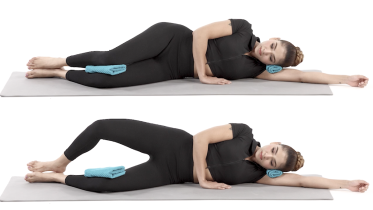 Clamshell
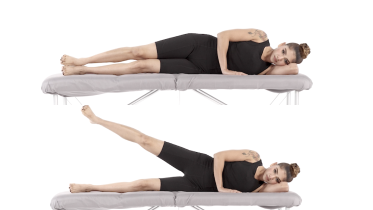 Side lying hip abduction
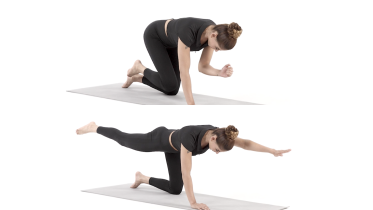 Bird dog
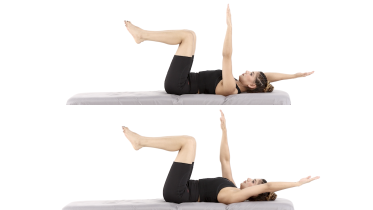 Dead bug
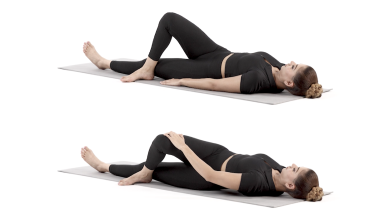 Piriformis stretch
Add walking alongside them. In the WalkBack trial, a progressive walking and education program guided by a physio delayed the next episode of back pain that limited daily activities, compared with no treatment (Pocovi and colleagues, 2024). Start at a distance that does not build the pain and add minutes before pace.
When to see a physio (physical therapist)
Book if the pain has not improved after a few weeks of managing it at home, if it is stopping you doing your usual activities, or if you are worried about it or struggling to cope (NHS). Go sooner if anything travels below the knee, if the leg feels weak or numb, or if you are not convinced the pain is coming from your back at all.
An assessment for one-sided pain looks at more than the sore spot. Expect the physio to watch you walk and stand on each leg, move your hips and your back in each direction, test the strength of the muscles around the hip and pelvis, and check the nerves in the leg if the symptoms travel. That usually narrows the field enough to start, which matters more than arriving at a label. A program done properly for 6 to 8 weeks with nothing to show for it is a reason to go back and have it changed, not a reason to push harder into the same thing.
Related exercise programs
See a doctor promptly if
- Emergency: numbness, tingling or altered feeling around or under your genitals, between your inner thighs, or around your bottom (anus), for example it feels different when you wipe after using the toilet. Call emergency services or go to an emergency department straight away. This can be a sign of pressure on the bundle of nerves at the base of the spine (cauda equina syndrome), which needs emergency treatment.
- Emergency: you find it hard to start peeing, cannot pee, cannot feel yourself peeing or cannot control when you pee, or you do not notice when you need to poo or cannot control when you poo, and this is not normal for you. The same applies to a new change in how your genitals feel during sex, or new trouble getting an erection or ejaculating. Call emergency services or go to an emergency department straight away. These can also be signs of cauda equina syndrome.
- Emergency: sciatica in both legs, or pain, tingling, numbness or weakness in both legs. The same applies if you lose feeling in one leg. Call emergency services or go to an emergency department straight away.
- Emergency: back or leg pain that started after a serious accident, such as a car crash or a fall from a height, or back pain with chest pain. Call emergency services.
- Emergency: new neck or back pain after a fall, a knock or a jolt, even a minor one such as a trip or a sudden stop in a car, if you have a condition that stiffens the spine, such as ankylosing spondylitis. Call emergency services or go to an emergency department straight away, do not drive yourself, and tell the staff about your spine condition, so they keep your neck and back in their usual position. A stiff spine can break after a small injury, and the break is easy to miss at first. If the pain started straight after the injury, or you also have numbness, tingling or weakness in your arms or legs, keep still and call emergency services.
- Emergency: you have had cancer, now or in the past, and your back or neck pain feels like a tight band around your body, or comes with pain spreading down an arm or leg, weakness, numbness or pins and needles in your arms or legs, trouble walking, or trouble controlling your bladder or bowels. Call your cancer team's emergency number straight away, or go to an emergency department if you do not have one or cannot get through. This can be cancer pressing on the spinal cord (metastatic spinal cord compression), which needs treatment straight away.
- Emergency: pain in your lower tummy or pelvis that is severe, is getting worse, or hurts when you move or touch the area, or that comes with feeling faint, dizzy or lightheaded, passing out, pain at the tip of your shoulder, trouble breathing, heavy bleeding from the vagina, or sudden confusion. Call emergency services or go to an emergency department straight away. Tell them if there is any chance you are pregnant.
- Same day: a leg or foot that is getting weaker, for example your foot drags, catches on the ground or slaps down when you walk (foot drop). Get medical advice the same day. If the weakness is getting worse by the hour, go to an emergency department.
- Same day: back pain after a minor fall or strain if you are older, have low bone density (osteoporosis) or have taken steroid tablets for a long time. Get medical advice the same day.
- Same day: back or leg pain with a fever, or you feel hot, cold, shivery or generally unwell. Get medical advice the same day, and go to an emergency department if you feel very unwell.
- Same day: you have back pain and have lost weight without trying. Get medical advice the same day and mention the weight loss.
- Same day: new back pain and you have had cancer, now or in the past. Get medical advice the same day and mention your cancer history. If you are being treated for cancer now, contact your cancer team the same day.
- Same day: severe pain that comes on suddenly or is getting worse quickly. Get medical advice the same day.
- Same day: back or side pain together with pain, burning or stinging when you pee, needing to pee more often or more urgently than usual, pee that looks dark or cloudy, or blood in your pee. Get medical advice the same day, for example an urgent appointment with your doctor. This can be an infection in the kidney or urinary tract rather than a problem with your back. If you are pregnant, contact your midwife or maternity unit the same day. If you become confused or drowsy, or have trouble speaking, call emergency services or go to an emergency department straight away.
- Same day: severe pain that comes in waves, starts in your side or lower back and spreads toward your lower tummy or groin, especially with feeling sick, being sick, needing to pee often or pee that looks cloudy. Get medical advice the same day, for example an urgent appointment with your doctor. This can be a kidney stone rather than a back problem. If the pain is severe and you also have a high temperature or feel hot, cold or shivery, go to an emergency department.
- Same day: lower back, lower tummy or pelvic pain together with trouble peeing or pooing, pain when you pee or needing to pee more often than usual, blood in your pee or poo, unusual vaginal discharge or bleeding, a high temperature or feeling hot, cold or shivery, or feeling or being sick. Get medical advice the same day. Pain in this area can come from the bladder, the bowel or the reproductive organs rather than from a muscle or a joint.
- Same day: lower tummy or pelvic pain and you are pregnant or think you might be. Contact your midwife or maternity unit straight away if you are pregnant, or get medical advice the same day if you might be. Pain low in the tummy early in pregnancy needs checking, because a pregnancy can grow outside the womb (ectopic pregnancy).
- Same day: period pain or pelvic pain that is severe or worse than usual, and painkillers have not helped. Get medical advice the same day.
- Same day: a calf or thigh that is newly swollen, warm, tender, red or darker than usual, has swollen veins that are sore to touch, or has a throbbing or cramping pain that does not fit your injury or condition, or that feels different from normal muscle soreness after exercise. This can be a sign of a blood clot (deep vein thrombosis), especially after surgery, an injury, time in a cast or boot, a long trip or a spell of being much less mobile than usual. Get medical advice the same day. If you are also short of breath or have chest pain, call emergency services.
- Within a few days: pain that is worse at night, or does not ease at all when you rest. See your doctor within a few days. If you have had cancer, now or in the past, or you have lost weight without trying, get medical advice the same day. If you are being treated for cancer now, contact your cancer team the same day.
- Within 2 weeks: lower back or pelvic pain on one side that comes and goes with your periods or is clearly worse during them, or that comes with pain during sex, bleeding between periods, or periods that have become heavier or more irregular. Book an appointment with your doctor and say that the pain follows your cycle.
- Within 2 weeks: lower tummy or pelvic pain that keeps coming back or does not go away, or that comes with bloating that does not settle, feeling full very quickly when you eat, losing your appetite, or a lasting change in your bowel habits. Book an appointment with your doctor.
- Within 2 weeks: back or buttock pain that started before the age of 45, has lasted more than three months, is worse after rest and in the morning, and eases when you move. This is not an emergency, but see your doctor in the next week or two and ask whether it could be inflammatory back pain (axial spondyloarthritis).
Common questions
Is lower back pain on the right side a kidney problem?
Usually not, and the side is the least helpful part of the question, because you have a kidney at the back on each side. What separates the two is the company the pain keeps. A kidney or urinary infection turns up with a temperature, flu-like aching and sickness, plus something wrong at the toilet: stinging or burning, going far more often, or pee that looks dark or cloudy. A stone announces itself differently again, starting in the side of the tummy or lower back, spreading toward the groin, coming in waves, and hitting levels of pain that are hard to sit through. Pain that responds to how you move, sit, lift or lie, with nothing unusual happening when you pee, is behaving like a back.
Can gas or constipation cause one sided lower back pain?
There is no good research tying trapped wind to pain on one side of the lower back, so treat that explanation with caution. Constipation and irritable bowel syndrome are listed by the NHS among the common causes of pain in the pelvic area, and pelvic pain and low back pain overlap, so the bowel is not irrelevant. What the NHS does flag is back pain that gets worse when you cough, sneeze or open your bowels, which is a reason to book an appointment. A change in your bowel habit that lasts, or blood in your poo, belongs with a doctor rather than a physio, whatever your back is doing.
Why does one side of my lower back hurt above the hip?
That spot, just above the rim of the pelvis and off to one side, covers several structures at once. The muscles running down beside the spine attach there, the top of the pelvis sits under it, and the sacroiliac joint is a little lower and more toward the middle. Pain there that is tender to press and stirred up by twisting or by standing on that leg is a common presentation of ordinary one-sided low back pain. Nobody can tell from the location alone which tissue is responsible, and a systematic review of 62 diagnostic studies concluded only that identifying a source may be possible for some people with persistent low back pain, not for everyone. The early treatment is the same either way.
Why does one side of my lower back hurt when I walk or lift my leg?
Both put your body weight through one leg at a time, and the pelvis has to stay level while that happens. If the muscles at the side of the hip are not sharing the work well, the joints on that side take more of it, and a sore spot notices. Lifting the leg to put on trousers or get into a car adds a turning force through the pelvis, which is why that movement often finds a painful sacroiliac joint. Pain that stays in the back and buttock is a local pattern. Pain that shoots below the knee, with pins and needles or numbness, points at an irritated nerve instead, and that changes what a physio does next.
What causes lower back pain on one side in women?
The same list as for anyone else, with a few extra possibilities. Period pain is described by the NHS as cramps in the tummy that spread to the back and thighs, and endometriosis can cause pain in the lower tummy and back at any point in the month, rather than during a period alone. Neither is a back problem, and neither is diagnosed by a physio. So the question to answer first is whether the pain follows your cycle or follows your activity. Pain that comes and goes with periods, or that turns up with pain during sex or bleeding between periods, is a reason to see your doctor, and it is listed in the warning signs on this page.
Is one sided lower back pain a sign of pregnancy or ovulation?
It is not a reliable sign of either, and nothing on this page should be used to work out whether you are pregnant. Back pain is common enough in the general population that it cannot carry that kind of meaning on its own, and a pregnancy test answers the question properly. If you are pregnant, back and pelvic pain is assessed and managed differently, so the pregnancy back and pelvic pain program on this site is the right starting point and your midwife or maternity physio leads the plan. Severe pain in the pelvis or lower tummy, particularly with feeling faint, passing out or heavy vaginal bleeding, is an emergency for anyone and is listed in the warning signs here.
References
- National Institute for Health and Care Excellence. Low back pain and sciatica in over 16s: assessment and management (NG59). Published 2016, last updated July 2026. https://www.nice.org.uk/guidance/ng59
- George SZ, Fritz JM, Silfies SP, et al. Interventions for the management of acute and chronic low back pain: revision 2021. Clinical practice guidelines linked to the International Classification of Functioning, Disability and Health from the Academy of Orthopaedic Physical Therapy of the American Physical Therapy Association. Journal of Orthopaedic and Sports Physical Therapy. 2021;51(11):CPG1-CPG60. https://doi.org/10.2519/jospt.2021.0304
- Hartvigsen J, Hancock MJ, Kongsted A, et al. What low back pain is and why we need to pay attention. The Lancet. 2018;391(10137):2356-2367. https://doi.org/10.1016/S0140-6736(18)30480-X
- Han CS, Hancock MJ, Sharma S, et al. Low back pain of disc, sacroiliac joint, or facet joint origin: a diagnostic accuracy systematic review. EClinicalMedicine. 2023;59:101960. https://doi.org/10.1016/j.eclinm.2023.101960
- Pocovi NC, Lin CWC, French SD, et al. Effectiveness and cost-effectiveness of an individualised, progressive walking and education intervention for the prevention of low back pain recurrence in Australia (WalkBack): a randomised controlled trial. The Lancet. 2024;404(10448):134-144. https://doi.org/10.1016/S0140-6736(24)00755-4
- Vleeming A, Albert HB, Ostgaard HC, Sturesson B, Stuge B. European guidelines for the diagnosis and treatment of pelvic girdle pain. European Spine Journal. 2008;17(6):794-819. https://doi.org/10.1007/s00586-008-0602-4
- NHS. Back pain. https://www.nhs.uk/conditions/back-pain/
- NHS. Sciatica. https://www.nhs.uk/conditions/sciatica/
- NHS. Kidney infection. https://www.nhs.uk/conditions/kidney-infection/
- NHS. Kidney stones. https://www.nhs.uk/conditions/kidney-stones/
- NHS. Period pain. https://www.nhs.uk/conditions/period-pain/
- NHS. Endometriosis. https://www.nhs.uk/conditions/endometriosis/
- NHS. Pelvic pain. https://www.nhs.uk/conditions/pelvic-pain/
Written and checked by the PocketPhysio editorial team. Last updated 2026-09-30.
This page is general education, not a diagnosis or a personal treatment plan. See a physiotherapist or doctor for advice about your own situation.