
Back spasm: what to do in the first hour and after
Warning signs, and when to get help
What is a back spasm, and what causes one?
A back spasm is a muscle contracting hard and staying contracted. You feel it as a grip, a lock or a clamp rather than as an ache, and it usually arrives the instant you move a certain way. People describe it as the back going into a vice, or as something catching and not releasing. Most of the time it sits low, on one side, somewhere between the bottom rib and the top of the pelvis.
One thing is worth saying plainly before anything else. Back spasm describes what a muscle is doing, not why it is doing it. The NHS back pain page mentions muscle spasms exactly once, in the sentence about heat packs, and handles everything else under back pain. NICE's low back pain and sciatica guideline does not use the word at all, and that is not an oversight. It reflects how this is managed: the spasm is treated as part of an episode of low back pain, the episode gets the attention, and nobody goes looking for a separate condition called spasm.
So the useful question is what loaded the back. In clinic the answer is usually a strain of the muscles or the soft tissue, set off by one movement on top of a week that had already been asking a lot. Lifting from the floor with a twist in it does it. So does a sneeze, a bed that is too soft on holiday, and standing up from a car seat after three hours. The pulled back muscle program is the one to follow if that is your story, and it covers the strain itself in more detail than this page does.
Two other causes behave differently and are worth separating early. An irritated nerve root in the lower back can leave the muscles around it guarding, and that version normally sends pain, numbness or tingling down the leg, which is the pattern on our sciatica and lumbar disc herniation pages. And a back that goes into spasm after a minor fall, in someone older or with low bone density, is on this page's same day list for a reason, because a small fracture in a vertebra can present exactly like a bad strain.
What to do for a back spasm in the first hour
The order matters more than the detail.
Stop the movement that triggered it. Do not try to stretch through a muscle that is actively gripping, and do not twist to test it. Then find a position the muscle will switch off in. Lying on your back with the knees bent and the feet flat suits most people; lying on one side with a pillow between the knees is the next to try; some find standing with a hand on the wall and the hips rocking gently better than either. There is no correct position here, only the one that drops your pain by a few points.
Breathe out slowly. Pain makes people hold their breath and brace the whole trunk, which keeps the muscle recruited. A dozen slow breaths with a long exhale often does more in two minutes than anything else available to you at home.
Use heat if you have it. The NHS names a heat pack or hot water bottle, wrapped in a tea towel, for joint stiffness or muscle spasms, and suggests an anti-inflammatory such as ibuprofen if that is suitable for you. Wrapped, 15 to 20 minutes, not slept on.
Then move. Not far, and not well. Standing up and walking the length of the hall and back, twice an hour, is the target for the rest of the day. The NHS puts staying active and continuing with daily activities first and says not to stay in bed for long periods, and our page on whether to rest or move covers why that holds even when it feels wrong.
Heat or ice for back spasms?
Heat, if you have to pick one, because that is the job the NHS gives it. Its list puts an ice pack wrapped in a tea towel against pain and swelling and a heat pack against joint stiffness or muscle spasms. We would not be dogmatic about it. The evidence underneath both is thin, people respond differently, and the one in your freezer at 11pm beats the one you have to go out and buy. Our heat or ice page goes through what the research actually supports.
Lower back spasm, upper back and middle back
A lower back spasm is the common one, and it is the one the rest of this page is written around. The muscle that grips runs alongside the spine, and it tends to lock you into a slight lean to one side, which is why people arrive at an appointment standing crooked and apologizing for it. That lean is a response, not a deformity, and it usually unwinds as the episode settles.
Spasm higher up behaves a little differently. A muscle spasm between the shoulder blades or in the middle back is more often linked to a sustained position, a desk week or a new training movement, than to one lifting moment, and the muscles involved sit closer to the ribs. Our page on pain between the shoulder blades handles that region, including the causes there that have nothing to do with muscle.
Wherever it sits, a muscle spasm in the lower back on the left or the right side, with no leg symptoms and no warning signs, is managed the same way. The side it is on does not change the plan.
Back spasm medication: what the evidence shows
This is the part to take to a doctor or pharmacist rather than to a website, because what is available differs by country and what suits you depends on your other medicines and conditions. The research behind the class, though, is the same wherever you live.
Cashin and colleagues (2021) pooled the randomized trials of muscle relaxants in adults with non-specific low back pain for the BMJ, analyzing 31 trials and 6,505 people. For the class most used, the non-benzodiazepine antispasmodics, in people with acute back pain, at two weeks or less, the pooled difference in pain intensity was 7.7 points on a 0 to 100 scale compared with control, on very low certainty evidence. The reviewers described that as a small reduction that is not clinically important, found no meaningful effect on disability, and reported that these drugs may increase the risk of adverse events, with a relative risk of 1.6. Their conclusion was that considerable uncertainty remains about both efficacy and safety.
That population matters: adults with ordinary short term low back pain, which is who most people reading this page are. It does not tell you that a muscle relaxant will not help you on a bad night. It does mean the average benefit is smaller than the reputation, and that someone needs to weigh it against the side effects for you specifically. Never start, stop or change a prescribed medicine on the strength of a web page.
How long does a back spasm last, and what helps after it?
The spasm is short and the episode is not. Expect waves over the first day or two and soreness for longer. The NHS says back pain usually improves within a few weeks.
The advice for those weeks is dull. Keep moving, in smaller amounts than usual. Vary positions before the back asks you to rather than after. Walk daily, even briefly.
Sleep and workload belong in the conversation too, because a back that is already irritable is the one that spasms. The low back pain program is the staged version of all of that, and it is a better guide than this page once the first few days are behind you.
Two groups should start somewhere else. If you are pregnant or recently gave birth, back and pelvic pain is handled differently and with your own midwife or maternity physio leading, so go to the pregnancy back and pelvic pain program rather than following this page. And after spinal surgery, the plan from your surgical team comes first, not this page.
Exercises that can help
None of these is for the hour the muscle is locked. They are for the days after, once you can move without the back catching. The pelvic tilt and the cat camel usually start at 5 to 10 slow repetitions, two or three times a day; the knee to chest and the lower trunk rotation are held 10 to 30 seconds and repeated 3 to 5 times each side; the glute bridge often begins at 2 sets of 8 to 10. Brisk walking commonly starts at 5 to 10 minutes and builds by a few minutes at a time. Your physio will adjust this. Stop anything that brings the gripping feeling back and try it again in a day or two. If you have high blood pressure, breathe steadily through every repetition and never hold your breath. With low bone density (osteoporosis), ask your physio before the knee to chest stretch, the cat camel and the lower trunk rotation, because deep forward bending and twisting to the end of the range are usually limited. If you have had a fracture in your spine, check with your physio before you begin. If you have had a hip replacement, get the go-ahead from your surgeon or physio before you try the knee to chest stretch, the lower trunk rotation and the glute bridge. Pulling the knee in bends the hip well past a right angle, and many surgeons ask you to avoid that for the first months after some operations. If you have had spinal surgery, follow the plan from your surgical team rather than this page. If you are pregnant or recently gave birth, back and pelvic pain needs its own program, so use the [pregnancy back and pelvic pain program](/conditions/pregnancy-back-and-pelvic-pain/) and ask your midwife, doctor or physio.
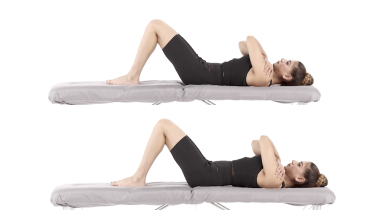 Pelvic tilt
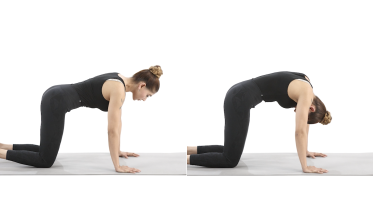 Cat-camel stretch
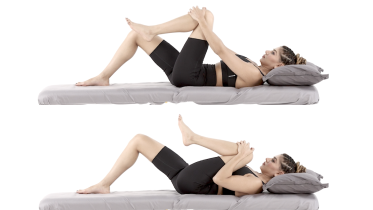 Knee to chest stretch
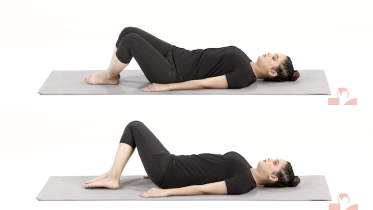 Lower trunk rotation
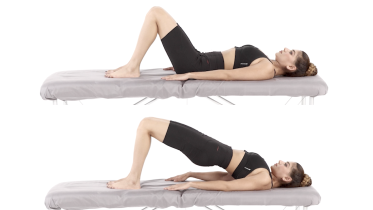 Glute bridge
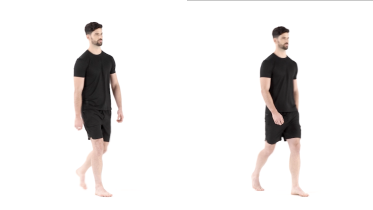 Brisk walking
When to see a physio (physical therapist)
Book an appointment if the back has not improved after a few weeks of home care, if it is stopping your normal activities, or if you are worried about it or struggling to cope, which are the three the NHS names, and also if the spasms keep returning, which is ours rather than theirs. Bring the detail that is easy to forget at an appointment: what you were doing in the second it caught, what position relieves it, whether anything travels into the leg, and what it does at night.
A physio's job here is not to release the muscle that gripped. It is to work out what the back was being asked to do, test the joints and nerves, and then load the back back up in a way it can take. If spasms have become a pattern rather than an event, that assessment is the thing most likely to change it.
Some signs should not wait for an appointment. Read the warning signs below, and act on the timing given for each one.
Related exercise programs
Warning signs
Get emergency help now
- Emergency: numbness, tingling or altered feeling around or under your genitals, between your inner thighs, or around your bottom (anus), for example it feels different when you wipe after using the toilet. Call emergency services or go to an emergency department straight away. This can be a sign of pressure on the bundle of nerves at the base of the spine (cauda equina syndrome), which needs emergency treatment.
- Emergency: you find it hard to start peeing, cannot pee, cannot feel yourself peeing or cannot control when you pee, or you do not notice when you need to poo or cannot control when you poo, and this is not normal for you. The same applies to a new change in how your genitals feel during sex, or new trouble getting an erection or ejaculating. Call emergency services or go to an emergency department straight away. These can also be signs of cauda equina syndrome.
- Emergency: sciatica in both legs, or pain, tingling, numbness or weakness in both legs. The same applies if you lose feeling in one leg. Call emergency services or go to an emergency department straight away.
- Emergency: back or leg pain that started after a serious accident, such as a car crash or a fall from a height, or back pain with chest pain. Call emergency services. If the pain started straight after the accident, keep still while you wait.
- Emergency: sudden, severe pain in your lower back or tummy that is not like your usual back pain, if you have been told you have a swelling of the main blood vessel in your tummy (abdominal aortic aneurysm), you are over 60, you smoke or used to smoke, or you have high blood pressure. The same applies if sudden, severe back or tummy pain comes with feeling faint or passing out, pale, sweaty or clammy skin, a racing heartbeat or being short of breath. Call emergency services straight away. This can be a sign of an aneurysm bursting, which needs treatment in hospital at once.
- Emergency: you have had cancer, now or in the past, and your back or neck pain feels like a tight band around your body, or comes with pain spreading down an arm or leg, weakness, numbness or pins and needles in your arms or legs, trouble walking, or trouble controlling your bladder or bowels. Call your cancer team's emergency number straight away, or go to an emergency department if you do not have one or cannot get through. This can be cancer pressing on the spinal cord (metastatic spinal cord compression), which needs treatment straight away.
- Emergency: new neck or back pain after a fall, a knock or a jolt, even a minor one such as a trip or a sudden stop in a car, if you have a condition that stiffens the spine, such as ankylosing spondylitis. Call emergency services or go to an emergency department straight away, do not drive yourself, and tell the staff about your spine condition, so they keep your neck and back in their usual position. A stiff spine can break after a small injury, and the break is easy to miss at first. If the pain started straight after the injury, or you also have numbness, tingling or weakness in your arms or legs, keep still and call emergency services.
- Emergency: back pain with a fever, or you feel hot, shivery or very unwell, and you also have new weakness, numbness or tingling in one or both legs, or new trouble with your bladder or bowels. Call emergency services or go to an emergency department straight away. This can be an infection pressing on the nerves in the spine (spinal epidural abscess), which needs emergency treatment.
Get help today
- Same day: a leg or foot that is getting weaker, for example your foot drags, catches on the ground or slaps down when you walk (foot drop). Get medical advice the same day. If the weakness is getting worse by the hour, go to an emergency department.
- Same day: back or leg pain with a fever, or you feel hot, cold, shivery or generally unwell. Get medical advice the same day, and go to an emergency department if you feel very unwell.
- Same day: severe pain that comes on suddenly or is getting worse quickly. Get medical advice the same day.
- Same day: back pain after a minor fall or strain if you are older, have low bone density (osteoporosis) or have taken steroid tablets for a long time. Get medical advice the same day. Until it has been checked, stop the exercises and keep away from lifting, bending forward and twisting, because those load a bone in the spine that may be broken.
- Same day: you have back pain and have lost weight without trying. Get medical advice the same day and mention the weight loss.
- Same day: new back pain and you have had cancer, now or in the past. Get medical advice the same day and mention your cancer history. If you are being treated for cancer now, contact your cancer team the same day.
- Same day: a calf or thigh that is newly swollen or getting more swollen, warm, tender, red or darker than usual, has swollen veins that are sore to touch, or has a throbbing or cramping pain that does not fit your injury or condition, or that feels different from normal muscle soreness after exercise. This can be a sign of a blood clot (deep vein thrombosis), especially after surgery, an injury, time in a cast or boot, a long trip or a spell of being much less mobile than usual. Get medical advice the same day. If you are also short of breath or have chest pain, call emergency services.
- Same day: pain that is worse at night, or does not ease at all when you rest. If you have had cancer, now or in the past, or you have lost weight without trying, get medical advice the same day.
Book an appointment
- Within a few days: pain that is worse at night, or does not ease at all when you rest. See your doctor within a few days.
- Within 2 weeks: pain that spreads down the leg below the knee, especially with numbness or tingling in the leg or foot. Book an appointment with a doctor or physio.
- Within a week or two: back or buttock pain that started before the age of 45, has lasted more than three months, is worse after rest and in the morning, and eases when you move. This is not an emergency, but see your doctor in the next week or two and ask whether it could be inflammatory back pain (axial spondyloarthritis).
- Routine: back pain that comes from the top of your back, between your shoulders, rather than your lower back, and has not been checked, or back pain that is worse when you sneeze, cough or poo, or comes with a lump or swelling, or a back that has changed shape. Book an appointment with your doctor, as the NHS advises, and have it checked before you start these exercises. If the pain came on suddenly, get medical advice the same day.
Common questions
What do you do for a back spasm?
Get out of the position you were in, and into one the muscle will let go in. Lying on your back with your knees bent and your feet flat, or on your side with a pillow between your knees, works for most people; some do better standing with a hand on a wall and the hips rocked gently back and forth. Slow breathing out helps more than it sounds like it should, because holding your breath and bracing keeps the muscle switched on. For stiffness and spasm the NHS suggests heat, from a heat pack or a hot water bottle, with a cloth around it so it never rests against bare skin, and an anti-inflammatory such as ibuprofen if that suits you; it says paracetamol on its own is not recommended for back pain, although it may be used alongside another painkiller. Then start moving again before it feels comfortable to. The NHS puts staying active and carrying on with daily activities at the top of its list and says not to stay in bed for long periods.
How long does a back spasm last?
Less precisely than you would like. The NHS back pain page and NICE's low back pain guideline both handle a spasm as part of an episode of back pain, and neither gives a figure for how long the gripping itself lasts, so a page that hands you a confident number is handing you somebody's estimate. What people describe in clinic is minutes to hours, coming in waves over the first day or two rather than as one long squeeze. The part that is sourced is the episode around it: the NHS says back pain usually improves within a few weeks, though it can sometimes last longer or keep coming back. What is worth watching is the trend rather than any single bad hour. Spasms that are getting further apart and less fierce over a week are behaving normally. Spasms that are getting more frequent, or pain that is worse at night or does not ease at rest, is a reason to be seen rather than to wait it out.
Is heat or ice better for back spasms?
Heat is the one named for spasm. The NHS lists an ice pack wrapped in a tea towel to reduce pain and swelling and a heat pack to relieve joint stiffness or muscle spasms, so on its own account the two do different jobs. In the clinic we are less precise than that, because the honest position is that the research behind either is thin and people differ a lot. If 15 to 20 minutes of heat loosens the grip, use heat. If a cold pack suits you better, that is not a mistake. Our page on heat or ice for back pain sets out what the evidence does and does not support. Do not lie on a heat pack and fall asleep, and keep a towel between the pack and your skin.
What causes a back spasm?
Usually an ordinary back strain, and usually one movement: a twist with a load, lifting from the floor, a sneeze caught halfway, or getting out of the car after a long drive. Behind that there is often a build-up nobody noticed, which is a week of long sitting, poor sleep, a heavier gym week, or a job that has been busier than usual. A nerve root in the lower back that is already irritated can also set the muscles around it off, and that version usually comes with pain, numbness or tingling traveling into the leg. The spasm is the muscle's response, not the cause, so a physio will spend the appointment on what loaded the back rather than on the muscle that seized.
Should I see a doctor for a back spasm?
Not for a one-off spasm that is settling, if nothing on this page's warning list fits you. The NHS says to see a GP if back pain does not improve after treating it at home for a few weeks, if it is stopping you doing your day-to-day activities, or if you are worried about it or struggling to cope. We would add one of our own to that list: spasms that keep coming back are worth an assessment even when each one settles, because the pattern is the thing that responds to treatment. Some signs should not wait: read the warning signs section on this page and act on the timing given for each line, because they are not all at the same level of urgency.
References
- NHS. Back pain. Page last reviewed and read 28 October 2026. https://www.nhs.uk/conditions/back-pain/
- National Institute for Health and Care Excellence. Low back pain and sciatica in over 16s: assessment and management (NG59). Published 2016, last updated July 2026. https://www.nice.org.uk/guidance/ng59
- healthdirect. Back pain, an overview. Australian Government. https://www.healthdirect.gov.au/back-pain
- Cashin AG, Folly T, Bagg MK, et al. Efficacy, acceptability, and safety of muscle relaxants for adults with non-specific low back pain: systematic review and meta-analysis. BMJ. 2021;374:n1446. https://doi.org/10.1136/bmj.n1446
- NHS. Sciatica. Page last reviewed 3 December 2024. https://www.nhs.uk/conditions/sciatica/
- NHS. Abdominal aortic aneurysm. https://www.nhs.uk/conditions/abdominal-aortic-aneurysm/
- National Institute for Health and Care Excellence. Abdominal aortic aneurysm: diagnosis and management (NG156). Published March 2020. https://www.nice.org.uk/guidance/ng156
- Darouiche RO. Spinal epidural abscess. New England Journal of Medicine. 2006;355(19):2012-2020. https://doi.org/10.1056/NEJMra055111
- National Institute for Health and Care Excellence. Spinal metastases and metastatic spinal cord compression (NG234). Published September 2023. https://www.nice.org.uk/guidance/ng234
- NHS. DVT (deep vein thrombosis). Page last reviewed 30 April 2026. https://www.nhs.uk/conditions/deep-vein-thrombosis-dvt/
Written and checked by the PocketPhysio editorial team. Last updated 2026-10-28.
This page is general education, not a diagnosis or a personal treatment plan. See a physiotherapist or doctor for advice about your own situation.