
Part of Low back pain
Heat or ice for back pain: which helps, and how to use them safely
Warning signs, and when to get help
Is heat or ice better for back pain?
Heat, on the evidence there is, though neither does a great deal. The American College of Physicians guideline recommends superficial heat for back pain of recent onset, based on moderate-quality evidence (Qaseem and colleagues, 2017). It does not make the same recommendation for cold.
That rests largely on a Cochrane review of 9 trials with 1,117 people. It found moderate evidence that heat wraps eased pain and disability a little, for a short time, in back pain that had lasted less than three months, and adding exercise to the heat helped further. For cold there was too little research to say either way, and the few comparisons of heat with cold disagreed (French and colleagues, 2006).
Most of those trials used adhesive heat wraps worn at a low temperature for hours, not a hot water bottle on the sofa. In one of them, 371 adults with new low back pain were given a heat wrap for 8 hours a day, ibuprofen or acetaminophen (paracetamol), and the wrap group reported more pain relief over the first days (Nadler and colleagues, 2002). The company that made the wrap funded that trial.
Newer work is less kind. In a Canadian trial of 99 adults with new low back pain, published in 2026, a heat wrap worn 8 hours a day for a week did no better than an unheated sham wrap on back-related disability at one week, with or without exercise added. All three groups improved by about the same amount over that week (Côté-Picard and colleagues, 2026). It is one small trial, and the American College of Physicians guideline came out years before it, but it makes the case for heat weaker than the guideline suggests: much of the easing people notice in the first week may come with time rather than from the heat.
One small trial compared heat and cold directly. In an emergency department, 60 adults with a back or neck strain all took ibuprofen and then had 30 minutes of either a heating pad or a cold pack. Both groups improved a little, and by much the same amount (Garra and colleagues, 2010).
So treat heat as a comfort measure with, at best, a modest edge, not a treatment. Its real job is to make the first movements of the day, or of an exercise session, easier.
Where does "ice for the first 48 hours" come from?
From first aid for sprains and strains, where a joint swells quickly after a twist and cooling is meant to limit it. The rule spread from there to backs, and you will still find it on clinic websites and in some hospital leaflets. That is why the advice you read seems to contradict itself.
No back pain trial supports a 48 hour ice rule, and the Cochrane review could not find enough research on cold for back pain to recommend it either way. Even for sprains and strains, a 2020 editorial in the British Journal of Sports Medicine left ice out of its plan for soft tissue injuries, saying there is no high-quality evidence on how well ice works for them (Dubois and Esculier, 2020).
None of this makes ice harmful. If a cold pack numbs the pain enough for you to get moving, use it. It just has less behind it than people assume.
How to use heat on your back
Any of these will do: a hot water bottle filled from the hot tap rather than a boiling kettle, a microwavable wheat bag, a gel pack, an electric heating pad, or an adhesive heat wrap. Wrap anything hot in a towel so it never touches bare skin. Follow the instructions that came with it, especially for heating times in the microwave.
Lie on your front or side and rest the pack on top of the sore area, rather than lying on it. NHS physiotherapy leaflets give different times, mostly between 15 and 30 minutes, so about 15 to 20 minutes is a sensible middle, and you can repeat it a few times a day. Check your skin after the first few minutes and again as you go. Set a timer, and never fall asleep with heat on your back. Adhesive wraps are the exception to the time limit, as they are designed for longer wear at a low temperature, so follow the packet.
Then move. A short walk or the gentle exercises below, done while the back still feels looser, is what the heat is for. The low back pain program suggests a heat pack before your exercises for the same reason.
How to use ice on your back
Wrap an ice pack or a bag of frozen peas in a damp tea towel. Lie on your front or side and rest it on the sore area for about 10 to 15 minutes, the time NHS physiotherapy leaflets give. Take it off if the skin starts to sting, burn or go numb, and let the skin warm up fully before you use it again. Never put ice straight on bare skin.
Who should not use heat or ice?
NHS physiotherapy leaflets list the same groups for both. Do not use heat or ice on skin that has lost its normal feeling, on broken or thin skin, on an unhealed wound or over an infection. Do not use them if you have poor circulation. If diabetes has dulled the feeling in your skin (diabetic neuropathy), do not use heat or ice on that area. With diabetes and normal feeling, take extra care and check your skin often, and ask your doctor, nurse or physio first if you are not sure how your skin feels, because diabetes can dull the feeling without you noticing.
If the skin does burn, cool it under cool running water for 20 minutes. The NHS sends large or deep burns, any burn bigger than the hand of the person burned, and any burn that leaves the skin white or charred to an emergency department. For a smaller burn that blisters, get medical advice the same day, for example from an urgent care center or a phone advice line. Do the same for any burn, even a small one, if you are pregnant, over 60, or have diabetes or a heart, lung or liver condition.
If you are pregnant, NHS maternity physios suggest a pack that feels warm rather than hot on the lower back, with the same timing and skin checks as above. Ask your midwife or physio if you are unsure.
Heat is also the wrong answer for back pain that comes with a fever or feeling hot, cold or shivery. That means getting medical advice the same day, and going to an emergency department if you feel very unwell. The warning list below gives the full set of signs, and when back pain is serious explains each one.
Heat, then move
Guidelines agree that staying active matters more than anything you put on your back. Should I rest or move with back pain explains why, and walking for back pain shows how to build up. These two exercises suit the minutes straight after heat.
Exercises that can help
Try these straight after heat, while the back feels looser. Pelvic tilt: many programs start with 2 to 3 sets of 10, holding each tilt for about 5 seconds. Lower trunk rotation: often 10 to 15 slow rolls to each side, pausing for 3 to 5 seconds at the end of each roll. Both once or twice a day. Your physio will adjust this.
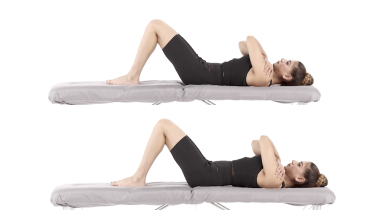 Pelvic tilt
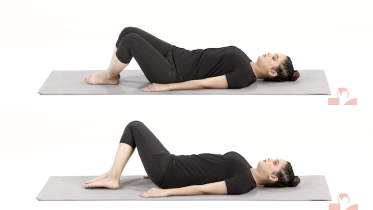 Lower trunk rotation
If you are pregnant and past the first three months, check with your physio before exercising flat on your back. If you have high blood pressure, breathe steadily through every hold and never hold your breath. If you have had a hip replacement, get the go-ahead from your surgeon or physio before you try the lower trunk rotation. Rolling the knees to one side turns the upper hip inward and across the middle of your body, and many surgeons ask you to avoid that for the first months after some operations. With low bone density (osteoporosis), ask your physio before the trunk rotation, because twisting to the end of the range is usually limited.
If heat at night is your plan, read sleeping positions for back pain first, and if you are wondering which movements to hold back on for now, exercises to avoid with lower back pain covers that. How long does back pain last explains what recovery usually looks like, and leg pain belongs on the sciatica page.
Related exercise programs
Warning signs
Get emergency help now
- Emergency: numbness, tingling or altered feeling around or under your genitals, between your inner thighs, or around your bottom (anus), for example it feels different when you wipe after using the toilet. Call emergency services or go to an emergency department straight away. This can be a sign of pressure on the bundle of nerves at the base of the spine (cauda equina syndrome), which needs emergency treatment.
- Emergency: you find it hard to start peeing, cannot pee, cannot feel yourself peeing or cannot control when you pee, or you do not notice when you need to poo or cannot control when you poo, and this is not normal for you. The same applies to a new change in how your genitals feel during sex, or new trouble getting an erection or ejaculating. Call emergency services or go to an emergency department straight away. These can also be signs of cauda equina syndrome.
- Emergency: sciatica in both legs, or pain, tingling, numbness or weakness in both legs. The same applies if you lose feeling in one leg. Call emergency services or go to an emergency department straight away.
- Emergency: back or leg pain that started after a serious accident, such as a car crash or a fall from a height, or back pain with chest pain. Call emergency services. If the pain started straight after the accident, keep still while you wait.
- Emergency: sudden, severe pain in your lower back or tummy that is not like your usual back pain, if you have been told you have a swelling of the main blood vessel in your tummy (abdominal aortic aneurysm), you are over 60, you smoke or used to smoke, or you have high blood pressure. The same applies if sudden, severe back or tummy pain comes with feeling faint or passing out, pale, sweaty or clammy skin, a racing heartbeat or being short of breath. Call emergency services straight away. This can be a sign of an aneurysm bursting, which needs treatment in hospital at once.
- Emergency: new neck or back pain after a fall, a knock or a jolt, even a minor one such as a trip or a sudden stop in a car, if you have a condition that stiffens the spine, such as ankylosing spondylitis. Call emergency services or go to an emergency department straight away, do not drive yourself, and tell the staff about your spine condition, so they keep your neck and back in their usual position. A stiff spine can break after a small injury, and the break is easy to miss at first. If the pain started straight after the injury, or you also have numbness, tingling or weakness in your arms or legs, keep still and call emergency services.
- Emergency: you have had cancer, now or in the past, and your back or neck pain feels like a tight band around your body, or comes with pain spreading down an arm or leg, weakness, numbness or pins and needles in your arms or legs, trouble walking, or trouble controlling your bladder or bowels. Call your cancer team's emergency number straight away, or go to an emergency department if you do not have one or cannot get through. This can be cancer pressing on the spinal cord (metastatic spinal cord compression), which needs treatment straight away.
- Emergency: back pain with a fever, or you feel hot, shivery or very unwell, and you also have new weakness, numbness or tingling in one or both legs, or new trouble with your bladder or bowels. Call emergency services or go to an emergency department straight away. This can be an infection pressing on the nerves in the spine (spinal epidural abscess), which needs emergency treatment.
Get help today
- Same day: a leg or foot that is getting weaker, for example your foot drags, catches on the ground or slaps down when you walk (foot drop). Get medical advice the same day. If the weakness is getting worse by the hour, go to an emergency department.
- Same day: back pain after a minor fall or strain if you are older, have low bone density (osteoporosis) or have taken steroid tablets for a long time. Get medical advice the same day.
- Same day: back or leg pain with a fever, or you feel hot, cold, shivery or generally unwell. Get medical advice the same day, and go to an emergency department if you feel very unwell.
- Same day: you have back pain and have lost weight without trying. Get medical advice the same day and mention the weight loss.
- Same day: new back pain and you have had cancer, now or in the past. Get medical advice the same day and mention your cancer history. If you are being treated for cancer now, contact your cancer team the same day.
- Same day: severe pain that comes on suddenly or is getting worse quickly. Get medical advice the same day.
- Same day: pain that is worse at night, or does not ease at all when you rest. If you have had cancer, now or in the past, or you have lost weight without trying, get medical advice the same day.
Book an appointment
- Within a few days: pain that is worse at night, or does not ease at all when you rest. See your doctor within a few days.
Common questions
Should I alternate heat and ice for back pain?
You can if you like, but no trial has tested switching between them for back pain, so there is no reason to think it beats using one. Pick the one that makes it easier to get moving and stick with it. The same safety rules apply to both: wrap the pack, keep heat to about 15 to 20 minutes and ice to about 10 to 15, and check your skin as you go.
Can I sleep on a heating pad?
No. An NHS ice and heat therapy leaflet warns against lying, sitting or sleeping on a heat pack, because that raises the risk of a burn, and a burn is more likely on skin that does not feel heat properly. Use heat for a set time before bed and take it away before you settle. The sleeping positions page on this site has pillow set-ups that help without any heat.
How long should I leave heat or ice on my back?
NHS physiotherapy leaflets give different times for heat, mostly between 15 and 30 minutes, and about 15 to 20 minutes, wrapped in a towel, is a common middle ground. For ice they suggest less, about 10 to 15 minutes. You can repeat either a few times a day. Lift the pack and look at your skin after the first few minutes. Take it away for good if the skin turns bright red, blotchy or blistered, or feels sore, burning or numb. Adhesive low-level heat wraps are different: they are made to be worn for hours at a much lower temperature, so follow the instructions on the packet.
Is heat or ice better for a back spasm?
The trials looked at new low back pain in general rather than spasm on its own, and in them heat had the better evidence. Many people find warmth eases the tight, gripping feeling of a spasm, and NHS back pain advice mentions heat for stiffness and spasm. If ice suits you better, use it. Either way, the aim is to ease the spasm enough to move gently, because staying active is what guidelines recommend.
References
- Qaseem A, Wilt TJ, McLean RM, Forciea MA. Noninvasive treatments for acute, subacute, and chronic low back pain: a clinical practice guideline from the American College of Physicians. Annals of Internal Medicine. 2017;166(7):514-530. https://doi.org/10.7326/M16-2367
- French SD, Cameron M, Walker BF, Reggars JW, Esterman AJ. Superficial heat or cold for low back pain. Cochrane Database of Systematic Reviews. 2006;(1):CD004750. https://doi.org/10.1002/14651858.CD004750.pub2
- Nadler SF, Steiner DJ, Erasala GN, et al. Continuous low-level heat wrap therapy provides more efficacy than ibuprofen and acetaminophen for acute low back pain. Spine. 2002;27(10):1012-1017. https://pubmed.ncbi.nlm.nih.gov/12004166/
- Garra G, Singer AJ, Leno R, et al. Heat or cold packs for neck and back strain: a randomized controlled trial of efficacy. Academic Emergency Medicine. 2010;17(5):484-489. https://doi.org/10.1111/j.1553-2712.2010.00735.x
- Côté-Picard C, Tittley J, Mailloux C, et al. Heatwrap and exercise in acute low back pain: a multi-arm randomised controlled trial. Musculoskeletal Science and Practice. 2026;84:103587. https://doi.org/10.1016/j.msksp.2026.103587
- Dubois B, Esculier JF. Soft-tissue injuries simply need PEACE and LOVE. British Journal of Sports Medicine. 2020;54(2):72-73. https://doi.org/10.1136/bjsports-2019-101253
- South West Yorkshire Partnership NHS Foundation Trust. Ice and heat therapy. Patient leaflet. https://www.southwestyorkshire.nhs.uk/wp-content/uploads/2018/05/Ice-and-heat-therapy.pdf
- Calderdale and Huddersfield NHS Foundation Trust. Use of heat and cold (ice) therapy, for injury or pain. Patient leaflet. https://plr.cht.nhs.uk/download/969/Use%20of%20Heat%20&%20Cold%20(ice)%20Therapy%20for%20Injury%20or%20pain
- NHS. Burns and scalds. https://www.nhs.uk/conditions/burns-and-scalds/
- South Tees Hospitals NHS Foundation Trust. Therapeutic aids for pregnancy. https://www.southtees.nhs.uk/resources/therapeutic-aids-for-pregnancy/
- NHS. Back pain. https://www.nhs.uk/conditions/back-pain/
- NHS. Abdominal aortic aneurysm. https://www.nhs.uk/conditions/abdominal-aortic-aneurysm/
- National Institute for Health and Care Excellence. Abdominal aortic aneurysm: diagnosis and management (NG156). 2020. https://www.nice.org.uk/guidance/ng156
- Darouiche RO. Spinal epidural abscess. New England Journal of Medicine. 2006;355(19):2012-2020. https://doi.org/10.1056/NEJMra055111
Written and checked by the PocketPhysio editorial team. Last updated 2026-10-16.
This page is general education, not a diagnosis or a personal treatment plan. See a physiotherapist or doctor for advice about your own situation.