
Part of Low back pain
Is walking good for lower back pain? How much, how fast and what the trials show
Warning signs, and when to get help
Is walking good for lower back pain? What the trials show
The strongest evidence comes from WalkBack, an Australian trial published in the Lancet in 2024. It recruited 701 adults who had recently recovered from an episode of low back pain and asked a practical question: can a walking program keep the next episode away? Half were given an individualized, progressive walking program with education, supported by 6 sessions with a physio over 6 months. The other half had no treatment.
People in the walking group lasted longer before back pain flared badly enough to limit their daily activities again: half had a new episode by 208 days, compared with 112 days in the group left untreated (Pocovi and colleagues, 2024). The trial reports this as a hazard ratio of 0.72, which means a lower chance of that next episode starting at any point during follow-up. The authors also found a high chance that it was cost-effective in the Australian health system.
It was not free of downsides. The walking group reported more lower limb injuries than the group with no program, though the total number of adverse events was similar. That is a good reason to build up gradually rather than jump straight to long walks. Be clear, too, about what WalkBack tested: preventing the next episode in people who had already recovered, not treating pain you have right now.
Does walking help back pain you have now?
For back pain that has already lasted months, the evidence is smaller but encouraging. A review that pooled 5 trials compared walking programs with other forms of exercise. Pain, disability, quality of life and fear of movement improved about as much with walking as with the other exercise, and adding walking on top of an exercise program did not give extra benefit in the short term (Vanti and colleagues, 2019).
For new back pain, nobody has run a large trial of walking on its own. What exists is the general guideline advice: NICE and Australia's care standard both point people toward staying active, and walking is the most practical way to do that for most people. The should I rest or move page explains why bed rest lost out in the trials.
A large Norwegian study adds a different kind of evidence. Around 11,000 adults wore movement sensors on the thigh and back for up to a week, and those who walked more each day were less likely to report chronic low back pain about 4 years later (Haddadj and colleagues, 2025). That is an association, not proof that walking prevented it, but it points the same way as the trial.
How much should you walk with back pain?
Start with a dose you can finish comfortably. Many programs begin with 10 to 20 minutes, including a few minutes of slow walking at each end, on most days of the week, and add time before speed. If even 10 minutes is too much on a bad day, two or three short walks of a few minutes each can replace one longer one; that is a common clinic adjustment rather than something a trial has tested. Your physio will adjust this.
Build up by a few minutes at a time, using the next morning as your check. If your back feels about the same or better, add a little. If it is clearly worse, drop back to the last comfortable amount for a few days. The pain monitoring model explains this way of judging load.
As a longer-term target, the WalkBack program aimed to build people gradually toward about 30 minutes of walking, five times a week, over 6 months. That fits the World Health Organization advice of at least 150 minutes of moderate activity a week. Distance matters less than time; for some people 1 km (about 0.6 miles) is a good first goal, for others it is 3 km (nearly 2 miles).
Should you walk when your back hurts?
Usually, yes, with the pace and distance turned down. During a flare, keep the walks short and frequent rather than stopping them. A walk to the end of the street and back, a few times a day, keeps the back moving without asking much of it.
Pace matters more than people expect. A sore back often prefers a relaxed, even pace with natural arm swing over a fast march with long strides. Flat routes come before hills. A treadmill is useful when you want an even surface and the option to stop at any time, but there is no evidence it beats walking outside for back pain.
If you have just recovered from an episode, this is the stage WalkBack tested. Keep walking even once the pain has gone, because back pain often comes back and how long does back pain last explains why the months after recovery matter.
Why does your back hurt when you walk?
Most often because a stiff, sore back takes a few minutes to loosen. That ache usually eases as you go. If it builds instead, slow down and shorten your stride before you give up on the walk.
A different pattern needs checking. Ache, heaviness or tingling in a leg that builds the further you walk and eases when you sit down or lean forward on a shopping cart is typical of narrowing of the spinal canal (spinal stenosis), and the spinal stenosis program has a walk and rest plan for it. Narrowed arteries in the legs can produce the same pattern, so if a doctor has not checked it, book an appointment with your doctor, and see your doctor within a few days if the distance you can walk has become much shorter over a few weeks.
Pain, tingling, numbness or weakness in both legs, legs that keep getting weaker even slowly, or numbness around your genitals or bottom or a change in your bladder or bowels is different: those mean calling emergency services or going to an emergency department straight away. If a doctor has already told you that you have spinal stenosis, its page explains which changes in both legs are its usual pattern and which are an emergency. The warning list below gives the full set of signs.
Other exercises for days when walking is too much
Some days a walk is not on. These two are done lying down and keep the lower back moving gently.
Exercises that can help
Brisk walking is the main one. Many programs begin at 10 to 20 minutes on most days of the week, with a few minutes of slow walking to start and finish, and add time before speed. On days when walking is too much, the pelvic tilt (2 to 3 sets of 10, holding each tilt for about 5 seconds) and the lower trunk rotation (10 to 15 slow rolls to each side, with a hold of 3 to 5 seconds) keep the back moving, each once or twice a day. Your physio will adjust this.
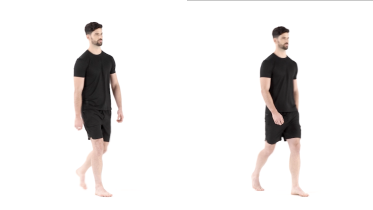 Brisk walking
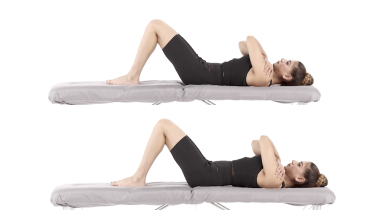 Pelvic tilt
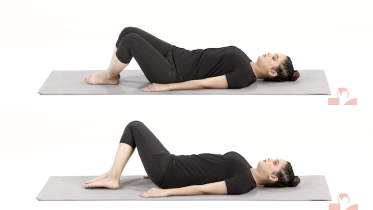 Lower trunk rotation
Walking with a heart or lung condition, with high blood pressure, or soon after an operation? Agree the pace and the time with your doctor or physio first. If you are pregnant, check with your midwife or physio before you start a new walking plan. If your balance is unsure, pick a route with a rail or wall along it and use your walking aid if you have one.
If you are pregnant and past the first three months, check with your physio before exercising flat on your back. With low bone density (osteoporosis), ask your physio how far to take the trunk rotation, since twisting to the end of the range is usually limited. If you have had a hip replacement, get the go-ahead from your surgeon or physio before you try the lower trunk rotation. Rolling the knees to one side turns the upper hip inward and across the middle of your body, and many surgeons ask you to avoid that for the first months after some operations.
Where walking fits in
Walking is one part of recovery, alongside the strength work in the low back pain program. If you sit all day, back pain at work has ideas for fitting a walk into a working day, and exercises to avoid covers what to put on hold while your back is sore. Heat before a walk can take the edge off stiffness; the heat or ice page explains how to use it safely. If pain wakes you at night, sleeping positions for back pain may help, and when is back pain serious sets out which signs need checking and how quickly. The brisk walking page shows the walk itself step by step.
Related exercise programs
Warning signs
Get emergency help now
- Emergency: if chest pain, pressure or tightness does not ease quickly when you rest, spreads to your arm, neck, jaw, stomach or back, or comes with sweating, feeling sick, feeling light-headed or being short of breath, call emergency services straight away, as this can be a heart attack. If it eases quickly and none of these happen, get medical advice the same day, and do not exercise again until you have been checked.
- Emergency: if you faint while exercising, call emergency services, even if you feel fine again quickly.
- Emergency: numbness, tingling or altered feeling around or under your genitals, between your inner thighs, or around your bottom (anus), for example it feels different when you wipe after using the toilet. Call emergency services or go to an emergency department straight away. This can be a sign of pressure on the bundle of nerves at the base of the spine (cauda equina syndrome), which needs emergency treatment.
- Emergency: you find it hard to start peeing, cannot pee, cannot feel yourself peeing or cannot control when you pee, or you do not notice when you need to poo or cannot control when you poo, and this is not normal for you. The same applies to a new change in how your genitals feel during sex, or new trouble getting an erection or ejaculating. Call emergency services or go to an emergency department straight away. These can also be signs of cauda equina syndrome.
- Emergency: sciatica in both legs, or pain, tingling, numbness or weakness in both legs. The same applies if you lose feeling in one leg. Call emergency services or go to an emergency department straight away.
- Emergency: back or leg pain that started after a serious accident, such as a car crash or a fall from a height, or back pain with chest pain. Call emergency services. If the pain started straight after the accident, keep still while you wait.
- Emergency: sudden, severe pain in your lower back or tummy that is not like your usual back pain, if you have been told you have a swelling of the main blood vessel in your tummy (abdominal aortic aneurysm), you are over 60, you smoke or used to smoke, or you have high blood pressure. The same applies if sudden, severe back or tummy pain comes with feeling faint or passing out, pale, sweaty or clammy skin, a racing heartbeat or being short of breath. Call emergency services straight away. This can be a sign of an aneurysm bursting, which needs treatment in hospital at once.
- Emergency: new neck or back pain after a fall, a knock or a jolt, even a minor one such as a trip or a sudden stop in a car, if you have a condition that stiffens the spine, such as ankylosing spondylitis. Call emergency services or go to an emergency department straight away, do not drive yourself, and tell the staff about your spine condition, so they keep your neck and back in their usual position. A stiff spine can break after a small injury, and the break is easy to miss at first. If the pain started straight after the injury, or you also have numbness, tingling or weakness in your arms or legs, keep still and call emergency services.
- Emergency: you have had cancer, now or in the past, and your back or neck pain feels like a tight band around your body, or comes with pain spreading down an arm or leg, weakness, numbness or pins and needles in your arms or legs, trouble walking, or trouble controlling your bladder or bowels. Call your cancer team's emergency number straight away, or go to an emergency department if you do not have one or cannot get through. This can be cancer pressing on the spinal cord (metastatic spinal cord compression), which needs treatment straight away.
- Emergency: back pain with a fever, or you feel hot, shivery or very unwell, and you also have new weakness, numbness or tingling in one or both legs, or new trouble with your bladder or bowels. Call emergency services or go to an emergency department straight away. This can be an infection pressing on the nerves in the spine (spinal epidural abscess), which needs emergency treatment.
Get help today
- Same day: a leg or foot that is getting weaker, for example your foot drags, catches on the ground or slaps down when you walk (foot drop). Get medical advice the same day. If the weakness is getting worse by the hour, go to an emergency department.
- Same day: back pain after a minor fall or strain if you are older, have low bone density (osteoporosis) or have taken steroid tablets for a long time. Get medical advice the same day.
- Same day: back or leg pain with a fever, or you feel hot, cold, shivery or generally unwell. Get medical advice the same day, and go to an emergency department if you feel very unwell.
- Same day: you have back pain and have lost weight without trying. Get medical advice the same day and mention the weight loss.
- Same day: new back pain and you have had cancer, now or in the past. Get medical advice the same day and mention your cancer history. If you are being treated for cancer now, contact your cancer team the same day.
- Same day: severe pain that comes on suddenly or is getting worse quickly. Get medical advice the same day.
- Same day: pain that is worse at night, or does not ease at all when you rest. If you have had cancer, now or in the past, or you have lost weight without trying, get medical advice the same day.
Book an appointment
- Within a few days: pain that is worse at night, or does not ease at all when you rest. See your doctor within a few days.
- Routine: pain or aching in a leg that comes on when you walk and goes after a few minutes' rest, and a doctor has not checked it yet. Book an appointment with your doctor. Narrowed arteries in the legs (peripheral arterial disease) can cause this too, and they need different treatment. If the distance you can walk before the pain starts has become much shorter over a few weeks, see your doctor within a few days. Pain, tingling, numbness or weakness in both legs is on the emergency list above.
Common questions
How long should I walk for lower back pain?
Start with what you can manage comfortably, which for many people is 10 to 20 minutes, including a few minutes of slow walking at each end, on most days of the week. Add time before you add speed, a few minutes at a time, as long as your back feels about the same or better the next morning. The WalkBack program aimed to build people up gradually toward about 30 minutes, five times a week, over 6 months. Your physio will adjust this.
Is walking better than resting for back pain?
For most people, yes. Guidelines in the UK and Australia, and Choosing Wisely advice in the US and Canada, favor staying active over resting in bed, and walking is the easiest way to do that around the house and outside. Short rests when the pain is bad are fine. The aim is to keep getting up and moving in between, even if the walks are short to begin with.
Why does my lower back hurt when I walk?
Often because the back is stiff and sore and walking is the first sustained thing it has done that day; that ache usually eases after the first few minutes. Walking fast with long strides, or up and down hills, can also stir up a sore back, so slow down, take shorter steps and stick to flat routes for now. A different pattern is aching or heaviness that spreads into a leg as you walk and eases when you sit or bend forward. If a doctor has not checked that yet, book an appointment with your doctor. Narrowed arteries in the legs (peripheral arterial disease) can cause this too, and they need different treatment. If the distance you can walk before the pain starts has become much shorter over a few weeks, see your doctor within a few days. Pain, tingling, numbness or weakness in both legs is different: call emergency services or go to an emergency department straight away. If a doctor has already told you that you have narrowing of the spinal canal (spinal stenosis), the spinal stenosis page explains which changes in both legs are its usual pattern and which are an emergency.
Can walking stop back pain coming back?
It can help delay it. In the WalkBack trial, people who had just recovered from an episode of low back pain and followed a progressive walking and education program went longer before their next activity-limiting episode than people with no program, a median of 208 days against 112 (Pocovi and colleagues, 2024). No program stops back pain coming back altogether, but walking is cheap, low risk and easy to keep up.
References
- Pocovi NC, Lin CWC, French SD, et al. Effectiveness and cost-effectiveness of an individualised, progressive walking and education intervention for the prevention of low back pain recurrence in Australia (WalkBack): a randomised controlled trial. The Lancet. 2024;404(10448):134-144. https://doi.org/10.1016/S0140-6736(24)00755-4
- Vanti C, Andreatta S, et al. The effectiveness of walking versus exercise on pain and function in chronic low back pain: a systematic review and meta-analysis of randomized trials. Disability and Rehabilitation. 2019;41(6):622-632. https://pubmed.ncbi.nlm.nih.gov/29207885/
- Haddadj R, Nordstoga AL, Nilsen TIL, et al. Volume and intensity of walking and risk of chronic low back pain. JAMA Network Open. 2025;8(6):e2515592. https://doi.org/10.1001/jamanetworkopen.2025.15592
- NHS. Back pain. https://www.nhs.uk/conditions/back-pain/
- National Institute for Health and Care Excellence. Low back pain and sciatica in over 16s: assessment and management (NG59). Published 2016, last updated July 2026. https://www.nice.org.uk/guidance/ng59
- World Health Organization. Physical activity fact sheet. https://www.who.int/news-room/fact-sheets/detail/physical-activity
- Australian Commission on Safety and Quality in Health Care. Low Back Pain Clinical Care Standard. Sydney: ACSQHC, 2022. https://www.safetyandquality.gov.au/standards/clinical-care-standards/low-back-pain-clinical-care-standard
- Choosing Wisely Canada. Treating lower-back pain: how much bed rest is too much? Patient pamphlet. https://choosingwiselycanada.org/pamphlet/treating-lower-back-pain/
- North American Spine Society. Don't recommend bed rest for more than 48 hours when treating low back pain. Choosing Wisely. https://www.choosingwisely.org/clinician-lists/north-american-spine-society-bed-rest-for-more-than-48-hours/
- NHS. Abdominal aortic aneurysm. https://www.nhs.uk/conditions/abdominal-aortic-aneurysm/
- National Institute for Health and Care Excellence. Abdominal aortic aneurysm: diagnosis and management (NG156). 2020. https://www.nice.org.uk/guidance/ng156
- Darouiche RO. Spinal epidural abscess. New England Journal of Medicine. 2006;355(19):2012-2020. https://doi.org/10.1056/NEJMra055111
Written and checked by the PocketPhysio editorial team. Last updated 2026-10-16.
This page is general education, not a diagnosis or a personal treatment plan. See a physiotherapist or doctor for advice about your own situation.