
Part of Low back pain
Best sleeping position for lower back pain: pillows, positions and getting up
Warning signs, and when to get help
What is the best sleeping position for lower back pain?
There is no winner backed by research. A 2019 scoping review looked for studies linking sleep posture with spinal symptoms and, out of more than 4,000 articles, found four that qualified. In all four, people reported their own sleeping position, and only one added camera recordings. Side lying looked slightly protective, but the authors concluded there were not enough good studies to answer the question (Cary and colleagues, 2019).
So physios work from a simpler idea. A sore back settles better when it is not held at the end of its range for hours: not twisted, not deeply arched, not curled up tight. Pillows do most of that job. Start from the position you naturally fall asleep in and adjust it, rather than forcing yourself into a new one that keeps you awake. That is practice reasoning, not a tested rule.
Sleep matters for its own sake, too. When researchers pooled data on nearly 2,000 people with low back pain, more than half reported disturbed sleep (Alsaadi and colleagues, 2011, corrected in 2012). A set-up that buys you an extra hour of rest is worth having even if it changes nothing in the back itself.
How to set up each sleeping position
On your side
Bend your knees a little and put a pillow between them. Many physios suggest a long pillow that runs down to your ankles, so the top leg cannot drop forward and drag your pelvis into a twist.
Use a head pillow thick enough to fill the gap between your ear and the mattress, so your neck lines up with the rest of your spine. Hugging a second pillow stops the top shoulder rolling forward. Either side is fine. If one side hurts, start on the other.
On your back
Slide one or two pillows under your knees so they stay bent and your lower back can sink toward the mattress. Keep the head pillow fairly thin, or your chin gets pushed toward your chest.
From about 28 weeks of pregnancy the NHS advises going to sleep on your side rather than on your back, because it says sleeping on your back after that point can double the risk of stillbirth. So use the side position with a pillow between your knees, and leave lying on your back until after the birth. The NHS also says not to worry if you wake up on your back: settle onto your side again and carry on. Back and pelvic pain in pregnancy has its own plan on the pregnancy back and pelvic pain page, and your midwife or maternity physio can check your pillow set-up.
On your front
Front sleeping is not banned. It does hold the lower back arched for hours, so a flat pillow under your hips and lower tummy takes some of that arch out. Use a thin head pillow or none. If you wake stiff, try a halfway position: turned partly onto your side, with the top knee drawn up and resting on a pillow. Like the side and back set-ups, these are practice advice that physios commonly give, not positions a trial has tested.
How do you get in and out of bed with back pain?
Sitting straight up from flat, like a sit-up, often hurts a sore back. Roll instead. Bend both knees, turn onto your side with your shoulders and hips moving as one piece, then let your lower legs slide off the edge while your arms push you up to sitting. Pause on the edge before you stand. To lie down, sit near the pillow end, lower yourself onto your elbow as your legs come up, and roll onto your back in one go. The log roll out of bed page breaks this into steps with a video.
Turning over in the night uses the same trick: knees bent, a gentle tightening of the tummy, and shoulders and hips turning together. Switch on a light before getting up for the bathroom, and keep any walking aid within reach of the bed.
After back surgery, the way your surgical team taught you to get in and out of bed comes first. If you have had a hip replacement, get the go-ahead from your surgeon or physio before you try the log roll. The bent knees tip across as you roll, which can take the top leg across the middle of your body, and many surgeons ask you to avoid that for the first months after some operations. Your surgical team may show you their own way of turning, sometimes with a pillow between the knees.
What should you do when back pain wakes you at night?
Change something small. Turn over, add or move a pillow, or do a few slow pelvic tilts where you lie. If that does not settle it within a few minutes, get up, walk around the house for a short while, and go back to bed. No trial has tested this, but lying awake and tense for an hour rarely helps.
Heat before bed suits some people. Use it for a set time and take it away before you fall asleep, never on skin that cannot feel heat properly. The page on heat or ice for back pain explains how.
If leg pain is what keeps you awake, the sciatica page is the better place to start.
Pain that is worse at night, or does not ease at all when you rest, means seeing your doctor within a few days. The warning list below gives the full set of signs, including when to get medical advice the same day. The page on when back pain is serious explains each one.
Does your mattress matter?
A little. The research is set out on the lower back pain in the morning page, and the short version is that a medium firm bed that has not sagged is a reasonable default (Kovacs and colleagues, 2003). Sleeping on the floor or on a board has no trial behind it, and you do not need to buy anything before trying the pillow changes above.
Gentle movements for the start and end of the day
None of this replaces daytime activity. NICE advises encouraging people with low back pain to carry on with their normal activities, and a day spent moving tends to make for a better night than a day spent resting. Should I rest or move with back pain covers the daytime side, and walking for back pain is an easy place to start.
Exercises that can help
The log roll is for every trip in and out of bed while your back is sore, and in reverse when you lie down. The pelvic tilt can be done on the mattress before you get up or before you settle for the night: many programs start with 2 to 3 sets of 10, holding each tilt for about 5 seconds, once or twice a day. Your physio will adjust this.
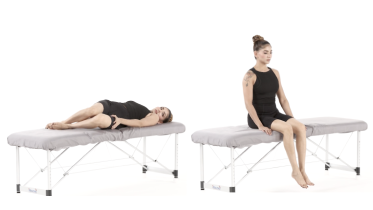 Log roll out of bed
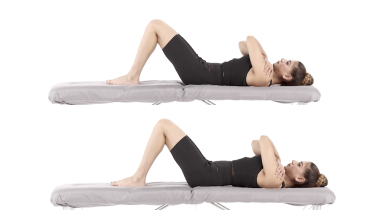 Pelvic tilt
If you are pregnant and past the first three months, check with your physio before exercising flat on your back. If you have high blood pressure, breathe steadily through every hold and never hold your breath. The full staged plan is on the low back pain page, exercises to avoid with lower back pain covers what to hold back on for now, and how long does back pain last explains what recovery usually looks like.
Related exercise programs
Warning signs
Get emergency help now
- Emergency: numbness, tingling or altered feeling around or under your genitals, between your inner thighs, or around your bottom (anus), for example it feels different when you wipe after using the toilet. Call emergency services or go to an emergency department straight away. This can be a sign of pressure on the bundle of nerves at the base of the spine (cauda equina syndrome), which needs emergency treatment.
- Emergency: you find it hard to start peeing, cannot pee, cannot feel yourself peeing or cannot control when you pee, or you do not notice when you need to poo or cannot control when you poo, and this is not normal for you. The same applies to a new change in how your genitals feel during sex, or new trouble getting an erection or ejaculating. Call emergency services or go to an emergency department straight away. These can also be signs of cauda equina syndrome.
- Emergency: sciatica in both legs, or pain, tingling, numbness or weakness in both legs. The same applies if you lose feeling in one leg. Call emergency services or go to an emergency department straight away.
- Emergency: back or leg pain that started after a serious accident, such as a car crash or a fall from a height, or back pain with chest pain. Call emergency services. If the pain started straight after the accident, keep still while you wait.
- Emergency: sudden, severe pain in your lower back or tummy that is not like your usual back pain, if you have been told you have a swelling of the main blood vessel in your tummy (abdominal aortic aneurysm), you are over 60, you smoke or used to smoke, or you have high blood pressure. The same applies if sudden, severe back or tummy pain comes with feeling faint or passing out, pale, sweaty or clammy skin, a racing heartbeat or being short of breath. Call emergency services straight away. This can be a sign of an aneurysm bursting, which needs treatment in hospital at once.
- Emergency: new neck or back pain after a fall, a knock or a jolt, even a minor one such as a trip or a sudden stop in a car, if you have a condition that stiffens the spine, such as ankylosing spondylitis. Call emergency services or go to an emergency department straight away, do not drive yourself, and tell the staff about your spine condition, so they keep your neck and back in their usual position. A stiff spine can break after a small injury, and the break is easy to miss at first. If the pain started straight after the injury, or you also have numbness, tingling or weakness in your arms or legs, keep still and call emergency services.
- Emergency: you have had cancer, now or in the past, and your back or neck pain feels like a tight band around your body, or comes with pain spreading down an arm or leg, weakness, numbness or pins and needles in your arms or legs, trouble walking, or trouble controlling your bladder or bowels. Call your cancer team's emergency number straight away, or go to an emergency department if you do not have one or cannot get through. This can be cancer pressing on the spinal cord (metastatic spinal cord compression), which needs treatment straight away.
- Emergency: back pain with a fever, or you feel hot, shivery or very unwell, and you also have new weakness, numbness or tingling in one or both legs, or new trouble with your bladder or bowels. Call emergency services or go to an emergency department straight away. This can be an infection pressing on the nerves in the spine (spinal epidural abscess), which needs emergency treatment.
Get help today
- Same day: a leg or foot that is getting weaker, for example your foot drags, catches on the ground or slaps down when you walk (foot drop). Get medical advice the same day. If the weakness is getting worse by the hour, go to an emergency department.
- Same day: back pain after a minor fall or strain if you are older, have low bone density (osteoporosis) or have taken steroid tablets for a long time. Get medical advice the same day.
- Same day: back or leg pain with a fever, or you feel hot, cold, shivery or generally unwell. Get medical advice the same day, and go to an emergency department if you feel very unwell.
- Same day: you have back pain and have lost weight without trying. Get medical advice the same day and mention the weight loss.
- Same day: new back pain and you have had cancer, now or in the past. Get medical advice the same day and mention your cancer history. If you are being treated for cancer now, contact your cancer team the same day.
- Same day: severe pain that comes on suddenly or is getting worse quickly. Get medical advice the same day.
- Same day: pain that is worse at night, or does not ease at all when you rest. If you have had cancer, now or in the past, or you have lost weight without trying, get medical advice the same day.
Book an appointment
- Within a few days: pain that is worse at night, or does not ease at all when you rest. See your doctor within a few days.
Common questions
Where should I put a pillow for lower back pain, between or under my knees?
It depends which way you lie. On your side, the pillow goes between your knees, and a long one that reaches down to your ankles stops the top leg dropping forward and pulling your pelvis round. On your back, one or two pillows go under your knees so your lower back can relax down onto the mattress. From about 28 weeks of pregnancy the NHS advises going to sleep on your side rather than on your back, because it says sleeping on your back after that point can double the risk of stillbirth. So use the side position with a pillow between your knees, and leave lying on your back until after the birth. The NHS also says not to worry if you wake up on your back: settle onto your side again and carry on. Neither pillow set-up has had its own trial. Physios suggest them because they are free and quick to test.
Why does my lower back hurt more at night?
Hours of lying still let a sore back stiffen, and a position that holds it twisted or arched adds to that. This kind of night ache tends to ease within minutes of turning over, moving the pillows or getting up for a short walk. One pattern needs checking: pain that is worse at night, or does not ease at all when you rest. See your doctor within a few days. If you have had cancer, now or in the past, or you have lost weight without trying, get medical advice the same day. If you are being treated for cancer now, contact your cancer team the same day.
How do I get out of bed with lower back pain?
Roll first, then sit up. Bend both knees, turn onto your side with your shoulders and hips moving together, then let your lower legs slide off the edge of the bed while you push up with your arms. Sit on the edge for a moment before you stand. Getting into bed is the same movement backward. If you have had back surgery or a hip replacement, use the method your surgical team showed you, because their instructions come first.
Can I sleep with a heating pad on my back?
No. Use heat for about 15 to 20 minutes before you settle for the night, then take it away. Do not lie, sit or fall asleep on a heat pack: an NHS leaflet on ice and heat therapy says this makes a skin burn more likely, and the risk goes up if the skin on your back does not feel normally or you have diabetes or poor circulation. The heat or ice page on this site covers safe use in more detail.
References
- Cary D, Briffa K, McKenna L. Identifying relationships between sleep posture and non-specific spinal symptoms in adults: a scoping review. BMJ Open. 2019;9(6):e027633. https://doi.org/10.1136/bmjopen-2018-027633
- Alsaadi SM, McAuley JH, Hush JM, Maher CG. Prevalence of sleep disturbance in patients with low back pain. European Spine Journal. 2011;20(5):737-743. https://doi.org/10.1007/s00586-010-1661-x
- Alsaadi SM, McAuley JH, Hush JM, Maher CG. Erratum to: Prevalence of sleep disturbance in patients with low back pain. European Spine Journal. 2012;21(3):554-560. https://doi.org/10.1007/s00586-011-1954-8
- Kovacs FM, Abraira V, Pena A, et al. Effect of firmness of mattress on chronic non-specific low-back pain: randomised, double-blind, controlled, multicentre trial. The Lancet. 2003;362(9396):1599-1604. https://doi.org/10.1016/S0140-6736(03)14792-7
- NHS. 27 weeks pregnant: the best sleeping positions during pregnancy. Best Start in Life week by week guide. https://www.nhs.uk/best-start-in-life/pregnancy/week-by-week-guide-to-pregnancy/2nd-trimester/week-27/
- National Institute for Health and Care Excellence. Low back pain and sciatica in over 16s: assessment and management (NG59). Published 2016, last updated July 2026. https://www.nice.org.uk/guidance/ng59
- South West Yorkshire Partnership NHS Foundation Trust. Ice and heat therapy. Patient leaflet. https://www.southwestyorkshire.nhs.uk/wp-content/uploads/2018/05/Ice-and-heat-therapy.pdf
- NHS. Abdominal aortic aneurysm. https://www.nhs.uk/conditions/abdominal-aortic-aneurysm/
- National Institute for Health and Care Excellence. Abdominal aortic aneurysm: diagnosis and management (NG156). 2020. https://www.nice.org.uk/guidance/ng156
- Darouiche RO. Spinal epidural abscess. New England Journal of Medicine. 2006;355(19):2012-2020. https://doi.org/10.1056/NEJMra055111
Written and checked by the PocketPhysio editorial team. Last updated 2026-10-17.
This page is general education, not a diagnosis or a personal treatment plan. See a physiotherapist or doctor for advice about your own situation.