
Part of Low back pain
Should I rest or move with back pain? How to stay active on a bad day
Warning signs, and when to get help
Should I rest or move with back pain? What the trials found
Bed rest used to be the standard advice. It was tested and it lost. In a Finnish trial from 1995, adults with a new episode of low back pain were given 2 days of bed rest, a set of back exercises, or advice to carry on with ordinary activities as far as the pain allowed. At 3 and 12 weeks the ordinary activity group had recovered best, and the bed rest group recovered slowest (Malmivaara and colleagues, 1995). The exercise group also did less well than the people who simply kept going with their day, which is worth remembering: gentle exercises sit on top of normal activity, they do not replace it.
A Cochrane review later pulled together the trials of advice to rest in bed against advice to stay active. For low back pain without leg pain, the two trials it found showed small improvements in pain and function with advice to stay active. For sciatica, it found little or no difference between the two (Dahm and colleagues, 2010). So the case against bed rest is strongest for ordinary back pain, and even with sciatica, resting in bed does not come out ahead.
Today's guidelines agree. NICE asks clinicians to encourage people to continue with their normal activities. Australia's low back pain care standard says people should be encouraged to stay active and to continue or return to usual activity, including work, as soon as they can. In the US, the North American Spine Society's Choosing Wisely advice is not to recommend bed rest for more than 48 hours.
What does keeping moving mean on a bad day?
It does not mean carrying on as if nothing happened. It means doing as much of your normal day as you can, in smaller pieces. On a bad day that might be getting dressed, walking around the house every hour, making a meal in two halves with a sit-down in between, and a short walk to the end of the street.
Some practical swaps help. Sit on a firm chair with arms rather than a low sofa. Get out of bed by rolling onto your side first and pushing up with your arms. Split jobs like vacuuming or gardening into 10 minute spells. None of this has been tested in its own trial; treat it as the practice advice many clinics give in the first week.
Short rests are part of the plan. Lying on your side with a pillow between your knees is a common position of ease, and so is lying on your back with your knees bent. If you are pregnant, rest on your side rather than your back from the second trimester on. The NHS puts the limit at a few minutes flat on your back in later pregnancy, because it can make you dizzy and is not good for the baby, and UK pelvic health physiotherapy guidance (POGP) advises against resting motionless on your back, suggesting an upright position or lying on your left side instead. Ask your midwife or physio which positions suit you, as back pain in pregnancy needs its own plan.
How do you judge how much to do?
Use the next morning as your guide. If your back feels about the same or a little better the next day, the amount you did was fine. If it is clearly worse, or pain has spread further into your leg, you did too much: drop back a step for a day or two, then build again. Our guide to the pain monitoring model explains this check in more detail.
A Lancet review found that for nearly all people with low back pain, no specific cause can be identified, and only a small proportion have a serious one (Hartvigsen and colleagues, 2018). That is why physios are generally comfortable with people moving gently through mild discomfort. Pushing hard into sharp pain is a different thing, and it is not needed to get better.
Gentle movements to start with
The stage 1 exercises from the low back pain program are done lying down and move the lower back through a small, comfortable range. Do them on the bed if getting to the floor is hard.
Exercises that can help
These three are done lying down and suit a sore back in the first days. Typical starting doses from each exercise page: pelvic tilt, 2 to 3 sets of 10 with a hold of about 5 seconds; knee to chest stretch, 3 to 5 gentle holds of 15 to 30 seconds on each leg; lower trunk rotation, 10 to 15 slow rolls to each side with a 3 to 5 second hold; each once or twice a day. Your physio will adjust this.
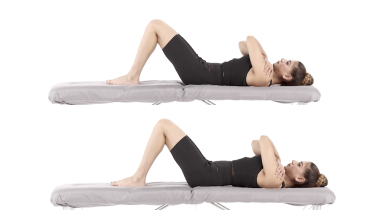 Pelvic tilt
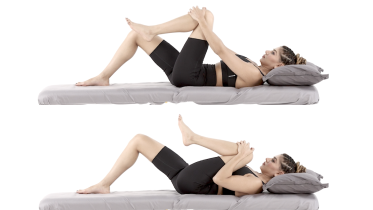 Knee to chest stretch
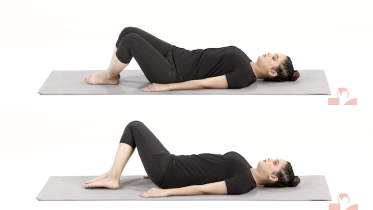 Lower trunk rotation
If you are pregnant and past the first three months, check with your physio before exercising flat on your back. If you have high blood pressure, breathe steadily through every repetition and never hold your breath. If you have low bone density (osteoporosis), ask your physio before the knee to chest stretch and the trunk rotation, because deep forward bending and twisting are usually limited. If you have had a hip replacement, get the go-ahead from your surgeon or physio before you try the knee to chest stretch or the lower trunk rotation. Pulling the knee in bends the hip well past a right angle and rolling the knees to one side turns the upper hip inward and across the middle of your body, and many surgeons ask you to avoid that for the first months after some operations.
Should you go to work, the gym or for a walk with back pain?
Work: Australia's care standard encourages staying at work or going back as soon as you can, and some changes, such as lighter duties or more breaks, often make that possible. If you sit for long periods, movement breaks has simple ways to get up during the day, and back pain when sitting covers chairs and car seats.
The gym: drop the load, not the habit. Lower back pain after deadlifts covers how to get back to lifting.
Walking: usually one of the best things to do, starting with short walks and adding a few minutes at a time.
Heat or ice: the American College of Physicians recommends superficial heat for back pain of recent onset, based on moderate-quality evidence (Qaseem and colleagues, 2017). Use it to make moving easier, not as a reason to stay on the sofa.
Our low back pain program page links to more on each of these, and how long does back pain last explains what recovery usually looks like week by week.
When rest is not the answer
Some symptoms mean you should get checked rather than push on. Numbness around your genitals or bottom, new trouble with your bladder or bowels, or pain, tingling, numbness or weakness in both legs means calling emergency services or going to an emergency department straight away. A foot that drags or slaps down when you walk means getting medical advice the same day. The warning list below gives the full set of signs. If the pain is not easing after a few weeks of keeping active, see a physio or doctor, and if it travels below the knee, the sciatica page is a good next read.
Related exercise programs
Warning signs
Get emergency help now
- Emergency: numbness, tingling or altered feeling around or under your genitals, between your inner thighs, or around your bottom (anus), for example it feels different when you wipe after using the toilet. Call emergency services or go to an emergency department straight away. This can be a sign of pressure on the bundle of nerves at the base of the spine (cauda equina syndrome), which needs emergency treatment.
- Emergency: you find it hard to start peeing, cannot pee, cannot feel yourself peeing or cannot control when you pee, or you do not notice when you need to poo or cannot control when you poo, and this is not normal for you. The same applies to a new change in how your genitals feel during sex, or new trouble getting an erection or ejaculating. Call emergency services or go to an emergency department straight away. These can also be signs of cauda equina syndrome.
- Emergency: sciatica in both legs, or pain, tingling, numbness or weakness in both legs. The same applies if you lose feeling in one leg. Call emergency services or go to an emergency department straight away.
- Emergency: back or leg pain that started after a serious accident, such as a car crash or a fall from a height, or back pain with chest pain. Call emergency services. If the pain started straight after the accident, keep still while you wait.
- Emergency: sudden, severe pain in your lower back or tummy that is not like your usual back pain, if you have been told you have a swelling of the main blood vessel in your tummy (abdominal aortic aneurysm), you are over 60, you smoke or used to smoke, or you have high blood pressure. The same applies if sudden, severe back or tummy pain comes with feeling faint or passing out, pale, sweaty or clammy skin, a racing heartbeat or being short of breath. Call emergency services straight away. This can be a sign of an aneurysm bursting, which needs treatment in hospital at once.
- Emergency: new neck or back pain after a fall, a knock or a jolt, even a minor one such as a trip or a sudden stop in a car, if you have a condition that stiffens the spine, such as ankylosing spondylitis. Call emergency services or go to an emergency department straight away, do not drive yourself, and tell the staff about your spine condition, so they keep your neck and back in their usual position. A stiff spine can break after a small injury, and the break is easy to miss at first. If the pain started straight after the injury, or you also have numbness, tingling or weakness in your arms or legs, keep still and call emergency services.
- Emergency: you have had cancer, now or in the past, and your back or neck pain feels like a tight band around your body, or comes with pain spreading down an arm or leg, weakness, numbness or pins and needles in your arms or legs, trouble walking, or trouble controlling your bladder or bowels. Call your cancer team's emergency number straight away, or go to an emergency department if you do not have one or cannot get through. This can be cancer pressing on the spinal cord (metastatic spinal cord compression), which needs treatment straight away.
- Emergency: back pain with a fever, or you feel hot, shivery or very unwell, and you also have new weakness, numbness or tingling in one or both legs, or new trouble with your bladder or bowels. Call emergency services or go to an emergency department straight away. This can be an infection pressing on the nerves in the spine (spinal epidural abscess), which needs emergency treatment.
Get help today
- Same day: a leg or foot that is getting weaker, for example your foot drags, catches on the ground or slaps down when you walk (foot drop). Get medical advice the same day. If the weakness is getting worse by the hour, go to an emergency department.
- Same day: back pain after a minor fall or strain if you are older, have low bone density (osteoporosis) or have taken steroid tablets for a long time. Get medical advice the same day.
- Same day: back or leg pain with a fever, or you feel hot, cold, shivery or generally unwell. Get medical advice the same day, and go to an emergency department if you feel very unwell.
- Same day: you have back pain and have lost weight without trying. Get medical advice the same day and mention the weight loss.
- Same day: new back pain and you have had cancer, now or in the past. Get medical advice the same day and mention your cancer history. If you are being treated for cancer now, contact your cancer team the same day.
- Same day: severe pain that comes on suddenly or is getting worse quickly. Get medical advice the same day.
- Same day: pain that is worse at night, or does not ease at all when you rest. If you have had cancer, now or in the past, or you have lost weight without trying, get medical advice the same day.
Book an appointment
- Within a few days: pain that is worse at night, or does not ease at all when you rest. See your doctor within a few days.
Common questions
Is bed rest bad for back pain?
Long spells of it are. Choosing Wisely Canada's patient leaflet says staying in bed for more than 48 hours will not help and may slow your recovery, and the North American Spine Society advises against recommending bed rest for more than 48 hours. Lying down for a short while when the pain is bad is fine. The aim is to get up and moving again in between, even if it is only around the house.
How much rest is OK in the first day or two?
As much as you need in short spells, but not whole days in bed. Many people find that lying down for a while eases a bad spell, and that is reasonable. A common suggestion from physios is to get up at least every hour or so while you are awake, to walk around the house or make a drink, and that is practice advice rather than a tested rule. Doing a little often tends to work better than one big effort.
Should I exercise through back pain?
Through mild discomfort, usually yes. Through sharp or spreading pain, no. A dull ache or a stretching feeling that has calmed down by the following day is a reasonable amount. Pain that travels further into a leg, new pins and needles, or a back that wakes up worse the next day all mean the load was too high, so ease off and let your physio know. Small movements done lying down, such as a pelvic tilt, are the usual place to begin, and your physio will adjust the dose.
Can I go to work with back pain?
Often, yes, with some changes. Australia's low back pain care standard says people should be encouraged to continue or return to their usual activities, including work, as soon as they can. That might mean shorter shifts, lighter duties for a while or more breaks from sitting. If your job is heavy or the pain stops you doing it safely, talk to your doctor or physio about a gradual return.
References
- National Institute for Health and Care Excellence. Low back pain and sciatica in over 16s: assessment and management (NG59). Published 2016, last updated July 2026. https://www.nice.org.uk/guidance/ng59
- Dahm KT, Brurberg KG, Jamtvedt G, Hagen KB. Advice to rest in bed versus advice to stay active for acute low-back pain and sciatica. Cochrane Database of Systematic Reviews. 2010;(6):CD007612. https://doi.org/10.1002/14651858.CD007612.pub2
- Hartvigsen J, Hancock MJ, Kongsted A, et al. What low back pain is and why we need to pay attention. The Lancet. 2018;391(10137):2356-2367. https://doi.org/10.1016/S0140-6736(18)30480-X
- Malmivaara A, Häkkinen U, Aro T, et al. The treatment of acute low back pain: bed rest, exercises, or ordinary activity? New England Journal of Medicine. 1995;332(6):351-355. https://doi.org/10.1056/NEJM199502093320602
- Australian Commission on Safety and Quality in Health Care. Low Back Pain Clinical Care Standard. Sydney: ACSQHC, 2022. https://www.safetyandquality.gov.au/standards/clinical-care-standards/low-back-pain-clinical-care-standard
- Choosing Wisely Canada. Treating lower-back pain: how much bed rest is too much? Patient pamphlet. https://choosingwiselycanada.org/pamphlet/treating-lower-back-pain/
- North American Spine Society. Don't recommend bed rest for more than 48 hours when treating low back pain. Choosing Wisely. https://www.choosingwisely.org/clinician-lists/north-american-spine-society-bed-rest-for-more-than-48-hours/
- NHS. Exercise in pregnancy. https://www.nhs.uk/pregnancy/keeping-well/exercise/
- Qaseem A, Wilt TJ, McLean RM, Forciea MA. Noninvasive treatments for acute, subacute, and chronic low back pain: a clinical practice guideline from the American College of Physicians. Annals of Internal Medicine. 2017;166(7):514-530. https://doi.org/10.7326/M16-2367
- NHS. Abdominal aortic aneurysm. https://www.nhs.uk/conditions/abdominal-aortic-aneurysm/
- National Institute for Health and Care Excellence. Abdominal aortic aneurysm: diagnosis and management (NG156). 2020. https://www.nice.org.uk/guidance/ng156
- Darouiche RO. Spinal epidural abscess. New England Journal of Medicine. 2006;355(19):2012-2020. https://doi.org/10.1056/NEJMra055111
Written and checked by the PocketPhysio editorial team. Last updated 2026-10-18.
This page is general education, not a diagnosis or a personal treatment plan. See a physiotherapist or doctor for advice about your own situation.