
Part of Desk job pain: neck, back and wrist aches sorted by body area
Desk stretches and movement breaks: a 1, 3 and 5 minute routine
Warning signs, and when to get help
Do desk stretches and movement breaks actually help?
Probably a little, and they cost almost nothing. The evidence is thinner than the many desk stretch posters suggest, so here it is as it stands.
A 2018 systematic review of trials in office workers found low-quality and conflicting evidence that breaks in general eased pain, and low-quality evidence that they eased discomfort (Waongenngarm and colleagues, 2018). The picture changed when the reviewers looked only at active breaks, where people got up and changed posture: for those, the evidence that they helped with pain and discomfort was moderate quality. Breaks also did not make people less productive.
One trial since then is worth knowing about. It followed 193 office workers in Bangkok, chosen because they were at higher risk of neck and back pain, for 6 months. Both the group given an active break program and the group given a posture shifting program had fewer new cases of neck and low back pain than the control group, although neither approach reduced how bad the pain was once it had started (Waongenngarm and colleagues, 2021). A 2025 Cochrane review was more cautious still and called the evidence on extra work breaks for back and neck pain very uncertain (Luger and colleagues, 2025).
So treat movement breaks as a low-cost habit with some support, not a cure. In practice, the people who do best are the ones who get up often, rather than the ones with the longest stretch routine.
How often should you take a movement break?
Nobody has pinned down a best number. The WHO guidelines advise adults to limit the time they spend sitting and to replace some of it with activity of any intensity, but they say the evidence was not strong enough to set a limit (Bull and colleagues, 2020). Australia's national movement guidelines likewise advise breaking up long periods of sitting.
Workplace guidance is more concrete. The UK Health and Safety Executive says there is no legal rule on how long or how often breaks should be, and that short, frequent breaks are better than longer, less frequent ones, giving the example that 5 to 10 minutes every hour beats 20 minutes every 2 hours. Ideally, it adds, you choose when to take them, and each one lets you get up and move around, or at least stretch and change posture.
A sore back usually wants breaks sooner than that. Our page on back pain when sitting explains why. The simplest way to remember is to tie a break to something that already happens: the end of a call, sending a long email, the kettle. If you prefer a reminder, set a timer for the gap that suits your day and adjust it after a week.
A 1, 3 and 5 minute desk stretches routine
Each move links to its own page, which has a video and the steps as well as the stop signs. The doses below are the starting ranges from those pages.
1 minute: stand up and reset (use it most often)
Stand up, put your hands on the back of your hips and do 3 to 5 standing back extensions, holding each for about 10 seconds. Then walk somewhere, even if it is only to refill a glass or open a window. Taking a phone call standing up or walking counts too.
3 minutes: neck, upper back and wrists (a few times a day)
Sit tall with your feet flat. Do 8 to 10 chin tucks, holding each for 3 to 5 seconds, then 5 to 10 slow seated thoracic extensions with your arms crossed and your upper back clear of the backrest. Follow them with 5 to 10 slow seated trunk rotations to each side, keeping your knees pointing forward. Finish standing at the table with the wrist extensor stretch, 2 holds of 15 to 30 seconds on each arm. At the low end of each range this takes about 3 minutes.
5 minutes: add the legs (once a day)
Use a sturdy chair that does not roll, not a wheeled office chair, and do 2 sets of 5 to 10 sit to stands. Then hold the edge of the desk for 2 sets of 10 to 15 calf raises, and march on the spot for 30 seconds to 1 minute, twice, with the marching on the spot page as your guide. Sit back down for the upper trapezius stretch, holding the side of the chair seat and tilting your head away, for 15 to 30 seconds, 2 to 3 times on each side.
Exercises that can help
Not every move belongs in every break. The quick ones can be repeated a few times through the day: 3 to 5 standing back extensions with a hold of about 10 seconds, 8 to 10 chin tucks with a 3 to 5 second hold, 5 to 10 slow seated thoracic extensions, 5 to 10 slow seated trunk rotations to each side, and 2 to 4 wrist extensor stretches of 15 to 30 seconds. The others have a daily limit: the upper trapezius stretch is held for 15 to 30 seconds, 2 to 3 times on each side, once or twice a day; sit to stand starts at 2 to 3 sets of 5 to 10 and calf raises at 2 to 3 sets of 10 to 15, once a day; and marching on the spot runs for 30 seconds to 1 minute, 2 to 3 times, once or twice a day. Your physio will adjust this.
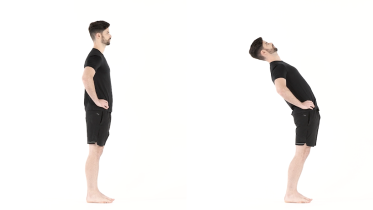 Standing back extension
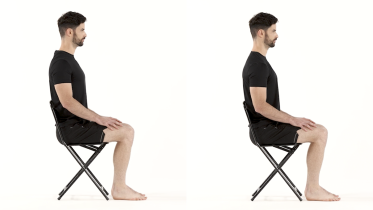 Chin tuck
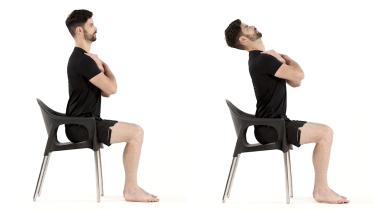 Seated thoracic extension
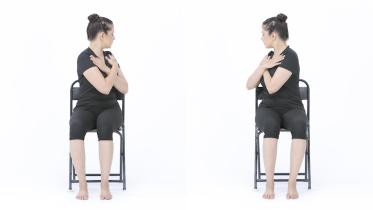 Seated trunk rotation
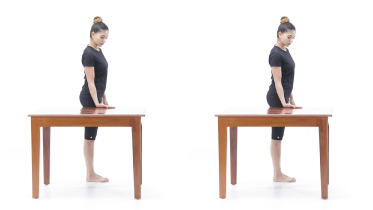 Wrist extensor stretch
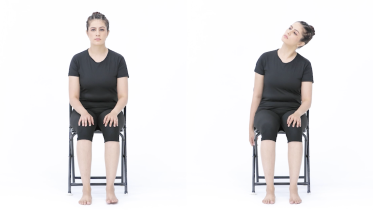 Upper trapezius stretch
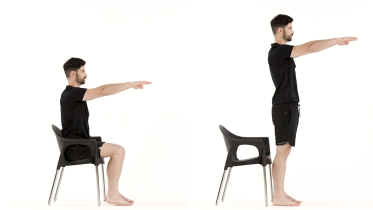 Sit to stand
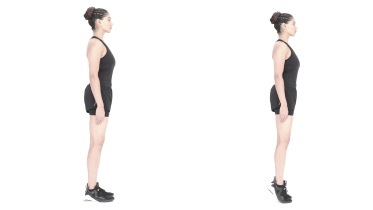 Calf raises
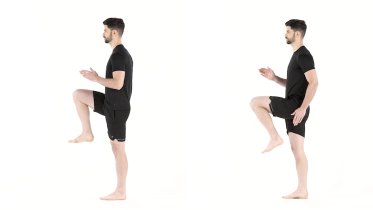 Marching on the spot
Who should check before trying these?
Every exercise page carries its own precautions, and a break at your desk does not change them. The ones that come up most often with this routine are below.
The chin tuck and upper trapezius stretch move the neck. After neck surgery or a broken bone in the neck, check with your surgeon or physio before you start. If a neck movement makes you dizzy, stop, sit still until it settles, and get medical advice the same day before you try again. The warning list below says what to do if it does not settle.
For the back and trunk moves, ask your physio how far to turn in the seated trunk rotation if you have low bone density (osteoporosis) or have broken a bone in your spine or ribs. If you have had a fracture in your spine, check with your physio before the seated thoracic extension as well. If you have had surgery on your spine in recent months, get the go-ahead from your surgical team or physio first. Backward bending often aggravates a narrowed spinal canal (spinal stenosis) or a forward-slipped vertebra (spondylolisthesis), so if you have been told you have either, ask your physio before the standing back extension.
After recent heart or chest surgery, get your surgeon's or surgical team's okay first, because the seated turn and the seated thoracic extension twist and stretch across the healing breastbone. If the breastbone clicks, grinds, shifts or feels as if it is moving while you do it, stop, and contact your surgical team the same day.
For the wrist extensor stretch: after a broken wrist, hand or forearm, or surgery on any of them such as a tendon repair, start only when your doctor, surgeon, physio or hand therapist says the bone or repair is ready for this, and follow their plan for how much to do. After a recent wrist sprain, check with your physio before stretching into a full bend. After a broken or dislocated elbow, or elbow surgery such as a tendon repair, follow your surgeon's or physio's plan, and start this exercise only when they have cleared you. If your thumb and first fingers tingle, leave this stretch out for now and ask your physio, because holding the wrist fully bent can press on the nerve at the wrist.
If you have had a hip replacement, get the go-ahead from your surgeon or physio before you try sit to stand or marching on the spot. Standing up from a low seat and lifting the knee high both bend the hip past a right angle, and many surgeons ask you to avoid that for the first months after some operations. If you are pregnant, check with your midwife or physio before you start sit to stand. After an Achilles tendon repair or ankle surgery, calf raises usually come back at a set stage of your surgeon's plan, so check with your physio first.
Keep a hand on the desk or a counter for the calf raises and the marching if your balance is unsure. With a heart condition or high blood pressure, check with your doctor before you start.
Stop the leg moves at once for chest pain or pressure, dizziness or feeling faint, a racing or irregular heartbeat, or being far more out of breath than the effort should cause. If chest pain does not ease quickly when you rest, call emergency services straight away. A face that droops on one side, an arm you cannot lift or keep up, speech that slurs, or sudden dizziness with a fall is a possible stroke, and also means calling emergency services, even if it passes. The warning list below gives the full set of signs for both.
Are desk stretches enough exercise?
No, and they are not meant to be. They break up sitting and move stiff joints, but they do little for fitness or strength. For a neck that keeps aching at work, strength has better evidence than stretching: a review of 27 workplace trials found moderate-quality evidence that neck and shoulder strengthening, and general fitness training, reduced neck pain in office workers who already had it (Chen and colleagues, 2018). The neck pain program and the working from home back and neck pain page build that strength in stages.
Short bursts of harder effort through the day are a separate idea, and exercise snacks covers what the research has and has not shown about them. If your forearms are the part that hurts, wrist pain from typing has the right next step, and the work from home ergonomics page helps if your setup keeps pushing you back into the same position.
When to see a physio (physical therapist)
Book an appointment if the same ache is still there after two or three weeks of regular breaks and a sensible setup, if any of these moves makes it clearly worse the next day, or if it is starting to affect your sleep or your work. Go sooner if pain, pins and needles or numbness spread into an arm or a leg.
A physio will want to know what your working day looks like as much as where it hurts. They can swap moves that do not suit you, add the strength work that a stretch routine leaves out, and set doses that fit your own neck, back or wrists. The warning signs below come first, at the speed each one gives.
Related exercise programs
Warning signs
Get emergency help now
- Emergency: if chest pain, pressure or tightness does not ease quickly when you rest, spreads to your arm, neck, jaw, stomach or back, or comes with sweating, feeling sick, feeling light-headed or being short of breath, call emergency services straight away, as this can be a heart attack. If it eases quickly and none of these happen, get medical advice the same day, and do not exercise again until you have been checked.
- Emergency: if you faint while exercising, call emergency services, even if you feel fine again quickly.
- Emergency: any sign of a stroke, even if it goes away. That means a face that droops on one side, an arm you cannot lift or keep up, slurred or muddled speech, weakness or numbness on one side of your body or face, sudden blurred vision, double vision or loss of sight, trouble swallowing, sudden dizziness with unsteadiness or falling over, a sudden severe headache, or a sudden fall where your legs give way but you do not black out (a drop attack). Call emergency services straight away. With neck pain, these can rarely come from a tear in an artery in the neck.
- Emergency: pain, tingling, numbness or weakness in both legs, numbness or altered feeling around your genitals or bottom, or new trouble peeing or controlling your bladder or bowels. The same applies if you lose feeling in one leg. Call emergency services or go to an emergency department straight away. These can be signs of pressure on the nerves at the base of the spine (cauda equina syndrome).
Get help today
- Same day: dizziness, a spinning feeling or feeling sick that comes on when you turn or tip your head, without any of the emergency signs above. Stop the exercises and get medical advice the same day. If you faint, it does not settle within a few minutes of sitting still, or you cannot stand or walk steadily, call emergency services.
- Same day: pins and needles in your arm or hand that do not go away after you stop, or part of your arm or hand goes numb. Get medical advice the same day. If one side of your face or body suddenly goes numb or weak, or your speech becomes slurred or muddled, call emergency services, even if it goes away.
- Same day: a calf or thigh that is newly swollen or getting more swollen, warm, tender, red or darker than usual, has swollen veins that are sore to touch, or has a throbbing or cramping pain that does not fit your injury or condition, or that feels different from normal muscle soreness after exercise. This can be a sign of a blood clot (deep vein thrombosis), especially after surgery, an injury, time in a cast or boot, a long trip or a spell of being much less mobile than usual. Get medical advice the same day. If you are also short of breath or have chest pain, call emergency services.
- Same day: severe pain that comes on suddenly or is getting worse quickly. Get medical advice the same day.
Common questions
What stretches can I do at my desk?
Ones that need nothing more than your chair and the table edge. Chin tucks and the upper trapezius stretch work the neck, seated thoracic extensions and seated trunk rotations move the upper back, the wrist extensor stretch eases the back of the forearm, and a standing back extension undoes some of the bend of a long sit. Add a few leg moves once a day, such as sit to stands from a chair that does not roll, calf raises holding the desk and marching on the spot. Each one has its own page with a video and the usual dose, and your physio will adjust this.
How often should I take a movement break?
There is no proven best interval. The WHO guidelines say the evidence was not enough to set a limit for sitting time (Bull and colleagues, 2020), and a 2025 Cochrane review found too little good-quality evidence to say which break schedule works best (Luger and colleagues, 2025). UK guidance for screen workers says short, frequent breaks beat long, rare ones, with the example that 5 to 10 minutes every hour is better than 20 minutes every 2 hours. In between those, a quick stand and stretch whenever you finish a task or a call keeps you from sitting still for long stretches. If your back is already sore, it usually prefers breaks that come sooner and more often.
How long should a desk movement break be?
Long enough to change position properly, which can be well under a minute. Trials in office workers have tested many different break lengths and schedules, and none has set a minimum. A useful pattern is a quick stand and stretch of about a minute several times a day, a 3 minute set for the neck, the upper back and the wrists a few times a day, and one longer break that adds some leg work. Getting up often matters more than how long each break lasts.
Do movement breaks count as exercise?
Partly. They break up sitting, which the WHO guidelines advise for adults, and they move the joints that stiffen at a desk, but a few stretches will not get your heart and lungs working or build much strength. The same guidelines still advise 150 to 300 minutes of moderate activity a week, or 75 to 150 minutes of vigorous activity, plus muscle strengthening on at least 2 days (Bull and colleagues, 2020). Think of the breaks as one part of an active day rather than a replacement for the rest of it.
References
- Waongenngarm P, Areerak K, Janwantanakul P. The effects of breaks on low back pain, discomfort, and work productivity in office workers: a systematic review of randomized and non-randomized controlled trials. Applied Ergonomics. 2018;68:230-239. https://doi.org/10.1016/j.apergo.2017.12.003
- Waongenngarm P, van der Beek AJ, Akkarakittichoke N, Janwantanakul P. Effects of an active break and postural shift intervention on preventing neck and low-back pain among high-risk office workers: a 3-arm cluster-randomized controlled trial. Scandinavian Journal of Work, Environment and Health. 2021;47(4):306-317. https://doi.org/10.5271/sjweh.3949
- Luger T, Ferenchak SA, Rieger MA, Steinhilber B. Work-break interventions for preventing musculoskeletal symptoms and disorders in healthy workers. Cochrane Database of Systematic Reviews. 2025;(10):CD012886. https://doi.org/10.1002/14651858.CD012886.pub3
- Bull FC, Al-Ansari SS, Biddle S, et al. World Health Organization 2020 guidelines on physical activity and sedentary behaviour. British Journal of Sports Medicine. 2020;54(24):1451-1462. https://doi.org/10.1136/bjsports-2020-102955
- Health and Safety Executive. Work routine and breaks: display screen equipment (DSE). https://www.hse.gov.uk/msd/dse/work-routine.htm
- Australian Government. Australian 24-hour movement guidelines for adults (18 to 64 years) and older adults (65 years and over). 2026. https://www.health.gov.au/sites/default/files/2026-03/australian-24-hour-movement-guidelines-for-adults-18-to-64-years-and-older-adults-65-years.pdf
- Chen X, Coombes BK, Sjøgaard G, Jun D, O'Leary S, Johnston V. Workplace-based interventions for neck pain in office workers: systematic review and meta-analysis. Physical Therapy. 2018;98(1):40-62. https://doi.org/10.1093/ptj/pzx101
- NHS. Chest pain. Page last reviewed 8 August 2023. https://www.nhs.uk/symptoms/chest-pain/
- NHS. Fainting. Page last reviewed 17 August 2026. https://www.nhs.uk/symptoms/fainting/
- NHS. Symptoms of a stroke. Page last reviewed 12 September 2024. https://www.nhs.uk/conditions/stroke/symptoms/
- NHS. DVT (deep vein thrombosis). Page last reviewed 30 April 2026. https://www.nhs.uk/conditions/deep-vein-thrombosis-dvt/
Written and checked by the PocketPhysio editorial team. Last updated 2026-10-16.
This page is general education, not a diagnosis or a personal treatment plan. See a physiotherapist or doctor for advice about your own situation.