
Part of Desk job pain: neck, back and wrist aches sorted by body area
Standing desk back pain: does standing help, and can it make things worse?
Warning signs, and when to get help
Does a standing desk help back pain?
It helps you sit less. Whether it helps your back is far less certain. A Cochrane review of workplace programs found that office workers given sit-stand desks sat for roughly 100 fewer minutes each working day in the first three months, and for about an hour less a day after three to twelve months, although the evidence was low quality and nobody has tracked it for longer (Shrestha and colleagues, 2018).
Pain is a different question. When a second Cochrane team pooled the trials that measured musculoskeletal symptoms, sit-stand desks did not lower how strongly people felt their low back symptoms over the short term compared with carrying on as before. The evidence was low quality, and the authors noted that some changes to the physical workplace hinted at a benefit that larger trials could still confirm (Parry and colleagues, 2019). The back pain when sitting page reaches the same view from the sitting side.
One meta-analysis is a little more positive. Pooling 8 studies, it found a small drop in low back discomfort with sit-stand desks, mostly in workers who had no back pain to start with, worth roughly a third to half a point on a 0 to 10 scale (Agarwal and colleagues, 2018). The authors pointed out that hardly any studies included people who already had back pain. So the honest summary is a modest comfort gain for some people, rather than a treatment.
Do standing desks really cut back pain by half?
You will see figures like this on desk sellers' pages. The best-known version seems to come from a small workplace project in Minneapolis, where 24 office workers were given a sit-stand device for 4 weeks and 10 colleagues were not (Pronk and colleagues, 2012). Upper back and neck pain dropped by 54% in the group with the device, and most of the improvement had gone within 2 weeks of the devices being taken away.
That is an interesting early study, but it measured upper back and neck pain rather than low back pain, it was small, and it lasted a month. It is not evidence that a standing desk halves back pain, and the larger reviews above found much smaller effects or none.
Can a standing desk cause back pain?
It can, if you simply replace one fixed position with another. In a lab study, 20 adults stood at a computer for 2 hours, and their discomfort rose in every body area as the time went on, reaching levels that matter in the low back and around the hips and thighs (Baker and colleagues, 2018). A review of mainly workplace surveys found that standing for more than 4 hours a workday went with somewhat higher odds of low back symptoms (Coenen and colleagues, 2018). Most of those studies were snapshots, so they show a link rather than a cause.
In clinic, the people who come in with standing desk back pain usually bought the desk on a Monday and stood all week. Their backs were not damaged; they had swapped hours of stillness in a chair for hours of stillness on their feet. The fix is almost always the same: shorter spells and more switching.
One pattern needs a different response. If standing or walking brings on aching, heaviness, cramping or tingling in your buttocks or legs that eases when you sit or bend forward, that fits spinal stenosis more than a desk problem, and it is worth having examined. Pain running below the knee with tingling in the foot belongs with the sciatica program.
How long should you stand at a standing desk?
Nobody has tested an ideal amount. A 2015 expert statement suggested that office workers build up to 2 hours a day of standing and light walking during working hours, and later to 4 hours (Buckley and colleagues, 2015). It was expert opinion rather than a trial result, and it counted walking as well as standing, so it is not a target for standing still.
A starting pattern many physios use, as practice rather than a tested rule:
- Stand for 15 to 30 minutes at a time, two or three times a day, for the first week.
- Add time only when your back and feet feel fine the next morning.
- Switch before you start to ache rather than after, and sit back down without guilt.
- Use the switch as a cue to move: a few calf raises, a back extension, or a walk to refill your water glass.
The movement breaks page has short routines to fill those switches, and the neck and back page covers the rest of a desk day.
Setting the height of a standing desk
Set the desk so that, standing tall with your shoulders relaxed, your elbows bend to about a right angle and your forearms rest roughly level with the keyboard, with your wrists close to straight. That height depends entirely on your own body, so ignore any fixed number on the box. Then check the screen: the US Occupational Safety and Health Administration suggests the top line sits at or below eye level, about 50 to 100 cm (20 to 40 inches) from your eyes. A laptop on a standing desk still needs a separate keyboard and a raised screen, just as it does when you sit.
Reset the height every time you switch, because your sitting and standing heights differ. Many people skip this and end up hunched over a desk left at its sitting height. While you stand, shift your weight from foot to foot, and rest one foot on a low box or step now and then if it eases your back.
Wear supportive shoes rather than standing in socks for long spells. Some people find an anti-fatigue mat makes standing more comfortable, which is a fair reason to use one, but none of the reviews on this page tested mats, so treat one as a comfort choice. The home desk setup page covers chairs, laptops and screens in more detail.
Exercises for the standing parts of the day
These three suit a standing desk. Calf raises get the muscles of the lower leg working while you stand, which is when the legs tend to feel heavy. The standing back extension moves your lower back the opposite way to a long spell of leaning toward the screen. Brisk walking is the one that changes the day most; a short walk at lunchtime and at the end of work does more than any desk setting.
If your balance is unsure, do calf raises facing a kitchen counter or with a wall within reach. If you have had an Achilles tendon repair or ankle surgery, your physio will tell you when calf raises fit into your plan. Ask your physio before the standing back extension if you have been told you have spinal stenosis (a narrowed spinal canal) or spondylolisthesis (a vertebra that has slipped forward), as leaning back tends to stir both up. With a heart or lung condition, high blood pressure, or after a recent operation, ask your doctor or physio how much to walk and how fast before you start. If you are pregnant, check with your midwife or physio before you start brisk walking.
Exercises that can help
These three suit the standing and moving parts of the day. Many programs use 2 to 3 sets of 10 to 15 calf raises on both legs once a day or a few days a week, 3 to 5 standing back extensions held for about 10 seconds several times a day, and 10 to 20 minutes of brisk walking on most days, adding time before speed. Your physio will adjust this.
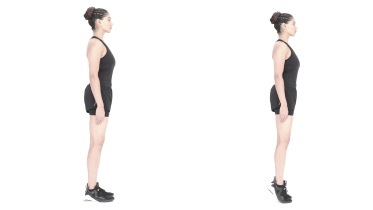 Calf raises
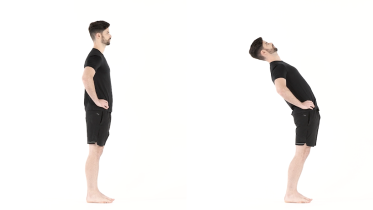 Standing back extension
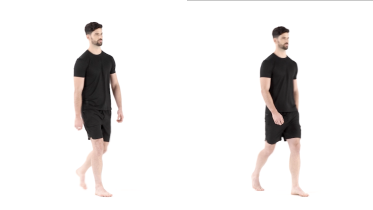 Brisk walking
Stop an exercise if pain spreads into your buttock or leg or you get numbness or tingling, and tell your physio. Chest pain, pressure or tightness during exercise means stopping at once; if it does not ease quickly when you rest, or comes with sweating, feeling sick or breathlessness, call emergency services. The warning signs below give the full line.
When to see a physio (physical therapist)
Book an assessment if your back has not clearly improved after a few weeks of changing how you sit, stand and move, if standing brings on symptoms in your legs, or if the pain keeps returning every busy week. A physio will look at your desk, your day and how your back moves, and can set a plan that suits the work you do. Guidelines for back pain put staying active and exercise first, ahead of equipment (NICE NG59), and the low back pain program builds that up stage by stage.
Serious causes of back pain are uncommon, and clinicians screen for them on purpose using an agreed set of warning features (Finucane and colleagues, 2020). Numbness around your genitals or bottom, new trouble with your bladder or bowels, or pain, tingling, numbness or weakness in both legs means calling emergency services or going to an emergency department straight away. The warning signs below carry their own time frames, and the working from home and desk work hub links the rest of this topic.
Related exercise programs
Warning signs
Get emergency help now
- Emergency: if chest pain, pressure or tightness does not ease quickly when you rest, spreads to your arm, neck, jaw, stomach or back, or comes with sweating, feeling sick, feeling light-headed or being short of breath, call emergency services straight away, as this can be a heart attack. If it eases quickly and none of these happen, get medical advice the same day, and do not exercise again until you have been checked.
- Emergency: if you faint while exercising, call emergency services, even if you feel fine again quickly.
- Emergency: numbness, tingling or altered feeling around or under your genitals, between your inner thighs, or around your bottom (anus), for example it feels different when you wipe after using the toilet. Call emergency services or go to an emergency department straight away. This can be a sign of pressure on the bundle of nerves at the base of the spine (cauda equina syndrome), which needs emergency treatment.
- Emergency: you find it hard to start peeing, cannot pee, cannot feel yourself peeing or cannot control when you pee, or you do not notice when you need to poo or cannot control when you poo, and this is not normal for you. The same applies to a new change in how your genitals feel during sex, or new trouble getting an erection or ejaculating. Call emergency services or go to an emergency department straight away. These can also be signs of cauda equina syndrome.
- Emergency: sciatica in both legs, or pain, tingling, numbness or weakness in both legs. The same applies if you lose feeling in one leg. Call emergency services or go to an emergency department straight away.
- Emergency: back or leg pain that started after a serious accident, such as a car crash or a fall from a height, or back pain with chest pain. Call emergency services. If the pain started straight after the accident, keep still while you wait.
- Emergency: sudden, severe pain in your lower back or tummy that is not like your usual back pain, if you have been told you have a swelling of the main blood vessel in your tummy (abdominal aortic aneurysm), you are over 60, you smoke or used to smoke, or you have high blood pressure. The same applies if sudden, severe back or tummy pain comes with feeling faint or passing out, pale, sweaty or clammy skin, a racing heartbeat or being short of breath. Call emergency services straight away. This can be a sign of an aneurysm bursting, which needs treatment in hospital at once.
- Emergency: you have had cancer, now or in the past, and your back or neck pain feels like a tight band around your body, or comes with pain spreading down an arm or leg, weakness, numbness or pins and needles in your arms or legs, trouble walking, or trouble controlling your bladder or bowels. Call your cancer team's emergency number straight away, or go to an emergency department if you do not have one or cannot get through. This can be cancer pressing on the spinal cord (metastatic spinal cord compression), which needs treatment straight away.
- Emergency: new neck or back pain after a fall, a knock or a jolt, even a minor one such as a trip or a sudden stop in a car, if you have a condition that stiffens the spine, such as ankylosing spondylitis. Call emergency services or go to an emergency department straight away, do not drive yourself, and tell the staff about your spine condition, so they keep your neck and back in their usual position. A stiff spine can break after a small injury, and the break is easy to miss at first. If the pain started straight after the injury, or you also have numbness, tingling or weakness in your arms or legs, keep still and call emergency services.
- Emergency: back pain with a fever, or you feel hot, shivery or very unwell, and you also have new weakness, numbness or tingling in one or both legs, or new trouble with your bladder or bowels. Call emergency services or go to an emergency department straight away. This can be an infection pressing on the nerves in the spine (spinal epidural abscess), which needs emergency treatment.
Get help today
- Same day: a leg or foot that is getting weaker, for example your foot drags, catches on the ground or slaps down when you walk (foot drop). Get medical advice the same day. If the weakness is getting worse by the hour, go to an emergency department.
- Same day: back or leg pain with a fever, or you feel hot, cold, shivery or generally unwell. Get medical advice the same day, and go to an emergency department if you feel very unwell.
- Same day: you have back pain and have lost weight without trying. Get medical advice the same day and mention the weight loss.
- Same day: new back pain and you have had cancer, now or in the past. Get medical advice the same day and mention your cancer history. If you are being treated for cancer now, contact your cancer team the same day.
- Same day: back pain after a minor fall or strain if you are older, have low bone density (osteoporosis) or have taken steroid tablets for a long time. Get medical advice the same day.
- Same day: a calf or thigh that is newly swollen or getting more swollen, warm, tender, red or darker than usual, has swollen veins that are sore to touch, or has a throbbing or cramping pain that does not fit your injury or condition, or that feels different from normal muscle soreness after exercise. This can be a sign of a blood clot (deep vein thrombosis), especially after surgery, an injury, time in a cast or boot, a long trip or a spell of being much less mobile than usual. Get medical advice the same day. If you are also short of breath or have chest pain, call emergency services.
- Same day: severe pain that comes on suddenly or is getting worse quickly. Get medical advice the same day.
- Same day: pain that is worse at night, or does not ease at all when you rest. If you have had cancer, now or in the past, or you have lost weight without trying, get medical advice the same day.
Book an appointment
- Within a few days: pain that is worse at night, or does not ease at all when you rest. See your doctor within a few days.
- Within a week or two: back or buttock pain that started before the age of 45, has lasted more than three months, is worse after rest and in the morning, and eases when you move. This is not an emergency, but see your doctor in the next week or two and ask whether it could be inflammatory back pain (axial spondyloarthritis).
Common questions
Is a standing desk good for back pain?
It can help some people feel more comfortable, but it is not a proven treatment. Pooled workplace trials found that sit-stand desks did not reduce how strongly people felt their low back symptoms in the short term compared with no change, on low-quality evidence (Parry and colleagues, 2019). A separate meta-analysis found a small drop in low back discomfort, mainly in workers who had no back pain to begin with (Agarwal and colleagues, 2018). The desk is most useful as a way to change position more often, alongside walking and exercise.
Can a standing desk make back pain worse?
Yes, if you swap long sitting for long standing. In a lab study, 20 adults who stood at a computer for 2 hours reported more discomfort in every body area as the time went on (Baker and colleagues, 2018), and a review of workplace studies linked standing for more than 4 hours a workday with low back symptoms (Coenen and colleagues, 2018). Build standing time up gradually and keep switching between sitting, standing and moving. If standing brings on aching, heaviness or tingling in your legs that eases when you sit or bend forward, get it checked, as that pattern fits spinal stenosis.
How long should I stand at a standing desk each day?
No trial has worked out the right amount. A 2015 expert statement suggested office workers build up to 2 hours a day of standing and light walking during working hours, and later to 4 hours (Buckley and colleagues, 2015), but that was expert opinion rather than a tested dose. In practice, many physios suggest starting with standing spells of 15 to 30 minutes a few times a day and adding time only when your back and feet are fine the next morning. Your physio will adjust this.
Do I need an anti-fatigue mat for a standing desk?
Not necessarily. Some people find a cushioned mat makes longer standing spells more comfortable, which is a fair reason to use one, but none of the reviews on this page tested mats for back pain, so treat one as a comfort choice rather than a treatment. Supportive shoes, shifting your weight and switching back to sitting before you start to ache matter more.
References
- Parry SP, Coenen P, Shrestha N, O'Sullivan PB, Maher CG, Straker LM. Workplace interventions for increasing standing or walking for decreasing musculoskeletal symptoms in sedentary workers. Cochrane Database of Systematic Reviews. 2019;(11):CD012487. https://doi.org/10.1002/14651858.CD012487.pub2
- Shrestha N, Kukkonen-Harjula KT, Verbeek JH, Ijaz S, Hermans V, Pedisic Z. Workplace interventions for reducing sitting at work. Cochrane Database of Systematic Reviews. 2018;(12):CD010912. https://doi.org/10.1002/14651858.CD010912.pub5
- Agarwal S, Steinmaus C, Harris-Adamson C. Sit-stand workstations and impact on low back discomfort: a systematic review and meta-analysis. Ergonomics. 2018;61(4):538-552. https://doi.org/10.1080/00140139.2017.1402960
- Coenen P, Willenberg L, Parry S, et al. Associations of occupational standing with musculoskeletal symptoms: a systematic review with meta-analysis. British Journal of Sports Medicine. 2018;52(3):176-183. https://pubmed.ncbi.nlm.nih.gov/27884862/
- Baker R, Coenen P, Howie E, Williamson A, Straker L. A detailed description of the short-term musculoskeletal and cognitive effects of prolonged standing for office computer work. Ergonomics. 2018;61(7):877-890. https://doi.org/10.1080/00140139.2017.1420825
- Pronk NP, Katz AS, Lowry M, Payfer JR. Reducing occupational sitting time and improving worker health: the Take-a-Stand Project, 2011. Preventing Chronic Disease. 2012;9:E154. https://doi.org/10.5888/pcd9.110323
- Buckley JP, Hedge A, Yates T, et al. The sedentary office: an expert statement on the growing case for change towards better health and productivity. British Journal of Sports Medicine. 2015;49(21):1357-1362. https://doi.org/10.1136/bjsports-2015-094618
- Occupational Safety and Health Administration. Computer workstations eTool: monitors. https://www.osha.gov/etools/computer-workstations/components/monitors
- National Institute for Health and Care Excellence. Low back pain and sciatica in over 16s: assessment and management (NG59). Published 2016, last updated July 2026. https://www.nice.org.uk/guidance/ng59
- NHS. Back pain. Page last reviewed 5 March 2026. https://www.nhs.uk/conditions/back-pain/
- Finucane LM, Downie A, Mercer C, et al. International framework for red flags for potential serious spinal pathologies. Journal of Orthopaedic and Sports Physical Therapy. 2020;50(7):350-372. https://doi.org/10.2519/jospt.2020.9971
- NHS. Chest pain. Page last reviewed 8 August 2023. https://www.nhs.uk/symptoms/chest-pain/
- NHS. Deep vein thrombosis. https://www.nhs.uk/conditions/deep-vein-thrombosis-dvt/
- NHS. Fainting. https://www.nhs.uk/symptoms/fainting/
- NHS. Abdominal aortic aneurysm. https://www.nhs.uk/conditions/abdominal-aortic-aneurysm/
- National Institute for Health and Care Excellence. Abdominal aortic aneurysm: diagnosis and management (NG156). 2020. https://www.nice.org.uk/guidance/ng156
- Darouiche RO. Spinal epidural abscess. New England Journal of Medicine. 2006;355(19):2012-2020. https://doi.org/10.1056/NEJMra055111
Written and checked by the PocketPhysio editorial team. Last updated 2026-10-16.
This page is general education, not a diagnosis or a personal treatment plan. See a physiotherapist or doctor for advice about your own situation.