
Part of Desk job pain: neck, back and wrist aches sorted by body area
Working from home back and neck pain: why it starts and a desk routine that helps
Warning signs, and when to get help
Why does working from home cause back and neck pain?
It is rarely one thing. The move home changed the furniture and the hours, and took away a lot of incidental movement, all at once, and a neck or back that coped with the old pattern can start to complain under the new one. Nothing has to be damaged for that to happen.
The research fits that picture without proving a cause. A Dutch study followed more than 40,000 workers through the first year of the pandemic and found that those working from home had slightly higher odds of pain in the low back, the upper back and the neck, shoulders or arms than those still going in to work (Bosma and colleagues, 2023). The differences were modest, which matches what physios see: plenty of home workers have no trouble at all.
The quality of the home setup looks like part of the story. In a Japanese survey of nearly 13,000 desk workers, working from home 2 or more days a week went with higher odds of low back pain among people whose home workspace was poor, while people with a good workspace showed no such rise as their home days increased (Matsugaki and colleagues, 2022). That was a single survey at one point in time, so it shows a link rather than proof, but it points at something you can change.
The part people forget is the lost movement. The walk to the train, the stairs to a meeting, the trip to a colleague's desk: at home those vanish, and a whole day can pass with little more than trips from the desk to the kettle and back. In clinic, the home workers whose pain settles fastest are usually the ones who put that movement back on purpose.
Is it the laptop, the chair or the hours?
All three, in that rough order of how often they turn up. A laptop joins the screen and the keyboard, so you can have one at a good height or the other, never both. Used flat on a table, it pulls your head down and forward for hours, and physios see that pattern over and over in people who work from home. The US Occupational Safety and Health Administration suggests the top line of the screen sits at or below eye level, at a distance of about 50 to 100 cm (20 to 40 inches) from your eyes. A stack of books under the laptop plus a separate keyboard and mouse gets you there for very little money, and the home desk setup page walks through the rest.
The chair matters less than people expect. A dining chair is fine for many backs if your feet reach the floor and you can sit back into it, with a small cushion behind your lower back if that feels easier. What a chair cannot do is make eight unbroken hours comfortable. The back pain when sitting page covers why the length of a sitting spell tends to matter more than its exact shape.
There is no single correct posture to hold all day either. A forward head is common in people with and without neck pain, and the forward head posture page explains what the research does and does not show. A useful rule in practice: whatever position you are in, plan to be in a different one in half an hour.
Sit, stand, walk: shaping the home working day
Think about the pattern of the whole day before the details of the desk. A rough rhythm many physios suggest, as practice rather than a tested rule, is a change of position every 30 minutes or so, a few minutes on your feet every hour, and a proper walk at least once in the working day. Take calls standing or walking where you can. Read long documents in a different chair from the one you type in.
Evidence for breaks is thin rather than strong. A Cochrane review of ergonomic programs for office workers found very low-quality evidence that extra short breaks eased neck and arm discomfort in data entry workers (Hoe and colleagues, 2018). That is not a reason to skip them; it is a reason not to expect miracles from any single fix. The movement breaks page has timed break routines, and the standing desks page covers whether a sit-stand desk is worth buying.
Use the old commuting time. A 15 to 20 minute walk before you sit down in the morning, or at the time you used to travel home, replaces the movement you lost and gives your neck and back a break from the screen in one go.
A 10 minute desk routine for the neck and back
The six exercises below take about 10 minutes if you do them all, and most people split them across the day. The first five can be done in a work chair. The chin tuck and the upper trapezius stretch suit a neck that stiffens through the afternoon. The scapular squeeze and the seated thoracic extension work the upper back, which tends to round toward a low screen. The seated turn and the standing back extension move the middle and lower back the opposite way to sitting.
A mild stretch or a working feeling is normal. Stop an exercise if pain, numbness or tingling spreads into an arm or leg, and tell your physio. If a neck movement makes you dizzy, stop, sit still until it settles, and get medical advice the same day before you try again. The warning signs below give the full list with their time frames.
After neck surgery or a broken bone in the neck, check with your surgeon or physio before you start. If you have rheumatoid arthritis, or you have been told the spaces around the nerves or spinal cord in your neck are narrowed, check with your physio or doctor before you start. The same applies if you have Down syndrome or have been told the top of your neck is unstable. If you have had surgery on your spine in recent months, get the go-ahead from your surgical team or physio first. If you have low bone density (osteoporosis) or have broken a bone in your spine, check with your physio how far to take the turns and the backward leans. With spinal stenosis or spondylolisthesis, ask your physio before you lean back in the standing back extension.
After recent heart or chest surgery, get your surgeon's or surgical team's okay first, because the scapular squeeze, the seated thoracic extension and the seated turn all pull and twist across the healing breastbone. If the breastbone clicks, grinds, shifts or feels as if it is moving while you do it, stop, and contact your surgical team the same day.
Exercises that can help
These six fit into a work chair or the space beside your desk. Many programs use 8 to 10 chin tucks with a 3 to 5 second hold, upper trapezius stretch holds of 15 to 30 seconds repeated 2 to 3 times on each side, 10 to 15 shoulder blade squeezes held for about 5 seconds, 5 to 10 slow seated thoracic extensions, 5 to 10 slow seated turns to each side, and 3 to 5 standing back extensions held for about 10 seconds. Each exercise page says how often to repeat it through the day. Your physio will adjust this.
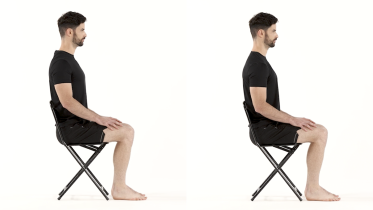 Chin tuck
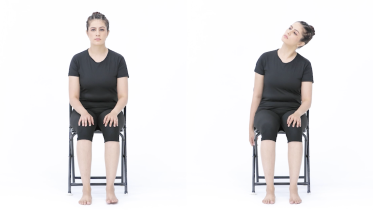 Upper trapezius stretch
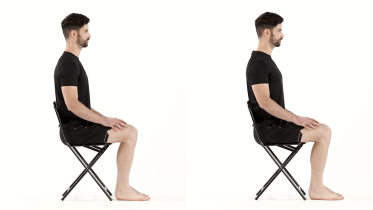 Scapular squeeze
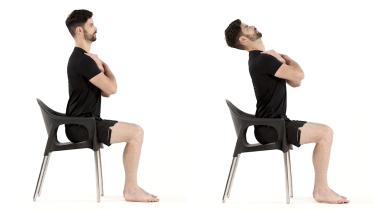 Seated thoracic extension
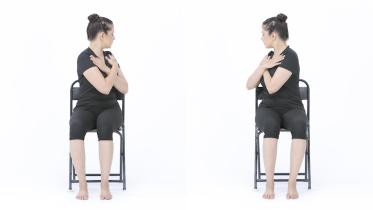 Seated trunk rotation
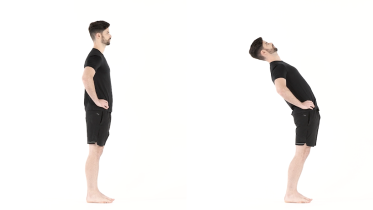 Standing back extension
Do exercises help desk neck and back pain?
For the neck, the best support is for strength work. A review of 8 trials in office workers with neck pain found that strengthening exercise reduced neck pain compared with no exercise (Louw and colleagues, 2017). The US physical therapy guideline for neck pain recommends exercise for the neck and the muscles around the shoulder blades at every stage, with endurance work once pain has hung around for a few weeks (Blanpied and colleagues, 2017). The neck pain program builds that up stage by stage, and the upper back pain program does the same between the shoulder blades.
For the lower back, guidelines put staying active and exercise ahead of passive treatment. NICE suggests considering a group exercise program and encourages people to carry on with their normal activities, and the 2021 US guideline for physical therapists recommends exercise for back pain that has lasted (George and colleagues, 2021). The low back pain program is the place to start if the back is the main problem. The desk routine above is a way to break up the day; it does not replace a full program for a back or neck that keeps flaring.
When is it more than a desk ache?
Most desk aches stay in the neck, the shoulders and the back, ease within minutes of moving, and are better at the weekend. A few patterns are different. Pain, pins and needles or numbness running down one arm can come from an irritated nerve in the neck, which the cervical radiculopathy page covers. Pain running below the knee with tingling in the foot points to the sciatica program rather than a desk routine.
Headaches that build through the working day and sit like a band around the head often fit tension-type headache, and that page lists the headache warning signs that need a doctor quickly. If the ache is mostly a burning or aching spot beside a shoulder blade, pain between the shoulder blades sorts the usual causes, including the rare ones that come from the heart or lungs.
A few signs cannot wait. Any sign of a stroke, such as a face that droops on one side, an arm you cannot lift or keep up, speech that slurs or sudden dizziness with a fall, means calling emergency services straight away. Numbness around your genitals or bottom, new trouble with your bladder or bowels, or pain, tingling, numbness or weakness in both legs means calling emergency services or going to an emergency department straight away. Every warning sign, with how fast to act on it, is in the list at the bottom of this page.
When to see a physio (physical therapist)
Book an assessment if the pain has not clearly improved after a few weeks of changing your setup and your day, if it wakes you at night, if it keeps coming back every busy week, or if anything spreads into an arm or leg. A physio will look at how your neck and back move alongside how your desk and working day are set up, and that usually gives you a more useful plan than another piece of equipment. Serious causes are uncommon. Part of every assessment is a deliberate check for them, using warning features that an international group of clinicians agreed on (Finucane and colleagues, 2020).
For wrist and forearm aches from typing, see the wrists page, and for the rest of this topic, start at the working from home and desk work hub.
Related exercise programs
Warning signs
Get emergency help now
- Emergency: any sign of a stroke, even if it goes away. That means a face that droops on one side, an arm you cannot lift or keep up, slurred or muddled speech, weakness or numbness on one side of your body or face, sudden blurred vision, double vision or loss of sight, trouble swallowing, sudden dizziness with unsteadiness or falling over, a sudden severe headache, or a sudden fall where your legs give way but you do not black out (a drop attack). Call emergency services straight away. With neck pain, these can rarely come from a tear in an artery in the neck.
- Emergency: a new headache, or new pain on one side of your face, jaw or neck, with a drooping eyelid or a smaller pupil on the same side, or with a new pulsing or whooshing sound in one ear that keeps time with your heartbeat. Call emergency services or go to an emergency department straight away, and do not drive yourself. This can be a tear in an artery in the neck (cervical artery dissection), which can lead to a stroke.
- Emergency: a sudden, severe headache or neck pain that feels new and unlike anything you have had before. Call emergency services straight away.
- Emergency: neck, jaw or arm pain that comes with chest pain, shortness of breath, sweating or feeling sick. Call emergency services.
- Emergency: back or leg pain that started after a serious accident, such as a car crash or a fall from a height, or back pain with chest pain. Call emergency services. If the pain started straight after the accident, keep still while you wait.
- Emergency: sudden, severe pain in your lower back or tummy that is not like your usual back pain, if you have been told you have a swelling of the main blood vessel in your tummy (abdominal aortic aneurysm), you are over 60, you smoke or used to smoke, or you have high blood pressure. The same applies if sudden, severe back or tummy pain comes with feeling faint or passing out, pale, sweaty or clammy skin, a racing heartbeat or being short of breath. Call emergency services straight away. This can be a sign of an aneurysm bursting, which needs treatment in hospital at once.
- Emergency: new problems walking, for example your legs feel stiff, heavy or weak or you have become unsteady on your feet, new trouble controlling your bladder or bowels, or hands that suddenly become clumsy, for example you can no longer do up buttons. Call emergency services straight away. These can be signs of pressure on the spinal cord in the neck.
- Emergency: numbness, tingling or altered feeling around or under your genitals, between your inner thighs, or around your bottom (anus), for example it feels different when you wipe after using the toilet. Call emergency services or go to an emergency department straight away. This can be a sign of pressure on the bundle of nerves at the base of the spine (cauda equina syndrome), which needs emergency treatment.
- Emergency: you find it hard to start peeing, cannot pee, cannot feel yourself peeing or cannot control when you pee, or you do not notice when you need to poo or cannot control when you poo, and this is not normal for you. The same applies to a new change in how your genitals feel during sex, or new trouble getting an erection or ejaculating. Call emergency services or go to an emergency department straight away. These can also be signs of cauda equina syndrome.
- Emergency: sciatica in both legs, or pain, tingling, numbness or weakness in both legs. The same applies if you lose feeling in one leg. Call emergency services or go to an emergency department straight away.
- Emergency: you have had cancer, now or in the past, and your back or neck pain feels like a tight band around your body, or comes with pain spreading down an arm or leg, weakness, numbness or pins and needles in your arms or legs, trouble walking, or trouble controlling your bladder or bowels. Call your cancer team's emergency number straight away, or go to an emergency department if you do not have one or cannot get through. This can be cancer pressing on the spinal cord (metastatic spinal cord compression), which needs treatment straight away.
- Emergency: new neck or back pain after a fall, a knock or a jolt, even a minor one such as a trip or a sudden stop in a car, if you have a condition that stiffens the spine, such as ankylosing spondylitis. Call emergency services or go to an emergency department straight away, do not drive yourself, and tell the staff about your spine condition, so they keep your neck and back in their usual position. A stiff spine can break after a small injury, and the break is easy to miss at first. If the pain started straight after the injury, or you also have numbness, tingling or weakness in your arms or legs, keep still and call emergency services.
- Emergency: a stiff neck with a fever, a severe headache that is getting worse, pain when you look at bright lights, confusion, or a rash that does not fade when you press a glass on it. Call emergency services. These can be signs of meningitis.
- Emergency: back pain with a fever, or you feel hot, shivery or very unwell, and you also have new weakness, numbness or tingling in one or both legs, or new trouble with your bladder or bowels. Call emergency services or go to an emergency department straight away. This can be an infection pressing on the nerves in the spine (spinal epidural abscess), which needs emergency treatment.
- Emergency: neck pain with a fever, or you feel hot, shivery or very unwell, and you also have new weakness, numbness or tingling in one or both arms or legs, new trouble walking, or new trouble with your bladder or bowels. Call emergency services or go to an emergency department straight away. This can be an infection pressing on the spinal cord or nerves in the neck (spinal epidural abscess), which needs emergency treatment.
Get help now, day or night
- You have rheumatoid arthritis and get new neck pain, or a new headache at the back of your head that keeps coming back. If it comes with tingling or numbness in your hands or arms, get medical advice the same day. If you also feel unsteady on your feet or your legs feel stiff, heavy or weak, call emergency services straight away. Without any of those, tell your doctor or rheumatology team within a few days, and leave out any neck exercises until you have been checked.
Get help today
- Same day: dizziness, a spinning feeling or feeling sick that comes on when you turn or tip your head, without any of the emergency signs above. Stop the exercises and get medical advice the same day. If you faint, it does not settle within a few minutes of sitting still, or you cannot stand or walk steadily, call emergency services.
- Same day: hands that have slowly become clumsy, for example trouble doing up buttons or dropping things, or numbness in both hands. Get medical advice the same day. These can be signs of pressure on the spinal cord in the neck (cervical myelopathy). If the clumsiness or numbness gets worse quickly, call emergency services straight away.
- Same day: pain or tingling in both arms at the same time, rather than in one. Get medical advice the same day. This can also be a sign of pressure on the spinal cord in the neck.
- Same day: an arm or hand that is getting weaker. Get medical advice the same day.
- Same day: a leg or foot that is getting weaker, for example your foot drags, catches on the ground or slaps down when you walk (foot drop). Get medical advice the same day. If the weakness is getting worse by the hour, go to an emergency department.
- Same day: severe pain that comes on suddenly or is getting worse quickly. Get medical advice the same day.
- Same day: neck pain with a fever or chills, or you feel generally unwell. Get medical advice the same day, and go to an emergency department if you feel very unwell.
- Same day: back or leg pain with a fever, or you feel hot, cold, shivery or generally unwell. Get medical advice the same day, and go to an emergency department if you feel very unwell.
- Same day: new neck pain and you have had cancer, now or in the past, or you have lost weight without trying. Get medical advice the same day and mention it. If you are being treated for cancer now, contact your cancer team the same day.
- Same day: new back pain and you have had cancer, now or in the past. Get medical advice the same day and mention your cancer history. If you are being treated for cancer now, contact your cancer team the same day.
- Same day: you have back pain and have lost weight without trying. Get medical advice the same day and mention the weight loss.
- Same day: back pain after a minor fall or strain if you are older, have low bone density (osteoporosis) or have taken steroid tablets for a long time. Get medical advice the same day.
- Same day: pain that is worse at night, or does not ease at all when you rest. If you have had cancer, now or in the past, or you have lost weight without trying, get medical advice the same day.
Book an appointment
- Within a few days: pain that is worse at night, or does not ease at all when you rest. See your doctor within a few days.
- Within a week or two: back or buttock pain that started before the age of 45, has lasted more than three months, is worse after rest and in the morning, and eases when you move. This is not an emergency, but see your doctor in the next week or two and ask whether it could be inflammatory back pain (axial spondyloarthritis).
Common questions
Why did my neck and back start hurting after working from home?
Usually because the home working day changed shape. Many people swapped an office desk for a laptop on a kitchen table, lost the walk to the station and the trips between meeting rooms, and started sitting through back-to-back video calls. A large Dutch study found slightly higher odds of neck, upper back and low back pain in people working from home than in people at their usual workplace (Bosma and colleagues, 2023). In a Japanese study of nearly 13,000 desk workers, working from home 2 or more days a week went with more low back pain only for those whose home workspace was poor (Matsugaki and colleagues, 2022). Raising the screen, getting a separate keyboard and building movement back into the day usually help more than any single purchase.
Is it bad to work from the couch or bed?
For an hour now and then, no. For whole working days, it tends to cause trouble, because a laptop on your lap pulls your head and shoulders down and forward and gives your forearms nothing to rest on. There is no single safe or harmful position, but a soft seat makes it hard to change position, and changing position is what a sore neck and back need most. If the couch is the only option some days, prop the laptop on a cushion or a tray, sit back with your lower back supported, and get up more often than you would at a desk.
How often should I get up from my desk when working from home?
No trial has settled an exact number. A pattern many physios suggest, as practice rather than a tested rule, is a short change of position every 30 minutes or so and a proper few minutes on your feet at least once an hour. A Cochrane review found very low-quality evidence that extra short breaks eased neck and arm discomfort in data entry workers (Hoe and colleagues, 2018). The easiest way to make it stick is to tie the break to something that already happens, such as the end of each call or each refill of your water glass.
What exercises help neck and back pain from sitting at a desk?
Small ones you will actually repeat during the day, plus strength work a few times a week. A chin tuck, a shoulder blade squeeze, a seated upper back extension and a seated turn take a minute between them and can be done in a work chair. In a review of 8 trials in office workers with neck pain, strengthening exercise reduced neck pain compared with no exercise (Louw and colleagues, 2017). Walking is the other half of the plan, because it changes the whole day rather than one position. Your physio will adjust this to your neck and back.
References
- Bosma E, Loef B, van Oostrom SH, Lifelines Corona Research Initiative, Proper KI. The longitudinal association between working from home and musculoskeletal pain during the COVID-19 pandemic. International Archives of Occupational and Environmental Health. 2023;96(4):521-535. https://pubmed.ncbi.nlm.nih.gov/36566457/
- Matsugaki R, Ishimaru T, Hino A, et al. Low back pain and telecommuting in Japan: influence of work environment quality. Journal of Occupational Health. 2022;64(1):e12329. https://doi.org/10.1002/1348-9585.12329
- Hoe VCW, Urquhart DM, Kelsall HL, Zamri EN, Sim MR. Ergonomic interventions for preventing work-related musculoskeletal disorders of the upper limb and neck among office workers. Cochrane Database of Systematic Reviews. 2018;(10):CD008570. https://doi.org/10.1002/14651858.CD008570.pub3
- Louw S, Makwela S, Manas L, Meyer L, Terblanche D, Brink Y. Effectiveness of exercise in office workers with neck pain: a systematic review and meta-analysis. South African Journal of Physiotherapy. 2017;73(1):392. https://doi.org/10.4102/sajp.v73i1.392
- Blanpied PR, Gross AR, Elliott JM, et al. Neck pain: revision 2017. Clinical practice guidelines linked to the International Classification of Functioning, Disability and Health from the Orthopaedic Section of the American Physical Therapy Association. Journal of Orthopaedic and Sports Physical Therapy. 2017;47(7):A1-A83. https://doi.org/10.2519/jospt.2017.0302
- George SZ, Fritz JM, Silfies SP, et al. Interventions for the management of acute and chronic low back pain: revision 2021. Journal of Orthopaedic and Sports Physical Therapy. 2021;51(11):CPG1-CPG60. https://doi.org/10.2519/jospt.2021.0304
- National Institute for Health and Care Excellence. Low back pain and sciatica in over 16s: assessment and management (NG59). Published 2016, last updated July 2026. https://www.nice.org.uk/guidance/ng59
- Occupational Safety and Health Administration. Computer workstations eTool: monitors. https://www.osha.gov/etools/computer-workstations/components/monitors
- Finucane LM, Downie A, Mercer C, et al. International framework for red flags for potential serious spinal pathologies. Journal of Orthopaedic and Sports Physical Therapy. 2020;50(7):350-372. https://doi.org/10.2519/jospt.2020.9971
- Rushton A, Carlesso LC, Flynn T, et al. International framework for examination of the cervical region for potential of vascular pathologies of the neck prior to musculoskeletal intervention: International IFOMPT Cervical Framework. Journal of Orthopaedic and Sports Physical Therapy. 2023;53(1):7-22. https://doi.org/10.2519/jospt.2022.11147
- Davies BM, Mowforth OD, Smith EK, Kotter MR. Degenerative cervical myelopathy. BMJ. 2018;360:k186. https://doi.org/10.1136/bmj.k186
- NHS. Neck pain. https://www.nhs.uk/symptoms/neck-pain-and-stiff-neck/
- NHS. Back pain. Page last reviewed 5 March 2026. https://www.nhs.uk/conditions/back-pain/
- NHS. Symptoms of a stroke. https://www.nhs.uk/conditions/stroke/symptoms/
- NHS. Meningitis. https://www.nhs.uk/conditions/meningitis/
- Cancer Research UK. Spinal cord compression. https://www.cancerresearchuk.org/about-cancer/coping/physically/spinal-cord-compression
- NHS. Abdominal aortic aneurysm. https://www.nhs.uk/conditions/abdominal-aortic-aneurysm/
- National Institute for Health and Care Excellence. Abdominal aortic aneurysm: diagnosis and management (NG156). 2020. https://www.nice.org.uk/guidance/ng156
- Darouiche RO. Spinal epidural abscess. New England Journal of Medicine. 2006;355(19):2012-2020. https://doi.org/10.1056/NEJMra055111
Written and checked by the PocketPhysio editorial team. Last updated 2026-10-16.
This page is general education, not a diagnosis or a personal treatment plan. See a physiotherapist or doctor for advice about your own situation.