
Part of Low back pain
Back pain at work: staying at work, lighter duties and getting back
Warning signs, and when to get help
Should you go to work with back pain?
For most people with ordinary back pain, yes, as long as the job can be made manageable for the next few weeks. Serious causes are uncommon. In nearly everyone with low back pain no single damaged structure can be identified, and only a small share turn out to have something like a fracture, an infection or cancer (Hartvigsen and colleagues, 2018). So the pain is real, but it is rarely a sign that work is harming your spine.
Australia's care standard is the clearest guideline on this point. It asks clinicians to encourage people with low back pain to continue or return to usual activities, work included, as soon as they can (ACSQHC, 2022). NICE in the UK makes the same broader point about carrying on with normal activities.
That is not the same as doing your full job at full speed on day one. It means not waiting for the last of the pain to go before you go back. In practice, the longer someone is away, the bigger the step back into work tends to feel, which is why physios usually prefer an early, partial return to a late, complete one.
What changes help you keep working?
The right changes depend on the job. In a manual job, the usual short-term changes are less heavy or repeated lifting, sharing loads with a colleague, using the carts, trolleys and lifting aids that are already there, and swapping some bending tasks for other work. Splitting a shift so the heavier jobs come in short blocks often helps too. If the pain started with a single heavy lift, lower back pain after deadlifts explains how that kind of strain usually behaves and how load is built back up.
Lifting technique gets a lot of attention, but the evidence behind teaching it is weak. A Cochrane review of workplace lifting advice and training, with or without lifting aids, found moderate-quality evidence that it did not prevent back pain or back-related disability, and no trials that tested it as a treatment (Verbeek and colleagues, 2011). What tends to matter more is how much you lift, how often, and how quickly you build back to your normal load.
In a desk job, the changes are smaller but just as useful: getting up more often, taking calls standing, walking to speak to a colleague, and splitting long screen tasks. In clinic, some people with a sore back say a later start helps, because the stiff first hour of the day then happens at home; that is practice experience, not a tested rule.
How do you talk to your employer about back pain at work?
Be specific and put a time limit on it. "For the next three weeks I can do everything except the heavy deliveries, and I would like to review it after that" is much easier for a manager to agree to than a vague request. Lead with what you can do, then what you cannot.
If your workplace has an occupational health service, ask to be referred. They know which jobs exist and which can be changed. Agree a date to check in as well. A plan with no review date tends to drift.
What support and paperwork exist in your country?
The systems are different in each country, so treat this as a starting point, not legal advice.
UK: a fit note can say you "may be fit for work" and suggest a phased return, altered hours, amended duties or workplace adaptations, rather than signing you off. Since July 2022, physiotherapists, nurses, occupational therapists and pharmacists can issue fit notes as well as doctors.
USA: there is no national fit note. If you work for a private company or a state or local government, workers' compensation for an injury at work goes through your state's workers' compensation board, and federal employees have a separate federal program run by the Department of Labor. Some back conditions count as a disability under the Americans with Disabilities Act, which can mean your employer has to consider a reasonable accommodation, and the Job Accommodation Network is a free Department of Labor service that explains how to ask.
Canada, Australia and New Zealand: each Canadian province and territory has its own workers' compensation board. Australia has a scheme for each state and territory, plus Commonwealth schemes. In New Zealand, ACC covers injuries wherever they happen, including at work, and a physio can lodge the claim for an injury from an accident. A claim for an injury that built up gradually because of your work has to be lodged by a doctor.
How do you get back to work after time off?
Plan the return before the first day, with your employer and, if you can, your physio or doctor. A graded return usually starts with shorter days or lighter tasks and builds up over a few weeks. A Cochrane review found moderate-quality evidence that workplace interventions, meaning changes to the work or the workplace agreed with the worker, shortened the time to returning to work for people off sick with muscle and joint problems (van Vilsteren and colleagues, 2015).
Use the next morning to judge each step. If your back feels about the same or better the day after a shift, the amount was fine and you can add a little more. If it is clearly worse, hold at that level for a few days before stepping up again. A rough day is not a reason to go back to square one.
Sitting and desk work
If sitting is the main trigger, that has its own pages. Back pain when sitting covers chairs, car seats and why the length of a sitting spell matters more than getting your posture exactly right, and the working from home and desk work hub covers setup, standing desks and movement breaks. The short version: change position before your back asks you to.
Exercises for a working day
These two fit around a job without changing clothes. The seated tilt can be done at a desk, and a walk can replace part of a lunch break or a commute.
Exercises that can help
Two that fit into a working day. The seated pelvic tilt usually starts at 5 to 10 slow repetitions, several times a day, as a break from sitting. Brisk walking often starts at 10 to 20 minutes on most days, with a few minutes of slow walking at each end, adding time before speed. Your physio will adjust this.
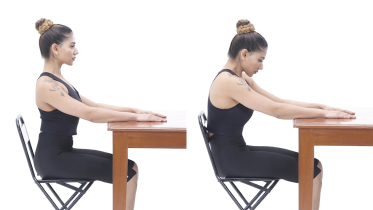 Seated pelvic tilt
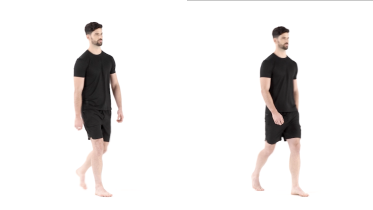 Brisk walking
After recent back surgery, check with your physio before adding the bending and arching of the seated pelvic tilt. With low bone density (osteoporosis) or a past fracture in your spine, keep the slouch part small and ask your physio how far to go. Brisk walking raises your heart rate: with a heart condition or high blood pressure, check with your doctor before you start. If you are pregnant, check with your midwife or physio before you start.
When to stay off work, and when to get checked
Time off makes more sense if you cannot do any version of your job safely, for example a driving job when you cannot turn to check behind you, or if the pain is stopping you sleeping. See a physio or doctor if things are not improving after a few weeks; how long does back pain last explains what a normal recovery looks like. Should I rest or move with back pain covers the first bad days, and is walking good for lower back pain shows how to build walking up.
Some signs mean getting help, not going to work. Numbness around your genitals or bottom, new trouble with your bladder or bowels, or pain, tingling, numbness or weakness in both legs means calling emergency services or going to an emergency department straight away. When is back pain serious explains each warning sign, and the warning list below gives the full set and how quickly to act. The low back pain program has the exercises to rebuild strength, and the exercises to avoid and heat or ice pages cover two common questions from people working through back pain.
Related exercise programs
Warning signs
Get emergency help now
- Emergency: numbness, tingling or altered feeling around or under your genitals, between your inner thighs, or around your bottom (anus), for example it feels different when you wipe after using the toilet. Call emergency services or go to an emergency department straight away. This can be a sign of pressure on the bundle of nerves at the base of the spine (cauda equina syndrome), which needs emergency treatment.
- Emergency: you find it hard to start peeing, cannot pee, cannot feel yourself peeing or cannot control when you pee, or you do not notice when you need to poo or cannot control when you poo, and this is not normal for you. The same applies to a new change in how your genitals feel during sex, or new trouble getting an erection or ejaculating. Call emergency services or go to an emergency department straight away. These can also be signs of cauda equina syndrome.
- Emergency: sciatica in both legs, or pain, tingling, numbness or weakness in both legs. The same applies if you lose feeling in one leg. Call emergency services or go to an emergency department straight away.
- Emergency: back or leg pain that started after a serious accident, such as a car crash or a fall from a height, or back pain with chest pain. Call emergency services. If the pain started straight after the accident, keep still while you wait.
- Emergency: sudden, severe pain in your lower back or tummy that is not like your usual back pain, if you have been told you have a swelling of the main blood vessel in your tummy (abdominal aortic aneurysm), you are over 60, you smoke or used to smoke, or you have high blood pressure. The same applies if sudden, severe back or tummy pain comes with feeling faint or passing out, pale, sweaty or clammy skin, a racing heartbeat or being short of breath. Call emergency services straight away. This can be a sign of an aneurysm bursting, which needs treatment in hospital at once.
- Emergency: new neck or back pain after a fall, a knock or a jolt, even a minor one such as a trip or a sudden stop in a car, if you have a condition that stiffens the spine, such as ankylosing spondylitis. Call emergency services or go to an emergency department straight away, do not drive yourself, and tell the staff about your spine condition, so they keep your neck and back in their usual position. A stiff spine can break after a small injury, and the break is easy to miss at first. If the pain started straight after the injury, or you also have numbness, tingling or weakness in your arms or legs, keep still and call emergency services.
- Emergency: you have had cancer, now or in the past, and your back or neck pain feels like a tight band around your body, or comes with pain spreading down an arm or leg, weakness, numbness or pins and needles in your arms or legs, trouble walking, or trouble controlling your bladder or bowels. Call your cancer team's emergency number straight away, or go to an emergency department if you do not have one or cannot get through. This can be cancer pressing on the spinal cord (metastatic spinal cord compression), which needs treatment straight away.
- Emergency: back pain with a fever, or you feel hot, shivery or very unwell, and you also have new weakness, numbness or tingling in one or both legs, or new trouble with your bladder or bowels. Call emergency services or go to an emergency department straight away. This can be an infection pressing on the nerves in the spine (spinal epidural abscess), which needs emergency treatment.
Get help today
- Same day: a leg or foot that is getting weaker, for example your foot drags, catches on the ground or slaps down when you walk (foot drop). Get medical advice the same day. If the weakness is getting worse by the hour, go to an emergency department.
- Same day: back pain after a minor fall or strain if you are older, have low bone density (osteoporosis) or have taken steroid tablets for a long time. Get medical advice the same day.
- Same day: back or leg pain with a fever, or you feel hot, cold, shivery or generally unwell. Get medical advice the same day, and go to an emergency department if you feel very unwell.
- Same day: you have back pain and have lost weight without trying. Get medical advice the same day and mention the weight loss.
- Same day: new back pain and you have had cancer, now or in the past. Get medical advice the same day and mention your cancer history. If you are being treated for cancer now, contact your cancer team the same day.
- Same day: severe pain that comes on suddenly or is getting worse quickly. Get medical advice the same day.
- Same day: pain that is worse at night, or does not ease at all when you rest. If you have had cancer, now or in the past, or you have lost weight without trying, get medical advice the same day.
Book an appointment
- Within a few days: pain that is worse at night, or does not ease at all when you rest. See your doctor within a few days.
- Within a week or two: back or buttock pain that started before the age of 45, has lasted more than three months, is worse after rest and in the morning, and eases when you move. This is not an emergency, but see your doctor in the next week or two and ask whether it could be inflammatory back pain (axial spondyloarthritis).
Common questions
Should I call in sick with back pain?
Sometimes, but often not for long. A day or two off during a bad flare is reasonable, especially if your job is physical and nobody can change it at short notice. Beyond that, most people do better going back with some changes than waiting until the pain has gone completely, which can take weeks. If your work cannot be adjusted and you cannot do it safely, talk to your doctor or physio about time off with a clear plan for coming back.
What should I do if I hurt my back at work?
Tell your manager or supervisor, ideally the same day, and report it through your workplace process, such as an incident form or accident book. Workers' compensation schemes in the US, Canada and Australia, and ACC in New Zealand, each have their own claim steps, so a written record from the start helps. Then look after it the way you would any back pain: keep moving within what you can manage and get it assessed if it is not settling. If the pain began with one heavy lift, the page on lower back pain after deadlifts covers that kind of strain.
Can my physio give me a note for work?
In the UK, yes. Since July 2022 physiotherapists, nurses, occupational therapists and pharmacists can issue fit notes as well as doctors. In New Zealand a physio can lodge an ACC claim for an injury from an accident, though a claim for an injury that built up gradually at work has to go through a doctor. In other countries the rules differ, so ask your physio or doctor what your employer or scheme will accept, and whether a short letter describing the duties you can manage now would help.
Does a back brace help at work?
Probably not much. For preventing back pain, a Cochrane review found moderate evidence that a lumbar support does no better than training or doing nothing at all, and whether supports help once you already have pain was unclear (van Duijvenbode and colleagues, 2008). NICE advises against offering belts or corsets for low back pain. Changing what you lift, how often and for how long usually makes more difference than anything you wear.
References
- Australian Commission on Safety and Quality in Health Care. Low Back Pain Clinical Care Standard. Sydney: ACSQHC, 2022. https://www.safetyandquality.gov.au/standards/clinical-care-standards/low-back-pain-clinical-care-standard
- van Vilsteren M, van Oostrom SH, de Vet HCW, Franche RL, Boot CRL, Anema JR. Workplace interventions to prevent work disability in workers on sick leave. Cochrane Database of Systematic Reviews. 2015;(10):CD006955. https://doi.org/10.1002/14651858.CD006955.pub3
- Verbeek JH, Martimo KP, Karppinen J, Kuijer PPFM, Viikari-Juntura E, Takala EP. Manual material handling advice and assistive devices for preventing and treating back pain in workers. Cochrane Database of Systematic Reviews. 2011;(6):CD005958. https://pubmed.ncbi.nlm.nih.gov/21678349/
- Hartvigsen J, Hancock MJ, Kongsted A, et al. What low back pain is and why we need to pay attention. The Lancet. 2018;391(10137):2356-2367. https://doi.org/10.1016/S0140-6736(18)30480-X
- National Institute for Health and Care Excellence. Low back pain and sciatica in over 16s: assessment and management (NG59). Published 2016, last updated July 2026. https://www.nice.org.uk/guidance/ng59
- van Duijvenbode IC, Jellema P, van Poppel MN, van Tulder MW. Lumbar supports for prevention and treatment of low back pain. Cochrane Database of Systematic Reviews. 2008;(2):CD001823. https://doi.org/10.1002/14651858.CD001823.pub3
- GOV.UK. Getting the most out of the fit note: guidance for employers and line managers. https://www.gov.uk/government/publications/fit-note-guidance-for-employers-and-line-managers/getting-the-most-out-of-the-fit-note-guidance-for-employers-and-line-managers
- GOV.UK. Who can issue fit notes: guidance for healthcare professionals and their employers. https://www.gov.uk/government/publications/who-can-issue-fit-notes-guidance-for-healthcare-professionals-and-their-employers/who-can-issue-fit-notes-guidance-for-healthcare-professionals-and-their-employers
- U.S. Department of Labor, Office of Disability Employment Policy. Americans with Disabilities Act. https://www.dol.gov/agencies/odep/ada
- Job Accommodation Network. Employees' practical guide to requesting and negotiating reasonable accommodation under the Americans with Disabilities Act. https://askjan.org/publications/individuals/employee-guide.cfm
- U.S. Department of Labor. Workers' compensation. https://www.dol.gov/general/topic/workcomp
- Association of Workers' Compensation Boards of Canada. https://awcbc.org/
- Safe Work Australia. Workers' compensation. https://www.safeworkaustralia.gov.au/workers-compensation
- ACC. Getting help after an injury (ACC2399). https://www.acc.co.nz/assets/im-injured/ea9de15ad3/acc2399-injury-help.pdf
- ACC. Lodging a claim for a patient. https://www.acc.co.nz/for-providers/lodging-claims/lodging-a-claim-for-a-patient
- NHS. Abdominal aortic aneurysm. https://www.nhs.uk/conditions/abdominal-aortic-aneurysm/
- National Institute for Health and Care Excellence. Abdominal aortic aneurysm: diagnosis and management (NG156). 2020. https://www.nice.org.uk/guidance/ng156
- Darouiche RO. Spinal epidural abscess. New England Journal of Medicine. 2006;355(19):2012-2020. https://doi.org/10.1056/NEJMra055111
Written and checked by the PocketPhysio editorial team. Last updated 2026-10-16.
This page is general education, not a diagnosis or a personal treatment plan. See a physiotherapist or doctor for advice about your own situation.