
Part of Low back pain
Exercises to avoid with lower back pain: what to pause, change or bring back later
Warning signs, and when to get help
Which exercises should you avoid with lower back pain?
Very few, for very long. Guidelines on both sides of the Atlantic recommend exercise for low back pain: the American Physical Therapy Association guideline for acute and chronic pain (George and colleagues, 2021), and NICE for a flare-up, choosing the type of exercise around the person rather than from a fixed list. For pain that has lasted three months or more, a Cochrane review found exercise probably reduces pain compared with no treatment or usual care (Hayden and colleagues, 2021). What physios change during a flare is the load, the range and the timing. Here is what usually goes on hold, and what replaces it.
Heavy or fast lifting. Deadlifts, heavy squats and lifting things off the floor at work all put big loads through the back. Cut the weight for a while rather than stopping. You do not need to relearn lifting with a rigid, straight back either: a 2020 review found low-quality evidence that lifting with a more rounded lower back is not a risk factor for back pain starting or carrying on (Saraceni and colleagues, 2020). Lower back pain after deadlifts covers the gym side, and back pain at work covers lifting on the job.
Sit-ups and crunches. Curling up from the floor bends the back forward under load, and a flared back often objects. Swap them for the dead bug, which works the stomach muscles with the back held still, and test the sit-up again once things have settled.
Long toe-touch stretches. Holding a deep standing forward bend at the end of its range for 30 seconds is a lot to ask of a back that is already irritated. The knee to chest stretches in stage 1 of the program are different: you lie on your back, the floor takes your weight, and you choose how far to go. Shorter, gentler movements like these do the job for now, and lower back pain when bending forward explains that pattern in more detail. If a stretch sends pain or tingling down your leg, that is a nerve question, and the sciatica page covers it.
Jumping and running. Impact repeated hundreds of times can keep a sore back grumbling. Walking keeps you moving while it settles, and walking for back pain has a plan for building it up.
The superman and other face-down back lifts. Later, not never. They sit in stage 3 of the low back pain program, for when the easier trunk exercises in stage 2 feel steady. The cobra stretch in stage 2 is not on hold: your arms take the weight and the back muscles do not lift the body.
Is it the exercise or how much you did?
Most of the time it is how much. A back that coped with ten minutes of gardening can flare after a whole afternoon of it, and the same goes for a gym session after a month off. Physios see that pattern far more often than an exercise that is harmful in itself, though that is practice experience rather than a tested rule.
Some discomfort while you exercise is allowed. A review of trials in long-lasting muscle and joint pain compared exercise programs that let pain build during the session with programs that kept it pain free. The painful programs did slightly better on pain in the short term, and neither came out ahead after that (Smith and colleagues, 2017). That review did not test sharp pain or pain spreading down a leg, which are different.
The more useful test comes the morning after. A back that wakes no worse, or slightly easier, coped with the session. A back that wakes clearly stiffer and sorer, or with pain reaching further into a leg, was asked for too much, so go back to an easier level for a couple of days before building up again. The pain monitoring model sets out that check in more detail.
What can you do instead while your back settles?
Pick exercises that keep the back fairly still while your arms, legs and trunk muscles work. The four below come from the program, in the order most people use them. Australia's low back pain care standard asks clinicians to encourage people to stay active and return to their usual activities, so these sit alongside normal daily movement rather than replacing it.
Exercises that can help
The first three are common swaps while a sore back settles, and the superman is the later step once they feel steady. Typical starting doses from each exercise page: dead bug, 2 to 3 sets of 6 to 10 slow reps each side; bird dog, 1 to 2 sets of 6 to 10 reps each side, holding each reach for a few seconds at first and building toward 8 to 10 seconds; glute bridge, 2 to 3 sets of 10 to 12 with a short hold at the top; superman, 1 to 3 sets of 5 to 10 lifts with a hold of about 5 seconds. Your physio will adjust this.
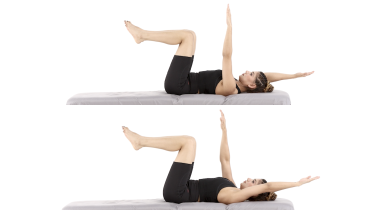 Dead bug
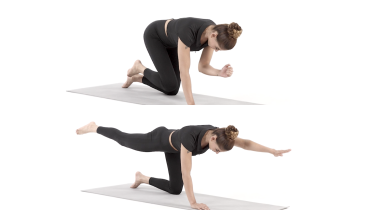 Bird dog
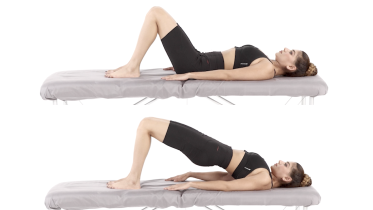 Glute bridge
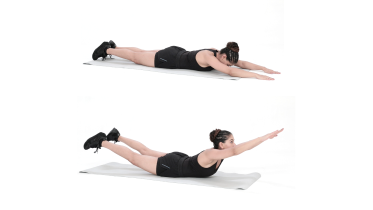 Superman
If you are pregnant and past the first three months, check with your physio before exercising flat on your back, and ask about the superman too, because it is done lying face down. If you have high blood pressure, breathe steadily through every repetition and never hold your breath.
Some days even these are too much. A warm pack on the back first can take the edge off the stiffness, and heat or ice for back pain explains how. A better night helps the next session too: sleeping positions for back pain has the pillow set-ups.
How do you bring an exercise back?
Start with a smaller version of it. A lighter weight, a shorter range, fewer sets, or a half-way step such as lifting only the arms in the superman. Change one thing at a time, so that if your back reacts you know what caused it.
Then build over weeks, not days. Add a little load or range when the current level feels easy and your back is fine the next morning. A small flare along the way is common and not a sign of damage: go back to the last level that felt fine for a few days and climb again. If the same exercise flares your back every time you return to it, or you are not sure which level to restart at, a physio can look at how you move and adjust the plan. Returning to the gym after injury has a step plan for training.
Who needs extra care?
Two diagnoses change the picture for leaning back. With a narrowed spinal canal (spinal stenosis) or one vertebra slipped forward on the one below (spondylolisthesis), backward bending can stir symptoms up. Ask your physio before any exercise that arches the back, which includes the superman, the cobra stretch and the standing back extension. The superman also loads the back face down, so one more check applies to it. If you have had a fracture in your spine, check with your physio before you begin.
Low bone density (osteoporosis) changes it for bending forward and twisting. Programs for it usually limit deep forward bends and twists taken to the end of the range, so check with your physio before the knee to chest stretches and the trunk rotation, and expect sit-ups and crunches to be swapped for something else.
After back surgery, follow your surgeon's and physio's plan for the first months rather than this page. Pregnancy needs its own plan for back and pelvic pain. And if your pain is not easing, or you are unsure whether it is safe to exercise at all, when back pain is serious lists the signs that need a doctor first. The warning list below gives the full set, with how quickly to act.
Related exercise programs
Warning signs
Get emergency help now
- Emergency: numbness, tingling or altered feeling around or under your genitals, between your inner thighs, or around your bottom (anus), for example it feels different when you wipe after using the toilet. Call emergency services or go to an emergency department straight away. This can be a sign of pressure on the bundle of nerves at the base of the spine (cauda equina syndrome), which needs emergency treatment.
- Emergency: you find it hard to start peeing, cannot pee, cannot feel yourself peeing or cannot control when you pee, or you do not notice when you need to poo or cannot control when you poo, and this is not normal for you. The same applies to a new change in how your genitals feel during sex, or new trouble getting an erection or ejaculating. Call emergency services or go to an emergency department straight away. These can also be signs of cauda equina syndrome.
- Emergency: sciatica in both legs, or pain, tingling, numbness or weakness in both legs. The same applies if you lose feeling in one leg. Call emergency services or go to an emergency department straight away.
- Emergency: back or leg pain that started after a serious accident, such as a car crash or a fall from a height, or back pain with chest pain. Call emergency services. If the pain started straight after the accident, keep still while you wait.
- Emergency: sudden, severe pain in your lower back or tummy that is not like your usual back pain, if you have been told you have a swelling of the main blood vessel in your tummy (abdominal aortic aneurysm), you are over 60, you smoke or used to smoke, or you have high blood pressure. The same applies if sudden, severe back or tummy pain comes with feeling faint or passing out, pale, sweaty or clammy skin, a racing heartbeat or being short of breath. Call emergency services straight away. This can be a sign of an aneurysm bursting, which needs treatment in hospital at once.
- Emergency: new neck or back pain after a fall, a knock or a jolt, even a minor one such as a trip or a sudden stop in a car, if you have a condition that stiffens the spine, such as ankylosing spondylitis. Call emergency services or go to an emergency department straight away, do not drive yourself, and tell the staff about your spine condition, so they keep your neck and back in their usual position. A stiff spine can break after a small injury, and the break is easy to miss at first. If the pain started straight after the injury, or you also have numbness, tingling or weakness in your arms or legs, keep still and call emergency services.
- Emergency: you have had cancer, now or in the past, and your back or neck pain feels like a tight band around your body, or comes with pain spreading down an arm or leg, weakness, numbness or pins and needles in your arms or legs, trouble walking, or trouble controlling your bladder or bowels. Call your cancer team's emergency number straight away, or go to an emergency department if you do not have one or cannot get through. This can be cancer pressing on the spinal cord (metastatic spinal cord compression), which needs treatment straight away.
- Emergency: back pain with a fever, or you feel hot, shivery or very unwell, and you also have new weakness, numbness or tingling in one or both legs, or new trouble with your bladder or bowels. Call emergency services or go to an emergency department straight away. This can be an infection pressing on the nerves in the spine (spinal epidural abscess), which needs emergency treatment.
Get help today
- Same day: a leg or foot that is getting weaker, for example your foot drags, catches on the ground or slaps down when you walk (foot drop). Get medical advice the same day. If the weakness is getting worse by the hour, go to an emergency department.
- Same day: back pain after a minor fall or strain if you are older, have low bone density (osteoporosis) or have taken steroid tablets for a long time. Get medical advice the same day.
- Same day: back or leg pain with a fever, or you feel hot, cold, shivery or generally unwell. Get medical advice the same day, and go to an emergency department if you feel very unwell.
- Same day: you have back pain and have lost weight without trying. Get medical advice the same day and mention the weight loss.
- Same day: new back pain and you have had cancer, now or in the past. Get medical advice the same day and mention your cancer history. If you are being treated for cancer now, contact your cancer team the same day.
- Same day: severe pain that comes on suddenly or is getting worse quickly. Get medical advice the same day.
- Same day: pain that is worse at night, or does not ease at all when you rest. If you have had cancer, now or in the past, or you have lost weight without trying, get medical advice the same day.
Book an appointment
- Within a few days: pain that is worse at night, or does not ease at all when you rest. See your doctor within a few days.
Common questions
Are sit-ups bad for your lower back?
Not for everyone, and not forever. If curling up from the floor stirs up your back, swap sit-ups and crunches for an exercise that works the stomach muscles while the back stays still, such as the dead bug, and try the curl again once your back has settled. The exception is low bone density (osteoporosis): programs for it usually leave sit-ups and crunches out, because repeated forward bending of the spine under load is the movement they limit, so ask your physio for a different core exercise.
Can I keep going to the gym with lower back pain?
Usually, yes, with lighter loads for a while. Keep the habit and cut the weight, the range or the number of sets on the lifts that bother your back, and keep training the parts that do not. Build back up in small steps, checking how your back feels the next morning. If a lift sends pain down your leg, stop that lift and talk to your physio.
Should I stop running with lower back pain?
Not always. Shorter, slower runs on flat ground are a reasonable test once walking is comfortable, and if running stirs your back up, walking keeps you active while it settles. If your back wakes up clearly worse after a run, the next one should be shorter or slower. Running is not a treatment for back pain on its own, so keep up the strength work in your program as well.
Is the superman exercise bad for lower back pain?
No, but it comes later rather than first. In a staged low back pain program it sits in the strength stage, after easier exercises such as the bird dog feel steady. Start with an easier version, such as lifting only the arms or only the legs. If you have been told you have narrowing of the spinal canal (spinal stenosis) or a forward slip of one vertebra on another (spondylolisthesis), check with your physio first, because the arched position can make both worse.
References
- National Institute for Health and Care Excellence. Low back pain and sciatica in over 16s: assessment and management (NG59). Published 2016, last updated July 2026. https://www.nice.org.uk/guidance/ng59
- George SZ, Fritz JM, Silfies SP, et al. Interventions for the management of acute and chronic low back pain: revision 2021. Clinical practice guidelines linked to the International Classification of Functioning, Disability and Health from the Academy of Orthopaedic Physical Therapy of the American Physical Therapy Association. Journal of Orthopaedic and Sports Physical Therapy. 2021;51(11):CPG1-CPG60. https://doi.org/10.2519/jospt.2021.0304
- Hayden JA, Ellis J, Ogilvie R, Malmivaara A, van Tulder MW. Exercise therapy for chronic low back pain. Cochrane Database of Systematic Reviews. 2021;(9):CD009790. https://doi.org/10.1002/14651858.CD009790.pub2
- Saraceni N, Kent P, Ng L, Campbell A, Straker L, O'Sullivan P. To flex or not to flex? Is there a relationship between lumbar spine flexion during lifting and low back pain? A systematic review with meta-analysis. Journal of Orthopaedic and Sports Physical Therapy. 2020;50(3):121-130. https://doi.org/10.2519/jospt.2020.9218
- Smith BE, Hendrick P, Smith TO, et al. Should exercises be painful in the management of chronic musculoskeletal pain? A systematic review and meta-analysis. British Journal of Sports Medicine. 2017;51(23):1679-1687. https://doi.org/10.1136/bjsports-2016-097383
- Australian Commission on Safety and Quality in Health Care. Low Back Pain Clinical Care Standard. Sydney: ACSQHC, 2022. https://www.safetyandquality.gov.au/standards/clinical-care-standards/low-back-pain-clinical-care-standard
- NHS. Abdominal aortic aneurysm. https://www.nhs.uk/conditions/abdominal-aortic-aneurysm/
- National Institute for Health and Care Excellence. Abdominal aortic aneurysm: diagnosis and management (NG156). 2020. https://www.nice.org.uk/guidance/ng156
- Darouiche RO. Spinal epidural abscess. New England Journal of Medicine. 2006;355(19):2012-2020. https://doi.org/10.1056/NEJMra055111
Written and checked by the PocketPhysio editorial team. Last updated 2026-10-16.
This page is general education, not a diagnosis or a personal treatment plan. See a physiotherapist or doctor for advice about your own situation.