
Spondylolisthesis exercises and physiotherapy
What is spondylolisthesis?
Spondylolisthesis means one of the bones in your spine (a vertebra) has slipped forward on the one below it. The NHS notes it is most common in the lower back, and that it can happen without any symptoms at all. When it does cause trouble, the usual complaints are low back pain that is worse when you stand or walk and eases when you sit or bend forward, pain into the buttocks or thighs, tight hamstrings, or sciatica down one leg.
Slips also turn up on scans of people who have no back pain. In a study that looked at CT scans of 188 adults from the community, a break in the back part of a vertebra (spondylolysis) showed up in 11.5% of them, and neither that break nor either type of slip was clearly linked to having back pain (Kalichman 2009). So the slip on your report may or may not explain your pain. Your physio will look at how you move and what eases or stirs up your symptoms, not just the scan.
Degenerative and isthmic spondylolisthesis
Adults usually have one of two types. They behave differently, which is why your physio will want to know which one you have.
Degenerative spondylolisthesis comes from wear and tear. As the discs and small joints at the back of the spine change with age, one vertebra can slide a little on the next. It mostly affects people over 50, is more common in women, and usually sits between the fourth and fifth lumbar vertebrae (Kalichman and Hunter 2008). OrthoInfo describes symptoms that ease when you bend forward or sit and get worse when you stand or walk, often with weak, numb or tingling legs after standing or walking for a long time. That is the pattern of narrowing around the nerves, and the spinal stenosis program covers it in detail.
Isthmic spondylolisthesis starts with a stress fracture in a thin bridge of bone at the back of the vertebra (the pars interarticularis). OrthoInfo explains that the fracture usually happens in the teenage years but often only causes symptoms in middle age. It tends to give activity-related back pain, sometimes with leg pain.
How this page differs from other back pages
This page is about a slip that a doctor has found on an X-ray or scan. If your pain stays in your back and nobody has named a cause, start with the low back pain program. If your scan report talks about worn or bulging discs, see degenerative disc disease. If your legs get heavy or painful as you walk and ease when you sit or lean forward, the spinal stenosis program fits better, whether or not a slip is the cause.
Do exercises help spondylolisthesis?
Exercise and physiotherapy are standard first treatment. The NHS lists physiotherapy to strengthen and stretch the muscles alongside avoiding the activities that make symptoms worse, and OrthoInfo says specific exercises can strengthen and stretch the lower back and stomach muscles. The research behind this is small and mostly old, so the evidence for any one exercise is thin.
The best known trial took 44 people with long-lasting back pain and a stress fracture or slip on their X-rays (O'Sullivan 1997). A 10 week program that trained the deep stomach and back muscles reduced pain and disability, and the benefit held at 30 months, while the group who had their usual treatment showed no meaningful improvement. It was one small trial. Still, it is the main reason programs like this one are built around trunk control.
Why forward bending often feels easier
Many people with a slip find that bending forward, sitting or lying with their knees bent eases the pain, and that standing tall or leaning back makes it worse. The NHS describes this pattern. Physios often start with positions that round or flatten the lower back and go carefully with exercises that arch it repeatedly or under load. The reasoning is that arching loads the back of the spine, where the slip and any stress fracture sit.
Evidence for this forward bending bias is weak. The main study is a retrospective one from 1989: 48 people with a slip were taught either forward bending (flexion) or backward bending (extension) strengthening exercises, and at 3 years 19% of the forward bending group had moderate or severe pain, against 67% of the backward bending group (Sinaki 1989). That study looked back at records rather than assigning people at random, so it cannot prove the difference. Treat it as a reason to start gently and see how your own back responds, not as a rule that you must never bend backward.
How to use this program
Choose the stage that fits your back as it is today, and begin at stage 1 when in doubt. Move up when the current stage feels easy and your back and legs settle well afterward.
Every exercise page lists a typical starting dose. As a rough guide, the stage 1 exercises are often done once or twice a day: 2 to 3 sets of 10 pelvic tilts with a 5 second hold, 5 to 10 back flattening holds of about 10 seconds, 8 to 10 deep trunk holds of 5 to 10 seconds, and 3 to 5 knee to chest holds of 15 to 30 seconds. In stage 2, many programs use 2 to 3 sets of 6 to 10 slow dead bugs on each side, 1 to 2 sets of 6 to 10 bird dogs on each side, and 2 to 3 sets of 10 to 12 bridges. The side hip exercises often start at 2 to 3 sets of 10 to 15 on each side, supine marching at 2 to 3 sets of 8 to 12 lifts per leg, and brisk walking at 10 to 20 minutes on most days.
In stage 3, plank holds often start at 10 to 30 seconds, done 3 to 5 times, a few days a week. Sit to stand often starts at 2 to 3 sets of 5 to 10, and the squat at 2 to 3 sets of 8 to 12, a few days a week. Your physio will adjust this.
Some mild aching or a pulling feeling in your back is common with these exercises. It is usually fine if it has settled by the next day and is not building from one week to the next. Stop an exercise and tell your physio if pain spreads into your leg or further down it, you get new numbness or tingling, or your back is clearly worse the next morning. Breathe normally through every hold rather than holding your breath, especially if you have high blood pressure.
The exercise program
Stage 1: Settle the back with gentle forward positions
For a flare-up, or when standing, walking or leaning back stirs your back up. These are small movements done lying on your back, and most of them round the lower back a little or press it flat, the direction many people with a slip find easier. The deep trunk holds wake up the muscles around your middle without moving your spine much. Keep the ones that leave your back and legs the same or easier. If getting down to the floor and back up is a struggle, a firm bed works too.
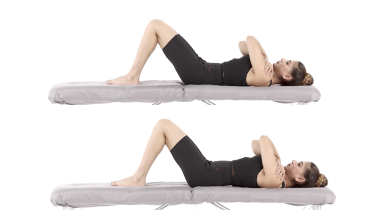 Pelvic tilt
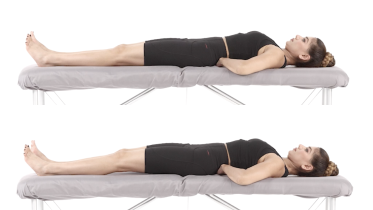 Lying back flattening hold
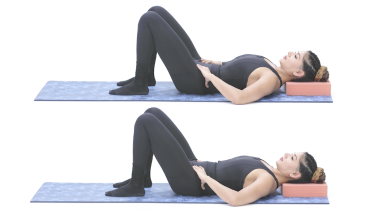 Transverse abdominis activation
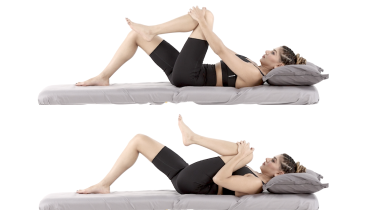 Knee to chest stretch
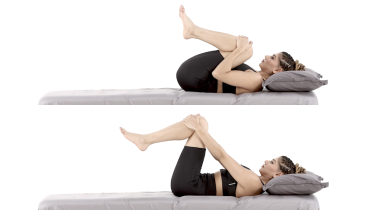 Double knee to chest stretch
Stage 2: Build trunk and hip control
When moving around the house is easier, which takes a few days for some people and a few weeks for others. The dead bug, bird dog and supine marching ask you to keep your back still while your arms or legs move, and the clamshell and side leg lift work the muscles at the side of your hip. On the bird dog, lift the leg only to hip height so your lower back does not arch. Keep bridges low enough that your back stays flat at the top. Brisk walking builds everyday stamina, and short spells with rests are fine if your legs get heavy.
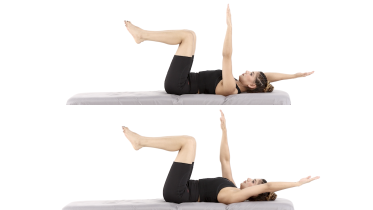 Dead bug
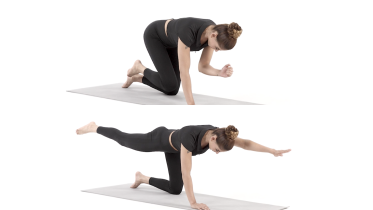 Bird dog
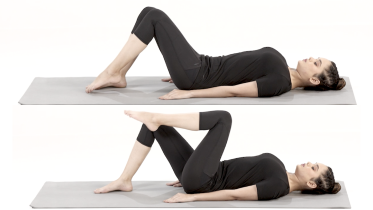 Supine marching
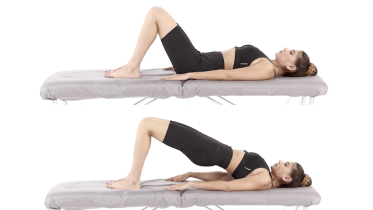 Glute bridge
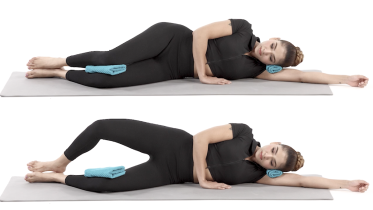 Clamshell
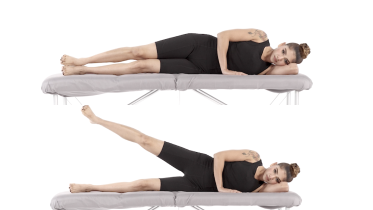 Side lying hip abduction
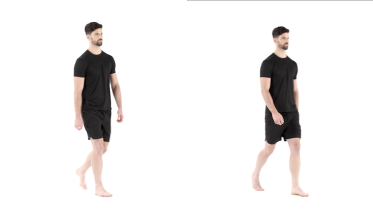 Brisk walking
Stage 3: Build strength for everyday loads
For lifting, housework, gardening, sport and long days on your feet. Start with the kneeling plank and move to the full plank only when you can hold your back flat without your hips sagging, since a sagging plank arches the lower back. Sit to stand and the squat work your thighs and buttocks, the muscles that lower you into a chair and lift you out again. Keep your chest lifted and your back in its normal curve as you squat, rather than leaning back at the top.
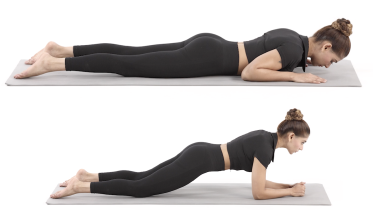 Kneeling plank
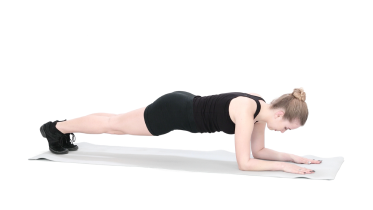 Plank
Plank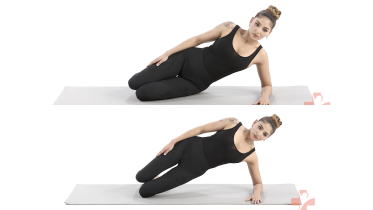 Kneeling side plank
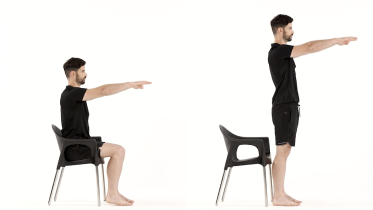 Sit to stand
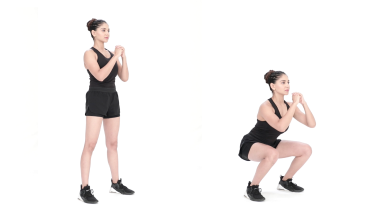 Squat
SquatWhat to avoid or change
You do not have to give up bending, lifting or sport for good. Build up load in small steps, and break big jobs such as gardening into shorter spells. Check with your physio before exercises that arch your lower back, such as standing back extension, the cobra stretch, the superman and prone back extension. The NHS lists athletics and gymnastics among the activities that can make symptoms worse, so talk a return to sports like these through with your physio first.
If you have low bone density (osteoporosis), ask your physio before the knee to chest stretches, because deep forward bending of the spine is usually limited. If you feel unsteady on your feet, stand beside a kitchen counter or a sturdy chair you can hold for the standing exercises.
If you have had a hip replacement, get the go-ahead from your surgeon or physio before you try the knee to chest stretches, supine marching, the clamshell, side lying hip abduction, the kneeling side plank, sit to stand or the squat. Pulling the knee in or squatting low bends the hip well past a right angle and opening the knee in the clamshell turns the thigh outward, and many surgeons ask you to avoid that for the first months after some operations. The side leg work and the side plank load the side of the hip, and some operations limit this kind of work for the first months, so the timing depends on your surgery.
Rehab after spinal surgery is a different job, and this program is not built for it. If you have had an operation on your back, such as a fusion or a decompression, follow your surgeon's program. If you are pregnant, check with your physio or midwife before you start. It is also written for adults only. If a child or teenager has back pain, especially a young athlete or gymnast, get them checked by a doctor or physio first.
Exercise or surgery?
For most people with a slip, exercise and other nonsurgical care come first. OrthoInfo says surgery is usually considered for a degenerative slip after 3 to 6 months of nonsurgical treatment that has not helped, and for an isthmic slip after 6 to 12 months. Nerve symptoms that keep getting worse, such as weakness or numbness, are also a reason to discuss surgery. The NHS names spinal fusion and lumbar decompression as the usual operations.
For adults with an isthmic slip and at least a year of back pain or sciatica that badly limited their daily life, one trial is worth knowing about. It took 111 people aged 18 to 55 and gave them either a year of exercise or a spinal fusion. At 2 years, pain and function were better in the surgery group (Möller and Hedlund 2000).
About 9 years on, the pain and disability scores of the two groups no longer differed clearly, but 76% of the surgery group rated themselves better or much better overall, against 50% of the exercise group (Ekman 2005). The authors called the long-term gain from surgery modest. So if months of good exercise have not helped, talking to a spine specialist is a reasonable next step.
When to see a physio or doctor
See a physio or GP if your back pain has not improved after 3 to 4 weeks, if you find it hard to walk or stand up straight, or if numbness or tingling in your leg is not settling, as the NHS advises. Book an appointment too if symptoms stop you doing normal activities, or you are not improving after several weeks of regular exercise. The warning signs below range from an emergency to a routine appointment. The most urgent are numbness around your genitals or bottom, new bladder or bowel trouble, both legs getting weaker, and a foot or leg that suddenly turns cold, pale or numb.
For physiotherapists
What patients get here is a starting point, not a treatment plan. O'Sullivan 1997 is the main randomized trial of exercise: 44 patients with chronic low back pain and radiological spondylolysis or spondylolisthesis, 10 weeks of specific training of the deep abdominal muscles and lumbar multifidus, compared with usual care, with gains in pain and disability maintained at 30 months. The flexion bias rests mainly on the retrospective Sinaki 1989 cohort (n = 48), so the case against extension work is weak; screen each patient's directional response rather than applying it as a blanket rule.
Kalichman and Hunter 2008 summarize the natural history of degenerative spondylolisthesis: slip progression in about a third of patients managed without surgery over long follow-up, no correlation between progression and symptoms, and 76% of those neurologically intact at baseline still intact at 10 years, whereas 83% of those with neurogenic claudication or vesicorectal symptoms at baseline who declined surgery deteriorated (Matsunaga 2000, cited in that review). For isthmic spondylolisthesis in adults with a year or more of severe pain, Möller and Hedlund 2000 favored posterolateral fusion over a 1 year exercise program at 2 years; at a mean of 9 years (Ekman 2005) only the global self-rating still differed significantly, and the authors describe the long-term benefit as modest. Kalichman 2009 found no significant association between spondylolysis or either type of listhesis and low back pain in a community CT sample, which helps when a patient is alarmed by an incidental finding. Degenerative slips commonly present with neurogenic claudication, so screen for vascular claudication as on the stenosis page, and use the Finucane 2020 red flags framework as a prompt for clinical reasoning rather than a checklist.
See a doctor promptly if
- Emergency: numbness, tingling or altered feeling around or under your genitals, between your inner thighs, or around your bottom (anus), for example it feels different when you wipe after using the toilet. Call emergency services or go to an emergency department straight away. This can be a sign of pressure on the bundle of nerves at the base of the spine (cauda equina syndrome), which needs emergency treatment.
- Emergency: you find it hard to start peeing, cannot pee, cannot feel yourself peeing or cannot control when you pee, or you do not notice when you need to poo or cannot control when you poo, and this is not normal for you. The same applies to a new change in how your genitals feel during sex, or new trouble getting an erection or ejaculating. Call emergency services or go to an emergency department straight away. These can also be signs of cauda equina syndrome.
- Emergency: sciatica in both legs, or tingling, numbness or weakness in both legs, that is new for you or getting worse quickly. The same applies if both legs keep getting weaker, even slowly, for example both feet drag or catch on the ground. The same applies if you lose feeling in one leg. Call emergency services or go to an emergency department straight away. Aching, heaviness or tingling in both legs that has built up slowly over weeks or months, comes on with walking or standing and settles within minutes when you sit or bend forward is the usual stenosis pattern and is not an emergency on its own. If a doctor has not checked it yet, book an appointment. If numbness in both legs is slowly spreading or getting worse, get medical advice the same day, and tell your doctor about any other change.
- Emergency: your foot or leg suddenly turns cold, pale or blue, or suddenly becomes very painful, numb or weak, even while you are resting. Call emergency services or go to an emergency department straight away. This can be a sign that the blood supply to the leg is blocked, which needs treatment at once.
- Emergency: back or leg pain that started after a serious accident, such as a car crash or a fall from a height, or back pain with chest pain. Call emergency services.
- A leg or foot that is getting weaker, for example your foot drags, catches on the ground or slaps down when you walk (foot drop). Get medical advice the same day. If the weakness is getting worse by the hour, go to an emergency department.
- Emergency: new neck or back pain after a fall, a knock or a jolt, even a minor one such as a trip or a sudden stop in a car, if you have a condition that stiffens the spine, such as ankylosing spondylitis. Call emergency services or go to an emergency department straight away, do not drive yourself, and tell the staff about your spine condition, so they keep your neck and back in their usual position. A stiff spine can break after a small injury, and the break is easy to miss at first. If the pain started straight after the injury, or you also have numbness, tingling or weakness in your arms or legs, keep still and call emergency services.
- Back pain after a minor fall or strain if you are older, have low bone density (osteoporosis) or have taken steroid tablets for a long time. Get medical advice the same day.
- Back or leg pain with a fever, or you feel hot, cold, shivery or generally unwell. Get medical advice the same day, and go to an emergency department if you feel very unwell.
- You have back pain and have lost weight without trying. Get medical advice the same day and mention the weight loss.
- New back pain and you have had cancer, now or in the past. Get medical advice the same day and mention your cancer history. If you are being treated for cancer now, contact your cancer team the same day.
- Emergency: you have had cancer, now or in the past, and your back or neck pain feels like a tight band around your body, or comes with pain spreading down an arm or leg, weakness, numbness or pins and needles in your arms or legs, trouble walking, or trouble controlling your bladder or bowels. Call your cancer team's emergency number straight away, or go to an emergency department if you do not have one or cannot get through. This can be cancer pressing on the spinal cord (metastatic spinal cord compression), which needs treatment straight away.
- Pain that is worse at night, or does not ease at all when you rest. See your doctor within a few days. If you have had cancer, now or in the past, or you have lost weight without trying, get medical advice the same day. If you are being treated for cancer now, contact your cancer team the same day.
- Severe pain that comes on suddenly or is getting worse quickly. Get medical advice the same day.
- Same day: a severe burning pain in your feet or legs that carries on even when you rest, skin on your feet or lower legs that has become pale, shiny, smooth and dry, sores on your feet or legs that do not heal, or toes that have become cold and numb and are turning red and then black. Contact your doctor straight away, the same day. These can be signs that poor circulation in the legs has become serious (critical limb ischemia). If a sore or toe is also getting red, hot and swollen, or you feel feverish or very unwell, go to an emergency department.
- Routine: pain or aching in your legs that comes on when you walk and goes after a few minutes' rest, and a doctor has not checked it yet. Book an appointment with your doctor. Narrowed arteries in the legs (peripheral arterial disease) can cause this too, and they need different treatment. If the distance you can walk before the pain starts has become much shorter over a few weeks, see your doctor within a few days.
Common questions
Can spondylolisthesis get worse?
The slip can creep further over the years, but that does not always mean more pain. A review of degenerative spondylolisthesis describes a long-term study of 145 people treated without surgery: the slip progressed in 34% of them, and the change in the slip did not match the change in their symptoms. In the same study, 76% of people who had no nerve problems at the start still had none after 10 years. People who already had nerve symptoms, such as leg pain brought on by walking or bladder trouble, and did not have surgery did much less well: most of them got worse over the years (Kalichman and Hunter 2008). Tell your doctor if your legs get weaker or more numb, or your walking distance keeps shrinking.
What exercises should I avoid with spondylolisthesis?
No exercise is banned for everyone, but exercises that arch the lower back stir symptoms up for some people. Check with your physio before the cobra stretch, the superman, prone back extensions and standing back bends. The NHS also suggests avoiding activities that make your symptoms worse, such as bending, lifting, athletics and gymnastics. How your back and legs respond matters most: an exercise that leaves pain lingering or spreading down a leg is one to drop for now.
Is walking good for spondylolisthesis?
For most people, yes, and it is part of stage 2 of this program. If walking makes your legs ache or feel heavy and sitting or bending forward eases it, the slip may be narrowing the space around the nerves, and the walk and rest plan on the spinal stenosis page suits you better. Start with a distance you can manage and add a few minutes at a time. Your physio will adjust the plan to how far you can walk.
Can spondylolisthesis be treated without surgery?
Often, yes. The NHS lists physiotherapy to strengthen and stretch the muscles, anti-inflammatory painkillers, steroid injections and avoiding the activities that make it worse as the treatments to try first. OrthoInfo says surgery is usually considered for a degenerative slip after 3 to 6 months of nonsurgical treatment that has not helped, and for an isthmic slip after 6 to 12 months. Nerve symptoms that keep getting worse, such as weakness or numbness, are also a reason to discuss surgery. Exercise is not meant to move the bone back into place. The aim is a back that hurts less and lets you do more.
Is spondylolisthesis the same as a slipped disc?
No. The NHS points out the difference: in spondylolisthesis a bone of the spine (a vertebra) slips forward, while a slipped disc is a problem with the soft cushion between two bones. The two can cause similar symptoms, such as sciatica down one leg. If a disc has been found on your scan, see the lumbar disc herniation program.
References
- NHS. Spondylolisthesis. Last reviewed 17 March 2026. https://www.nhs.uk/conditions/spondylolisthesis/
- American Academy of Orthopaedic Surgeons. Adult spondylolisthesis in the low back. OrthoInfo. https://www.orthoinfo.org/en/diseases--conditions/adult-spondylolisthesis-in-the-low-back/
- Kalichman L, Hunter DJ. Diagnosis and conservative management of degenerative lumbar spondylolisthesis. European Spine Journal. 2008;17(3):327-335. https://doi.org/10.1007/s00586-007-0543-3
- Kalichman L, Kim DH, Li L, Guermazi A, Berkin V, Hunter DJ. Spondylolysis and spondylolisthesis: prevalence and association with low back pain in the adult community-based population. Spine. 2009;34(2):199-205. https://doi.org/10.1097/BRS.0b013e31818edcfd
- Sinaki M, Lutness MP, Ilstrup DM, Chu CP, Gramse RR. Lumbar spondylolisthesis: retrospective comparison and three-year follow-up of two conservative treatment programs. Archives of Physical Medicine and Rehabilitation. 1989;70(8):594-598. https://pubmed.ncbi.nlm.nih.gov/2527488/
- O'Sullivan PB, Phyty GD, Twomey LT, Allison GT. Evaluation of specific stabilizing exercise in the treatment of chronic low back pain with radiologic diagnosis of spondylolysis or spondylolisthesis. Spine. 1997;22(24):2959-2967. https://doi.org/10.1097/00007632-199712150-00020
- Möller H, Hedlund R. Surgery versus conservative management in adult isthmic spondylolisthesis: a prospective randomized study, part 1. Spine. 2000;25(13):1711-1715. https://doi.org/10.1097/00007632-200007010-00016
- Ekman P, Möller H, Hedlund R. The long-term effect of posterolateral fusion in adult isthmic spondylolisthesis: a randomized controlled study. The Spine Journal. 2005;5(1):36-44. https://doi.org/10.1016/j.spinee.2004.05.249
- Finucane LM, Downie A, Mercer C, et al. International framework for red flags for potential serious spinal pathologies. Journal of Orthopaedic and Sports Physical Therapy. 2020;50(7):350-372. https://doi.org/10.2519/jospt.2020.9971
- NHS. Back pain. https://www.nhs.uk/conditions/back-pain/
Written and checked by the PocketPhysio editorial team. Last updated 2026-09-28.
This page is general education, not a diagnosis or a personal treatment plan. See a physiotherapist or doctor for advice about your own situation.