Lying back flattening hold
The lying back flattening hold is a gentle holding exercise for your stomach muscles. You lie on your back, press the hollow of your lower back softly down toward the surface, so your pelvis tips back a little, and hold for about 10 seconds while you keep breathing normally. Almost nothing moves, which is why physios often give it early, while bigger back movements are still uncomfortable.
How to do the lying back flattening hold
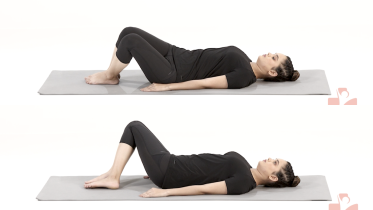
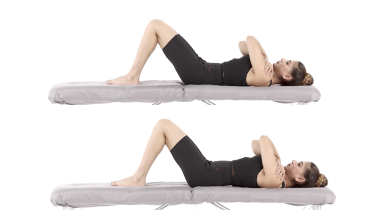
- Lie flat on a firm bed or a floor mat, legs straight and arms folded over your chest, as in the video.
- Notice the natural hollow in your lower back, where it does not touch the surface.
- Keeping your hips, legs and head where they are, gently tighten your stomach to press your lower back down toward the surface, as if closing that hollow. Your pelvis tips back a little as you do it.
- Hold the press for about 10 seconds. Breathe normally the whole time.
- Let go completely and take a few relaxed breaths before pressing again.
What you should feel
A steady, light tightening in your stomach, with your lower back resting flatter on the surface. Very little should move that anyone could see.
Common mistakes
- Letting your breathing stop while you push.
- Pushing so hard that your head or heels dig in, your shoulders lift or your bottom comes off the surface.
- Tensing your neck and jaw while you hold.
- Starting the next press before the last one has fully let go.
How often
The voice guide uses a 10 second hold. Many programs work up to 5 to 10 of these holds, done once or twice a day. Your physio will adjust this.
Stop and check with your physio if
- Pain in your back that gets sharper while you press, or pain, tingling or numbness that spreads into one leg.
- Numbness around your genitals or bottom, new trouble with your bladder or bowels, pain, tingling, numbness or weakness in both legs, or loss of feeling in one leg. Call emergency services or go to an emergency department straight away.
- Your leg or foot gets weaker, for example your foot drags, catches on the ground or slaps down when you walk (foot drop). Get medical advice the same day. If the weakness is getting worse by the hour, go to an emergency department.
From the clinic
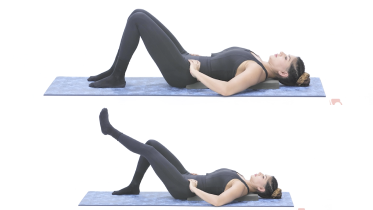
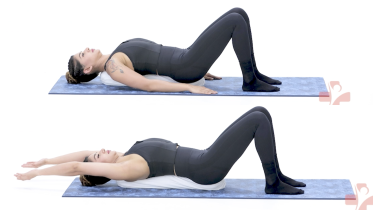
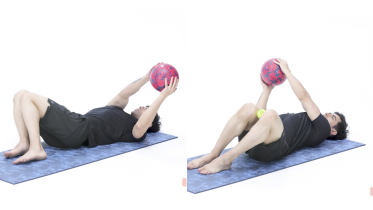
In the voice guide your knees are bent and one hand rests in the hollow of your lower back, so you can feel your back press down onto it. The video has the legs straight and the arms folded. If lying with straight legs pulls on your back, bend your knees with your feet flat, as the voice guide describes. Keep the effort light enough that you could still talk.
The pelvic tilt uses the same stomach action as a small, repeated movement with your knees bent. Once you can hold your back flat without effort, the dead bug asks you to keep it there while your arms and legs move. If a rounded upper back means your head does not rest comfortably on the surface, put a pillow under it.
If you have high blood pressure, breathe steadily through every hold and never hold your breath. If you are pregnant and past the first three months, check with your physio before exercising flat on your back. If you have had a fracture in your spine, check with your physio before you begin. After recent back or stomach surgery, ask your surgeon or physio when holds like this can start. If you have recently given birth, including by cesarean section, or you have a gap down the middle of your stomach muscles (diastasis recti), ask your physio, midwife or doctor first.
Written and checked by the PocketPhysio editorial team. Last updated 2026-09-26.
This page is general education, not a diagnosis or a personal treatment plan. If you have pain, an injury or a health condition, see a physiotherapist or doctor before starting new exercises.