Lying upper body rotation
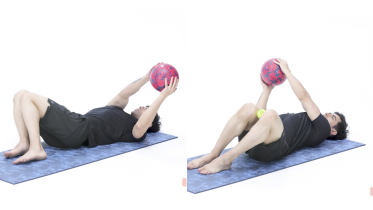
The lying upper body rotation is a gentle turning exercise for the middle and upper back, done on your back with your knees bent. With your hands together and your arms pointing at the ceiling, you take your arms and upper body slowly to one side, then the other, while your knees and lower back stay still. Because the floor supports you the whole time, it is a steady place to start rotation work.
How to do the lying upper body rotation
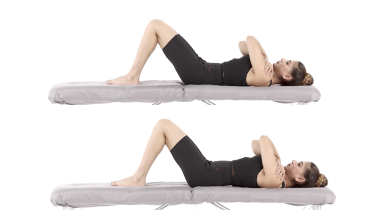
- Lie on your back on a mat, knees bent and feet flat on the floor about hip width apart. If your chin points up at the ceiling without one, rest your head on a thin pillow or folded towel.
- Clasp your hands together and lift your arms straight up so your hands point at the ceiling above your chest.
- Keeping your arms straight, slowly take them over to one side. Let your upper body turn after them, so the shoulder blade on the other side starts to lift from the floor.
- Keep your knees still and pointing at the ceiling, your lower back on the floor and your head resting on the mat.
- Hold for a few seconds where you feel a comfortable stretch, then come back to the middle and turn to the other side.
What you should feel
A turning stretch through the middle of your back and along the side of your ribs, with light work in your stomach muscles to bring you back to the middle.
Common mistakes
- Letting the knees tip over with the arms. That turns the lower back instead of the upper back.
- Bending the elbows, so the arms move but the chest stays flat.
- Arching the lower back off the floor to reach further.
- Letting the arms drop quickly to the side instead of guiding them.
How often
Many programs use 5 to 10 slow turns to each side, holding each for 3 to 5 seconds, once or twice a day. Your physio will adjust this.
Stop and check with your physio if
- Sharp or catching pain in your back or around your ribs as you turn.
- Pain, numbness or tingling spreading into an arm or down a leg.
- Pins and needles in your arm or hand that do not go away after you stop, or part of your arm or hand goes numb. Get medical advice the same day. If one side of your face or body suddenly goes numb or weak, or your speech becomes slurred or muddled, call emergency services, even if it goes away.
- Your shoulders ache or pinch while your arms are up. Rest them on your chest between turns, and stop if it keeps happening.
From the clinic
Keep the turn small at first. In the video the range to each side is modest and the knees hardly move. Copy that. This is the upper back partner of lower trunk rotation, where the knees move and the chest stays put. Once it feels easy, the open book stretch takes a similar turn further while you lie on your side.
If you have low bone density (osteoporosis) or an old fracture in your spine or ribs, check with your physio first and keep the turn small until they have set your range. If you have had surgery on your spine, chest or heart in recent months, get the go-ahead from your surgical team or physio first. If you are pregnant and past the first three months, check with your physio before exercising flat on your back.
Written and checked by the PocketPhysio editorial team. Last updated 2026-09-28.
This page is general education, not a diagnosis or a personal treatment plan. If you have pain, an injury or a health condition, see a physiotherapist or doctor before starting new exercises.