Lying trunk twist with a ball
The lying trunk twist with a ball is a controlled rotation exercise for the stomach and lower back muscles, done on your back with your knees bent. A small ball squeezed between your knees keeps your legs together, and you hold a second ball above your chest with straight arms. You then lower your knees slowly to one side while your arms move to the other, and bring both back to the middle before switching.
How to do the lying trunk twist with a ball
- Lie on your back on a mat with your knees bent and feet flat. Place a small soft ball between your knees and squeeze it lightly.
- Hold a second, larger ball in both hands and lift it above your chest with your arms straight.
- Tighten your lower stomach gently, drawing your belly button in a little, and keep breathing steadily.
- Slowly lower your knees to one side and take the ball in your hands the other way. Go only as far as you can control, without your lower back arching off the mat.
- Bring your knees and arms back to the middle together, slowly, then repeat to the other side.
What you should feel
Work in your stomach muscles, especially at the sides of your waist, as they control the knees on the way down and bring them back. You may also feel your inner thighs squeezing the ball and a gentle stretch across your back.
Common mistakes
- Letting the knees drop quickly, so gravity takes them rather than your stomach.
- Losing the squeeze on the ball, which lets the knees split apart.
- Arching your lower back off the mat as the knees go over.
- Holding your breath through the twist.
How often
Many programs use 5 to 10 slow twists to each side, for 1 to 3 sets, once a day or on most days. Your physio will adjust this.
Stop and check with your physio if
- Sharp pain in your lower back or hip during the twist. Try a smaller range, and stop if the pain returns.
- Pain that shoots down one leg, or a leg that tingles or goes numb.
- An ache or pinch in your shoulders from holding the ball up. Rest it on your chest between twists, and stop if the pinch comes back.
From the clinic
Keep the range small. In the video the knees tip only part of the way toward the floor, and the arms travel a similar distance the other way. This is a control exercise. Go only as far as your stomach can hold the position and bring you back smoothly. Any light, soft ball works in the hands, and a small cushion or rolled towel can take the place of the ball between your knees.
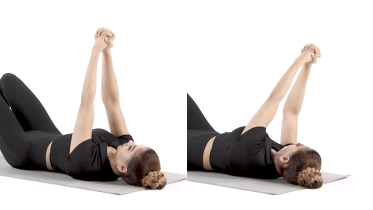
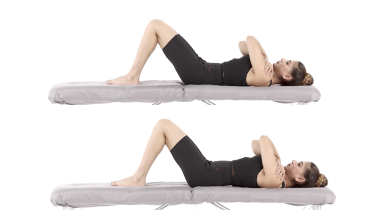
For a gentler start without the balls, lower trunk rotation moves only the knees, and the lying upper body rotation moves only the arms and chest. This exercise puts the two together, which makes it a bigger twist.
With low bone density (osteoporosis), talk to your physio before you start, as twisting with the upper and lower body going in opposite directions is often limited or kept small. If you have had a fracture in your spine, check with your physio before you begin. If you have had surgery on your spine, chest or heart in recent months, get the go-ahead from your surgical team or physio first. If you are pregnant and past the first three months, check with your physio before exercising flat on your back.
If you have had a hip replacement, get the go-ahead from your surgeon or physio before you try the lying trunk twist with a ball. As the knees drop to one side, the top hip turns inward and that knee moves across your body, and many surgeons ask you to avoid that for the first months after some operations.
Written and checked by the PocketPhysio editorial team. Last updated 2026-09-26.
This page is general education, not a diagnosis or a personal treatment plan. If you have pain, an injury or a health condition, see a physiotherapist or doctor before starting new exercises.