
Pulled muscle in the lower back: exercises and recovery
Warning signs, and when to get help
What a pulled muscle in the lower back actually is
Here is the straight answer, because almost nobody gives it. Nobody looked at the pulled muscle in your lower back. There is no test that shows a strained back muscle, scans are not arranged for this, and the term is a description of how the pain behaved rather than a finding. You lifted, twisted or reached, something caught, and now your back is sore and guarded. That story is so consistent that we all use the shorthand, including in the clinic.
What the research says about the underlying cause is honest and slightly unsatisfying. A Lancet review found that for nearly all people with low back pain a specific cause cannot be identified, and that only a small proportion have a serious one such as a fracture, cancer or infection (Hartvigsen and colleagues, 2018). The muscles, the small joints at the back of the spine, the discs and the surrounding tissues all have a nerve supply and all of them can hurt, usually together, and separating them in an individual back has not been possible.
So nothing here pretends that a muscle fiber tore and is now knitting back together on a timetable. What you have is an acute episode of low back pain with a mechanical trigger, which is what it almost certainly is, and what makes a difference to it is what you do in the first days and whether you get your back back to its old load tolerance before the next lift. For the general version of the plan, the low back pain program is the place to start, and the facet joint pain page covers the pattern that is worse leaning backward.
How do you know if it is a pulled muscle or something worse?
By what comes with it, not by how much it hurts. Severe pain is common with an ordinary strain, and plenty of people who can hardly get off the sofa on day two are fine in a fortnight.
What moves it out of the ordinary category is the company the pain keeps. Symptoms that travel down the leg, particularly below the knee, with pins and needles, numbness or weakness, suggest a nerve rather than a muscle and belong on the sciatica page. Then there are the symptoms that have nothing to do with movement: a fever, feeling generally unwell, weight you did not mean to lose, or pain that is no better at rest and wakes you at night. And anything involving the bladder, the bowels or the feeling around your genitals and bottom is an emergency, never something to sleep on.
Some people need extra care from the start. If you are older, have low bone density or have taken steroid tablets for a long time, a lift or a minor fall can break a bone in the spine, and it does not always announce itself; that needs checking the same day rather than an exercise plan. And anyone under 45 whose back or buttock pain has lasted more than three months, is worse after rest and in the morning and eases with movement should ask their doctor about inflammatory back pain, because that pattern is often mistaken for repeated strains for years (Finucane and colleagues, 2020).
Warning signs that need urgent help
The full list is at the bottom of this page, with how quickly to act on each line. Read it once before you start the exercises. The lines that cannot wait are numbness or altered feeling around your genitals or bottom, new trouble with your bladder or bowels, symptoms in both legs or loss of feeling in one leg, back pain after a serious accident, and back pain with chest pain. Those mean calling emergency services or going to an emergency department rather than finishing the page. Our guide to red flags in physiotherapy explains what clinicians are screening for and why.
How long does a pulled back muscle take to heal?
There is no answer specific to pulled back muscles, because nobody has followed a group of them. What there is comes from studies that recruit people at the start of an episode of acute low back pain and measure them again over the following year, and a meta-analysis pooled 33 of those cohorts covering 11,166 people. Average pain in the acute group fell from 52 out of 100 at the start to 23 at 6 weeks, 12 at 26 weeks and 6 at 52 weeks (Menezes Costa and colleagues, 2012). Most of the change arrived early and then the curve flattened out.
Read that as the shape rather than as your timetable. In practice the milestones people actually notice come in a fairly reliable order. Turning over in bed and getting up out of a chair stop being events in the first week or two, and sitting through a meal, then a car journey, comes next.
Bending to tie a shoe and getting a bag out of a car boot lag behind. Being able to pick up something heavy without thinking about it is last, and it is usually weeks after the pain has gone.
That gap between pain and capacity is the whole reason stage 3 exists. How long does back pain last goes into the research in more detail, including how often episodes come back.
The first few days
Do less of everything rather than nothing. That means your normal day in smaller pieces: dressing slowly, getting up and walking around the house every hour or so, cooking in two halves with a sit down in between, and a short walk to the end of the road and back a couple of times a day rather than one long outing.
Get out of bed by rolling onto your side first and pushing up with your arms, instead of sitting straight up from flat. That one movement is the worst offender in the first week. Sit on a firm chair with arms instead of a low sofa, because the sofa is easy to get into and hard to get out of. Keep the stage 1 movements small and frequent, two or three times through the day, and treat them as a way of stopping the back stiffening rather than as treatment.
Expect it to be worse first thing in the morning and worse again in the evening after a day on your feet. Both are normal. Lower back pain in the morning has a routine for the stiffest minutes of the day, and if bending is what catches you, lower back pain when bending forward explains what is going on.
Heat or ice for a pulled back muscle?
Whichever one makes it easier to move. Heat has slightly the better evidence in back pain, and for cold there was not enough research to say either way (French and colleagues, 2006), so treat the choice as comfort rather than treatment. The familiar rule about ice for the first 48 hours came from first aid for sprained ankles and has never been tested on backs. Heat or ice for back pain covers the timings, the skin checks and the people who should use neither.
Why resting in bed makes it worse
Because it was tested against carrying on, and it lost. A Cochrane review pooled the trials of advice to rest in bed against advice to stay active. For acute low back pain, the two trials it found, covering 401 adults, came out in favor of staying active on both pain and function, by a small margin (Dahm and colleagues, 2010). The NHS advice is the same: stay active and try to continue with your daily activities, and do not stay in bed for long periods of time.
The mechanism is not mysterious and you can watch it happen over a week. Lying still is comfortable, so you do more of it. The back gets stiffer, the thigh and trunk muscles switch down, confidence drops, and standing up becomes a bigger event each day than it was the day before. Nobody intends this. It is simply what happens when the only thing that makes the pain stop is not moving.
A short lie down to take the edge off is fine. Lying on your side with a pillow between your knees, or on your back with your knees bent, is a common position of ease. The problem is the day spent there, not the twenty minutes. Should I rest or move with back pain works through what that looks like on a bad day.
How to use this program
Pick the stage that matches today. If you are unsure, start at stage 1, and move up when the current stage feels easy and your back settles well afterward. Mild discomfort or a stretching feeling during an exercise is common and usually fine if it has gone by the next morning and is not building up week on week. Pain that spreads further into your leg, or new numbness or tingling, means stop and tell your physio.
Each exercise page gives a typical starting dose. As a rough guide, many programs start at 1 to 2 sets of 8 to 10 slow repetitions, or 2 to 3 gentle holds of 15 to 30 seconds for the stretches, once or twice a day, with 10 to 20 minutes of walking split through the day. The stage 3 strength work is usually done on 2 to 3 days a week, building toward 2 to 3 sets, with a rest day between sessions. Your physio will adjust the exercises and the numbers to suit you.
If you have high blood pressure, breathe steadily through every repetition and never hold your breath. If you have been told you have narrowing of the spinal canal (spinal stenosis) or a forward slip of one vertebra on another (spondylolisthesis), check with your physio before the face-down back extension, because bending backward can make both worse. If you have had a fracture in your spine, check with your physio before you begin.
With low bone density (osteoporosis), ask your physio before the knee to chest stretch, the lower trunk rotation and the loaded lifting work in stage 3, because deep forward bending, twisting to the end of the range and heavy lifting are usually limited. If you have had a hip replacement, get the go-ahead from your surgeon or physio before you try the knee to chest stretch, the lower trunk rotation, the bridge, the squats, the single leg deadlift or the standing hip extension. Pulling the knee in bends the hip well past a right angle, and many surgeons ask you to avoid that for the first months after some operations.
This program is not for the first months after back surgery: follow the plan from your surgeon and physio. If you are pregnant, back and pelvic pain needs its own program, so ask your midwife, doctor or physio.
The exercise program
Stage 1: The first few days
For a back that is sore, stiff and guarded, when getting out of bed and standing up from a chair are the hard moments. These are small movements, kept well inside comfort, and they are there to stop the back seizing up rather than to treat anything. The walking matters as much as the floor work: short and often beats one long effort while things are still raw.
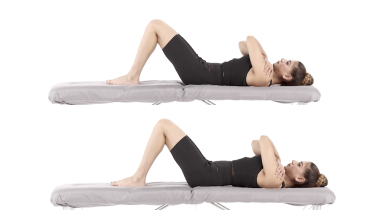 Pelvic tilt
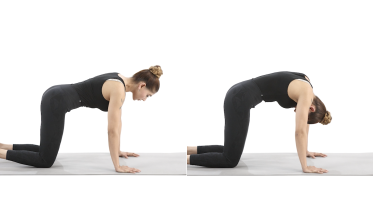 Cat-camel stretch
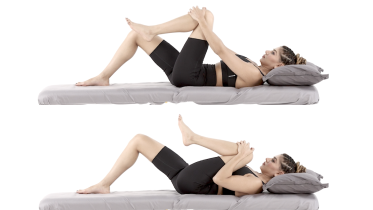 Knee to chest stretch
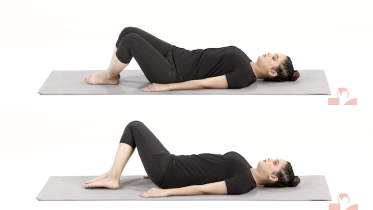 Lower trunk rotation
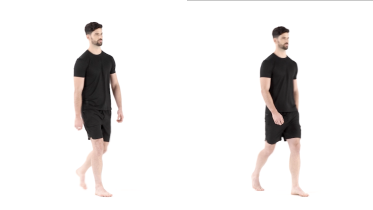 Brisk walking
Stage 2: Week one to three
When moving around the house is easier and you are no longer bracing all day. These ask your trunk to stay steady while your arms and legs move, which is the control you lost in the first few days. Add the face-down back extension only if leaning back feels comfortable, and keep it small. Light effort, normal breathing, and you should be able to hold a conversation through any of them.
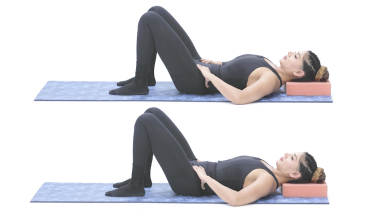 Transverse abdominis activation
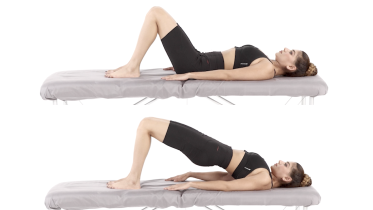 Glute bridge
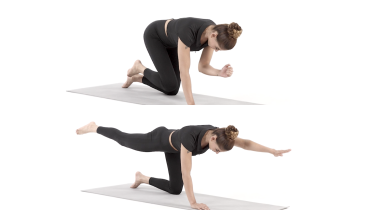 Bird dog
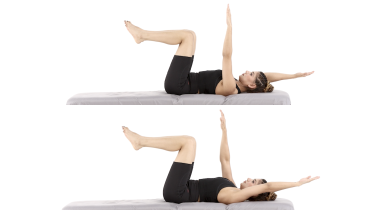 Dead bug
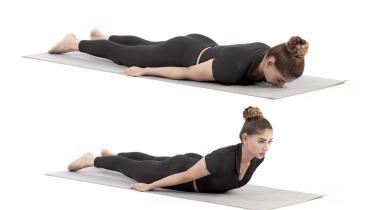 Prone back extension
Stage 3: Back to lifting and work
This stage is the one people skip, and skipping it is why the next episode arrives. Pain usually settles weeks before your back can take load again, so these rehearse the jobs that caused the problem: squatting to a box, picking something up from the floor on one leg, pulling a weight toward you. Start with no weight or a very light one and add slowly. Your physio will set the load and the progression.
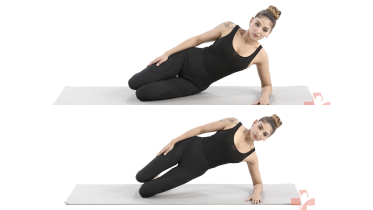 Kneeling side plank
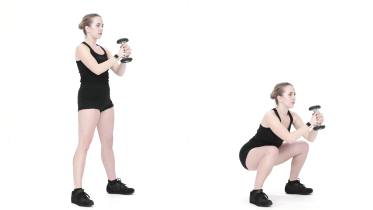 Goblet squat
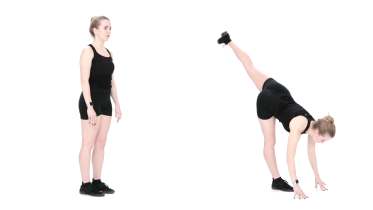 Single leg deadlift
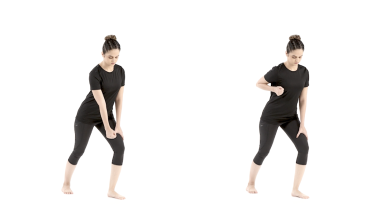 Lawnmower pull
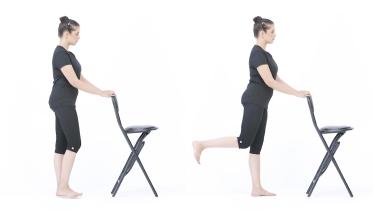 Standing hip extension
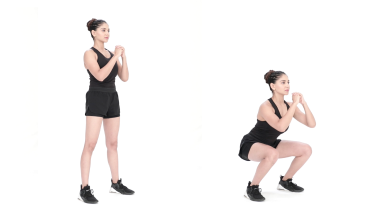 Squat
Sitting, lifting, sleeping and getting back to work
Sitting is usually the complaint of the second week rather than the first. No position lasts an hour, so change before the ache arrives instead of after it, get up for something every half hour or so, and put your feet flat on the floor rather than perching. Back pain when sitting covers chairs, car seats and desks properly.
Lifting is the part worth getting right. Physios are far less prescriptive about technique than they used to be, so the rules worth keeping are about the amount and the setup, not the shape of your spine, and they come from practice rather than from a trial.
Keep the load close to your body. Move your feet, and do not twist with something in your hands. Make two trips instead of one heavy one. Clear a path before you pick anything up, because the lifts that hurt people are usually the ones with an obstacle halfway, and test yourself on something light before the thing you actually need to move.
For the gym, drop the load and keep the habit. Back pain after deadlifts covers getting back to lifting, and muscle soreness or injury is a useful read if you are not sure whether what you feel the day after a session is ordinary soreness. At work, ask for the small changes rather than time off: lighter duties for a week or two, a chance to stand up through the day, help with the heavy jobs.
Painkillers: what the NHS advises
Pain relief is there to let you move, not to let you push through. The NHS advises taking an anti-inflammatory medicine like ibuprofen for back pain, while noting that these may not be suitable for everyone, and says that paracetamol on its own is not recommended for back pain although it may be used with another painkiller. If you are not sure which painkiller suits you, the NHS advice is to check with a pharmacist or a doctor, and that applies particularly if you take other medicines, have stomach, kidney, liver or heart problems, or are pregnant. Never stop or change a prescribed medicine on your own.
Medicine names and what is available over the counter differ between the USA, the UK, Canada, Australia and New Zealand, so your pharmacist is the right person to ask locally.
Stopping the next one
Recurrence is the normal course of low back pain, so this is worth a few minutes. The one thing that has been properly tested is walking. In the WalkBack trial, 701 adults who had recently recovered from an episode were given a progressive walking program with education from a physio over 6 months, and their next episode of back pain that limited daily activities came later than in the group given nothing: a median of 208 days against 112 (Pocovi and colleagues, 2024).
The rest is sensible rather than proven. Keep some strength work going after the pain has gone. That is what stage 3 is for, and it is the part most people leave out. Build load back in steps instead of taking a whole weekend of gardening after a quiet month. For back pain that has already lasted three months or more, a Cochrane review of 249 exercise trials found moderate certainty evidence that exercise reduces pain compared with no treatment, usual care or placebo, by about 15 points on a 0 to 100 scale at the earliest follow-up, which the review counted as a clinically important difference (Hayden and colleagues, 2021). The honest reading of that is that consistency matters more than which exercises you pick.
When to see a physio or doctor
See a physio or doctor if your back has not improved after a few weeks of looking after it at home, if it is stopping you working or sleeping, or if you are worried about it or struggling to cope. Pain that travels below the knee, or pins and needles in one leg, is worth getting checked whenever it appears. Go sooner if this is the third or fourth episode in a year, because the useful conversation then is about load and capacity rather than about the current flare. The warning signs that need faster action are listed below.
Check with your doctor before you start if you have a heart or lung condition, or blood pressure that is not under control.
For physiotherapists
The main job here is managing the label without dismissing it. Patients arrive with a mechanical story and a tissue model, and the useful move is to keep their story and replace the model: a mechanically triggered episode of non-specific low back pain, no imaging indicated, no structure identifiable in nearly all cases (Hartvigsen 2018), with a prognosis taken from the acute inception cohorts rather than from muscle healing timelines (Menezes Costa 2012, 33 cohorts, 11,166 participants).
Screen along the NG59 and IFOMPT lines at first contact, with particular attention to the vertebral fracture risk factors in older adults and long-term corticosteroid users, and to the inflammatory pattern in anyone under 45 with more than three months of symptoms (NG65). Risk stratification, for example with the STarT Back tool, is worth the two minutes on a recurrent presentation. Note that the NG59 July 2026 update removed two recommendations, 1.2.13 on psychological therapy and 1.2.14 on combined physical and psychological programs, and gives the same reason for both: a surveillance review found the recommendation may be out of date, and an update was not prioritized in this area. That is a withdrawal for want of a review, not a finding against psychological treatment, so do not read it as one, and check the current version before quoting it.
Stage 3 is where the clinical work on this presentation actually is. The common failure in this group is discharge at symptom resolution, with load tolerance never restored and a recurrence inside the year, so set a capacity target tied to the patient's actual demands and use the WalkBack findings when you sell the maintenance walking (Pocovi 2024). Function scores such as the Oswestry Disability Index or the Roland-Morris questionnaire track the first weeks better than pain alone.
Warning signs
Get emergency help now
- Emergency: numbness, tingling or altered feeling around or under your genitals, between your inner thighs, or around your bottom (anus), for example it feels different when you wipe after using the toilet. Call emergency services or go to an emergency department straight away. This can be a sign of pressure on the bundle of nerves at the base of the spine (cauda equina syndrome), which needs emergency treatment.
- Emergency: you find it hard to start peeing, cannot pee, cannot feel yourself peeing or cannot control when you pee, or you do not notice when you need to poo or cannot control when you poo, and this is not normal for you. The same applies to a new change in how your genitals feel during sex, or new trouble getting an erection or ejaculating. Call emergency services or go to an emergency department straight away. These can also be signs of cauda equina syndrome.
- Emergency: sciatica in both legs, or pain, tingling, numbness or weakness in both legs. The same applies if you lose feeling in one leg. Call emergency services or go to an emergency department straight away.
- Emergency: back or leg pain that started after a serious accident, such as a car crash or a fall from a height, or back pain with chest pain. Call emergency services. If the pain started straight after the accident, keep still while you wait.
- Emergency: sudden, severe pain in your lower back or tummy that is not like your usual back pain, if you have been told you have a swelling of the main blood vessel in your tummy (abdominal aortic aneurysm), you are over 60, you smoke or used to smoke, or you have high blood pressure. The same applies if sudden, severe back or tummy pain comes with feeling faint or passing out, pale, sweaty or clammy skin, a racing heartbeat or being short of breath. Call emergency services straight away. This can be a sign of an aneurysm bursting, which needs treatment in hospital at once.
- Emergency: new neck or back pain after a fall, a knock or a jolt, even a minor one such as a trip or a sudden stop in a car, if you have a condition that stiffens the spine, such as ankylosing spondylitis. Call emergency services or go to an emergency department straight away, do not drive yourself, and tell the staff about your spine condition, so they keep your neck and back in their usual position. A stiff spine can break after a small injury, and the break is easy to miss at first. If the pain started straight after the injury, or you also have numbness, tingling or weakness in your arms or legs, keep still and call emergency services.
- Emergency: back pain with a fever, or you feel hot, shivery or very unwell, and you also have new weakness, numbness or tingling in one or both legs, or new trouble with your bladder or bowels. Call emergency services or go to an emergency department straight away. This can be an infection pressing on the nerves in the spine (spinal epidural abscess), which needs emergency treatment.
- Emergency: you have had cancer, now or in the past, and your back or neck pain feels like a tight band around your body, or comes with pain spreading down an arm or leg, weakness, numbness or pins and needles in your arms or legs, trouble walking, or trouble controlling your bladder or bowels. Call your cancer team's emergency number straight away, or go to an emergency department if you do not have one or cannot get through. This can be cancer pressing on the spinal cord (metastatic spinal cord compression), which needs treatment straight away.
Get help today
- A leg or foot that is getting weaker, for example your foot drags, catches on the ground or slaps down when you walk (foot drop). Get medical advice the same day. If the weakness is getting worse by the hour, go to an emergency department.
- A calf or thigh that is newly swollen or getting more swollen, warm, tender, red or darker than usual, has swollen veins that are sore to touch, or has a throbbing or cramping pain that does not fit your injury or condition, or that feels different from normal muscle soreness after exercise. This can be a sign of a blood clot (deep vein thrombosis), especially after surgery, an injury, time in a cast or boot, a long trip or a spell of being much less mobile than usual. Get medical advice the same day. If you are also short of breath or have chest pain, call emergency services.
- Back pain after a minor fall or strain if you are older, have low bone density (osteoporosis) or have taken steroid tablets for a long time. Get medical advice the same day. Until it has been checked, stop the exercises and keep away from lifting, bending forward and twisting, because those load a bone in the spine that may be broken.
- Back or leg pain with a fever, or you feel hot, cold, shivery or generally unwell. Get medical advice the same day, and go to an emergency department if you feel very unwell.
- You have back pain and have lost weight without trying. Get medical advice the same day and mention the weight loss.
- New back pain and you have had cancer, now or in the past. Get medical advice the same day and mention your cancer history. If you are being treated for cancer now, contact your cancer team the same day.
- Same day: pain that is worse at night, or does not ease at all when you rest. If you have had cancer, now or in the past, or you have lost weight without trying, get medical advice the same day.
- Severe pain that comes on suddenly or is getting worse quickly. Get medical advice the same day.
Book an appointment
- Within a few days: pain that is worse at night, or does not ease at all when you rest. See your doctor within a few days.
- Back or buttock pain that started before the age of 45, has lasted more than three months, is worse after rest and in the morning, and eases when you move. This is not an emergency, but see your doctor in the next week or two and ask whether it could be inflammatory back pain (axial spondyloarthritis).
- Routine: back pain that comes from the top of your back, between your shoulders, rather than your lower back, and has not been checked, or back pain that is worse when you sneeze, cough or poo, or comes with a lump or swelling, or a back that has changed shape. Book an appointment with your doctor, as the NHS advises, and have it checked before you start this program. If the pain came on suddenly, get medical advice the same day.
Common questions
Is a pulled back muscle serious?
Usually not. A Lancet review found that only a small proportion of people with low back pain have a serious cause such as a fracture, cancer or infection (Hartvigsen and colleagues, 2018). What makes it worth a closer look is not how badly it hurts but what comes with it: a fever, weight you did not mean to lose, a cancer history, numbness around your genitals or bottom, any change in your bladder or bowels, or symptoms in both legs. Those are on the warning list on this page, and each line says how fast to act.
Should I stretch a pulled back muscle?
Gently, and not hard. The instinct to stretch a tight, aching back repeatedly feels better for about a minute and does not change anything. Small, slow movements through a comfortable range, like the ones in stage 1, do more than a long hard pull, and if a stretch makes the pain sharper or spreads it into your leg, that is the signal to stop rather than to push further.
Can I go to work with a pulled back muscle?
For most people yes, often with a few changes. Getting back to normal activity, work included, as early as you can is what guidelines advise, and the changes that make it possible are small: lighter duties for a week or two, more chances to get up and move, help with the heavy jobs, and a short walk at lunchtime. Staying off work for weeks tends to make the return harder rather than easier.
Why does my back keep going out?
Nothing is going out of place, although the phrase describes the feeling well. Recurrence is the normal course of low back pain rather than a sign that something was missed or that a joint keeps slipping. The two things that change the odds are getting your back back to its old tolerance for load, which is what stage 3 is for, and keeping some walking going after the pain has gone. How long does back pain last has the figures on how often episodes come back.
Do I need a scan for a pulled back muscle?
Almost never, and a scan would not show a strained muscle anyway. NICE advises against routine imaging for low back pain outside specialist care. Disc bulges and joint wear turn up on scans of large numbers of people who have no pain at all, and they get more common with age (Brinjikji and colleagues, 2015), so a report full of findings often creates worry without changing the treatment. Scans are arranged when a doctor suspects one of the serious causes on the warning list.
What is the difference between a pulled muscle and a slipped disc?
Where the symptoms go. A strain stays in the back, sometimes spreading into the buttock, and it is sore to press along the muscles beside the spine. A disc pressing on a nerve sends pain down the leg, often below the knee, usually with pins and needles, numbness or weakness, and it is often worse when you cough or sneeze. Leg symptoms are the thing that changes the plan, and the sciatica and lumbar disc herniation pages cover them.
References
- Hartvigsen J, Hancock MJ, Kongsted A, et al. What low back pain is and why we need to pay attention. The Lancet. 2018;391(10137):2356-2367. https://doi.org/10.1016/S0140-6736(18)30480-X
- Dahm KT, Brurberg KG, Jamtvedt G, Hagen KB. Advice to rest in bed versus advice to stay active for acute low-back pain and sciatica. Cochrane Database of Systematic Reviews. 2010;(6):CD007612. https://doi.org/10.1002/14651858.CD007612.pub2
- da C Menezes Costa L, Maher CG, Hancock MJ, McAuley JH, Herbert RD, Costa LO. The prognosis of acute and persistent low-back pain: a meta-analysis. CMAJ. 2012;184(11):E613-E624. https://doi.org/10.1503/cmaj.111271
- French SD, Cameron M, Walker BF, Reggars JW, Esterman AJ. Superficial heat or cold for low back pain. Cochrane Database of Systematic Reviews. 2006;(1):CD004750. https://doi.org/10.1002/14651858.CD004750.pub2
- Hayden JA, Ellis J, Ogilvie R, Malmivaara A, van Tulder MW. Exercise therapy for chronic low back pain. Cochrane Database of Systematic Reviews. 2021;(9):CD009790. https://doi.org/10.1002/14651858.CD009790.pub2
- Pocovi NC, Lin CWC, French SD, et al. Effectiveness and cost-effectiveness of an individualised, progressive walking and education intervention for the prevention of low back pain recurrence in Australia (WalkBack): a randomised controlled trial. The Lancet. 2024;404(10448):134-144. https://doi.org/10.1016/S0140-6736(24)00755-4
- Brinjikji W, Luetmer PH, Comstock B, et al. Systematic literature review of imaging features of spinal degeneration in asymptomatic populations. American Journal of Neuroradiology. 2015;36(4):811-816. https://doi.org/10.3174/ajnr.A4173
- National Institute for Health and Care Excellence. Low back pain and sciatica in over 16s: assessment and management (NG59). Published 2016, last updated July 2026. https://www.nice.org.uk/guidance/ng59
- Finucane LM, Downie A, Mercer C, et al. International framework for red flags for potential serious spinal pathologies. Journal of Orthopaedic and Sports Physical Therapy. 2020;50(7):350-372. https://doi.org/10.2519/jospt.2020.9971
- National Institute for Health and Care Excellence. Spondyloarthritis in over 16s: diagnosis and management (NG65). Published February 2017. https://www.nice.org.uk/guidance/ng65
- NHS. Back pain. https://www.nhs.uk/conditions/back-pain/
- NHS. Abdominal aortic aneurysm. https://www.nhs.uk/conditions/abdominal-aortic-aneurysm/
- National Institute for Health and Care Excellence. Abdominal aortic aneurysm: diagnosis and management (NG156). 2020. https://www.nice.org.uk/guidance/ng156
- NHS. Deep vein thrombosis (DVT). https://www.nhs.uk/conditions/deep-vein-thrombosis-dvt/
- Darouiche RO. Spinal epidural abscess. New England Journal of Medicine. 2006;355(19):2012-2020. https://doi.org/10.1056/NEJMra055111
Written and checked by the PocketPhysio editorial team. Last updated 2026-10-24.
This page is general education, not a diagnosis or a personal treatment plan. See a physiotherapist or doctor for advice about your own situation.