
Sacroiliac joint pain exercises and physiotherapy
What is sacroiliac joint pain?
The sacroiliac (SI) joints sit on either side of the flat bone at the base of your spine (the sacrum), where it joins the pelvis. You can find them roughly under the two dimples low on your back. SI joint pain is pain that comes from one or both of these joints, usually felt low in the back and in the buttock on one side, and sometimes down the back of the thigh (Vleeming 2008).
A review of SI joint pain lists the things that make it more likely: older age, a difference in leg length, inflammatory arthritis, earlier spine surgery, pregnancy, or an injury such as a fall (Cohen 2013). The same review found that people with SI joint pain are more likely than people whose back pain comes from the discs or the small joints of the spine to remember a specific event that set it off, and to feel the pain on one side, low down, rather than in the middle of the back.
This page is for SI joint pain in adults outside pregnancy. If your pain started while pregnant, the pregnancy back and pelvic pain program covers it, and if you are pregnant or have had a baby in the past year, check with your midwife, doctor or physio before you start anything here. For back pain in general, the low back pain program is the place to start. This page adds more hip and buttock strength work and explains what is different about the SI joint.
Why SI joint pain is hard to diagnose
It is honestly hard to be sure the SI joint is the cause. The pain pattern varies a lot between people and overlaps with pain from the discs, the small joints of the spine and the hip, and no single question or examination finding can reliably pick out a painful SI joint (Cohen 2013). Scans do not settle it either: the European pelvic girdle pain guidelines found no evidence for using X-rays, CT or bone scans to diagnose it (Vleeming 2008).
What physios use instead is a group of pain provocation tests. These press, squeeze or twist the pelvis in different ways to see whether they bring on your familiar pain. In a study of 48 patients, three or more positive tests out of six matched the result of a numbing injection into the joint well, and when none of the six brought on the familiar pain, the SI joint could be ruled out (Laslett 2005).
Later reviews are more cautious. A 2021 review that pooled five studies found that a positive cluster is not accurate enough to confirm SI joint pain, while a negative cluster is fairly good at ruling it out, and it rated the evidence as very low certainty (Saueressig 2021). Another review found the tests were a little more useful when combined with pain that is not in the middle of the back (Han 2023). So "SI joint pain" is often a working label rather than a firm diagnosis. That is fine for choosing exercises, because the approach is much the same either way.
Could it be inflammatory back pain?
Sometimes pain in the SI joints comes from inflammation, as in ankylosing spondylitis, a form of axial spondyloarthritis. The pattern of the pain is the main clue. The NHS describes back pain that gets better with exercise but not with rest, and pain in the area around the buttocks. Pain and stiffness are worse in the morning and at night.
NICE advises doctors to think about axial spondyloarthritis when back pain started before the age of 45 and has lasted longer than three months, alongside other features. A doctor can arrange the right tests, which may include blood tests, an X-ray or an MRI scan, and NICE advises referral to a rheumatologist, a specialist in joint and muscle conditions, when enough of these features are present. If this pattern sounds like yours, see your doctor rather than relying on exercise alone. The ankylosing spondylitis program explains the condition and its exercise plan.
Does exercise help SI joint pain?
Trials that test exercise specifically for SI joint pain are few and small. A 2017 review found nine studies of physio treatments, including three on exercise, and judged their quality as low to average (Al-Subahi 2017). So there is no well-tested exercise program for the SI joint on its own.
Because the SI joint is so hard to separate from other sources of back pain, physios usually follow low back pain guidance. NICE advises staying active and suggests considering a group exercise program for a flare of low back pain. A Cochrane review found that exercise probably reduces pain in back pain lasting three months or more, with a modest average benefit (Hayden 2021). The European pelvic girdle pain guidelines also recommend clear information and reassurance, and a treatment program fitted to the person that includes exercise (Vleeming 2008).
Most physio programs for SI joint pain include strength work for the buttock and hip muscles and for the trunk, because these muscles control the pelvis when you walk or climb stairs, and when you stand on one leg. Expect it to take weeks to months of steady work.
How to use this program
Pick the stage that matches how your back and buttock feel today. Unsure which one fits? Begin with stage 1. Go slowly and keep breathing normally, working in a range that is comfortable or only mildly uncomfortable.
Each exercise page gives its own starting dose. As a rough guide, many programs start with 2 to 3 sets of 10 pelvic tilts, 3 to 5 gentle knee to chest holds of 15 to 30 seconds on each leg, and 10 to 15 slow knee rolls to each side, once or twice a day. The hip exercises often start at 2 to 3 sets of 10 to 15 on each side, the bridge at 2 to 3 sets of 10 to 12, and the bird dog and dead bug at 6 to 10 slow repetitions on each side. In stage 3, side planks often start with holds of 10 to 30 seconds and the squat and single leg exercises at 2 to 3 sets of 8 to 12, a few days a week, with brisk walking at 10 to 20 minutes on most days. Your physio will adjust this.
Mild discomfort during an exercise is common and usually fine if it settles soon after and your back is no worse the next morning. If an exercise brings on your familiar pain and it is still there the next day, leave it out for now, go back a step and tell your physio. Move up a stage when the current one feels easy and your pain settles well afterward.
The exercise program
Stage 1: Settle it down and keep moving
For a new episode or a flare, when sitting, turning in bed or standing on one leg brings on the familiar ache. These are small movements done lying on your back, kept inside a comfortable range. The deep tummy hold teaches you to tighten your trunk gently before you add load. Keep walking at a pace and distance that does not build the pain.
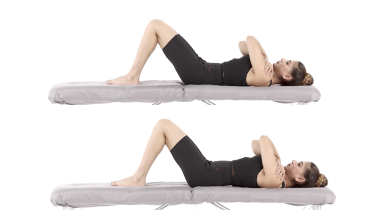 Pelvic tilt
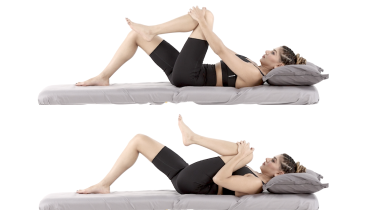 Knee to chest stretch
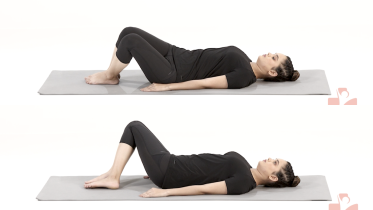 Lower trunk rotation
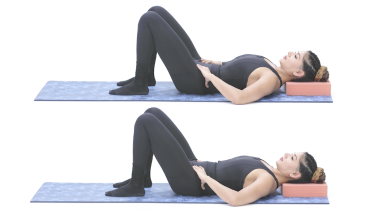 Transverse abdominis activation
Stage 2: Hip and trunk control
When everyday moving is easier. For some people that takes a few days, for others a few weeks. The bridge, clamshell and side leg lift work your buttock muscles, and the bird dog and dead bug train your trunk to stay steady while your arms and legs move. Both legs share the load in most of these, which tends to suit a sore SI joint better than standing on one leg.
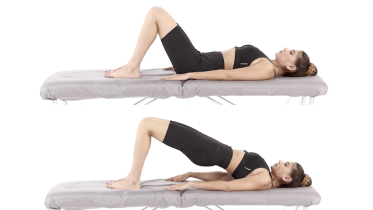 Glute bridge
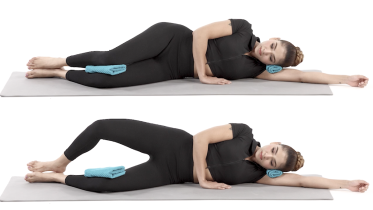 Clamshell
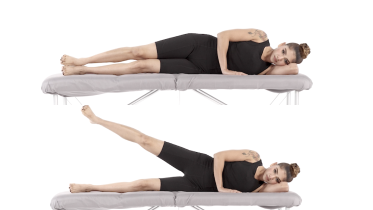 Side lying hip abduction
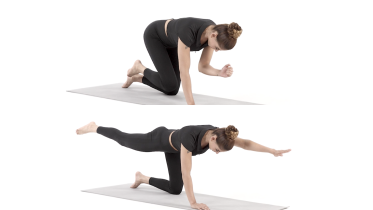 Bird dog
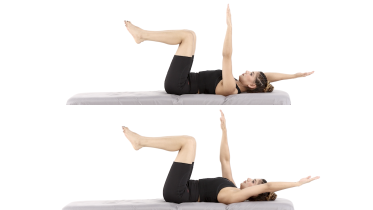 Dead bug
Stage 3: Strength for daily life
For lifting, stairs, sport and long days on your feet. Start with the kneeling side plank and move to the full side plank once you can hold it steadily. The single leg bridge and the step up put your weight through one leg, which can stir up SI joint pain in some people. If they do, stay with the two-legged exercises for longer and tell your physio. Brisk walking builds general fitness alongside the strength work.
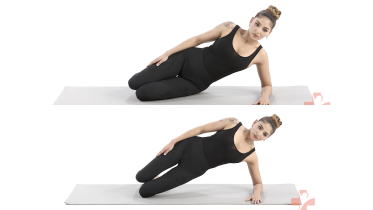 Kneeling side plank
.png) Side plank
Side plank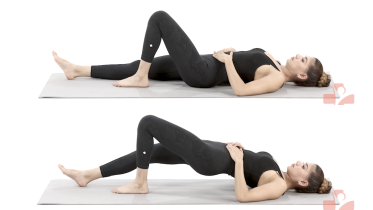 Single leg bridge
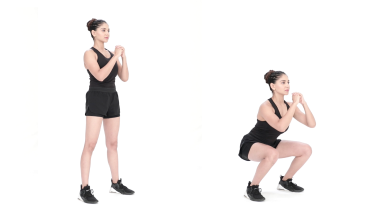 Squat
Squat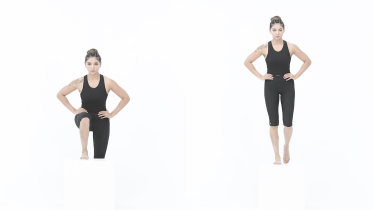 Step up
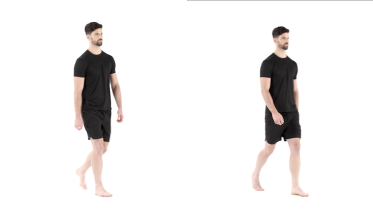 Brisk walking
What to avoid or change
Early on, standing on one leg, hopping, deep lunges and wide-legged stretches can stir up a sore SI joint. You do not have to give them up for good. Build up to them in small steps once the two-legged exercises feel easy.
Long spells of sitting are worth breaking up: stand and move around every so often. If sitting with your legs crossed brings on the pain, sit evenly on both buttocks instead. Split big jobs into shorter chunks rather than doing a full day of heavy work after a quiet spell.
If you have low bone density (osteoporosis), ask your physio before the knee to chest stretch, the lower trunk rotation and the side planks, because deep forward bending, twisting to the end of the range and loaded side positions are usually limited. If you have high blood pressure, breathe steadily through every hold and never hold your breath. If your balance is not steady, do the step up next to a rail or a sturdy surface you can hold.
If you have had a hip replacement, get the go-ahead from your surgeon or physio before you try the clamshell, the side lying hip abduction, the side planks, the bridges, the step up, the knee to chest stretch or the lower trunk rotation. Some operations limit this kind of work for the first months, so the timing depends on your surgery. After surgery on your spine or SI joint, follow your surgeon's program. This page is for adults: if a child or teenager has back or buttock pain that lasts, their doctor can refer them to the right specialist team.
When to see a physio or doctor
See a physio or doctor if your pain is not improving after a few weeks of looking after it at home, if it stops you doing your usual activities, or if you are worried about it. If pain travels below the knee or you get pins and needles in the leg, get that checked too, as a nerve may be irritated. NICE advises against spinal injections for low back pain. If your pain lasts despite several months of exercise, ask your doctor about other options. The signs that need urgent help are in the list below.
For physiotherapists
The program here is a starting framework for patients rather than a full plan. Laslett 2005 (48 patients, intra-articular anesthetic block as reference) found sensitivity 94% and specificity 78% for three or more of six positive provocation tests, an AUC of 0.842 for any two of the best four, and that all six negative ruled out the SIJ. Saueressig 2021 pooled five cluster studies: positive LR 2.13 (95% CI 1.2 to 3.9) and negative LR 0.33 (95% CI 0.11 to 0.72), very low certainty on GRADE, which at an assumed 20% prevalence gives a post-test probability of 35% after a positive cluster and 8% after a negative one. Szadek 2009 found discriminative power for the thigh thrust, the compression test and three or more positive stressing tests, but stressed that a true gold standard is lacking.
Han 2023 found that provocation tests combined with the absence of midline low back pain gave informative likelihood ratios. Screen for the inflammatory pattern early. NICE NG65 advises rheumatology referral when low back pain started before 45 and has lasted over three months with four or more further features (such as onset before 35, waking in the second half of the night, buttock pain, improvement with movement or with NSAIDs within 48 hours), or HLA-B27 testing with exactly three, and same-day ophthalmology for acute anterior uveitis. NG59 advises against spinal injections for low back pain, and its radiofrequency denervation recommendation covers only medial branch (facet) sources after a positive medial branch block, so it does not support SIJ procedures. Manage the rest along NICE NG59 lines, with risk stratification and a graded, individualized program of hip and trunk strengthening, and progress single-leg loading by symptom response.
See a doctor promptly if
- Emergency: numbness, tingling or altered feeling around or under your genitals, between your inner thighs, or around your bottom (anus), for example it feels different when you wipe after using the toilet. Call emergency services or go to an emergency department straight away. This can be a sign of pressure on the bundle of nerves at the base of the spine (cauda equina syndrome), which needs emergency treatment.
- Emergency: you find it hard to start peeing, cannot pee, cannot feel yourself peeing or cannot control when you pee, or you do not notice when you need to poo or cannot control when you poo, and this is not normal for you. The same applies to a new change in how your genitals feel during sex, or new trouble getting an erection or ejaculating. Call emergency services or go to an emergency department straight away. These can also be signs of cauda equina syndrome.
- Emergency: sciatica in both legs, or pain, tingling, numbness or weakness in both legs. The same applies if you lose feeling in one leg. Call emergency services or go to an emergency department straight away.
- Emergency: back or leg pain that started after a serious accident, such as a car crash or a fall from a height, or back pain with chest pain. Call emergency services.
- A leg or foot that is getting weaker, for example your foot drags, catches on the ground or slaps down when you walk (foot drop). Get medical advice the same day. If the weakness is getting worse by the hour, go to an emergency department.
- Emergency: new neck or back pain after a fall, a knock or a jolt, even a minor one such as a trip or a sudden stop in a car, if you have a condition that stiffens the spine, such as ankylosing spondylitis. Call emergency services or go to an emergency department straight away, do not drive yourself, and tell the staff about your spine condition, so they keep your neck and back in their usual position. A stiff spine can break after a small injury, and the break is easy to miss at first. If the pain started straight after the injury, or you also have numbness, tingling or weakness in your arms or legs, keep still and call emergency services.
- Back pain after a minor fall or strain if you are older, have low bone density (osteoporosis) or have taken steroid tablets for a long time. Get medical advice the same day.
- Back or leg pain with a fever, or you feel hot, cold, shivery or generally unwell. Get medical advice the same day, and go to an emergency department if you feel very unwell.
- You have back pain and have lost weight without trying. Get medical advice the same day and mention the weight loss.
- New back pain and you have had cancer, now or in the past. Get medical advice the same day and mention your cancer history. If you are being treated for cancer now, contact your cancer team the same day.
- Emergency: you have had cancer, now or in the past, and your back or neck pain feels like a tight band around your body, or comes with pain spreading down an arm or leg, weakness, numbness or pins and needles in your arms or legs, trouble walking, or trouble controlling your bladder or bowels. Call your cancer team's emergency number straight away, or go to an emergency department if you do not have one or cannot get through. This can be cancer pressing on the spinal cord (metastatic spinal cord compression), which needs treatment straight away.
- Pain that is worse at night, or does not ease at all when you rest. See your doctor within a few days. If you have had cancer, now or in the past, or you have lost weight without trying, get medical advice the same day. If you are being treated for cancer now, contact your cancer team the same day.
- Severe pain that comes on suddenly or is getting worse quickly. Get medical advice the same day.
- An eye that becomes red and painful. Get it checked by an eye specialist the same day, for example at an eye emergency department or urgent eye service, and mention your back or buttock pain. If you cannot be seen by an eye service that day, go to an emergency department. If your vision changes, light hurts your eye, the eye turns very dark red, or you also have a severe headache and feel sick, go to an emergency department or emergency eye service straight away, and do not drive yourself. This can be inflammation at the front of the eye (uveitis), which is linked to inflammatory back pain and can harm your sight if it is not treated quickly.
- Back or buttock pain that started before the age of 45, has lasted more than three months, is worse after rest and in the morning, and eases when you move. This is not an emergency, but see your doctor in the next week or two and ask whether it could be inflammatory back pain (axial spondyloarthritis).
Common questions
What does SI joint pain feel like?
Most often it is an ache low in the back and in the buttock on one side, below the belt line rather than in the middle of the spine. The European guidelines on pelvic girdle pain describe pain between the top of the pelvis and the fold of the buttock, near the SI joint, which can spread into the back of the thigh and makes standing, walking and sitting harder to keep up (Vleeming 2008). The pattern varies a lot from person to person, so it overlaps with other kinds of low back pain (Cohen 2013).
How do you know if back pain is coming from the SI joint?
Often you cannot know for sure. No single question or test can reliably pick out a painful SI joint (Cohen 2013). A physio can press on the pelvis in several ways to see whether your familiar pain comes on, and if none of these tests brings it on, the SI joint is unlikely to be the cause (Laslett 2005; Saueressig 2021). A positive result is less certain. Luckily, the exercise approach is much the same either way.
What is the difference between SI joint pain and sciatica?
SI joint pain is usually felt in the low back and buttock and sometimes the back of the thigh. Sciatica comes from an irritated nerve and tends to travel below the knee, often with pins and needles or numbness in the leg or foot. The two can feel alike in the buttock, so pain that runs below the knee is worth getting checked. The sciatica program covers nerve pain.
What exercises should I avoid with SI joint pain?
No trial has produced a list of exercises to avoid. The practical rule is to leave out, for now, anything that clearly brings on your familiar pain and keeps it going into the next day. For some people that means standing on one leg, hopping, deep lunges or wide-legged stretches early on. Most can come back as you get stronger, and your physio will adjust this.
Is walking good for SI joint pain?
For most people, yes. The NHS lists walking among the activities that may help ease back pain. SI joint and pelvic pain can make long walks harder at first (Vleeming 2008), so walk at a pace and distance that does not build the pain, take shorter steps, and add time slowly.
References
- Laslett M, Aprill CN, McDonald B, Young SB. Diagnosis of sacroiliac joint pain: validity of individual provocation tests and composites of tests. Manual Therapy. 2005;10(3):207-218. https://doi.org/10.1016/j.math.2005.01.003
- Saueressig T, Owen PJ, Diemer F, Zebisch J, Belavy DL. Diagnostic accuracy of clusters of pain provocation tests for detecting sacroiliac joint pain: systematic review with meta-analysis. Journal of Orthopaedic and Sports Physical Therapy. 2021;51(9):422-431. https://doi.org/10.2519/jospt.2021.10469
- Szadek KM, van der Wurff P, van Tulder MW, Zuurmond WW, Perez RS. Diagnostic validity of criteria for sacroiliac joint pain: a systematic review. The Journal of Pain. 2009;10(4):354-368. https://doi.org/10.1016/j.jpain.2008.09.014
- Han CS, Hancock MJ, Sharma S, et al. Low back pain of disc, sacroiliac joint, or facet joint origin: a diagnostic accuracy systematic review. EClinicalMedicine. 2023;59:101960. https://doi.org/10.1016/j.eclinm.2023.101960
- Cohen SP, Chen Y, Neufeld NJ. Sacroiliac joint pain: a comprehensive review of epidemiology, diagnosis and treatment. Expert Review of Neurotherapeutics. 2013;13(1):99-116. https://doi.org/10.1586/ern.12.148
- Vleeming A, Albert HB, Ostgaard HC, Sturesson B, Stuge B. European guidelines for the diagnosis and treatment of pelvic girdle pain. European Spine Journal. 2008;17(6):794-819. https://doi.org/10.1007/s00586-008-0602-4
- Al-Subahi M, Alayat M, Alshehri MA, et al. The effectiveness of physiotherapy interventions for sacroiliac joint dysfunction: a systematic review. Journal of Physical Therapy Science. 2017;29(9):1689-1694. https://doi.org/10.1589/jpts.29.1689
- National Institute for Health and Care Excellence. Low back pain and sciatica in over 16s: assessment and management (NG59). Published 2016, last updated July 2026. https://www.nice.org.uk/guidance/ng59
- Hayden JA, Ellis J, Ogilvie R, Malmivaara A, van Tulder MW. Exercise therapy for chronic low back pain. Cochrane Database of Systematic Reviews. 2021;(9):CD009790. https://doi.org/10.1002/14651858.CD009790.pub2
- National Institute for Health and Care Excellence. Spondyloarthritis in over 16s: diagnosis and management (NG65). Published February 2017. https://www.nice.org.uk/guidance/ng65
- NHS. Symptoms: Ankylosing spondylitis. Page last reviewed 5 January 2023. https://www.nhs.uk/conditions/ankylosing-spondylitis/symptoms/
- NHS. Back pain. https://www.nhs.uk/conditions/back-pain/
- Finucane LM, Downie A, Mercer C, et al. International framework for red flags for potential serious spinal pathologies. Journal of Orthopaedic and Sports Physical Therapy. 2020;50(7):350-372. https://doi.org/10.2519/jospt.2020.9971
Written and checked by the PocketPhysio editorial team. Last updated 2026-09-28.
This page is general education, not a diagnosis or a personal treatment plan. See a physiotherapist or doctor for advice about your own situation.