
Tailbone pain (coccydynia) exercises and physiotherapy
What is tailbone pain?
Your tailbone (coccyx) is the small, curved bone at the very bottom of your spine, below the flat bone at the base of the spine (the sacrum). When you sit, it shares your weight with the two sitting bones of the pelvis, like one leg of a tripod (Lirette 2014; Bain 2025). Tailbone pain, or coccydynia, is pain in and around this bone. The classic spot is in the middle, below the sacrum and above the anus, and it is worse while sitting and as you stand up from sitting (Foye 2017).
The NHS describes it as a dull ache with occasional sharp pains, and it can also flare when you bend forward or open your bowels. The causes it lists include pregnancy and childbirth, an injury such as a fall onto your bottom, long spells of sitting (for example driving or cycling), poor posture, and being overweight or underweight. Sometimes no cause is found. Women get it about five times as often as men (Benditz 2025).
How it differs from other low back and buttock pain
Tailbone pain sits right at the tip of the spine, between the buttocks, and there is usually one spot that is tender to press. Pain to one side, under the dimple low on your back, fits the sacroiliac joint pain program better. Pain deep in one buttock that can spread down the back of the leg is covered in the piriformis syndrome program. For pain higher up, across the lower back, start with the low back pain program.
Does exercise help tailbone pain?
Honestly, nobody knows for sure. Two systematic reviews from 2025 found only 9 and 10 small randomized trials of physical therapy for coccydynia (Blanco-Diaz 2025; Sidiq 2025). Several treatments improved pain and function in the short term, but the trials were small and mostly short, so neither review could say which treatment works best. Many of the treatments tested were hands-on or machine-based, such as manipulation, internal stretching or massage of the pelvic floor muscles, and shockwave therapy, rather than exercises you do at home.
The home exercise evidence is thinner still. In one trial of 48 people, 3 weeks of stretching two hip muscles, the piriformis deep in the buttock and the iliopsoas at the front of the hip, improved tenderness and the time people could sit without pain more than warm baths and ultrasound treatment did. Everyone in the trial was also told to sit less and use a cushion (Mohanty 2017). That is one small study, so treat it as a promising lead rather than proof.
The pelvic floor muscles attach to the tailbone. The NHS suggests trying pelvic floor exercises, and a review notes that pelvic floor rehab can help when spasm in the pelvic floor muscles is part of the problem (Lirette 2014). A clinic study of pelvic floor physical therapy aimed at relaxing these muscles found that pain scores fell by more than half on average in people who finished treatment, but it had no comparison group and some people also had medicines or injections (Scott 2017). That is why this program puts the weight on relaxing the pelvic floor, alongside gentle hip and back movement.
First steps: sitting, ice or heat, and pain relief
Start with how you sit. The NHS advises sitting upright with your lower back supported, using a specially designed coccyx cushion, and not sitting for a long time. Wedge-shaped coccyx cushions can take pressure off the tailbone, while ring or donut cushions can still press on it (Lirette 2014). Get up and move around regularly, and lie on your side when you rest.
The NHS also suggests an ice pack or a bag of frozen peas wrapped in a towel on the sore area for 20 to 30 minutes. Heat can help too, and a review suggests trying both, since neither has been shown to work better (Lirette 2014). Anti-inflammatory painkillers such as ibuprofen can ease the pain; ask a pharmacist whether they are safe for you. If opening your bowels makes it worse, the NHS suggests a laxative to soften your poo, which a pharmacist can also advise on.
How to use this program
Pick the stage that matches how your tailbone feels today, or begin with stage 1 if you cannot tell. Move slowly and keep every exercise in a range that is comfortable or only mildly uncomfortable.
Every exercise page lists a starting dose of its own. As a rough guide, many programs start with 5 to 10 slow belly breaths 1 to 3 times a day, and 8 to 10 slow breaths of the pelvic floor exercise, lifting on each breath out and letting go on each breath in, 3 times a day. The knee to chest stretch is often 3 to 5 gentle holds of 15 to 30 seconds on each leg, and the lower trunk rotation 10 to 15 slow rolls to each side, once or twice a day.
In stage 2, many programs use 5 to 10 slow cat-camel cycles once or more a day, and hold the piriformis and hip flexor stretches for 20 to 30 seconds, 2 to 3 times on each side, once or twice a day. In stage 3, the bridge is often 2 to 3 sets of 10 to 12 with a short hold at the top, sit to stand 2 to 3 sets of 5 to 10 on most days, and brisk walking 10 to 20 minutes on most days. Your physio will adjust this.
Mild discomfort during an exercise is common and usually fine if it settles soon after and is no worse the next morning. If an exercise brings on sharp tailbone pain, or the ache is still worse the next day, leave it out for now, go back a step and tell your physio. Once a stage feels easy and the ache settles quickly afterward, go on to the next one.
The exercise program
Stage 1: Ease the pressure and let go
For the first days or weeks, or a flare, when sitting is the hardest part of the day. All four are done lying down, which takes the weight off the tailbone for most people. Slow belly breathing and the pelvic floor exercise teach the muscles that attach to the tailbone to switch off as well as work, so give the relax as much attention as the squeeze. If the squeeze makes your tailbone ache more, leave the pelvic floor exercise out for now, keep the belly breathing and ask a physio who works with the pelvic floor. If lying on your back presses on the sore spot, use a bed rather than the floor. You can also do the breathing and the pelvic floor exercise lying on your side, and leave out the stretches on your back for now.
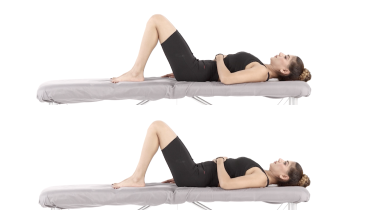 Diaphragmatic breathing
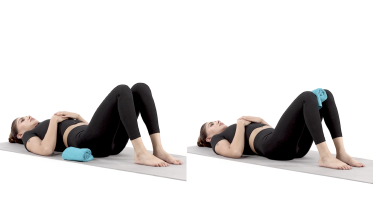 Pelvic floor exercise lying down
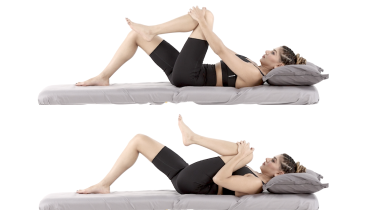 Knee to chest stretch
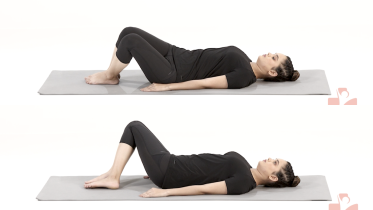 Lower trunk rotation
Stage 2: Loosen the hips and back
When short spells of sitting are easier. The cat-camel moves the whole spine on hands and knees, with no weight on the tailbone at all. The piriformis and hip flexor stretches work on the two hip muscles that were stretched in a small trial for tailbone pain. If lying on your back is still sore, do the piriformis stretch on a bed. Keep each one to a gentle pull. A sharp pain at the tailbone means ease off.
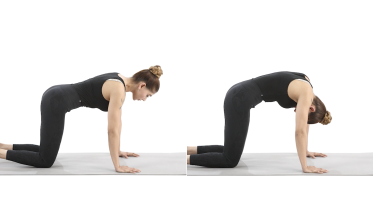 Cat-camel stretch
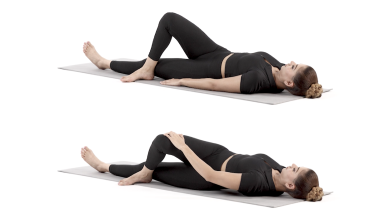 Piriformis stretch
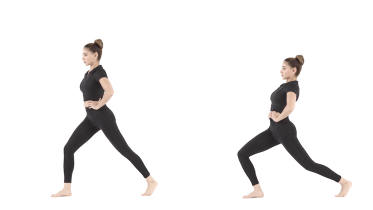 Hip flexor stretch
Stage 3: Back to sitting, walking and daily life
For getting back to work, driving, sport and longer days in a chair. The bridge builds your buttock muscles. Sit to stand practices the move out of a chair that so often catches the tailbone: put your coccyx cushion on the seat, lower yourself gently and lean forward from the hips before you rise. Brisk walking keeps you active on days you would otherwise sit for hours.
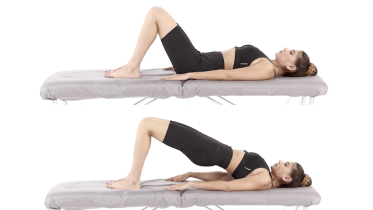 Glute bridge
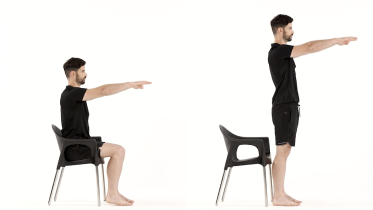 Sit to stand
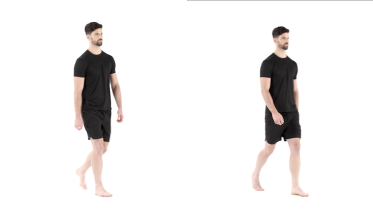 Brisk walking
What to avoid or change
Long spells of sitting are the main thing to cut down, especially on hard seats and in the car. Take your cushion with you, and stand up and move around every so often. If cycling or long drives set the pain off, cut them back for a while and build up again slowly as it settles.
If you have low bone density (osteoporosis), ask your physio before the knee to chest stretch, the lower trunk rotation and the rounding part of the cat-camel, because deep forward bending and twisting to the end of the range are usually limited. If you have high blood pressure, breathe steadily through every hold and never hold your breath. If your balance is not steady, do the hip flexor stretch and sit to stand next to a kitchen counter or a sturdy chair you can hold.
If you have had a hip replacement, get the go-ahead from your surgeon or physio before you try the knee to chest stretch, the lower trunk rotation, the piriformis stretch, the hip flexor stretch, the bridge or sit to stand. Some operations limit this kind of work for the first months, so the timing depends on your surgery. After surgery to remove the tailbone (coccygectomy), follow your surgeon's program.
Tailbone pain often starts in pregnancy or after giving birth. This page does not cover that time: if you are pregnant, or your tailbone pain started during pregnancy or after giving birth, check with your midwife, doctor or physio before you start anything here. If you have recently given birth, including by cesarean section, or you have a gap down the middle of your stomach muscles (diastasis recti), ask your physio, midwife or doctor first. The advice here is for adults. If a child or teenager has tailbone pain that lasts, their doctor can refer them to the right specialist team.
When to see a physio or doctor
The NHS advises seeing a doctor if tailbone pain has not improved after a few weeks of trying treatments at home, if it is affecting your daily activities, or if you have a fever along with it. A physical therapist (physiotherapist) can work on the muscles around the tailbone by hand, and some physios who specialize in the pelvic floor use internal techniques. If simple treatment has not helped, a doctor may offer a steroid and local anesthetic injection, and surgery to remove part or all of the tailbone is kept for the small number of cases where nothing else works (NHS; Bain 2025; Benditz 2025).
In the warning signs below, back pain includes pain at the tailbone. Rarely, tailbone pain comes from an infection or a growth rather than the joint and muscles (Lirette 2014; Bain 2025; Benditz 2025), which is why fever, weight loss, a cancer history and changes in your bowels need checking.
For physiotherapists
This page is a starting framework for patients, not a full plan. Foye 2017 describes the classic picture as midline pain below the sacrum and above the anus, worse in sitting and in sit to stand transitions, with focal tenderness on palpation. Benditz 2025 (Dtsch Arztebl Int) recommends dynamic lateral radiographs in sitting and standing to assess coccygeal mobility, conservative care before interventional methods, and coccygectomy only for intractable, instability-confirmed cases; in the meta-analysis it cites, coccygectomy gave pain relief in 84% and return to work in 76%, with wound complications in 5%. Lirette 2014 reports that conservative treatment succeeds in 90% of cases and lists pilonidal cysts and masses among the causes to rule out; Benditz 2025 adds tuberculosis, chordoma and osteoid osteoma as rare causes not to miss.
On the physical therapy evidence, Blanco-Diaz 2025 included 9 RCTs (532 participants) with moderate to high risk of bias: ESWT showed pain and function gains, sustained to six months in some trials, manual therapy helped most in recent-onset coccydynia with effects fading over time, and kinesiotaping helped pain more than disability. Sidiq 2025 included 10 RCTs (515 adults) and found short-term gains across ESWT, kinesiotaping with exercise, levator ani stretching or massage, manipulation and muscle energy technique, with long-term pain benefit reported for levator ani stretching or massage. Mohanty 2017 randomized 48 people to piriformis and iliopsoas stretching, the same stretching plus thoracic mobilization, or cushioning, sitz bath and phonophoresis (3 weeks, 5 sessions a week; all advised to minimize sitting and use a cushion), with better pressure pain threshold and pain-free sitting time in both stretching groups and no significant change in the conventional group. Scott 2017 is a retrospective chart review: in the 79 patients who completed pelvic floor physical therapy (mean 9 sessions), mean average pain fell from 5.08 to 1.91 out of 10, with no control group; treatment aimed at pelvic floor relaxation, and some patients also received baclofen, ganglion impar blocks or trigger point injections. Screen the pelvic floor, refer for pelvic health assessment where internal work is indicated, and progress sitting tolerance by symptom response.
See a doctor promptly if
- Emergency: numbness, tingling or altered feeling around or under your genitals, between your inner thighs, or around your bottom (anus), for example it feels different when you wipe after using the toilet. Call emergency services or go to an emergency department straight away. This can be a sign of pressure on the bundle of nerves at the base of the spine (cauda equina syndrome), which needs emergency treatment.
- Emergency: you find it hard to start peeing, cannot pee, cannot feel yourself peeing or cannot control when you pee, or you do not notice when you need to poo or cannot control when you poo, and this is not normal for you. The same applies to a new change in how your genitals feel during sex, or new trouble getting an erection or ejaculating. Call emergency services or go to an emergency department straight away. These can also be signs of cauda equina syndrome.
- Emergency: sciatica in both legs, or pain, tingling, numbness or weakness in both legs. The same applies if you lose feeling in one leg. Call emergency services or go to an emergency department straight away.
- Emergency: back or leg pain that started after a serious accident, such as a car crash or a fall from a height, or back pain with chest pain. Call emergency services.
- Emergency: you have had a fall or an injury and now have severe hip pain, or you cannot walk or put weight on the leg. Call emergency services or go to an emergency department. This can be a sign of a broken hip (hip fracture).
- Emergency: new neck or back pain after a fall, a knock or a jolt, even a minor one such as a trip or a sudden stop in a car, if you have a condition that stiffens the spine, such as ankylosing spondylitis. Call emergency services or go to an emergency department straight away, do not drive yourself, and tell the staff about your spine condition, so they keep your neck and back in their usual position. A stiff spine can break after a small injury, and the break is easy to miss at first. If the pain started straight after the injury, or you also have numbness, tingling or weakness in your arms or legs, keep still and call emergency services.
- Severe pain at the tailbone after a fall onto your bottom, pain that makes it very hard to stand up or walk, or pain that keeps getting worse in the days after the fall. Get medical advice the same day, for example at an urgent care center or emergency department, so a doctor can check for a broken bone.
- Back pain after a minor fall or strain if you are older, have low bone density (osteoporosis) or have taken steroid tablets for a long time. Get medical advice the same day.
- A leg or foot that is getting weaker, for example your foot drags, catches on the ground or slaps down when you walk (foot drop). Get medical advice the same day. If the weakness is getting worse by the hour, go to an emergency department.
- Tailbone, back or leg pain with a fever, or you feel hot, cold, shivery or generally unwell. Get medical advice the same day, and go to an emergency department if you feel very unwell. If you have a very high or very low temperature, shivering you cannot control, you are breathing very fast or finding it hard to breathe, you are confused or your speech is slurred, your skin, lips or tongue look blue, gray, pale or blotchy (on brown or black skin this can be easier to see on the palms of the hands or soles of the feet), or you have a rash that does not fade when you press it, call emergency services, as this can be sepsis.
- A painful lump at the top of the crease between your buttocks, or one that bleeds or leaks pus. Get medical advice the same day. This can be an infected pilonidal sinus, a skin problem that needs its own treatment.
- You have back pain and have lost weight without trying. Get medical advice the same day and mention the weight loss.
- New back pain and you have had cancer, now or in the past. Get medical advice the same day and mention your cancer history. If you are being treated for cancer now, contact your cancer team the same day.
- Emergency: you have had cancer, now or in the past, and your back or neck pain feels like a tight band around your body, or comes with pain spreading down an arm or leg, weakness, numbness or pins and needles in your arms or legs, trouble walking, or trouble controlling your bladder or bowels. Call your cancer team's emergency number straight away, or go to an emergency department if you do not have one or cannot get through. This can be cancer pressing on the spinal cord (metastatic spinal cord compression), which needs treatment straight away.
- Pain that is worse at night, or does not ease at all when you rest. See your doctor within a few days. If you have had cancer, now or in the past, or you have lost weight without trying, get medical advice the same day. If you are being treated for cancer now, contact your cancer team the same day.
- Severe pain that comes on suddenly or is getting worse quickly. Get medical advice the same day.
- Blood in your poo, bleeding from your bottom, or a change in your poo or how often you need to go that is not normal for you. See your doctor within a few days and mention your tailbone pain. If your poo is black or dark red, or you have bloody diarrhea, get medical advice the same day. If you are bleeding non-stop from your bottom, or there is a lot of blood or you see large clots, call emergency services.
Common questions
How long does tailbone pain last?
The NHS says tailbone pain may improve after a few weeks, but it can sometimes last longer. A review of coccydynia reports that simple treatment works for most people and that many cases settle without any medical treatment (Lirette 2014). If yours has not improved after a few weeks of home treatment, or it is affecting your daily life, see your doctor or a physio.
What is the best way to sit with tailbone pain?
Sit upright with your lower back supported, and use a coccyx cushion, as the NHS advises. Wedge-shaped coccyx cushions can take pressure off the tailbone while you sit (Lirette 2014). Just as important, do not sit for long spells: get up and move around regularly, and lie on your side when you rest, which the NHS suggests to take pressure off the coccyx.
Is a donut cushion good for tailbone pain?
Often not. A ring or donut cushion has been suggested for tailbone pain, but a review points out that it can still put pressure on the coccyx (Lirette 2014). A wedge-shaped coccyx cushion is the usual choice. Try it on the chair you use most, such as your desk chair or car seat.
What exercises help tailbone pain?
There is no well-tested exercise program for tailbone pain. Two reviews from 2025 found only about ten small trials of physical therapy, with short-term benefits and too much variation to say which treatment works best (Sidiq 2025; Blanco-Diaz 2025). In one small trial, stretching the piriformis and iliopsoas muscles at the hip helped more than warm baths and ultrasound treatment, with everyone also using a cushion (Mohanty 2017). The NHS suggests trying pelvic floor exercises. The program on this page uses gentle, low-risk versions of these, and your physio will adjust it to you.
Should I use ice or heat for tailbone pain?
Either can help, and a review suggests trying both, because neither has been shown to work better than the other (Lirette 2014). The NHS suggests an ice pack or a bag of frozen peas wrapped in a towel on the sore area for 20 to 30 minutes. Always keep a towel between the ice or a heat pack and your skin.
References
- NHS. Tailbone (coccyx) pain. Page last reviewed 20 November 2025. https://www.nhs.uk/conditions/tailbone-coccyx-pain/
- Lirette LS, Chaiban G, Tolba R, Eissa H. Coccydynia: an overview of the anatomy, etiology, and treatment of coccyx pain. Ochsner Journal. 2014;14(1):84-87. https://pubmed.ncbi.nlm.nih.gov/24688338/
- Foye PM. Coccydynia: tailbone pain. Physical Medicine and Rehabilitation Clinics of North America. 2017;28(3):539-549. https://doi.org/10.1016/j.pmr.2017.03.006
- Bain HL, Mabrouk A, Foye P. Coccyx pain. In: StatPearls. Treasure Island (FL): StatPearls Publishing; 2025. https://www.ncbi.nlm.nih.gov/books/NBK563139/
- Benditz A, Thoma R. Coccygodynia: diagnosis and treatment. Deutsches Arzteblatt International. 2025;122(23):638-644. https://doi.org/10.3238/arztebl.m2025.0154
- Sidiq M, Ravichandran H, Janakiraman B, et al. Effectiveness of physical therapy interventions for coccydynia: a systematic review with a narrative synthesis. Archives of Physiotherapy. 2025;15:77-89. https://doi.org/10.33393/aop.2025.3233
- Blanco-Diaz M, Palacios LR, Martinez-Ceron MDR, Perez-Dominguez B, Diaz-Mohedo E. Physiotherapy approaches for coccydynia: evaluating effectiveness and clinical outcomes. BMC Musculoskeletal Disorders. 2025;26(1):514. https://doi.org/10.1186/s12891-025-08744-3
- Mohanty PP, Pattnaik M. Effect of stretching of piriformis and iliopsoas in coccydynia. Journal of Bodywork and Movement Therapies. 2017;21(3):743-746. https://doi.org/10.1016/j.jbmt.2017.03.024
- Scott KM, Fisher LW, Bernstein IH, Bradley MH. The treatment of chronic coccydynia and postcoccygectomy pain with pelvic floor physical therapy. PM&R. 2017;9(4):367-376. https://doi.org/10.1016/j.pmrj.2016.08.007
- NHS. Back pain. https://www.nhs.uk/conditions/back-pain/
- NHS. Pilonidal sinus. https://www.nhs.uk/conditions/pilonidal-sinus/
- NHS. Symptoms of bowel cancer. https://www.nhs.uk/conditions/bowel-cancer/symptoms/
- NHS. Sepsis. Page last reviewed 14 May 2026. https://www.nhs.uk/conditions/sepsis/
- Finucane LM, Downie A, Mercer C, et al. International framework for red flags for potential serious spinal pathologies. Journal of Orthopaedic and Sports Physical Therapy. 2020;50(7):350-372. https://doi.org/10.2519/jospt.2020.9971
Written and checked by the PocketPhysio editorial team. Last updated 2026-09-28.
This page is general education, not a diagnosis or a personal treatment plan. See a physiotherapist or doctor for advice about your own situation.