Chest opener stretch
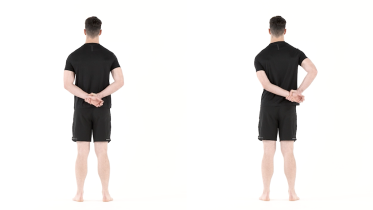
The chest opener is a standing stretch for the front of the chest and shoulders. You link your hands behind your back, draw them gently back and away from you, and let your chest lift as your shoulders roll back and down. It needs no equipment and is easy to fit in between spells at a desk.
How to do the chest opener stretch
- Stand upright, feet roughly hip width apart, with your arms relaxed at your sides.
- Take your hands behind you and link your fingers together. Keep your elbows straight or nearly straight.
- Roll your shoulders back and down so your shoulder blades draw a little toward each other.
- Draw your linked hands back and slightly away from your body while you let your chest lift and open. Stop as soon as you feel a stretch across the front of your chest and shoulders.
- Hold the stretch and keep breathing normally, then unlink your hands and let your arms relax by your sides.
What you should feel
A gentle pull across the front of the chest and the front of both shoulders, sometimes reaching into the upper arms. It should ease slightly as you hold it.
Common mistakes
- Arching your lower back or leaning backward to get your hands higher.
- Poking your chin forward as the chest lifts.
- Letting your shoulders lift and hunch as you draw the hands back.
- Forcing the hands up and back until the shoulders ache.
How often
Many programs hold the stretch for 15 to 30 seconds and repeat it 2 to 4 times, once or several times a day. Your physio will adjust this.
Stop and check with your physio if
- A sharp pain or a pinching feeling at the front or top of the shoulder.
- Tingling, numbness or pain running down an arm into your hand.
- Pins and needles in your arm or hand that do not go away after you stop, or part of your arm or hand goes numb. Get medical advice the same day. If one side of your face or body suddenly goes numb or weak, or your speech becomes slurred or muddled, call emergency services, even if it goes away.
- Your shoulder feels unstable, as though it could slip out.
- The shoulder feels as if it has slipped out of place, looks a different shape or suddenly locks so you cannot move the arm, or your hand turns cold, pale or blue. Go to an emergency department straight away, without driving yourself, and do not try to put the shoulder back in yourself.
From the clinic
If your hands cannot meet behind you, hold a towel, belt or strap between them and keep your hands as close together as feels comfortable. The stretch then comes from the gentle backward draw, not from how near your hands are to each other. The pec stretch works the same area one side at a time against a wall, so you can give a tighter side more time.
Taking the arms back behind the body puts a stretch through the front of the shoulder. If your shoulder has dislocated before, or you have had shoulder surgery, check with your surgeon or physio before you try this stretch. Let go at once if the shoulder feels as if it could slip.
Written and checked by the PocketPhysio editorial team. Last updated 2026-09-28.
This page is general education, not a diagnosis or a personal treatment plan. If you have pain, an injury or a health condition, see a physiotherapist or doctor before starting new exercises.