Deep neck flexor exercise
The deep neck flexor exercise is a tiny chin nod you do lying on your back, with a rolled towel under your neck. It works the small muscles deep in the front of the neck (deep neck flexors), and many neck pain programs include it.
How to do the deep neck flexor exercise
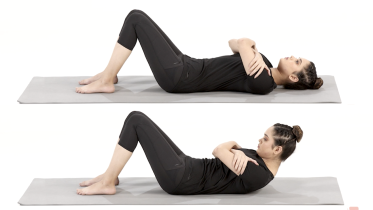
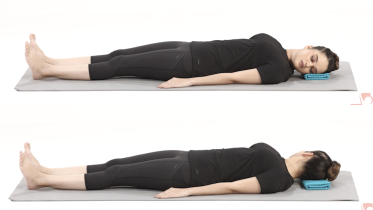
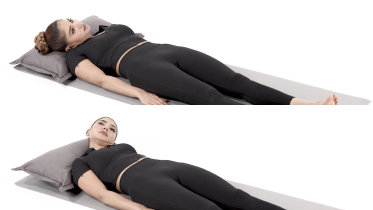
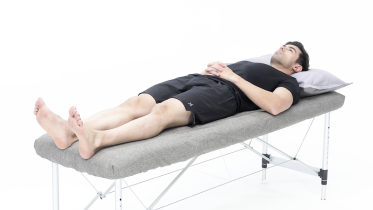
- Lie on your back on a mat with your legs straight and your arms resting by your sides.
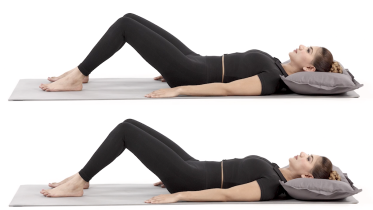
- Place a small rolled towel under the curve of your neck. The back of your head rests on the mat and your eyes look up at the ceiling.
- Gently tuck your chin, like a very small nod. Your head stays on the mat and does not lift.
- As you tuck, press the back of your neck softly down into the towel.
- Hold for a few seconds, then let go completely before the next one.
What you should feel
A light, gentle effort deep in the front of your neck, under the chin. The larger muscles at the side of your neck, and your jaw, should stay soft.
Common mistakes
- Lifting the head off the mat. That brings in the bigger neck muscles and turns it into a harder exercise.
- Pressing too hard. The effort is gentle, and a big push usually means the wrong muscles have taken over.
- Clenching your teeth or holding your breath through the hold.
How often
Programs often start with holds of about 5 to 10 seconds, repeated 5 to 10 times, once or twice a day. Your physio will adjust the hold and the count for you.
Stop and check with your physio if
- You feel dizzy, faint, unsteady or sick. Stop and get medical advice the same day. If you faint, it does not settle within a few minutes of sitting still, or you cannot stand or walk steadily, call emergency services.
- Things look double, your vision suddenly blurs or goes, your speech slurs or becomes muddled, swallowing becomes hard, your face or lips go numb, one side of your face droops or one side of your body goes weak or numb, you suddenly become so dizzy or unsteady that you fall or cannot stand or walk, your legs suddenly give way but you do not black out (a drop attack), or you get a sudden severe headache. Stop and call emergency services, even if it goes away.
- Tingling, numbness or pain shows up in an arm or hand.
- Your neck pain or headache gets clearly worse during or after the exercise.
From the clinic
The movement is tiny, and that is the hard part. Most people expect to feel a strong effort, so they push harder, and the big muscles on the side of the neck do the work instead. Rest two fingers lightly on the side of your neck while you tuck. If you feel a thick muscle there pop up and tighten, ease off a little.
A towel that is too thick pushes the head forward before you even start. You want just enough to fill the gap under your neck, so your face stays level with the ceiling. After neck surgery or a broken bone in the neck, check with your surgeon or physio before you start.
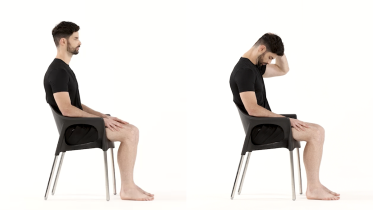
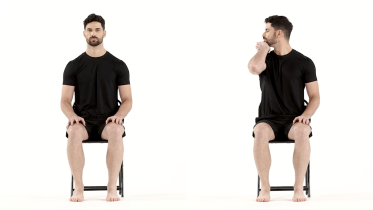
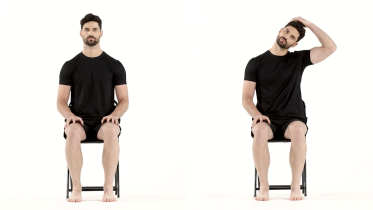
The chin tuck works the same deep muscles sitting up, and some programs use both.
Reviewed by the PocketPhysio by VirtueLife expert physiotherapy team. Last reviewed 2026-09-25.
This page is general education, not a diagnosis or a personal treatment plan. If you have pain, an injury or a health condition, see a physiotherapist or doctor before starting new exercises.