
Cervicogenic headache exercises and physiotherapy
What is a cervicogenic headache?
A cervicogenic headache starts from a problem in the upper neck, usually in its joints, discs or soft tissues. The international headache classification (ICHD-3) counts it as a secondary headache, meaning another condition causes it. The pain is referred: the problem sits in the neck, but you feel it in the head. It is not common. One review puts it at 1 to 4% of people with headaches (Bini 2022).
To make the diagnosis, ICHD-3 asks for a neck problem that can cause headache plus at least two signs that the two are linked. The signs are that the headache started around the same time as the neck problem, eases as the neck improves, comes with a stiff neck and is clearly worsened by certain neck movements, or goes away when a doctor numbs the painful structure in the neck. Features that point toward the neck include pain that stays on one side, a headache brought on by head movement or by pressing on the neck muscles, and pain that spreads from the back of the head toward the front.
How is cervicogenic headache different from tension-type headache and migraine?
Tension-type headache tends to press on both sides of the head. The neck and shoulder muscles are often sore, but the neck joints are not the source. Migraine usually throbs, can be severe, and brings feeling sick or a strong dislike of light and noise (ICHD-3). The difference matters because the treatment is different. Our tension-type headache program leans on relaxation and general neck and shoulder strength, while this one works on the stiff upper neck and the deep neck muscles.
Telling them apart is not always easy. In a study of people with one type of headache, restricted neck movement, upper neck joints that were painful or stiff when a physio examined them, and poor control of the deep neck flexors together picked out every case of cervicogenic headache, and these problems were not found in migraine or tension-type headache (Jull 2007). In older adults, though, neck problems turned up in migraine and tension-type headache as well (Uthaikhup 2009). Many people have more than one type of headache, so a physio or doctor needs to assess you.
When the neck pain bothers you more and the headaches only come now and then, the neck pain program may suit you better. If your headaches started after a car accident, start with the whiplash page and get checked first.
Do exercise and physio help cervicogenic headache?
The best-known trial is Jull and colleagues (2002). It split 200 people with cervicogenic headache into four groups: hands-on treatment to the neck, a specific exercise program, both together, or no treatment. The exercise program trained the deep neck muscles and the muscles around the shoulder blades with low-load holds, twice a day. After 6 weeks, exercise and hands-on treatment had each cut the number and severity of headaches, and the benefit was still there at 12 months. Combining the two was not clearly better than either on its own, although about 10% more people improved with both.
A smaller trial of 32 people tested a self-mobilization for the top of the neck, taught by a physio and done at home twice a day (Hall 2007). Compared with a sham version, it improved how far the upper neck turned straight after the first supervised session, and headache scores were lower at 4 weeks and 12 months. A review of eight trials of this kind of technique, called a SNAG, found it improved pain and neck movement (Cardoso 2022). The towel SNAG in stage 1 is a similar self-mobilization, but it is not the exact technique from these trials, which aimed at the top two bones of the neck. A physio needs to set the towel level and direction for you.
The wider evidence is more cautious. A review of 20 trials found that hands-on treatment and exercise may reduce headache intensity, frequency and disability, but most of the trials were at high risk of bias (Bini 2022). A review of exercise alone found benefits for headache intensity and frequency, with the certainty of the evidence rated low to very low (Becher 2023). An earlier review of six trials concluded that hands-on treatment combined with strength work for the neck and shoulder blades was the most effective for reducing pain (Racicki 2013). In the JOSPT neck pain guideline, neck pain with headache is a separate category, with exercise and hands-on treatment among its recommendations at different stages (Blanpied 2017).
How to use this program
Not sure which stage fits? Begin with stage 1. Move up when the current stage feels easy, your neck settles well afterward and your headaches are not getting more frequent. The deep neck flexor exercise in stage 2 is the core of the program, and it is worth having a physio check that you are doing it with the right muscles.
You will find the starting dose for each exercise on its own page. Typical figures are 5 to 10 slow neck turns to each side a few times a day, and 8 to 10 chin tucks with a 3 to 5 second hold. For the neck isometrics and the deep neck flexor exercise, a common start is gentle 5 to 10 second holds, 5 to 10 times, once or twice a day. The towel SNAG is often 6 to 10 slow turns to each side, once or twice a day. Hold the stretches for 15 to 30 seconds: the upper trapezius stretch 2 to 3 times a side and the suboccipital stretch 2 to 4 times, once or twice a day.
For wall angels, 1 to 3 sets of 8 to 12 once or twice a day is typical. The band row and pull-apart are usually 2 to 3 sets of 10 to 15, daily or every other day. The chin tuck head lift usually begins with 5 to 10 lifts once or twice a day, and the face-down chin tuck with 5 to 10 lifts once a day, with short holds that build toward 10 seconds. The Y and T raises are often 2 to 3 sets of 8 to 12 with a 3 to 5 second hold, once a day. Your physio will adjust this.
Your neck and shoulder muscles may ache a little during or after the exercises. That is common, and fine if it has gone within a day. What should not happen is your usual headache. If an exercise sets it off, leave that one out and tell your physio. Stop and check the warning signs below if you get pain, numbness or tingling running into your arm, dizziness, feeling sick or any change in your vision.
The exercise program
Stage 1: Settle the neck and keep it moving
For a flare-up, or when turning your head is stiff and brings the headache on. Keep every movement slow and inside a range that does not start your headache. In the isometric exercises your neck muscles push against your hand while your head stays still. The two stretches loosen the top of the shoulder and the base of the skull. Use the towel SNAG only after a physio has taught it to you, and only while the turn stays pain free. If a neck movement makes you dizzy, stop, sit still until it settles, and get medical advice the same day before you try again.
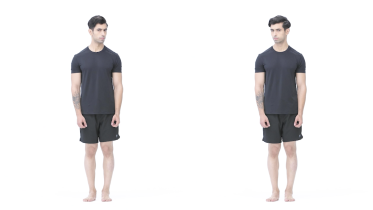 Neck rotation
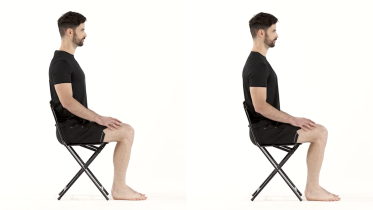 Chin tuck
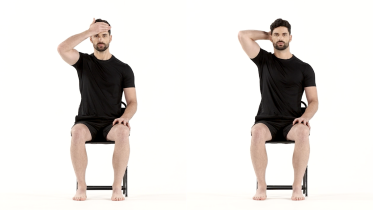 Neck isometric exercises
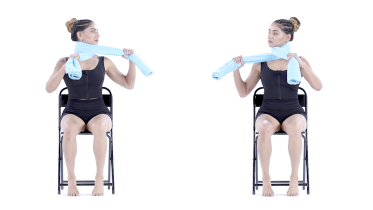 Neck rotation SNAG with a towel
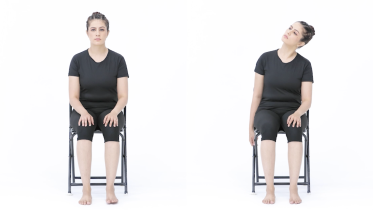 Upper trapezius stretch
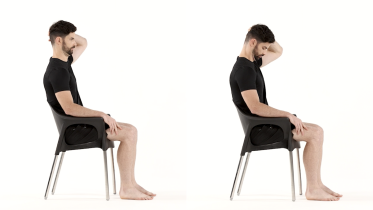 Suboccipital stretch
Stage 2: Train the deep neck and shoulder blade muscles
This stage is closest to the exercise program tested for cervicogenic headache, which trained the small muscles deep in the front of the neck with gentle, low-load holds, along with the muscles around the shoulder blades (Jull 2002). The deep neck flexor exercise is a tiny nod, and the effort is light, not a hard push. Wall angels and the band row work the muscles around your shoulder blades. Treat the standing posture check as a reset you return to a few times a day. You do not need to hold it for long.
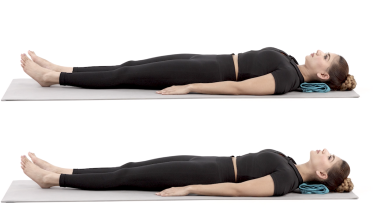 Deep neck flexor exercise
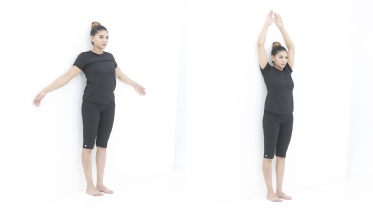 Wall angels
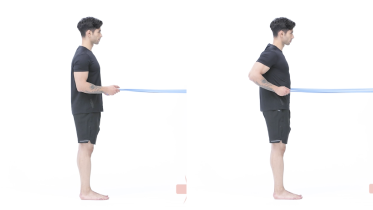 Resistance band row
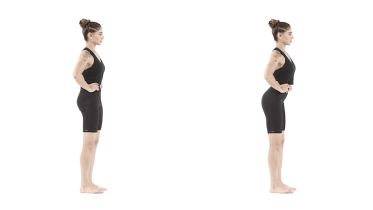 Correct standing posture
Stage 3: Build neck and upper back endurance
Once you can do the stage 2 holds with good control and your headaches are settling, these ask more of the same muscles. In the chin tuck head lift, the front neck muscles have to lift and hold your head against gravity. The face-down chin tuck does the same job for the back of the neck. The Y and T raises and the pull-apart strengthen the muscles that draw your shoulder blades back and down. Keep the deep neck flexor exercise going, and drop back a stage if your headaches start coming more often.
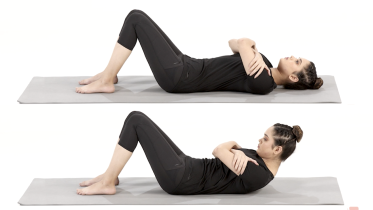 Chin tuck head lift
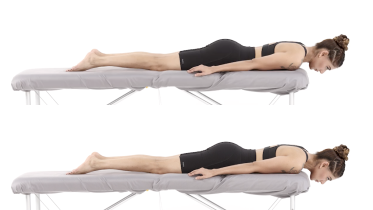 Prone chin tuck
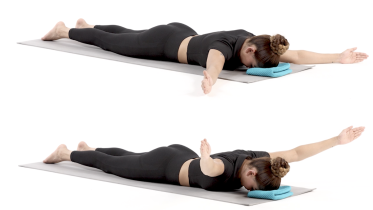 Prone Y raise
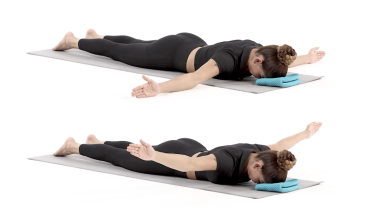 Prone T raise
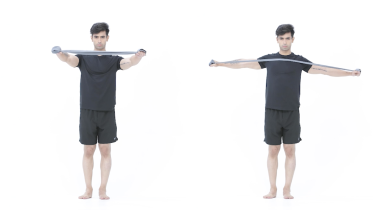 Band pull-apart
What to avoid or change
Avoid long spells with your neck in one position, especially bent forward over a phone or laptop. Get up and move every so often, and do a few stage 1 movements before you carry on. The NHS lists taking too many painkillers among the common causes of headaches, so keep a note of how often you take them and talk to your doctor if you take them on many days a month.
This program is for adults. A child or teenager with frequent headaches needs a doctor's check first. If you are pregnant, check with your midwife or doctor before you start. After neck surgery or a broken bone in the neck, check with your surgeon or physio before you start. If you have rheumatoid arthritis, or you have been told the spaces around the nerves or spinal cord in your neck are narrowed, check with your physio or doctor before you start.
When to see a physio or doctor
See a doctor first if you have not had your headaches diagnosed, and see them again if the pattern changes. The NHS says to see a GP when headaches come regularly, or when one is not easing with your own treatment or is getting worse. A physio can check your neck movement, your upper neck joints and your deep neck muscles, help work out whether the neck is really behind the headache, and work out a dose for you. Before any hands-on treatment to your neck, tell them about any new or unusual headache. Anything in the warning signs below needs quicker help than a routine appointment.
For physiotherapists
Use this page as a patient-facing starting point; the full plan comes from your own assessment. Under ICHD-3 11.2.1, the diagnosis rests on clinical or imaging evidence of a cervical disorder known to cause headache, plus at least two lines of causation: the headache began in temporal relation to the disorder, it improved as the disorder improved, cervical range is reduced and provocative maneuvers make the headache significantly worse, or diagnostic blockade abolishes it. The classification notes side-locked pain, provocation by digital pressure on neck muscles and by head movement, and posterior-to-anterior radiation as features that tend to separate it from migraine and tension-type headache, while not being unique to it. Headache from cervical myofascial pain is probably better coded as tension-type headache.
Jull 2007 found that restricted cervical movement, upper cervical joint dysfunction on manual examination and impaired craniocervical flexion together identified cervicogenic headache in 73 people with single headache types, with none of these impairments found in the migraine and tension-type groups. Uthaikhup 2009 found neck impairment across headache types in people aged 60 to 75, so the pattern is less specific in older adults. Hall 2007 selected participants with a limited flexion-rotation test, and the C1-C2 self-SNAG gained 15 degrees on that test compared with 5 with placebo, measured immediately after the supervised instruction session; headache index was lower at 4 weeks and 12 months. The towel SNAG in stage 1 is a general rotation SNAG, not Hall's C1-C2 technique with the self-SNAG strap, so set the level and direction after your own examination.
Jull 2002 treated for 6 weeks, with the exercise arm built on low-load endurance training of the cervical and scapular muscles, done twice a day. Bini 2022 (20 trials, 1,439 people) reported moderate to large short-term effects of manual therapy over sham for frequency and intensity, with smaller long-term effects and high risk of bias in most trials. Becher 2023 (11 studies) rated the exercise evidence low to very low. Present exercise and manual therapy as parts of care that work alongside each other, not as a proven cure on their own.
Headache and neck pain can be the first or only sign of cervical artery dissection. In one large series in Doukhi 2025, about 8% of patients had no symptom other than headache or neck pain; the review also reports minor trauma in the preceding weeks in about 40% of published series (coughing, neck movements and chiropractic manipulation are among the triggers named), Horner syndrome in 10 to 48% of carotid dissections and tinnitus in 3 to 9%. Screen with the IFOMPT cervical framework (Rushton 2023) before manual therapy, and take a new or changed headache pattern seriously. The SNNOOP10 list (Do 2019) and NICE CG150 cover the wider secondary headache red flags. For suspected degenerative cervical myelopathy, Davies 2018 advises referring promptly to a specialist.
See a doctor promptly if
- Emergency: any sign of a stroke, even if it goes away. That means a face that droops on one side, an arm you cannot lift or keep up, slurred or muddled speech, weakness or numbness on one side of your body or face, sudden blurred vision, double vision or loss of sight, trouble swallowing, sudden dizziness with unsteadiness or falling over, a sudden severe headache, or a sudden fall where your legs give way but you do not black out (a drop attack). Call emergency services straight away. With neck pain, these can rarely come from a tear in an artery in the neck.
- Emergency: a sudden, severe headache or neck pain that feels new and unlike anything you have had before. Call emergency services straight away.
- Emergency: a new headache, or new pain on one side of your face, jaw or neck, with a drooping eyelid or a smaller pupil on the same side, or with a new pulsing or whooshing sound in one ear that keeps time with your heartbeat. Call emergency services or go to an emergency department straight away, and do not drive yourself. This can be a tear in an artery in the neck (cervical artery dissection), which can lead to a stroke.
- Emergency: a stiff neck with a fever, a severe headache that is getting worse, pain when you look at bright lights, confusion, or a rash that does not fade when you press a glass on it. Call emergency services. These can be signs of meningitis.
- Emergency: a headache with a fit (seizure), drowsiness, confusion, new memory problems, a change in personality or behavior, or new trouble walking or keeping your balance. Call emergency services straight away.
- Emergency: neck pain straight after a high-energy accident, such as a crash at high speed, a car that rolled over, being thrown from a vehicle, being hit by a vehicle while walking or cycling, a motorbike or quad bike accident, a horse riding accident, a diving injury, or a fall from a height or down several stairs. Keep still and call emergency services. If the neck pain only starts later and nobody has checked your neck since, go to an emergency department straight away, and do not drive yourself.
- Emergency: in the first days after the accident, numbness, tingling, pins and needles or weakness in your arms or legs, or a sudden electric shock feeling in your neck and back that runs into your arms or legs. If it starts straight after the accident, keep still and call emergency services. If it starts later, call emergency services or go to an emergency department straight away, and do not drive yourself.
- Emergency: after a knock to the head, being very drowsy or finding it hard to keep your eyes open, confusion, a fit (seizure), new weakness or numbness anywhere in your body, new trouble understanding, speaking, walking or keeping your balance, new problems seeing or hearing, clear fluid coming from your ears or nose, bleeding from your ears or bruising behind them, a black eye when your eye was not hit, a dent in your head or a wound with something stuck in it, or a change in behavior. Call emergency services straight away. These can be signs of an injury to the brain.
- Emergency: after a knock to the head, you were knocked out, even for a moment, you cannot remember what happened just before or after, you have had a headache ever since, or you are being sick (vomiting). The same applies, even if you feel fine, if you take medicine that thins your blood, other than aspirin on its own, have a bleeding or clotting condition, have had brain surgery in the past, or had been drinking alcohol or taking drugs when it happened. Go to an emergency department straight away, and do not drive yourself.
- Emergency: a headache and you have had a head injury in the last 3 months. Go to an emergency department straight away, and do not drive yourself.
- Emergency: a headache with sudden, intense eye pain, a red eye, blurred vision or rainbow-colored rings around lights, often with feeling or being sick. Call emergency services or go to an emergency department straight away, and do not drive yourself. This can be a sudden rise in pressure inside the eye (acute glaucoma).
- Emergency: neck, jaw or arm pain that comes with chest pain, shortness of breath, sweating or feeling sick. Call emergency services.
- Emergency: new problems walking, for example your legs feel stiff, heavy or weak or you have become unsteady on your feet, new trouble controlling your bladder or bowels, or hands that suddenly become clumsy, for example you can no longer do up buttons. Call emergency services straight away. These can be signs of pressure on the spinal cord in the neck.
- Emergency: new neck or back pain after a fall, a knock or a jolt, even a minor one such as a trip or a sudden stop in a car, if you have a condition that stiffens the spine, such as ankylosing spondylitis. Call emergency services or go to an emergency department straight away, do not drive yourself, and tell the staff about your spine condition, so they keep your neck and back in their usual position. A stiff spine can break after a small injury, and the break is easy to miss at first. If the pain started straight after the injury, or you also have numbness, tingling or weakness in your arms or legs, keep still and call emergency services.
- Hands that have slowly become clumsy, for example trouble doing up buttons or dropping things, or numbness in both hands. Get medical advice the same day. These can be signs of pressure on the spinal cord in the neck (cervical myelopathy). If the clumsiness or numbness gets worse quickly, call emergency services straight away.
- Pain or tingling in both arms at the same time, rather than in one. Get medical advice the same day. This can also be a sign of pressure on the spinal cord in the neck.
- An arm or hand that is getting weaker. Get medical advice the same day.
- Neck pain after a car accident or a fall, even a minor one, if you are 65 or older, have low bone density (osteoporosis) or have taken steroid tablets for a long time. Get your neck checked by a doctor the same day, for example at an emergency department, before you start these exercises. At 65 or older, doctors usually want an X-ray or scan of the neck after an accident.
- A new headache and neck pain that feel different from anything you have had before, especially if they started after a neck injury or strain, even a minor one, a bout of heavy coughing, or having your neck manipulated, without any of the emergency signs above. Get checked by a doctor the same day, for example at an emergency department, before you start these exercises or have any hands-on treatment to your neck.
- New, frequent headaches with pain or tenderness at your temples or on your scalp, or jaw pain when you eat or talk. Get medical advice the same day. These can be signs of inflamed arteries in the head (temporal arteritis, also called giant cell arteritis). If your vision changes, call emergency services.
- A new kind of headache that starts after the age of 50, even without the signs in the line above. Get medical advice the same day. Inflamed arteries in the head (temporal arteritis) mainly affect people aged 50 and over, and need treating quickly to protect your sight.
- You are pregnant or had a baby in the last few weeks and have a severe headache that does not go away with simple painkillers, problems with your vision such as blurring or flashing lights, pain just below your ribs, vomiting, or sudden swelling of your face, hands or feet. Contact your maternity unit straight away, or get urgent medical help if you cannot reach them. These can be signs of pre-eclampsia.
- A headache that keeps getting worse and comes with a fever, or you feel generally unwell, without any of the emergency signs above. Get medical advice the same day. If your temperature is very high, call emergency services.
- Neck pain with a fever or chills, or you feel generally unwell. Get medical advice the same day, and go to an emergency department if you feel very unwell.
- A headache that is much worse when you lie down, or much worse when you sit or stand up and eases when you lie flat. Get medical advice the same day.
- Headaches that have started to wake you from sleep, or a headache with being sick (vomiting) that has no other obvious cause. Get medical advice the same day.
- A headache that comes on or gets worse when you cough, sneeze, strain, bend down or exercise. Get medical advice the same day.
- A headache with eye or vision problems, without any of the emergency signs above. Get medical advice the same day.
- A new headache and you have had cancer, now or in the past, or your immune system is weakened, for example by HIV or by medicines that suppress it. Get medical advice the same day and mention it. If you are being treated for cancer now, contact your cancer team the same day.
- New neck pain and you have had cancer, now or in the past, or you have lost weight without trying. Get medical advice the same day and mention it. If you are being treated for cancer now, contact your cancer team the same day.
- Emergency: you have had cancer, now or in the past, and your back or neck pain feels like a tight band around your body, or comes with pain spreading down an arm or leg, weakness, numbness or pins and needles in your arms or legs, trouble walking, or trouble controlling your bladder or bowels. Call your cancer team's emergency number straight away, or go to an emergency department if you do not have one or cannot get through. This can be cancer pressing on the spinal cord (metastatic spinal cord compression), which needs treatment straight away.
- Severe neck or arm pain that comes on suddenly or is getting worse quickly, without any of the emergency signs above. Get medical advice the same day.
- Dizziness, a spinning feeling or feeling sick that comes on when you turn or tip your head, without any of the emergency signs above. Stop the exercises and get medical advice the same day. If you faint, it does not settle within a few minutes of sitting still, or you cannot stand or walk steadily, call emergency services.
- You have rheumatoid arthritis and get new neck pain, or a new headache at the back of your head that keeps coming back. If it comes with tingling or numbness in your hands or arms, get medical advice the same day. If you also feel unsteady on your feet or your legs feel stiff, heavy or weak, call emergency services straight away. Without any of those, tell your doctor or rheumatology team within a few days, and leave out any neck exercises until you have been checked.
- Pain that is there all the time and does not ease with rest or changing position, or pain at night that keeps getting worse. See your doctor within a few days. If you have had cancer, now or in the past, or you have lost weight without trying, get medical advice the same day. If you are being treated for cancer now, contact your cancer team the same day.
- Your usual headaches change: they come more often, feel different, or keep getting worse over days or weeks. See your doctor within a few days. If they are getting worse quickly, get medical advice the same day.
Common questions
What does a cervicogenic headache feel like?
It usually starts in the neck or at the base of the skull and spreads over the head, often to the forehead or around the eye, and it tends to stay on the same side. Turning or bending your neck, holding it in one position for a long time, or pressing on the muscles at the top of the neck can bring on your usual headache. Your neck often feels stiff and does not turn as far as it should. These features are typical, but migraine and tension-type headache can share some of them, so a doctor or physio needs to check.
What is the difference between a cervicogenic headache and a tension headache?
Tension-type headache feels like pressure or tightness across both sides of the head, and the neck joints are not its source (ICHD-3). Cervicogenic headache does start in the neck. It is usually one-sided and set off by neck movement or posture. In one study, people with cervicogenic headache had stiff upper neck joints and poor control of the deep neck muscles, while people with migraine or tension-type headache did not (Jull 2007). See our tension-type headache program if that sounds more like yours.
Can physiotherapy help cervicogenic headache?
It is the main treatment, although the evidence is not strong. In the largest trial, 6 weeks of either specific neck and shoulder blade exercise or hands-on treatment meant fewer and milder headaches, and the gain held at 12 months (Jull 2002). Reviews since then agree that exercise and hands-on treatment may help, but say most trials have a high risk of bias and more good-quality research is needed (Bini 2022, Becher 2023).
Is neck manipulation safe for cervicogenic headache?
No serious side effects were reported in the trials of hands-on treatment for cervicogenic headache, but only 8 of the 20 trials said whether they checked, and a few noted mild, short-lived ones (Bini 2022). A tear in an artery in the neck is rare. It can follow a minor strain, and neck manipulation is among the strains reported before one (Doukhi 2025). This is why physios check for warning signs before any hands-on treatment (Rushton 2023). Tell your physio or therapist about any new or unusual headache, dizziness or problems with vision or speech before treatment. If you would rather not have manipulation, you can ask for gentler techniques. Exercise alone also helped in the largest trial (Jull 2002).
Can bad posture cause cervicogenic headache?
Long spells with your neck in one position can bring the headache on. One review of physio treatments notes that the neck problems behind it have been linked with long spells of bending the neck forward and with poor static postures (Racicki 2013). That does not mean there is one right posture. Changing position often, taking breaks from the screen and training the deep neck and shoulder blade muscles are the usual advice.
References
- Headache Classification Committee of the International Headache Society (IHS). The International Classification of Headache Disorders, 3rd edition. Cephalalgia. 2018;38(1):1-211. https://doi.org/10.1177/0333102417738202
- Jull G, Trott P, Potter H, Zito G, Niere K, Shirley D, Emberson J, Marschner I, Richardson C. A randomized controlled trial of exercise and manipulative therapy for cervicogenic headache. Spine. 2002;27(17):1835-1843. https://doi.org/10.1097/00007632-200209010-00004
- Hall T, Chan HT, Christensen L, Odenthal B, Wells C, Robinson K. Efficacy of a C1-C2 self-sustained natural apophyseal glide (SNAG) in the management of cervicogenic headache. Journal of Orthopaedic and Sports Physical Therapy. 2007;37(3):100-107. https://doi.org/10.2519/jospt.2007.2379
- Jull G, Amiri M, Bullock-Saxton J, Darnell R, Lander C. Cervical musculoskeletal impairment in frequent intermittent headache. Part 1: subjects with single headaches. Cephalalgia. 2007;27(7):793-802. https://doi.org/10.1111/j.1468-2982.2007.01345.x
- Uthaikhup S, Sterling M, Jull G. Cervical musculoskeletal impairment is common in elders with headache. Manual Therapy. 2009;14(6):636-641. https://doi.org/10.1016/j.math.2008.12.008
- Bini P, Hohenschurz-Schmidt D, Masullo V, Pitt D, Draper-Rodi J. The effectiveness of manual and exercise therapy on headache intensity and frequency among patients with cervicogenic headache: a systematic review and meta-analysis. Chiropractic and Manual Therapies. 2022;30(1):49. https://doi.org/10.1186/s12998-022-00459-9
- Becher B, Lozano-López C, Castro-Carletti EM, et al. Effectiveness of therapeutic exercise for the management of cervicogenic headache: a systematic review. Musculoskeletal Science and Practice. 2023;66:102822. https://doi.org/10.1016/j.msksp.2023.102822
- Racicki S, Gerwin S, Diclaudio S, Reinmann S, Donaldson M. Conservative physical therapy management for the treatment of cervicogenic headache: a systematic review. Journal of Manual and Manipulative Therapy. 2013;21(2):113-124. https://doi.org/10.1179/2042618612Y.0000000025
- Cardoso R, Seixas A, Rodrigues S, et al. The effectiveness of Sustained Natural Apophyseal Glide on Flexion Rotation Test, pain intensity, and functionality in subjects with Cervicogenic Headache: a systematic review of randomized trials. Archives of Physiotherapy. 2022;12(1):20. https://doi.org/10.1186/s40945-022-00144-3
- Blanpied PR, Gross AR, Elliott JM, et al. Neck pain: revision 2017. Clinical practice guidelines linked to the International Classification of Functioning, Disability and Health from the Orthopaedic Section of the American Physical Therapy Association. Journal of Orthopaedic and Sports Physical Therapy. 2017;47(7):A1-A83. https://doi.org/10.2519/jospt.2017.0302
- Doukhi D, Debette S, Mawet J. Headaches attributed to cranial and cervical artery dissections. The Journal of Headache and Pain. 2025;26(1):28. https://doi.org/10.1186/s10194-025-01958-9
- Rushton A, Carlesso LC, Flynn T, et al. International framework for examination of the cervical region for potential of vascular pathologies of the neck prior to musculoskeletal intervention: International IFOMPT Cervical Framework. Journal of Orthopaedic and Sports Physical Therapy. 2023;53(1):7-22. https://doi.org/10.2519/jospt.2022.11147
- Do TP, Remmers A, Schytz HW, et al. Red and orange flags for secondary headaches in clinical practice: SNNOOP10 list. Neurology. 2019;92(3):134-144. https://doi.org/10.1212/WNL.0000000000006697
- National Institute for Health and Care Excellence (NICE). Headaches in over 12s: diagnosis and management. Clinical guideline CG150. 2012, last updated 2025. https://www.nice.org.uk/guidance/cg150
- Davies BM, Mowforth OD, Smith EK, Kotter MR. Degenerative cervical myelopathy. BMJ. 2018;360:k186. https://doi.org/10.1136/bmj.k186
- NHS. Headaches. https://www.nhs.uk/symptoms/headaches/
- NHS. Symptoms of a stroke. https://www.nhs.uk/conditions/stroke/symptoms/
- NHS. Meningitis. https://www.nhs.uk/conditions/meningitis/
- NHS. Temporal arteritis. https://www.nhs.uk/conditions/temporal-arteritis/
- NHS. Head injury and concussion. https://www.nhs.uk/conditions/head-injury-and-concussion/
- NHS. Glaucoma. https://www.nhs.uk/conditions/glaucoma/
- NHS. Pre-eclampsia. https://www.nhs.uk/conditions/pre-eclampsia/
Written and checked by the PocketPhysio editorial team. Last updated 2026-09-28.
This page is general education, not a diagnosis or a personal treatment plan. See a physiotherapist or doctor for advice about your own situation.