Neck isometric exercises
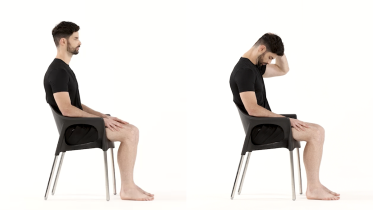
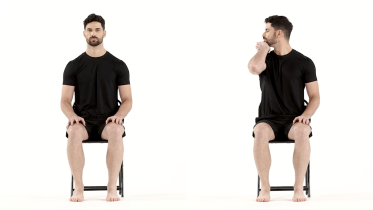
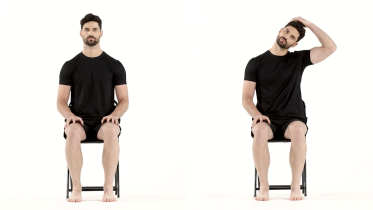
Neck isometric exercises work the neck muscles without moving the neck. You press your head into your own hand and hold it still (isometric exercise), first forward, then back, then to each side, sitting in a chair. They are often used while moving the neck through its full range is still too sore.
How to do the neck isometric exercises
- Sit tall on a chair with your feet flat and your shoulders relaxed. Look straight ahead.
- Forward: put your palm on your forehead and gently press your head into your hand. Your hand pushes back just enough that nothing moves. Hold, then relax.
- Backward: move the same hand to the back of your head and press your head back into it. Hold, then relax.
- Side: place your hand on the side of your head, just above the ear, and press your head sideways into it. Hold, then relax.
- Other side: use your other hand on the opposite side of your head and repeat.
What you should feel
A steady working feeling in the neck muscles on the side you are pressing toward. Your head stays still the whole time, so there is no movement to feel, only effort.
Common mistakes
- Pushing hard straight away. Build the pressure over a second or two and let it go just as slowly.
- Letting the head tip or turn. If it moves, your hand is not matching the push.
- Lifting the shoulders toward the ears as you press.
- Holding your breath. Breathe slowly through each hold.
How often
A common starting point is a gentle hold of 5 to 10 seconds in each direction, repeated 5 to 10 times, once or twice a day. Your physio will adjust the numbers for you.
Stop and check with your physio if
- You feel dizzy, faint or unsteady. Stop and get medical advice the same day. If you faint, it does not settle within a few minutes of sitting still, or you cannot stand or walk steadily, call emergency services.
- Things look double, your vision suddenly blurs or goes, your speech slurs or becomes muddled, swallowing becomes hard, your face or lips go numb, one side of your face droops or one side of your body goes weak or numb, you suddenly become so dizzy or unsteady that you fall or cannot stand or walk, your legs suddenly give way but you do not black out (a drop attack), or you get a sudden severe headache. Stop and call emergency services, even if it goes away.
- A press sends pain, numbness or tingling into your arm or hand.
- Pressing in one direction gives sharp neck pain. Leave that direction out and ask your physio.
From the clinic
This is a press, not a contest. Start with a small effort that you could hold comfortably for much longer than the count, and only build it up once all four directions feel easy. After neck surgery or a broken bone in the neck, check with your surgeon or physio before you start.
The video uses one hand for the forehead, the back of the head and one side, then switches hands for the other side. That is the simplest way to keep your head straight. Sitting in front of a mirror helps you spot any tilt you cannot feel.
Reviewed by the PocketPhysio by VirtueLife expert physiotherapy team. Last reviewed 2026-09-25.
This page is general education, not a diagnosis or a personal treatment plan. If you have pain, an injury or a health condition, see a physiotherapist or doctor before starting new exercises.