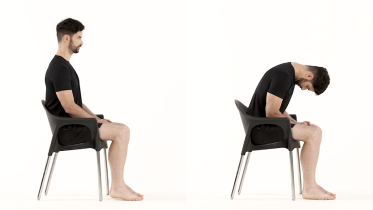
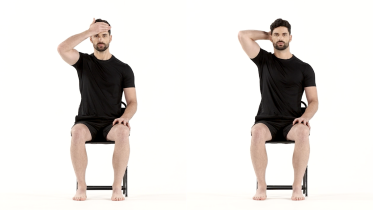
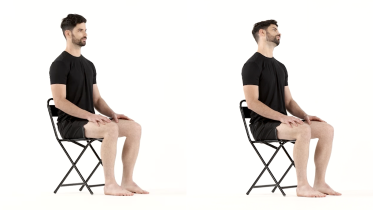
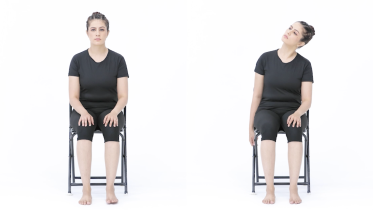
Lying chin tuck
The lying chin tuck is a gentle neck exercise done flat on your back without a pillow. You tuck your chin in and let the back of your head press softly into the bed, while you lengthen the back of your neck as if a rope were drawing your head away from your shoulders. Your head stays down the whole time. The small muscles deep in the front of the neck (deep neck flexors) work with the muscles along the back of the neck to hold the tuck, and lying down takes the weight of your head off them.
How to do the lying chin tuck
- Lie flat on your back on a bed or mat, legs out straight and arms resting on the bed beside you. Leave the pillow out, as the video and voice guide do.
- Look straight up at the ceiling and let your jaw and shoulders go loose.
- Draw your chin in toward your throat, so the back of your head presses gently into the bed.
- At the same time, think of growing taller through the top of your head, so the back of your neck lengthens along the bed.
- Hold for a few seconds while you breathe normally, then let the tuck go and rest before the next one.
What you should feel
A light effort deep in the front of your neck, and a gentle lengthening at the back of the neck and the base of the skull. It should not hurt.
Common mistakes
- Lifting your head off the bed. It stays resting down throughout.
- Driving your head back into the bed as hard as you can. Light pressure is plenty.
- Tipping your chin up toward the ceiling, which shortens the back of the neck instead of lengthening it.
- Biting down or holding your breath while you keep the tuck.
How often
Many programs start with 5 to 10 tucks, holding each one for 5 to 10 seconds, 1 to 3 times a day. Your physio will adjust this.
Stop and check with your physio if
- You feel dizzy, faint or unsteady. Stop and get medical advice the same day. If you faint, it does not settle within a few minutes of sitting still, or you cannot stand or walk steadily, call emergency services.
- Things look double, your vision suddenly blurs or goes, your speech slurs or becomes muddled, swallowing becomes hard, your face or lips go numb, one side of your face droops or one side of your body goes weak or numb, you suddenly become so dizzy or unsteady that you fall or cannot stand or walk, your legs suddenly give way but you do not black out (a drop attack), or you get a sudden severe headache. Stop and call emergency services, even if it goes away.
- Pain, pins and needles or numbness comes on in an arm or hand, or your neck pain turns sharp while you hold.
From the clinic
Some people cannot lie flat without their chin tipping up, often because the upper back is rounded. If that is you, a thin folded towel under your head is fine, as long as your face ends up level with the ceiling. The deep neck flexor exercise is close to this one, with a rolled towel under the neck and a smaller nod. Once you can find the tuck lying down, the seated chin tuck takes the same movement into sitting.
If a neck movement makes you dizzy, stop, sit still until it settles, and get medical advice the same day before you try again. If you have rheumatoid arthritis, or you have been told the spaces around the nerves or spinal cord in your neck are narrowed, check with your physio or doctor before you start. After neck surgery or a broken bone in the neck, check with your surgeon or physio before you start. If you are pregnant and past the first three months, check with your physio before exercising flat on your back.
If your neck pain started after a recent car accident or fall, get it checked by a doctor or physio before you begin. Keep still and call emergency services if the pain came straight after a high-speed crash, a car that rolled over, being thrown from a vehicle, being hit by a vehicle while walking or cycling, a motorbike or quad bike accident, a horse riding accident, a diving injury or a fall from a height or down several stairs, or if you have numbness, tingling or weakness in an arm or leg. If you hit your head and were knocked out, cannot remember what happened, have had a headache ever since, are being sick, or take medicine that thins your blood other than aspirin on its own, go to an emergency department, and do not drive yourself.
If you have a condition that stiffens the spine, such as ankylosing spondylitis, new neck pain after even a minor fall, knock or jolt is an emergency: keep still and call emergency services if it started straight after the injury, or go to an emergency department straight away, without driving yourself, if it started later. See a doctor the same day, before any exercise, if you are 65 or over, have low bone density (osteoporosis) or have taken steroid tablets for a long time, if your neck pain is severe, if you cannot turn your head halfway toward each shoulder, or if it hurts when you press on the bony middle of the back of your neck. Having none of these does not rule out an injury.
Written and checked by the PocketPhysio editorial team. Last updated 2026-09-28.
This page is general education, not a diagnosis or a personal treatment plan. If you have pain, an injury or a health condition, see a physiotherapist or doctor before starting new exercises.