
Part of Hip osteoarthritis
Hip arthritis flare up: what to do in the first few days
Warning signs, and when to get help
What is a hip arthritis flare up?
A spell where the hip is clearly worse than your own normal, lasting at least a day. That is close to the definition NICE uses in its osteoarthritis guideline: a temporary worsening of pain, swelling and stiffness that is worse than normal, may affect sleep, activity, function and mood, and lasts at least 24 hours. In the hip it has a recognizable shape: the groin ache gets louder and starts earlier in the day, the stiffness after sitting takes longer to walk off, the limp comes back or gets more obvious, and the jobs that were merely awkward become genuinely hard. Getting out of the car is usually the first thing people mention.
Researchers have taken flares seriously enough to build a measure for them. The Flare-OA questionnaire was developed and validated for flare in knee and hip osteoarthritis, with 19 items across 5 domains, tested in 398 patients, 86.7 percent of whom had knee rather than hip osteoarthritis (Traore and colleagues, 2022). That split matters, and it runs through this whole page. What the work tells you is still useful: a flare is defined by what the person reports, across those five domains, rather than by anything measurable in the joint.
A flare is a change in symptoms. It is not a reading of the joint, and the loose relationship between what a hip X-ray shows and how much a hip hurts cuts both ways (Kim and colleagues, 2015). Nobody can tell you from a fortnight of symptoms that the joint has definitely not changed, and this page will not pretend otherwise. What can be said is that treating every flare as evidence of decline is not supported, and that most of them settle back to your baseline if you let them.
The same question for the knee is answered separately, with its own research behind it, on knee arthritis flare ups.
What causes hip arthritis to flare up?
The trigger lists in circulation for hip arthritis are not sourced. Some of them are plainly recycled from other conditions. The one solid study of what triggers a flare, a case-crossover design comparing what people had been doing in the day before a flare with what they did at other times, was run in knee osteoarthritis. Its findings sit on our knee arthritis flare ups page with its citation, and they stay there, because a knee is not a hip and the activities that load the two are different. There is no published equivalent for the hip.
So what follows is practice observation, labeled as such. Hip flares most often follow:
- A day with far more walking or standing than the hip is used to. A city break, a long day at an event, a house move.
- The opposite: a long spell sitting still with the hip bent, especially a long drive or a flight, then standing up and walking straight away.
- A day of low chairs and low seats, where every stand-up came from the bottom of the hip's range.
- One big session of something, usually gardening, decorating or a clear-out, done in one go instead of spread out.
- A new exercise program started two or three steps above where it should have.
- Nothing identifiable at all, which is common enough that failing to find a cause does not mean you missed one.
Weather, stress and diet turn up on almost every list online. There is no source for any of them in hip osteoarthritis, so this page does not present them as causes. If you have noticed a reliable pattern in yourself, that is useful to know and worth mentioning, and it is still not something anyone can call general.
What should you do in the first few days?
Cut the load and keep the movement going. In the hip that comes down mostly to seat height and walking distance.
- Halve the walking and double the frequency. Three short walks beat one long one while the hip is irritable, and getting out at all beats a day indoors.
- Raise every seat you use. A firm cushion on the sofa, a dining chair instead of the armchair, and if a chair has arms, use them to push up. Low seats put the hip at the bottom of its range for the hardest movement of the day, which is standing up.
- Slide the sore leg forward before you stand, every time. It keeps the hip out of its deepest bend and it is a habit worth keeping after the flare passes.
- Take the stairs one at a time, leading with the good leg going up and the sore leg going down, with a hand on the rail. If the hip is bad enough that this is hard, use the rail on both sides where there is one.
- Plan the car. Sit down on the seat first with both feet still outside, then swing both legs round together. Getting out, reverse it. This is the single movement people flare the hip on while trying to look after it.
- Use a stick for a few days if you have one. Hold it in the hand opposite the sore hip so it takes load as you step onto that leg. NICE advises that a walking aid such as a stick can be considered for some people with hip or knee osteoarthritis, and a physio can set the height.
- Heat or cold, whichever helps. NHS self-care advice for hip pain includes an ice pack wrapped in a towel for up to 20 minutes every 2 to 3 hours; most stiff hips prefer warmth. Neither goes on skin that has lost feeling.
Medicines, including whether anything over the counter is safe alongside what you already take, are a conversation for a pharmacist or your doctor, not for this page. Never stop or change a prescribed medicine on your own.
If nights are the worst part of the flare, sleeping positions and night pain covers the set-up in detail, and hip pain when walking covers rebuilding distance once the flare settles.
Should you stop your exercises?
No. Scale them.
Take out anything on one leg, along with step ups, step downs and the band work: those load a single hip hardest, and they are also the ones a limping, tired hip does with the worst technique. Keep the lying and seated work at an easier setting, which keeps the joint moving and the muscles switched on without your body weight going through it, and do sit to stand from a higher chair and standing hip abduction with a hand on the counter rather than free standing.
Cut the numbers before you cut the list. Going from 3 sets to 1, at the bottom of the repetition range, usually gets a flare moving again where stopping altogether does not.
Judge all of it the next morning: if the hip is no worse when you get out of bed, the amount was right and you can repeat it. If it is sorer, stiffer for longer or your limp is worse, do less tomorrow, not nothing. Our guide to the pain monitoring model explains how physios use that 24-hour window.
Coming back, give it a week at the stage below the one you were on before the flare, then step up. If you cannot manage even the seated versions comfortably, seated and standing exercises for older adults is the gentler set with the support built in, and the full staged hip osteoarthritis program is where you return to.
Exercises that can help
These are the versions to fall back on when the hip is irritable. Seated hip flexion and the adductor ball squeeze keep the hip working without putting body weight through it, and the squeeze is best done sitting on a firm chair with the ball between your knees while the hip is sore. Sit to stand and standing hip abduction keep the functional and side-of-hip work going at an easier setting: use a higher chair for sit to stand, and hold a kitchen counter for the standing work. In a flare, start at the bottom of the range each exercise page gives, often 1 to 2 sets of 5 to 10 slow repetitions once a day rather than your normal numbers, and holds of about 5 to 10 seconds for the squeeze. Each exercise page gives its own dose, and your physio will adjust this.
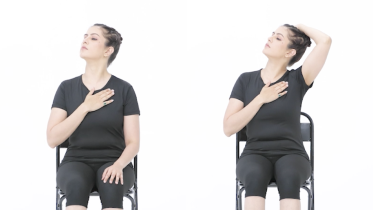 Seated hip flexion
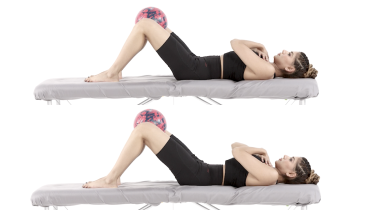 Adductor ball squeeze
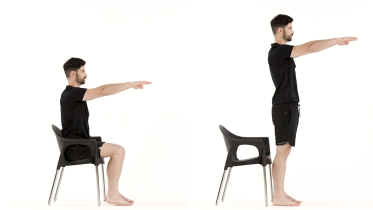 Sit to stand
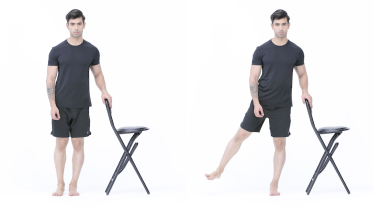 Standing hip abduction
While you exercise, stop straight away if you have any of these: chest pain or pressure, dizziness or feeling faint, a racing or irregular heartbeat, or being far more out of breath than the effort should cause. What to do next is in the warning signs below. If you have high blood pressure, breathe steadily through every repetition and never hold your breath.
If you have fallen in the past year, feel unsteady on your feet, or take medicines that make you dizzy, keep a hand on a kitchen counter or the back of a sturdy chair for the whole of the standing exercises, practice only when someone else is at home, and ask your doctor or physio about a falls check. If you live alone, that rule still stands, so plan around it rather than ignoring it. Do the exercises that ask for someone to be at home at your physio appointments or in a class instead, keep to the seated and supported work when you are on your own, and ask your physio which of the standing exercises you may do alone. Keep your phone in a pocket rather than in another room, so you can reach it from the floor, and ask about an alarm you wear.
If you do fall and cannot get up, or you think you may have hurt your head, neck, back or hip, stay where you are, keep warm and call emergency services, or get someone to call for you. Do not let anyone haul you up first.
If you are pregnant and past the first three months, check with your physio before exercising flat on your back, and do the adductor ball squeeze sitting up. If you have had a hip replacement, get the go-ahead from your surgeon or physio before you try these exercises. Some operations limit this kind of work for the first months, so the timing depends on your surgery. If you have had a hip fracture, follow the program your surgical team and physio gave you rather than this list. Check with your doctor before you start if you have a heart or lung condition, or blood pressure that is not under control.
How long does a hip arthritis flare up last?
Nobody has published a figure for the hip, and this page is not going to borrow one.
The numbers people quote, a median of 5 days here and 8 days there, come from diary and online studies in knee osteoarthritis. They are good studies and they are on our knee arthritis flare ups page with their citations. They were not measured in hips. A hip is a different joint, loaded differently, in a population with a different age profile, and a number that travels from one joint to another without anyone checking is how a false fact gets established. The Flare-OA work that covers both knee and hip osteoarthritis was built to measure whether a flare is happening and how severe it is, not how long it goes on (Traore and colleagues, 2022).
What is left is clinical experience, labeled as such. Most hip flares that are going to settle start easing within several days to a couple of weeks once the load comes down. Some run longer. What to watch is the direction, not the number of days: by the end of the second week you want to be able to say the hip is heading the right way, even if it is not back to baseline.
If it is not, book a review. Flares that arrive closer together, or that stop settling, usually mean the plan needs changing, not that the condition has, and that is a conversation about strength, load, sleep and weight. Treating hip arthritis without surgery sets out the full menu, with what the guidelines say about each part. OARSI names arthritis education and structured land-based exercise as the core treatments for hip osteoarthritis (Bannuru and colleagues, 2019), and a flare that keeps returning is often a sign the core is not being done at a high enough dose, not a sign it has failed.
When is it not a flare?
None of what follows is treated with a few lighter days, and this is the part of the page to read twice.
A hot, swollen hip, a change in the color of the skin over it, or hip pain with a fever or feeling hot, cold and shivery. A joint infection needs treating quickly, and that is same-day medical help with an emergency department if you feel very unwell. The warning list below carries the sepsis signs that mean calling emergency services.
Pain after a fall, any fall. If you have had a fall or an injury and now have severe hip pain, or you cannot walk or put weight on the leg, that is an emergency, because it can be a broken hip. And the one people get wrong: new hip or groin pain after even a small fall, if you are older, have low bone density or have taken steroid tablets long term, needs same-day advice even if you can still walk. Broken hips are not always obvious, and people do walk on them.
Severe pain that arrived suddenly with no fall, or pain getting worse quickly over a few days. Same-day advice, not a lighter week.
Night and rest pain that keeps building whatever you do, which has its own timing on the warning list and a faster route if you have had cancer or are losing weight without trying.
New pain in a hip that has been replaced. The dislocation signs are an emergency, a replaced joint can become infected years after the operation, and your surgical team is the first call. Hip replacement rehab is the right page for that reader rather than this one.
When to see a physio or doctor
Book a routine appointment with a doctor or physio if a flare has not started to ease after about 2 weeks, if flares are coming more often, if the hip is stiff for more than 30 minutes after waking, or if hip pain is stopping you sleeping or doing what you normally do. New hip pain that has not improved after 2 weeks of looking after it at home is worth getting checked (NHS). That 2 week mark is a rule of thumb from practice rather than a figure from research, which is worth knowing when you decide whether to wait.
A clinician can do more with the two or three days before the flare started than with the flare itself, along with what you have already tried. That is the part people have usually forgotten by the time they are seen.
Some signs need help faster, from an emergency visit to a doctor within a few days. They are listed under the warning signs below, each with its own timing.
Related exercise programs
Warning signs
Get emergency help now
- Emergency: if chest pain, pressure or tightness does not ease quickly when you rest, spreads to your arm, neck, jaw, stomach or back, or comes with sweating, feeling sick, feeling light-headed or being short of breath, call emergency services straight away, as this can be a heart attack. If it eases quickly and none of these happen, get medical advice the same day, and do not exercise again until you have been checked.
- Emergency: a racing, pounding, fluttering or irregular heartbeat that does not settle when you rest, or that comes with dizziness, feeling faint or fainting, chest pain or shortness of breath. Call emergency services straight away. If it has already stopped, get medical advice the same day.
- Emergency: you have had a fall or an injury and now have severe hip pain, or you cannot walk or put weight on the leg. Call emergency services or go to an emergency department. This can be a sign of a broken hip (hip fracture).
- Emergency: tingling or loss of feeling in the hip or leg after a fall or injury. Call emergency services or go to an emergency department.
- Emergency: you have had a hip replacement and have sudden severe pain in your hip or groin, sometimes with a clunk or pop, and you cannot move the leg or put weight on it, or the leg suddenly looks shorter or turned in or out. Do not try to walk on it or push it back into place. Keep still and call emergency services or go to an emergency department, and do not drive yourself. Your new hip may have come out of its socket (dislocated), and a medical team needs to put it back.
- Emergency: your operated leg looks shorter than it did, or its foot turns in or out more than before, or the hip moves in an unusual way, even if the pain is not severe. Keep your weight off it and go to an emergency department straight away, and do not drive yourself. If you are in severe pain or cannot move the leg, call emergency services.
- Emergency: pain, tingling, numbness or weakness in both legs, numbness or altered feeling around your genitals or bottom, or new trouble peeing or controlling your bladder or bowels. The same applies if you lose feeling in one leg. Call emergency services or go to an emergency department straight away. These can be signs of pressure on the nerves at the base of the spine (cauda equina syndrome).
Get help today
- Same day: the hip is hot and swollen, or the skin over it has changed color, or you have hip pain with a high temperature or feel hot, cold or shivery. Get medical help the same day, and go to an emergency department if you feel very unwell. A joint infection needs treatment quickly. If you have a very high or very low temperature, shivering you cannot control, you are breathing very fast or finding it hard to breathe, you are confused or your speech is slurred, your skin, lips or tongue look blue, gray, pale or blotchy (on brown or black skin this can be easier to see on the palms of the hands or soles of the feet), or you have a rash that does not fade when you press it, call emergency services, as this can be sepsis.
- Same day: at any time after your operation, even years later, new pain in your new hip along with a high temperature or feeling hot, cold or shivery, or a hip that becomes hot, red or swollen, which counts on its own, with or without pain and with or without a temperature. Contact your surgical team or get medical advice the same day. A new joint can become infected long after the operation, and that needs treating quickly. A normal temperature is not an all clear: OrthoInfo says fever is no longer considered a sign of an infection after a joint replacement, that the signs can be as little as mild redness and swelling and sometimes there are none at all, and that increased pain or stiffness in a joint that had been working well is one of them. So do not wait for a temperature before you report new or increasing pain in your new hip to your surgical team.
- Same day: you have had a hip replacement and your hip clunks and feels as if it partly slipped out of place and went back, even if it settles straight away and your leg looks normal. Stop the exercises, avoid the movement that brought it on, go back to your crutches or frame, and keep away from deep bending, crossing your legs and twisting on that leg until you have been seen. Contact your surgical team or get medical advice the same day. If the leg then looks shorter or turned, or you cannot move it or put weight on it, call emergency services.
- Same day: you have had a hip replacement and, after a fall or a knock, even a small one, your hip, groin or thigh is newly painful, bruised or swollen, even if you can still walk and your leg looks normal. Stop the exercises, go back to your crutches or frame and keep your full weight off that leg, and contact your surgical team or get medical advice the same day. A break in the bone around a new hip is not always obvious at first, and walking normally on one can move the broken ends apart.
- Same day: severe hip pain that came on suddenly without a fall, or pain that is getting worse quickly over a few days. Get medical advice the same day.
- Same day: new hip or groin pain after a fall, even a small one, if you are older, have low bone density (osteoporosis) or have taken steroid tablets for a long time, even if you can still walk. Get medical advice the same day. A broken hip is not always obvious at first.
- Same day: a leg or foot that is getting weaker, for example your foot drags, catches on the ground or slaps down when you walk (foot drop). Get medical advice the same day. If the weakness is getting worse by the hour, go to an emergency department.
- Same day: a calf or thigh that is newly swollen or getting more swollen, warm, tender, red or darker than usual, has swollen veins that are sore to touch, or has a throbbing or cramping pain that does not fit your injury or condition, or that feels different from normal muscle soreness after exercise. This can be a sign of a blood clot (deep vein thrombosis), especially after surgery, an injury, time in a cast or boot, a long trip or a spell of being much less mobile than usual. Get medical advice the same day. If you are also short of breath or have chest pain, call emergency services.
- Same day: you blacked out or fainted, even for a moment. Get medical advice the same day. Call emergency services instead if the person is not breathing, cannot be woken within 1 minute, has not fully recovered or has trouble speaking or moving, has chest pain or a pounding, fluttering or irregular heartbeat, fainted while exercising or lying down, is shaking or jerking, or was badly hurt.
- Same day: dizziness, lightheadedness, blurred vision or feeling faint when you stand up that is new for you, does not pass within a minute or two, keeps happening, or has made you fall. Sit or lie down, and get medical advice the same day. This can be a drop in blood pressure on standing (postural hypotension), a type of low blood pressure, which the NHS lists among the causes of falls, and your doctor can check it. Tell them about your medicines, because some can cause it. If it does not settle within a few minutes of sitting or lying still, call emergency services. If you faint, use the fainting line above.
- Same day: dizziness or feeling faint during or after exercise, other than the brief lightheadedness as you stand up covered in the line above, without any of the emergency signs above. Stop the exercises and get medical advice the same day. If you faint, it does not settle within a few minutes of sitting still, or you cannot stand or walk steadily, call emergency services.
- Same day: a child or teenager has sudden pain in the hip, thigh or knee, is limping, or cannot put weight on one leg. Get an urgent appointment with a doctor the same day. If they have a high temperature or seem very unwell, go to an emergency department. This page is for adults, and hip pain in children has different causes.
- Same day: hip or groin pain that is worse at night or does not ease with rest, and keeps getting worse. If you are being treated for cancer now, contact your cancer team the same day.
Book an appointment
- Within a day or two: hip or groin pain that is worse at night or does not ease with rest, and keeps getting worse. If you have had cancer, now or in the past, or are losing weight without trying, see your doctor sooner, within a day or two, and mention it. This applies even if the pain is not getting worse.
- Within a few days: hip or groin pain that is worse at night or does not ease with rest, and keeps getting worse. See your doctor within a few days.
- Within a few days: new groin or hip pain and you take steroid tablets long term, or have in the past, or you regularly drink a lot of alcohol. This can be a sign of a problem with the blood supply to the top of the thighbone (avascular necrosis). Book an appointment with your doctor within a few days and mention the steroids or alcohol.
- Routine: pain in your new hip that had settled and has come back, or pain that is getting worse month by month, for example in the groin or thigh when you first stand up and start to walk. This is not an emergency, but ask your surgical team for a review, as the parts of a new joint can loosen or wear over the years. Get medical advice the same day instead, not a routine appointment, if the hip also becomes hot, red or swollen, or you have a high temperature or feel hot, cold or shivery, or the pain is building week by week rather than month by month. A new joint can become infected years after the operation, and the two can feel similar at first.
Common questions
What causes hip arthritis to flare up?
Most often a day of more loading than usual, although plenty of flares arrive with no reason you can name. The trigger lists you will find online are not sourced, and the one good case-crossover study of flare triggers was done in knee osteoarthritis, not hip, so the honest answer is that nobody has published a trigger list for the hip. What physios see is a pattern around walking distance, long spells sitting still and in low seats, and new activity started too fast.
How long does a hip arthritis flare up last?
There is no published figure for the hip. The diary and online studies that produced the familiar numbers were in knee osteoarthritis, and applying a knee figure to a hip is the kind of borrowing that quietly becomes a fact, so this page does not do it. In practice most hip flares that settle do so over several days to a couple of weeks with the load cut back. A flare that has not begun to ease after about 2 weeks, or flares arriving closer together, is a reason to book a review.
Should I rest or keep moving during a hip arthritis flare?
Keep moving, less. A hip that is kept still for a day is stiffer and no less sore the next morning, and a sore hip that is pushed through its normal program gets worse. Short, frequent movement with the heavy loading taken out is the middle path: a few minutes every hour or two, shorter walks more often, and the seated versions of your exercises.
Should I stop my exercises during a flare?
Scale them, do not stop them. Drop to the lying and seated work, take the single leg and step exercises out, hold a counter for anything standing, and cut the numbers to the bottom of the range for a few days. Then use the next morning as your reading: no worse means the amount was right. The exercise set on this page is the fall-back version.
Is heat or ice better for a hip flare?
Either, whichever helps you, because there is little research to separate them. NHS self-care advice for hip pain includes an ice pack wrapped in a towel on the sore area for up to 20 minutes every 2 to 3 hours. Warmth often suits a stiff hip better than cold. Keep both off skin that has lost feeling, and do not use either to cover up a hip that is hot, red or swollen, which needs checking the same day.
Does a flare mean my arthritis is getting worse?
A flare is a change in symptoms, and it is not evidence either way about the joint. What is known is that the relationship between how a hip looks on an X-ray and how much it hurts is loose in both directions, so a bad fortnight is not a reading of your joint. We would not read a flare as a sign of deterioration, and we cannot promise you it is not: stages of hip arthritis and how fast it progresses sets out what is actually known about the course.
When is it not just a flare?
When the hip is hot and swollen or comes with a fever, when the pain followed a fall, when it came on suddenly and severely without a fall, when it is worse at night and keeps building, or when it is new pain in a hip that has been replaced. Each of those has its own timing in the warning list on this page, and none of them is a reason to try a few lighter days first.
References
- National Institute for Health and Care Excellence. Osteoarthritis in over 16s: diagnosis and management (NG226). 2022. https://www.nice.org.uk/guidance/ng226
- Bannuru RR, Osani MC, Vaysbrot EE, et al. OARSI guidelines for the non-surgical management of knee, hip, and polyarticular osteoarthritis. Osteoarthritis and Cartilage. 2019;27(11):1578-1589. https://doi.org/10.1016/j.joca.2019.06.011
- Traore Y, Epstein J, Spitz E, et al. Development and validation of the Flare-OA questionnaire for measuring flare in knee and hip osteoarthritis. Osteoarthritis and Cartilage. 2022;30(5):689-696. https://doi.org/10.1016/j.joca.2021.12.011
- Kim C, Nevitt MC, Niu J, et al. Association of hip pain with radiographic evidence of hip osteoarthritis: diagnostic test study. BMJ. 2015;351:h5983. https://doi.org/10.1136/bmj.h5983
- American Academy of Orthopaedic Surgeons. Osteoarthritis of the hip. OrthoInfo. https://www.orthoinfo.org/en/diseases--conditions/osteoarthritis-of-the-hip/
- NHS. Hip pain in adults. https://www.nhs.uk/symptoms/hip-pain/
- NHS. Osteoarthritis. https://www.nhs.uk/conditions/osteoarthritis/
- NHS. Complications of a hip replacement. Page last reviewed 6 March 2024. https://www.nhs.uk/tests-and-treatments/hip-replacement/complications-of-a-hip-replacement/
- NHS. Low blood pressure (hypotension). Page last reviewed 11 July 2023. https://www.nhs.uk/conditions/low-blood-pressure-hypotension/
Written and checked by the PocketPhysio editorial team. Last updated 2026-10-18.
This page is general education, not a diagnosis or a personal treatment plan. See a physiotherapist or doctor for advice about your own situation.