
Part of Knee osteoarthritis
Knee arthritis flare up: what to do, how long it lasts and when to worry
Warning signs, and when to get help
What is a knee arthritis flare up?
Knee osteoarthritis rarely hurts the same amount every day. Most people have an ordinary level of ache and stiffness that rises and falls a little. A flare is a clear step up from that level which lasts at least a day, and it often comes on quickly.
Researchers in the UK asked people with knee pain to keep a daily diary for up to three months. During a flare, people were more likely to describe the pain as sharp, throbbing, stabbing or burning, and more likely to notice swelling and stiffness, or to limp. They were also more often woken by pain, took more painkillers and stopped some of their usual activities (Parry and colleagues, 2019).
A flare is not a sign that the joint has suddenly worn out. It is usually a sore, irritable knee that needs a few lighter days. It does feel alarming, though, so it helps to have a plan ready before the next one.
What triggers a flare?
A larger UK study followed adults who reported knee flares online and compared what they had been doing just before each flare with what they did at other times. The knee giving way (buckling) was the strongest trigger. Other activity triggers were squatting or kneeling, standing for long spells without a rest, lifting or moving heavy things, climbing ladders, moderate or hard exercise, and a slip, trip or fall.
Things outside activity counted too. A poor night's sleep, low mood, feeling angry or irritable, and cold, damp weather were also linked with a flare starting within the next 24 hours (Thomas and colleagues, 2021).
Some of those you can plan around, such as spreading a big gardening job over several days instead of one. Others, like the weather, you cannot. A knee that keeps giving way is worth an assessment. Strength and balance work can often reduce it, and a brace helps some people (see knee braces for arthritis).
What should you do during a knee arthritis flare up?
Think "less, not none". These steps are common physio practice, not a tested protocol.
- Cut back the thing that set it off. Shorten walks, sit for jobs you would normally stand for, and leave the heavy lifting or the kneeling for a week.
- Keep moving. Gentle movement every hour or two usually eases stiffness better than a day on the sofa. Short walks around the house count.
- Drop to stage 1 exercises. Swap your usual strength routine for the lying and sitting exercises below.
- Use heat or cold if it helps. Warmth often suits a stiff knee and cold a puffy one. Wrap either in a towel and keep it on for 10 to 20 minutes. Skip both on skin that has lost feeling.
- Check your painkillers. NICE advises offering an anti-inflammatory gel (a topical NSAID) to people with knee osteoarthritis. A pharmacist can tell you whether one is safe alongside your other medicines. Never stop or change a prescribed medicine on your own.
A walking stick in the opposite hand from the sore knee can take some load off it for a few days. The 2019 US guideline from the American College of Rheumatology and the Arthritis Foundation strongly recommends a cane when knee arthritis is affecting walking, stability or pain enough to need one (Kolasinski and colleagues, 2020). Using one for a flare is common practice rather than something the guideline tested, and a physio can check the height and how you walk with it. Is walking good for knee arthritis covers how to build walking back up once the flare has passed.
How should you adjust your exercise in a flare?
Go back to stage 1 of the knee osteoarthritis program, whatever stage you had reached. Those exercises are done lying or sitting, so they keep the thigh muscles working and the knee bending without putting your body weight through it. Leave squats, step ups or split squats until the knee has settled.
Exercises that can help
These are the stage 1 exercises to fall back on during a flare, done lying or sitting so the knee carries no body weight. Start at the low end: many programs use 10 quad sets with a 5 to 10 second hold several times a day, 10 to 15 slow heel slides 2 or 3 times a day, 2 to 3 sets of 10 to 15 short arc quads with a 3 to 5 second hold once or twice a day, and 2 to 3 sets of 10 straight leg raises on each leg once a day. Your physio will adjust this.
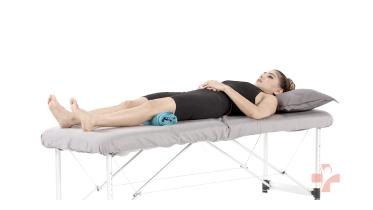 Quad sets (towel under knee)
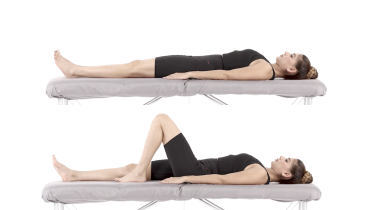 Heel slides
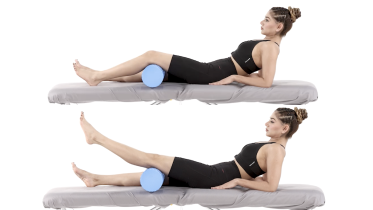 Short arc quads
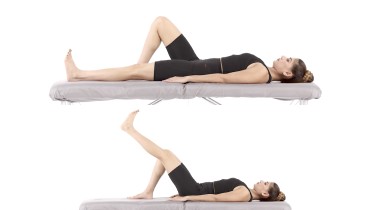 Straight leg raise
Use the next-morning check to guide you. If the knee is no worse the morning after your exercises, the amount was fine. If it is sorer, stiffer for longer or more swollen, do fewer repetitions the next day. Our guide to the pain monitoring model explains how physios use this kind of check.
Once the pain is back to your usual level for a few days in a row, return to the stage you were on before. Many people find it easier to restart with fewer sets or a lighter version for the first week, then build up again. Exercises to avoid with knee arthritis shows how to make squats, lunges or stairs easier while you rebuild. Cycling on a light setting is often comfortable earlier than walking far; see cycling and swimming for knee arthritis, and best exercise equipment for knee arthritis for simple kit to use at home.
If you are pregnant and past the first three months, check with your physio before exercising flat on your back, as some of these exercises are done lying down. If you have high blood pressure, breathe steadily through every repetition and never hold your breath. After a knee fracture or knee surgery, including a knee replacement, follow your surgeon's or physio's plan, and start these exercises only when they have cleared you.
How long does a knee arthritis flare up last?
Two UK studies give the best figures so far. In the daily diary study, flares lasted a median of 8 days, with the shortest at 2 days and the longest at 30 (Parry and colleagues, 2019). In the larger online study, the median was 5 days, and half of all flares lasted between 3 and 8 days (Thomas and colleagues, 2021). So most flares settle within about a week or so, but a few take several weeks.
If a flare has not started to ease after about two weeks, or flares are coming closer together, book an appointment with your physio or doctor. That timing is a practice rule of thumb, not a research cut-off. Frequent flares usually mean the plan needs changing, for example a different balance of rest and activity, more strength work between flares, or help with sleep or weight. If you carry extra weight, weight loss and knee arthritis explains how much it can ease the load on the knee. If flares keep coming despite all of that, when to consider surgery covers that conversation.
When is it not a flare?
Most flares feel like your usual arthritis, only louder. A few things that look like a flare need a doctor, not a lighter week.
Infection in the joint is the one not to miss. A knee that is hot, red and swollen, or knee pain with a high temperature or feeling hot, cold or shivery, needs medical advice the same day, and an emergency department if you feel very unwell.
Crystal arthritis can look the same. Gout brings sudden, severe pain with hot, swollen, red skin over the joint; it most often affects the big toe, but the NHS lists the knees among the other joints it can affect. Pseudogout, caused by a different kind of crystal, is most common in the knee, and comes on with sudden, intense pain and a warm, swollen, tender joint (Cleveland Clinic). Neither can be told apart from an infected joint at home, so treat a sudden hot, swollen knee the same way: medical advice the same day.
A newly swollen, warm or tender calf or thigh is a different matter, because it can be a blood clot, and a bad flare that keeps you much less mobile than usual is one of the times clots are more likely. Get medical advice the same day, and call emergency services if you are also short of breath or have chest pain. Pain after a fall or twist, or a knee that locks, also needs medical advice the same day. Swelling that comes up within a few hours of a twist, fall or blow means going to an emergency department straight away, and not driving yourself. The warning list below gives the full set of signs.
Related exercise programs
Warning signs
Get emergency help now
- Emergency: the knee has moved out of place, looks misshapen or is pointing at an odd angle, or you have tingling or no feeling in the knee, leg or toes, or your foot turns cold, pale or blue. Go to an emergency department straight away. Do not drive yourself: ask someone to drive you or call an ambulance.
- Emergency: the knee became very swollen very quickly, within a few hours of a twist, fall or blow, or you felt a pop or snap. Go to an emergency department straight away. Do not drive yourself: ask someone to drive you or call an ambulance.
Get help today
- Same day: the knee is hot, red and swollen, or you have knee pain with a high temperature or feel hot, cold or shivery. Get medical advice the same day, and go to an emergency department if you feel very unwell. This can be a sign of infection in the joint, which needs treatment quickly.
- Same day: the pain started with a fall, a twist or a blow to the knee, or you cannot put weight on the leg. Get medical advice the same day.
- Same day: the knee is locked, which means it is stuck bent and you cannot fully straighten it, even after gently trying to move it, or you cannot bend or straighten the leg at all. Get assessed the same day by a doctor, at urgent care or at an emergency department. A torn piece of meniscus can get caught in the joint and block it, and when a tear like this can be repaired, it should be done as early as possible. A knee that catches for a moment and then frees itself can happen with a meniscus tear. That is not the same as a locked knee, but tell your physio or doctor about it.
- Same day: the knee keeps giving way under you, or it gave way after a recent injury, or it gives way and is also very painful or swollen. Get medical advice the same day. If it only happens now and then, with no recent injury and no swelling, it is not an emergency, but book an assessment with a physio or doctor in the next few days.
- Same day: the knee swells up with no clear reason, especially if you take medicine to thin your blood. Get medical advice the same day.
- Same day: a calf or thigh that is newly swollen or getting more swollen, warm, tender, red or darker than usual, has swollen veins that are sore to touch, or has a throbbing or cramping pain that does not fit your injury or condition, or that feels different from normal muscle soreness after exercise. This can be a sign of a blood clot (deep vein thrombosis), especially after surgery, an injury, time in a cast or boot, a long trip or a spell of being much less mobile than usual. Get medical advice the same day. If you are also short of breath or have chest pain, call emergency services.
- Same day: pain at night or at rest that keeps getting worse. If you are being treated for cancer now, contact your cancer team the same day.
Book an appointment
- Within a day or two: pain at night or at rest that keeps getting worse. If you have had cancer, now or in the past, see your doctor sooner, within a day or two, and mention it, even if the pain is not getting worse. Do the same if you have knee pain and are losing weight without trying, even if it does not hurt at night.
- Within a few days: pain at night or at rest that keeps getting worse. See your doctor within a few days.
Common questions
How long does a knee arthritis flare up last?
Usually days rather than weeks. In a UK diary study the median flare lasted 8 days, with a range of 2 to 30 days (Parry and colleagues, 2019), and in a larger online study the median was 5 days, with half of flares lasting between 3 and 8 days (Thomas and colleagues, 2021). If a flare has not started to ease after about two weeks, or flares are coming more often, book an appointment with your physio or doctor. That two-week point is a rule of thumb from practice, not a figure from research.
Should I rest or exercise during an arthritis flare?
Do less, but keep moving. Cut back the activity that set it off for a few days and swap your usual strength work for the gentle stage 1 exercises done lying or sitting, which keep the knee moving without putting body weight through it. Full rest tends to leave the knee stiffer. Build back toward your normal program once the pain is back to your usual level.
Is heat or ice better for a knee arthritis flare up?
Use whichever feels better, because there is little research to choose between them for a flare. In practice, many people find warmth eases stiffness, while a cold pack suits a knee that feels puffy and warm after activity. Wrap either one in a towel and keep it on for 10 to 20 minutes. Do not use heat or ice on skin that has lost feeling, and do not use them to cover up a knee that is hot, red and swollen, which needs checking.
What triggers a knee arthritis flare up?
In a UK study of people who reported knee flares, the knee giving way was the strongest trigger. Squatting or kneeling, standing for long periods, lifting heavy things, climbing ladders, moderate or hard exercise, a slip, trip or fall, a poor night's sleep, low mood and cold, damp weather were all linked with flares starting within the next day (Thomas and colleagues, 2021). Some flares come with no clear cause.
When is a swollen knee more than a flare?
The knee is hot, red and swollen, or you have knee pain with a high temperature or feel hot, cold or shivery. Get medical advice the same day, and go to an emergency department if you feel very unwell. This can be a sign of infection in the joint, which needs treatment quickly. The same goes for a knee that suddenly becomes hot, red and very swollen without a fever, because gout or pseudogout look much the same as an infected joint at first.
References
- Parry E, Ogollah R, Peat G. 'Acute flare-ups' in patients with, or at high risk of, knee osteoarthritis: a daily diary study with case-crossover analysis. Osteoarthritis and Cartilage. 2019;27(8):1124-1128. https://doi.org/10.1016/j.joca.2019.04.003
- Thomas MJ, Rathod-Mistry T, Parry EL, Pope C, Neogi T, Peat G. Triggers for acute flare in adults with, or at risk of, knee osteoarthritis: a web-based case-crossover study in community-dwelling adults. Osteoarthritis and Cartilage. 2021;29(7):956-964. https://doi.org/10.1016/j.joca.2021.04.007
- National Institute for Health and Care Excellence. Osteoarthritis in over 16s: diagnosis and management (NG226). 2022. https://www.nice.org.uk/guidance/ng226
- Kolasinski SL, Neogi T, Hochberg MC, et al. 2019 American College of Rheumatology/Arthritis Foundation guideline for the management of osteoarthritis of the hand, hip, and knee. Arthritis Care and Research. 2020;72(2):149-162. https://doi.org/10.1002/acr.24131
- NHS. Gout. Page last reviewed 24 August 2023. https://www.nhs.uk/conditions/gout/
- Cleveland Clinic. Pseudogout (chondrocalcinosis or CPPD). https://my.clevelandclinic.org/health/diseases/pseudogout-chondrocalcinosis-cppd
Written and checked by the PocketPhysio editorial team. Last updated 2026-10-16.
This page is general education, not a diagnosis or a personal treatment plan. See a physiotherapist or doctor for advice about your own situation.