
Part of Knee osteoarthritis
Cycling and swimming for knee arthritis: how to set up and build up
Warning signs, and when to get help
What does the research say about aerobic exercise for knee arthritis?
Aerobic exercise came out on top in the biggest recent study, a 2025 network meta-analysis in the BMJ. It pooled 217 randomized trials with 15,684 people and compared broad types of exercise: aerobic, strengthening, flexibility, mind-body, neuromotor (balance and coordination) and mixed programs. Against no exercise, the aerobic programs helped pain, function, walking ability (gait) and quality of life, and the authors rated that evidence as moderate certainty (Yan and colleagues, 2025). They suggest aerobic exercise as a first-line treatment where the aim is better function and less pain.
Two things are worth knowing before you read the headlines. The study ranked aerobic exercise as one group, so it does not say cycling beats swimming or walking. The BMJ press release gave walking, cycling and swimming as examples of aerobic exercise, but the study did not compare them with each other. And only 40 of the trials reported side effects at all, and in those the authors found no clear difference between exercise and the comparison groups.
None of this means you should drop strengthening. The knee osteoarthritis program is built on it, and most people do best with both.
Is cycling good for knee arthritis?
For most people, yes. A meta-analysis of stationary cycling trials in knee osteoarthritis found it reduced pain and improved function in sport and recreation, though the effects on stiffness and everyday tasks were less clear (Luan and colleagues, 2021). In one trial, people with mild to moderate knee arthritis who did 12 weeks of group indoor cycling walked faster and had less pain after a six-minute walk than a control group (Salacinski and colleagues, 2012). It was a small trial of 37 people.
Why does it suit an arthritic knee? You sit, so the bike carries your body weight, and nothing lands. In a study using measuring implants in nine people with knee replacements, the force through the knee while pedaling stayed below the force of walking, rose as the pedaling got harder, and was lower at a quicker cadence (Kutzner and colleagues, 2012). Replaced knees are not arthritic ones, but the message is useful: spin lightly rather than push hard.
How to set up the bike
- Saddle height first. Sit on the bike with the pedal at its lowest point. Your knee should be slightly bent, not locked straight and not deeply bent. A review of saddle height research suggested about 25 to 30 degrees of knee bend at that point (Bini and colleagues, 2011). For most people that looks like a soft knee with the ball of the foot on the pedal.
- Resistance next. Start at a level where you could hold a conversation. If you have to stand on the pedals or grind, it is too heavy.
- Cadence. A smooth, steady spin is kinder to the knee than slow, heavy turns.
If your knee will not bend far enough yet to take the pedal over the top, rock the pedals back and forth through the range you have, or raise the saddle a little. The heel slides in the list below work on that bend.
How much to do
Many programs start with 10 to 15 minutes at an easy level, 2 or 3 times a week, then add a few minutes each week. That is a common clinic starting point rather than a dose tested in trials, and your physio will adjust it. The World Health Organization advises adults, including people with long-term conditions, to build toward 150 to 300 minutes of moderate activity a week (Bull and colleagues, 2020). Cycling, swimming and walking all count toward that total.
Is swimming good for knee arthritis?
Yes, and you do not need to swim lengths to get the benefit. A Cochrane review of 13 trials with 1,190 people found that a course of up to 12 weeks of exercise in water probably improves pain and disability a little in knee and hip osteoarthritis, measured straight after the course (Bartels and colleagues, 2016). The trials did not describe their exercises in enough detail to say which water program works best. The review describes this kind of exercise as usually done in warm water, at 32 to 36°C (about 90 to 97°F).
Ways to use the pool
- Walking in waist-deep or chest-deep water, forward, backward and sideways.
- A water exercise or aqua aerobics class, ideally one aimed at people with joint problems.
- Leg exercises holding the side, such as knee bends and slow kicks.
- Swimming with a gentle flutter kick, or a float held between the thighs so the arms do the work.
These are common physio suggestions rather than programs tested against each other. Choose a pool with a lifeguard on duty, and get out and sit down if you feel dizzy or faint.
A note on breaststroke
The breaststroke kick whips the lower legs out and round, which puts the inner side of the knee under strain. In a survey of competitive swimmers, pain on the inner side of the knee was common among breaststrokers (Rovere and Nichols, 1985). That was young athletes training hard, not people with arthritis, so treat it as a reason for caution rather than a ban. If breaststroke kick makes your knee ache, switch to flutter kick or use a float.
If you have had a hip replacement, get the go-ahead from your surgeon or physio before you try breaststroke kick. The kick swings the legs wide and turns the hips out, and many surgeons ask you to avoid that for the first months after some operations.
Which is better for knee arthritis, cycling or swimming?
Neither has been shown to beat the other, and the US guideline found no basis for ranking one form of exercise above another (Kolasinski and colleagues, 2020). Practical things decide it. A bike works in your living room in any weather. A pool takes more weight off the knee, but you have to get there. Plenty of people use both, plus walking, which has its own page: is walking good for knee arthritis.
Whatever you choose, judge it the next morning. Mild stiffness that has gone by breakfast is fine. A knee that is sorer or more swollen than the day before means cut the time or the resistance back a step. Bikes, pools and other kit are compared in best exercise equipment for knee arthritis, and exercises to avoid with knee arthritis covers what to change in the rest of your training.
Exercises that can help
Pedaling a full circle needs a good amount of knee bend, and pushing the pedals needs a strong thigh. These two help with both. Many programs use 10 to 15 slow heel slides, 2 or 3 times a day, and 2 to 3 sets of 10 to 15 seated knee extensions on each leg with a short hold, once a day. Your physio will adjust this.
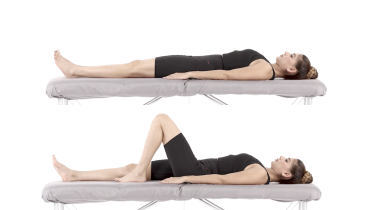 Heel slides
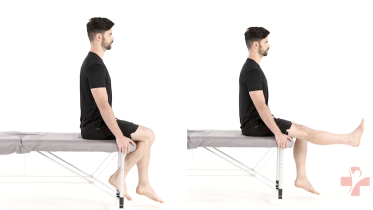 Seated knee extension
Who should check first?
With a heart condition or high blood pressure, check with your doctor before you start. If you are pregnant and past the first three months, check with your physio before exercising flat on your back, as the heel slides are done lying down. Stop at once for chest pain or pressure, dizziness or feeling faint, a racing or irregular heartbeat, or being far more out of breath than the effort should cause. If chest pain does not ease quickly with rest, call emergency services; the warning list below gives the full set of signs.
After a knee fracture or knee surgery, including a knee replacement, follow your surgeon's or physio's plan, and start cycling and swimming only when they have cleared you. Cycling after a knee replacement follows your surgical team's plan first; the knee replacement rehab program explains the stages.
Related exercise programs
Warning signs
Get emergency help now
- Emergency: if chest pain, pressure or tightness does not ease quickly when you rest, spreads to your arm, neck, jaw, stomach or back, or comes with sweating, feeling sick, feeling light-headed or being short of breath, call emergency services straight away, as this can be a heart attack. If it eases quickly and none of these happen, get medical advice the same day, and do not exercise again until you have been checked.
- Emergency: if you faint while exercising, call emergency services, even if you feel fine again quickly.
- Emergency: the knee has moved out of place, looks misshapen or is pointing at an odd angle, or you have tingling or no feeling in the knee, leg or toes, or your foot turns cold, pale or blue. Go to an emergency department straight away. Do not drive yourself: ask someone to drive you or call an ambulance.
- Emergency: the knee became very swollen very quickly, within a few hours of a twist, fall or blow, or you felt a pop or snap. Go to an emergency department straight away. Do not drive yourself: ask someone to drive you or call an ambulance.
Get help today
- Same day: the pain started with a fall, a twist or a blow to the knee, or you cannot put weight on the leg. Get medical advice the same day.
- Same day: the knee is locked, which means it is stuck bent and you cannot fully straighten it, even after gently trying to move it, or you cannot bend or straighten the leg at all. Get assessed the same day by a doctor, at urgent care or at an emergency department. A torn piece of meniscus can get caught in the joint and block it, and when a tear like this can be repaired, it should be done as early as possible. A knee that catches for a moment and then frees itself can happen with a meniscus tear. That is not the same as a locked knee, but tell your physio or doctor about it.
- Same day: the knee swells up with no clear reason, especially if you take medicine to thin your blood. Get medical advice the same day.
- Same day: the knee is hot, red and swollen, or you have knee pain with a high temperature or feel hot, cold or shivery. Get medical advice the same day, and go to an emergency department if you feel very unwell. This can be a sign of infection in the joint, which needs treatment quickly.
- Same day: a calf or thigh that is newly swollen or getting more swollen, warm, tender, red or darker than usual, has swollen veins that are sore to touch, or has a throbbing or cramping pain that does not fit your injury or condition, or that feels different from normal muscle soreness after exercise. This can be a sign of a blood clot (deep vein thrombosis), especially after surgery, an injury, time in a cast or boot, a long trip or a spell of being much less mobile than usual. Get medical advice the same day. If you are also short of breath or have chest pain, call emergency services.
- Same day: pain at night or at rest that keeps getting worse. If you are being treated for cancer now, contact your cancer team the same day.
Book an appointment
- Within a day or two: pain at night or at rest that keeps getting worse. If you have had cancer, now or in the past, see your doctor sooner, within a day or two, and mention it, even if the pain is not getting worse. Do the same if you have knee pain and are losing weight without trying, even if it does not hurt at night.
- Within a few days: pain at night or at rest that keeps getting worse. See your doctor within a few days.
Common questions
Is cycling good or bad for knee arthritis?
Good, for most people. A review of stationary cycling trials in knee osteoarthritis found it reduced pain and improved function in sport and recreation (Luan and colleagues, 2021). Keep the resistance light at first and set the saddle high enough that the knee never has to fold sharply at the top of the stroke.
Is swimming good for arthritic knees?
Yes, and so is exercising in water without swimming. A Cochrane review found that a course of up to 12 weeks of exercise in water probably improves pain and disability a little in people with knee and hip osteoarthritis (Bartels and colleagues, 2016). Physios commonly suggest front crawl or backstroke with a gentle flutter kick to start, and checking with your physio before using a strong breaststroke kick.
Which is better for knee arthritis, cycling or swimming?
Neither has been shown to beat the other. The 2025 BMJ review ranked aerobic exercise as a group, not individual activities (Yan and colleagues, 2025), and the US guideline found no evidence to put one form of exercise above another (Kolasinski and colleagues, 2020). Pick the one you enjoy and can get to, or mix both across the week.
How high should my bike seat be with knee arthritis?
High enough that your knee is still slightly bent, not locked straight, when the pedal is at its lowest point. A review of saddle height research suggested about 25 to 30 degrees of knee bend at that point (Bini and colleagues, 2011). A saddle set too low makes the knee fold further at the top of every turn, which a stiff, arthritic knee tends to dislike.
References
- Yan L, Li D, Xing D, et al. Comparative efficacy and safety of exercise modalities in knee osteoarthritis: systematic review and network meta-analysis. BMJ. 2025;391:e085242. https://doi.org/10.1136/bmj-2025-085242
- Luan L, Bousie J, Pranata A, Adams R, Han J. Stationary cycling exercise for knee osteoarthritis: a systematic review and meta-analysis. Clinical Rehabilitation. 2021;35(4):522-533. https://doi.org/10.1177/0269215520971795
- Salacinski AJ, Krohn K, Lewis SF, Holland ML, Ireland K, Marchetti G. The effects of group cycling on gait and pain-related disability in individuals with mild-to-moderate knee osteoarthritis: a randomized controlled trial. Journal of Orthopaedic and Sports Physical Therapy. 2012;42(12):985-995. https://doi.org/10.2519/jospt.2012.3813
- Kutzner I, Heinlein B, Graichen F, et al. Loading of the knee joint during ergometer cycling: telemetric in vivo data. Journal of Orthopaedic and Sports Physical Therapy. 2012;42(12):1032-1038. https://doi.org/10.2519/jospt.2012.4001
- BMJ Group. Walking, cycling and swimming likely best exercise for knee osteoarthritis. Press release. 2025. https://bmjgroup.com/walking-cycling-and-swimming-likely-best-exercise-for-knee-osteoarthritis/
- Bini R, Hume PA, Croft JL. Effects of bicycle saddle height on knee injury risk and cycling performance. Sports Medicine. 2011;41(6):463-476. https://doi.org/10.2165/11588740-000000000-00000
- Bartels EM, Juhl CB, Christensen R, et al. Aquatic exercise for the treatment of knee and hip osteoarthritis. Cochrane Database of Systematic Reviews. 2016;(3):CD005523. https://doi.org/10.1002/14651858.CD005523.pub3
- Rovere GD, Nichols AW. Frequency, associated factors, and treatment of breaststroker's knee in competitive swimmers. American Journal of Sports Medicine. 1985;13(2):99-104. https://doi.org/10.1177/036354658501300204
- Kolasinski SL, Neogi T, Hochberg MC, et al. 2019 American College of Rheumatology/Arthritis Foundation Guideline for the Management of Osteoarthritis of the Hand, Hip, and Knee. Arthritis Care and Research. 2020;72(2):149-162. https://doi.org/10.1002/acr.24131
- Bull FC, Al-Ansari SS, Biddle S, et al. World Health Organization 2020 guidelines on physical activity and sedentary behaviour. British Journal of Sports Medicine. 2020;54(24):1451-1462. https://doi.org/10.1136/bjsports-2020-102955
Written and checked by the PocketPhysio editorial team. Last updated 2026-10-16.
This page is general education, not a diagnosis or a personal treatment plan. See a physiotherapist or doctor for advice about your own situation.