
Part of Knee osteoarthritis
Weight loss and knee arthritis: how much helps and how to start
Warning signs, and when to get help
Does losing weight help knee arthritis?
For people who carry extra weight, yes. It is one of the few points the major osteoarthritis guidelines agree on. NICE advises clinicians to tell people with osteoarthritis who are living with overweight or obesity that losing weight will improve their quality of life and physical function and reduce pain. The 2019 US guideline from the American College of Rheumatology and the Arthritis Foundation strongly recommends weight loss for people with knee or hip osteoarthritis who are overweight (Kolasinski and colleagues, 2020), and its 2026 update keeps that as a strong recommendation.
The clearest trial is IDEA, which followed 454 older adults with knee osteoarthritis and overweight or obesity for 18 months. They were split into three groups: diet only, exercise only, or both together. The group that did both had less knee pain, better function, a faster walking speed and a better physical quality of life than the exercise-only group (Messier and colleagues, 2013).
A later trial, WE-CAN, ran a similar diet and exercise program for 823 adults aged 50 and over through community settings in North Carolina rather than a research clinic. After 18 months that group had lost more weight than a comparison group given health education and had better function, but the difference in knee pain was small (Messier and colleagues, 2022). So expect weight loss to help, but not to fix the knee on its own.
Weight is a sensitive subject, and nobody should feel blamed for their knees. Knee osteoarthritis has several causes and turns up in people of every size. Weight is simply one of the things that changes how much the joint has to carry, and it is one you can do something about.
How much weight do you need to lose for knee arthritis?
Less than most people assume. NICE tells clinicians to explain that losing any weight at all will probably help, and that a 10 percent loss will probably do more good than a 5 percent one. The US guideline describes benefit from about 5 percent, with the gains continuing as the loss grows past 10 and 20 percent.
Here is what those percentages look like in practice:
| Starting weight | 5 percent | 10 percent |
|---|---|---|
| 70 kg (154 lb) | 3.5 kg (8 lb) | 7 kg (15 lb) |
| 90 kg (198 lb) | 4.5 kg (10 lb) | 9 kg (20 lb) |
| 110 kg (243 lb) | 5.5 kg (12 lb) | 11 kg (24 lb) |
| 130 kg (287 lb) | 6.5 kg (14 lb) | 13 kg (29 lb) |
A target you can keep beats a big number you cannot. NICE also asks clinicians to help people choose their own goal, so work it out with your doctor, a dietitian or a weight management service. Food plans are their field, not a physio's.
One kind of weight loss is a warning sign rather than good news. If you are losing weight without trying and have knee pain, see your doctor sooner, within a day or two, and mention it. The warning list below gives the full set of signs.
How does extra weight affect the knee?
Your knee carries more than your body weight with every step, because the muscles pulling across it add their own force. An American study put 142 older adults with knee osteoarthritis who were overweight through walking tests, once before a period of weight loss and once after it. It worked out that each 1 lb of weight lost went with about 4 lb less load through the knee per step during daily activities. In metric, each 1 kg lost meant about 4 kg less load per step (Messier and colleagues, 2005). The loads were calculated from the walking tests rather than measured inside the joint, so read it as an estimate.
Spread over the thousands of steps in a normal day, a small loss on the scale adds up to a large drop in the total load the knee handles. That is the mechanical side. Pain in osteoarthritis depends on more than load, though. That is why strength and activity still matter whatever you weigh.
How can you exercise to lose weight when your knees hurt?
Pick activities that keep your heart rate up without pounding the knee, and build them slowly. In the IDEA trial, the exercise-only group lost 1.8 kg (about 4 lb) on average over 18 months, against 8.9 kg (about 20 lb) with diet alone and 10.6 kg (about 23 lb) with diet and exercise together (Messier and colleagues, 2013). So think of exercise as the part that protects your knee and your general health, and the diet as the part that moves the scale.
Good starting points:
- A stationary bike, where the seat carries your body weight. Cycling and swimming for knee arthritis covers saddle height and resistance.
- Water walking or an aqua class, which takes much of your weight off the knee and does not require you to swim.
- Walking in short spells spread across the day, then longer ones. Is walking good for knee arthritis sets out how to build up.
- Strength work for the thigh and hip two or three times a week, using the staged knee osteoarthritis program. Exercises to avoid with knee arthritis shows how to make squats and stairs easier while you build up.
Judge each step up by the next morning. If a mild ache has cleared by breakfast, carry on. If the knee is sorer or more swollen than it was the day before, go back to the last amount that settled. If the knee does flare, knee arthritis flare ups explains how to calm it and build back up. If you want to buy something, best exercise equipment for knee arthritis compares bikes, pools and other kit.
Exercises that can help
These three cover moving more and keeping the leg strong. Many programs start with 10 to 20 minutes of brisk walking on most days, including a few minutes of slower walking at each end, 2 to 3 sets of 5 to 10 sit to stands once a day or on most days, and 2 to 3 sets of 10 to 15 seated knee extensions on each leg with a short hold, once a day. Your physio will adjust this.
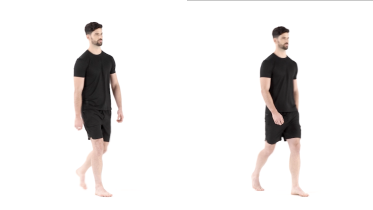 Brisk walking
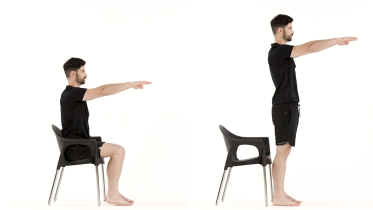 Sit to stand
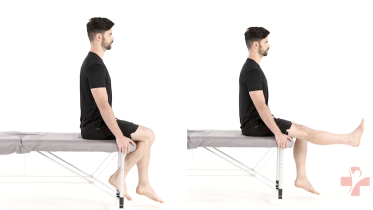 Seated knee extension
With a heart condition or high blood pressure, check with your doctor before you start. If you have high blood pressure, breathe steadily through every repetition and never hold your breath. If chest pain comes on while you exercise and does not ease quickly when you stop, call emergency services straight away. The warning list below gives the full set of signs.
Keeping your leg strong while the weight comes off
When people lose weight, some of what comes off is muscle. For a knee, that is the part you want to keep, because the thigh muscles (quadriceps) absorb load and steady the joint. A lighter body with a weaker thigh does not always feel better for long.
So keep the strengthening going for the whole time you are losing weight, and for good afterwards. For most people, the sit to stands and knee extensions, along with the other exercises in the knee program, are enough to start with. Track something you can feel, such as how many sit to stands you can do or how the stairs feel, as well as the number on the scale.
Weight loss medicines are a separate conversation for your doctor: GLP-1 medicines and knee arthritis covers what the 2026 guidance says, and strength training on GLP-1 medicines covers keeping muscle while you take one. Never stop or change a prescribed medicine on your own.
When to get more help
See a physio if your knee keeps flaring as you become more active, or if you have been building up slowly for 6 to 8 weeks and the knee is no better. A physio can set the right starting level and adjust the program as your weight changes. If your knee feels unstable or gives way as you do more, knee braces for arthritis explains when a brace is worth trying. Some people ask whether losing weight changes the picture for surgery; when to consider surgery covers that decision.
Related exercise programs
Warning signs
Get emergency help now
- Emergency: if chest pain, pressure or tightness does not ease quickly when you rest, spreads to your arm, neck, jaw, stomach or back, or comes with sweating, feeling sick, feeling light-headed or being short of breath, call emergency services straight away, as this can be a heart attack. If it eases quickly and none of these happen, get medical advice the same day, and do not exercise again until you have been checked.
- Emergency: if you faint while exercising, call emergency services, even if you feel fine again quickly.
- Emergency: the knee has moved out of place, looks misshapen or is pointing at an odd angle, or you have tingling or no feeling in the knee, leg or toes, or your foot turns cold, pale or blue. Go to an emergency department straight away. Do not drive yourself: ask someone to drive you or call an ambulance.
- Emergency: the knee became very swollen very quickly, within a few hours of a twist, fall or blow, or you felt a pop or snap. Go to an emergency department straight away. Do not drive yourself: ask someone to drive you or call an ambulance.
Get help today
- Same day: the pain started with a fall, a twist or a blow to the knee, or you cannot put weight on the leg. Get medical advice the same day.
- Same day: the knee is locked, which means it is stuck bent and you cannot fully straighten it, even after gently trying to move it, or you cannot bend or straighten the leg at all. Get assessed the same day by a doctor, at urgent care or at an emergency department. A torn piece of meniscus can get caught in the joint and block it, and when a tear like this can be repaired, it should be done as early as possible. A knee that catches for a moment and then frees itself can happen with a meniscus tear. That is not the same as a locked knee, but tell your physio or doctor about it.
- Same day: the knee keeps giving way under you, or it gave way after a recent injury, or it gives way and is also very painful or swollen. Get medical advice the same day. If it only happens now and then, with no recent injury and no swelling, it is not an emergency, but book an assessment with a physio or doctor in the next few days.
- Same day: the knee swells up with no clear reason, especially if you take medicine to thin your blood. Get medical advice the same day.
- Same day: the knee is hot, red and swollen, or you have knee pain with a high temperature or feel hot, cold or shivery. Get medical advice the same day, and go to an emergency department if you feel very unwell. This can be a sign of infection in the joint, which needs treatment quickly.
- Same day: a calf or thigh that is newly swollen or getting more swollen, warm, tender, red or darker than usual, has swollen veins that are sore to touch, or has a throbbing or cramping pain that does not fit your injury or condition, or that feels different from normal muscle soreness after exercise. This can be a sign of a blood clot (deep vein thrombosis), especially after surgery, an injury, time in a cast or boot, a long trip or a spell of being much less mobile than usual. Get medical advice the same day. If you are also short of breath or have chest pain, call emergency services.
- Same day: pain at night or at rest that keeps getting worse. If you are being treated for cancer now, contact your cancer team the same day.
Book an appointment
- Within a day or two: pain at night or at rest that keeps getting worse. If you have had cancer, now or in the past, see your doctor sooner, within a day or two, and mention it, even if the pain is not getting worse. Do the same if you have knee pain and are losing weight without trying, even if it does not hurt at night.
- Within a few days: pain at night or at rest that keeps getting worse. See your doctor within a few days.
Common questions
Does losing weight help knee arthritis pain?
Yes, for people who carry extra weight. NICE advises that losing weight improves pain and physical function, and the US guideline from the American College of Rheumatology and the Arthritis Foundation strongly recommends it for people with knee or hip osteoarthritis who are overweight (Kolasinski and colleagues, 2020). In the IDEA trial, people who combined a diet with exercise had less knee pain and better function after 18 months than people who only exercised (Messier and colleagues, 2013).
How much weight do I need to lose to help my knees?
Less than many people expect. NICE says any amount is likely to help, and that losing 10 percent of your body weight is likely to help more than 5 percent. The US guideline describes benefit starting at about 5 percent, with more as the loss grows. For someone weighing 90 kg (198 lb), 5 percent is about 4.5 kg (10 lb). Your doctor or a dietitian can help you set a goal that suits you.
How much pressure does each pound take off the knee?
In a study of 142 older adults with knee osteoarthritis who were overweight, each 1 lb of weight lost went with about 4 lb less load on the knee with every step during daily activities (Messier and colleagues, 2005). In metric terms the ratio is the same: about 4 kg less load per step for each 1 kg lost. Those loads were calculated from walking tests rather than measured inside the knee, so treat the number as an estimate.
Is diet or exercise more important for knee arthritis?
You do best with both. In the IDEA trial, the group that changed their diet and exercised had less pain and better function than the exercise-only group, while the diet changes did most of the work of lowering the force through the knee (Messier and colleagues, 2013). Exercise still matters on its own, because it builds the muscles that support the joint, and every osteoarthritis guideline recommends it whatever your weight.
References
- National Institute for Health and Care Excellence. Osteoarthritis in over 16s: diagnosis and management (NG226). 2022. https://www.nice.org.uk/guidance/ng226
- Kolasinski SL, Neogi T, Hochberg MC, et al. 2019 American College of Rheumatology/Arthritis Foundation guideline for the management of osteoarthritis of the hand, hip, and knee. Arthritis Care and Research. 2020;72(2):149-162. https://doi.org/10.1002/acr.24131
- Messier SP, Gutekunst DJ, Davis C, DeVita P. Weight loss reduces knee-joint loads in overweight and obese older adults with knee osteoarthritis. Arthritis and Rheumatism. 2005;52(7):2026-2032. https://doi.org/10.1002/art.21139
- Messier SP, Mihalko SL, Legault C, et al. Effects of intensive diet and exercise on knee joint loads, inflammation, and clinical outcomes among overweight and obese adults with knee osteoarthritis: the IDEA randomized clinical trial. JAMA. 2013;310(12):1263-1273. https://doi.org/10.1001/jama.2013.277669
- Messier SP, Callahan LF, Losina E, et al. Effect of diet and exercise on knee pain in patients with osteoarthritis and overweight or obesity: a randomized clinical trial. JAMA. 2022;328(22):2242-2251. https://doi.org/10.1001/jama.2022.21893
- American College of Rheumatology. 2026 update of the American College of Rheumatology recommendations for the management of osteoarthritis of the knee, hip, and hand. Guideline summary, approved by the ACR Board of Directors on 8 September 2026. https://assets.contentstack.io/v3/assets/bltee37abb6b278ab2c/bltb3d12c34020da842/oa-guideline-summary-2026.pdf
Written and checked by the PocketPhysio editorial team. Last updated 2026-10-16.
This page is general education, not a diagnosis or a personal treatment plan. See a physiotherapist or doctor for advice about your own situation.