
Part of Knee osteoarthritis
Exercises to avoid with knee arthritis: what to change instead
Warning signs, and when to get help
Do you need to avoid exercise with knee arthritis?
No. The guidelines point the other way. NICE advises offering therapeutic exercise to everyone with osteoarthritis, for example strengthening the muscles around the joint and general aerobic fitness. OARSI, the international osteoarthritis research society, lists structured land-based exercise as a core treatment for the knee.
The old worry that exercise grinds the joint away has been looked at directly. A systematic review of trials found that exercise which loads the knee did not appear to harm the cartilage in people with knee osteoarthritis or at risk of it, though the authors rated the evidence as low quality (Bricca and colleagues, 2019).
So the better question is which setting to turn down. Every exercise has four: how far the knee bends, how much weight it carries, how hard each rep lands, and how much you do in a week. When a patient says squats "kill" their knee, it nearly always turns out to be one of those settings that is wrong for them right now, not the squat.
Which exercises should you change with knee arthritis?
These are the ones people ask about most, with what to change and where to start.
Deep squats with heavy weights
Keep the squat and change the depth and the load. A shallow squat to a high chair asks far less of a sore knee than a deep squat holding a heavy bar. Start with the mini squat or a chair squat, lower the seat a little once a height has felt easy for a week, and work toward the bodyweight squat in stage 2 of the program. Weight goes on last. The page on knee pain when squatting goes deeper into depth and knee position.
Lunges and split squats
A lunge puts most of your weight through one bent knee, which is why it can feel like a big step up from a squat. Shorten the stride, hold a counter or a chair back, and lower only partway. The supported lunge is the version to begin with. The split squat sits in stage 3 of the program, once two-legged work feels easy. Walking lunges and jumping lunges add speed and impact, so leave those until last, if you want them at all.
Stairs and step ups
Stairs are hard for an arthritic knee, and dodging them for months makes them harder still. While the knee is grumpy, use the rail and take one step at a time. Then train the movement on purpose: a step up on a low step, raised when that height feels easy.
OrthoInfo suggests cutting down on activities that aggravate the knee, such as climbing stairs. Treat that as a short spell while the knee settles, not a rule for life. There is more on this in knee pain on stairs.
Kneeling
Kneeling bends the knee fully and presses on the front of it. Long spells on a hard floor are a common trigger for a flare. Kneel on a thick cushion or a gardening pad, go down on one knee instead of both, or sit on a low stool for jobs near the floor. This is daily life rather than training, so changing how you do it costs you nothing. Bending and kneeling in everyday tasks are covered in knee pain when bending.
Running
Running is not banned. In a study of more than 1,200 people aged 50 or over with knee osteoarthritis, running was linked with improving knee pain, not with worse pain or faster change on X-ray (Lo and colleagues, 2018). The runners chose to run, though, so their knees were probably the ones that coped. A large review found that recreational runners had lower rates of hip and knee osteoarthritis than people who did not run, while years of high-volume competitive running went with higher rates (Alentorn-Geli and colleagues, 2017).
In practice, if you already run and your knee is settled by the next morning, keep running and adjust distance and pace. If you have never run, starting with a painful arthritic knee is a big jump, and walking, cycling or swimming are easier first steps. OrthoInfo suggests swapping high-impact activities like jogging or tennis for lower-impact ones like swimming or cycling, which makes sense for a knee that keeps flaring with running. For runners whose knee hurts after a run, see knee pain after running.
Jumping and hopping
Box jumps, skipping and jump squats load the knee hard and fast on every landing. Few people with arthritic knees need them for daily life. If your sport demands landing, build a strength base first and add jumping with a physio. If you have had a hip or knee replacement, get the go-ahead from your surgeon before you try jumping or hopping. Many surgeons advise against jumping and hopping after a joint replacement for good, not just for the first months, because each landing sends high impact through the new joint.
Leg press and leg extension machines
No guideline bans gym machines. On the leg press, set the seat so your knees do not fold deeper than feels comfortable at the bottom, start light and push slowly. On the leg extension machine, use a light weight and shorten the range if the front of the knee complains. That is practice experience, not tested advice, so let the next-morning check below guide you. The seated knee extension is the home version.
How do you know an exercise was too much?
Judge it by tomorrow, not by today. A mild ache during a set that has eased by the next morning is fine for most people. A knee that is sorer, stiffer or more puffy the next day, or pain that creeps up from one week to the next, means the last setting you changed was too much. Go back one step and stay there for a week before trying again. Our guide to the pain monitoring model explains how physios use this check.
If the knee is already flared, drop back to the lying and sitting exercises in stage 1 of the knee osteoarthritis program until it calms down.
Easier versions to start with
Exercises that can help
These are the gentler versions to start from, roughly in order from easiest to hardest. Many programs begin with 2 to 3 sets: 10 to 15 for the mini squat and the seated knee extension (with a short hold), 8 to 12 for the chair squat and for each leg on the step up, and 6 to 10 on each leg for the supported lunge, which is often done a few times a week. Your physio will adjust this.
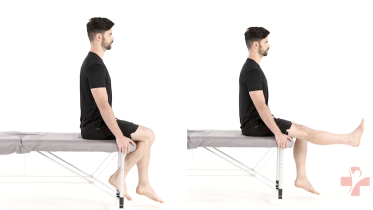 Seated knee extension
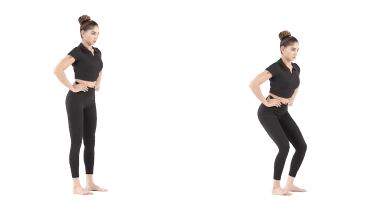 Mini squat
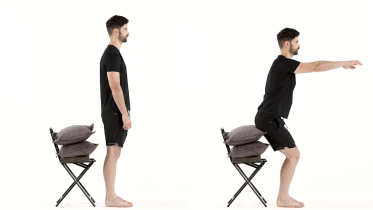 Chair squat
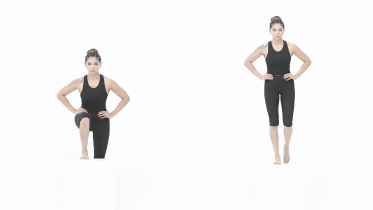 Step up
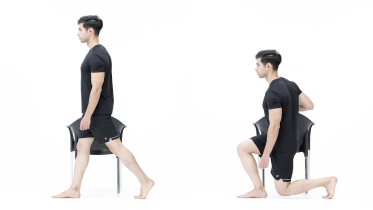 Supported lunge
If your balance is not steady, do the standing versions next to a kitchen counter or with a hand on the stair rail. If you have high blood pressure, breathe steadily through every repetition and never hold your breath.
For walking, the most common question of all, see is walking good for knee arthritis. Gear is covered in best exercise equipment for knee arthritis, and low-impact cardio in cycling and swimming for knee arthritis.
When to stop and get the knee checked
Some knee symptoms are not about which exercise you picked. A knee that locks, keeps giving way or swells up for no clear reason needs checking the same day. A pop with fast swelling, or a knee that looks misshapen, means going to an emergency department straight away. The warning list below gives the full set of signs.
After a knee fracture or knee surgery, including a knee replacement, follow your surgeon's or physio's plan, and start these exercises only when they have cleared you. If you are unsure which version suits you, a physio (physical therapist) can watch you squat, lunge and climb a step, and set a starting point that fits your knee.
Related exercise programs
Warning signs
Get emergency help now
- Emergency: you felt a sudden pop or tearing feeling just above or below your kneecap, you can see or feel a dip there, the kneecap seems to have moved up toward the thigh or to sag lower than usual, or you suddenly cannot straighten your knee or lift your leg out straight. Stop exercising and go to an emergency department straight away, even if you can still walk, as this can be a torn tendon at the front of the knee, either below the kneecap (patellar tendon) or above it (quadriceps tendon). Do not drive yourself. A repair usually does better if it is done soon after the injury.
- Emergency: the knee has moved out of place, looks misshapen or is pointing at an odd angle, or you have tingling or no feeling in the knee, leg or toes, or your foot turns cold, pale or blue. Go to an emergency department straight away. Do not drive yourself: ask someone to drive you or call an ambulance.
- Emergency: the knee became very swollen very quickly, within a few hours of a twist, fall or blow, or you felt a pop or snap. Go to an emergency department straight away. Do not drive yourself: ask someone to drive you or call an ambulance.
Get help today
- Same day: the pain started with a fall, a twist or a blow to the knee, or you cannot put weight on the leg. Get medical advice the same day.
- Same day: the knee is locked, which means it is stuck bent and you cannot fully straighten it, even after gently trying to move it, or you cannot bend or straighten the leg at all. Get assessed the same day by a doctor, at urgent care or at an emergency department. A torn piece of meniscus can get caught in the joint and block it, and when a tear like this can be repaired, it should be done as early as possible. A knee that catches for a moment and then frees itself can happen with a meniscus tear. That is not the same as a locked knee, but tell your physio or doctor about it.
- Same day: the knee keeps giving way under you, or it gave way after a recent injury, or it gives way and is also very painful or swollen. Get medical advice the same day. If it only happens now and then, with no recent injury and no swelling, it is not an emergency, but book an assessment with a physio or doctor in the next few days.
- Same day: the knee swells up with no clear reason, especially if you take medicine to thin your blood. Get medical advice the same day.
- Same day: the knee is hot, red and swollen, or you have knee pain with a high temperature or feel hot, cold or shivery. Get medical advice the same day, and go to an emergency department if you feel very unwell. This can be a sign of infection in the joint, which needs treatment quickly.
- Same day: a calf or thigh that is newly swollen or getting more swollen, warm, tender, red or darker than usual, has swollen veins that are sore to touch, or has a throbbing or cramping pain that does not fit your injury or condition, or that feels different from normal muscle soreness after exercise. This can be a sign of a blood clot (deep vein thrombosis), especially after surgery, an injury, time in a cast or boot, a long trip or a spell of being much less mobile than usual. Get medical advice the same day. If you are also short of breath or have chest pain, call emergency services.
- Same day: pain at night or at rest that keeps getting worse. If you are being treated for cancer now, contact your cancer team the same day.
Book an appointment
- Within a few days: the pain sits at one small spot on a bone that you can point to with a finger, such as the kneecap or the top of the shinbone, the bone aches at rest or at night, or hopping on that leg hurts at that one spot. Stop running, jumping and any exercise that hurts at that spot, and see a doctor within a few days, as this can be a stress fracture. This matters even more if the spot is on the kneecap, because doctors treat stress fractures there as high risk. If walking hurts or makes you limp, get it checked the same day. An X-ray can look normal for the first 2 to 3 weeks, so a normal early X-ray does not rule it out.
- Within a day or two: pain at night or at rest that keeps getting worse. If you have had cancer, now or in the past, see your doctor sooner, within a day or two, and mention it, even if the pain is not getting worse. Do the same if you have knee pain and are losing weight without trying, even if it does not hurt at night.
- Within a few days: pain at night or at rest that keeps getting worse. See your doctor within a few days.
Common questions
Are squats bad for knee arthritis?
No. A squat done to a depth and weight your knee accepts is one of the standard strength exercises for knee osteoarthritis, and it sits in stage 2 of our program. Trials of exercise that loads the knee have not shown harm to the joint cartilage, although that evidence is low quality (Bricca and colleagues, 2019). Start with a shallow squat to a high chair, then lower the seat or add weight in small steps.
Is running bad for knee arthritis?
Not for everyone. In a study of people aged 50 and over with knee osteoarthritis, those who chose to run had no more knee pain and no faster change on their X-rays than people who did not run (Lo and colleagues, 2018). That group had picked running because their knees coped with it, so it does not mean everyone should start. If you run already and the knee is settled by the next morning, adjust your distance rather than stopping.
Should I avoid stairs if I have knee arthritis?
Cut back on stairs you do not need while the knee is sore, but do not drop them for good. Stairs are a strength task, and avoiding them makes the muscles that carry you up them weaker. Use the handrail, go one step at a time, and practice with a step up on a low step until the stairs at home feel easier.
What exercises should I not do with knee arthritis?
Very few need to go completely. The ones to hold back on are high-impact work such as jumping, box jumps and jumping lunges, deep squats with heavy weights, and long spells of kneeling on a hard floor. Everything else can usually be made easier by changing depth, weight, speed or how much you do, then built back up.
References
- National Institute for Health and Care Excellence. Osteoarthritis in over 16s: diagnosis and management (NG226). 2022. https://www.nice.org.uk/guidance/ng226
- Bannuru RR, Osani MC, Vaysbrot EE, et al. OARSI guidelines for the non-surgical management of knee, hip, and polyarticular osteoarthritis. Osteoarthritis and Cartilage. 2019;27(11):1578-1589. https://doi.org/10.1016/j.joca.2019.06.011
- Bricca A, Juhl CB, Steultjens M, Wirth W, Roos EM. Impact of exercise on articular cartilage in people at risk of, or with established, knee osteoarthritis: a systematic review of randomised controlled trials. British Journal of Sports Medicine. 2019;53(15):940-947. https://doi.org/10.1136/bjsports-2017-098661
- Lo GH, Musa SM, Driban JB, et al. Running does not increase symptoms or structural progression in people with knee osteoarthritis: data from the osteoarthritis initiative. Clinical Rheumatology. 2018;37(9):2497-2504. https://doi.org/10.1007/s10067-018-4121-3
- Alentorn-Geli E, Samuelsson K, Musahl V, Green CL, Bhandari M, Karlsson J. The Association of Recreational and Competitive Running With Hip and Knee Osteoarthritis: A Systematic Review and Meta-analysis. Journal of Orthopaedic and Sports Physical Therapy. 2017;47(6):373-390. https://doi.org/10.2519/jospt.2017.7137
- American Academy of Orthopaedic Surgeons. Arthritis of the Knee. OrthoInfo. https://www.orthoinfo.org/en/diseases--conditions/arthritis-of-the-knee/
Written and checked by the PocketPhysio editorial team. Last updated 2026-10-16.
This page is general education, not a diagnosis or a personal treatment plan. See a physiotherapist or doctor for advice about your own situation.