
Part of Knee osteoarthritis
Knee brace for arthritis: does it help, and which type?
Warning signs, and when to get help
What types of knee brace are there?
Shops and websites sell dozens of designs, but in clinic they fall into four groups. Knowing which group you are looking at tells you what it can and cannot do.
Sleeves
A sleeve is a tube of elastic or neoprene that you pull on over the knee. It holds nothing in place mechanically. What people notice is warmth and gentle compression, plus a better sense of where the knee is. For some that is enough to make a walk feel more comfortable. Sleeves are the simplest and lowest risk option.
Hinged or stabilizing braces
These have a hinge on each side of the knee and straps above and below it. They are meant for a knee that feels wobbly or gives way. They are bulkier, so most people wear them for a particular job or outing rather than from morning to night.
Unloader braces
Arthritis is often worse on one side of the knee joint than the other. An unloader (or offloader) brace has a firm frame that pushes gently to shift some load off the worn side. It only makes sense when the wear is mainly on one side, and it has to be measured and adjusted to fit your leg.
Kneecap braces
When the arthritis sits mostly behind the kneecap (the patellofemoral joint), the worst moments tend to be stairs, squats or getting out of a low chair. A kneecap brace has a pad or strap around the kneecap that aims to guide it as the knee bends. The US guideline treats this type separately from the others. NICE groups knee tape in the same recommendation as braces and supports.
Does a knee brace help arthritis?
It helps some people a little, and the evidence is weaker than the packaging suggests.
A Cochrane review pooled 13 trials of braces and foot or ankle insoles for knee osteoarthritis. For braces, the reviewers could not reach a conclusion on pain, stiffness, function or quality of life, and rated the evidence low quality (Duivenvoorden and colleagues, 2015).
The strongest recent trial is PROP OA, published in the BMJ in 2026. It recruited 466 adults through general practices in four regions of England aged 45 and over with knee osteoarthritis. Everyone saw a trained physio in an NHS clinic. They got advice and written information, and left with an exercise plan.
Half were also fitted with one of three brace types chosen to match the part of the knee most affected: a kneecap brace, an unloader brace or a neutral stabilizing brace. They had a follow-up visit at two weeks and text reminders to help them keep wearing it.
At six months the brace group had improved more on a 0 to 100 knee symptom score, by about 3 points on average, and the difference was largest for pain, at about 6 points. The extra benefit got smaller over time (Holden and colleagues, 2026). The authors called the improvements small. Note what the braced group also had: the exercise plan. What the trial tested was a brace added to exercise, not a brace instead of it.
What do the guidelines say about a knee brace for arthritis?
They point in different directions, which is why people hear mixed messages from different clinicians.
NICE, the UK guideline, says not to routinely offer insoles, braces, tape, splints or supports to people with osteoarthritis. It makes an exception only when three things are all true: the joint is unstable or is being loaded abnormally, exercise is not working or is not suitable without an aid, and adding a device is likely to improve movement and function. The NICE committee also pointed out that some of these devices can cause blistering and other pressure damage.
The US guideline from the American College of Rheumatology gives braces for the main knee joint and for the kneecap a conditional recommendation in its 2026 update. Its 2019 version, written with the Arthritis Foundation, had been firmer about the main knee joint. It strongly recommended a brace there for people whose arthritis was affecting walking, stability or pain enough to need an assistive device, and who could put up with the bother of wearing one. It gave kneecap braces a conditional recommendation, and said good results depend on someone with the skill to fit the brace (Kolasinski and colleagues, 2020).
OARSI, the international osteoarthritis research society, went the other way in 2019 and recommended against knee braces, because it judged the evidence too poor to show that the benefit outweighed the downsides (Bannuru and colleagues, 2019).
All of these guidelines put exercise first. Where they agree, a brace is at most an extra for selected knees.
Who might try a knee brace?
A brace is worth raising with your physio if one of these fits you:
- Your knee gives way, or you feel it is about to, even though you have been doing your strengthening exercises. Get it assessed before you buy anything, as the warning list below explains.
- Your arthritis is clearly worse on one side of the knee, which an X-ray or your physio's examination can show, and an unloader brace might take some load off that side.
- The pain is mostly behind the kneecap and flares with stairs and squatting.
- You have a long walk, a day of gardening or a trip coming up that usually sets the knee off, and you want some extra confidence for that day. That last one is practice experience rather than something trials have tested.
Some people should check with a doctor or physio first. Straps and frames press on the skin, so take extra care if your skin is fragile, the circulation in your legs is poor, your legs swell, or your feet are numb, for example from diabetes, because you may not feel a sore starting. After a knee fracture or knee surgery, including a knee replacement, follow your surgeon's or physio's plan, and start these exercises only when they have cleared you. A brace given after surgery is a different device, set by your surgical team.
How do you choose a brace with your physio?
Start with an assessment rather than a shop. Your physio will look at which part of the knee hurts, how your leg lines up, whether the knee is stable and what you want to be able to do. That decides the type.
Go for the simplest brace that does the job. If you are unsure and the knee is stable, many physios suggest a sleeve as a cheap first try. That is common practice rather than trial evidence. An unloader brace needs proper measuring and adjusting by someone trained to fit it, as the US guideline points out. Whether a health service or insurer pays for one varies a great deal between countries and plans, so ask before you buy.
Give it a fair trial of a few weeks, and decide in advance how you will judge it: the pain on your hardest daily task, or how far you can walk before the knee complains. Keep the brace if it clearly helps. If it makes no difference, it has not earned its place.
While you wear it, check your skin each time it comes off. If your toes tingle, go numb or turn cold, pale or blue while you have it on, take it off at once. If feeling and color do not come back quickly, call emergency services or go to an emergency department straight away, and do not drive yourself. The warning list below gives the full set of signs.
Keep the strength work going
A brace supports the knee from outside. The thigh and hip muscles support it from inside, and only exercise builds them. The staged knee osteoarthritis program starts with lying and sitting exercises, and the ones below are a good base whether or not you use a brace.
Exercises that can help
A brace does not strengthen the thigh, so keep these going whether or not you wear one. Many programs use 10 quad sets with a 5 to 10 second hold several times a day, 2 to 3 sets of 10 straight leg raises on each leg once a day, 2 to 3 sets of 10 to 15 seated knee extensions on each leg with a short hold once a day, and 2 to 3 sets of 5 to 10 sit to stands once a day or on most days. Your physio will adjust this.
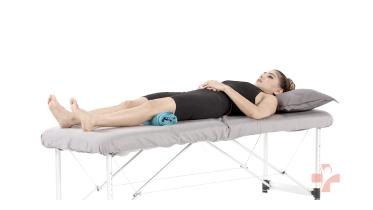 Quad sets (towel under knee)
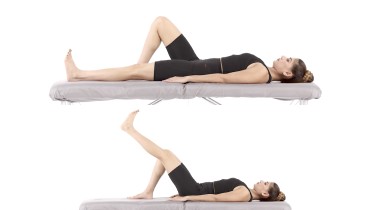 Straight leg raise
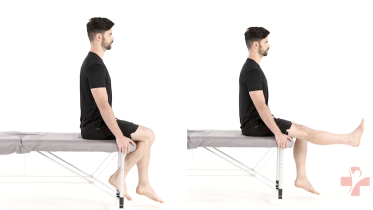 Seated knee extension
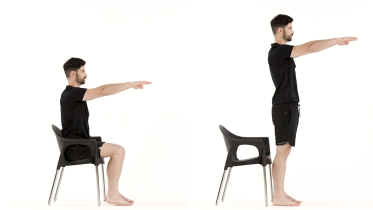 Sit to stand
If you are pregnant and past the first three months, check with your physio before exercising flat on your back, as the quad sets and straight leg raises are done lying down. If you have high blood pressure, breathe steadily through every repetition and never hold your breath.
For other ways to make the knee easier to live with, see is walking good for knee arthritis, best exercise equipment for knee arthritis, cycling and swimming for knee arthritis and exercises to avoid with knee arthritis. If you carry extra weight, weight loss and knee arthritis explains how much it helps, and knee arthritis flare ups covers what to do when the knee has a bad week. If exercise, a brace or the other options have not helped enough, when to consider surgery covers that next conversation.
Related exercise programs
Warning signs
Get emergency help now
- Emergency: the knee has moved out of place, looks misshapen or is pointing at an odd angle, or you have tingling or no feeling in the knee, leg or toes, or your foot turns cold, pale or blue. Go to an emergency department straight away. Do not drive yourself: ask someone to drive you or call an ambulance.
- Emergency: the knee became very swollen very quickly, within a few hours of a twist, fall or blow, or you felt a pop or snap. Go to an emergency department straight away. Do not drive yourself: ask someone to drive you or call an ambulance.
Get help today
- Same day: the pain started with a fall, a twist or a blow to the knee, or you cannot put weight on the leg. Get medical advice the same day.
- Same day: the knee is locked, which means it is stuck bent and you cannot fully straighten it, even after gently trying to move it, or you cannot bend or straighten the leg at all. Get assessed the same day by a doctor, at urgent care or at an emergency department. A torn piece of meniscus can get caught in the joint and block it, and when a tear like this can be repaired, it should be done as early as possible. A knee that catches for a moment and then frees itself can happen with a meniscus tear. That is not the same as a locked knee, but tell your physio or doctor about it.
- Same day: the knee keeps giving way under you, or it gave way after a recent injury, or it gives way and is also very painful or swollen. Get medical advice the same day. If it only happens now and then, with no recent injury and no swelling, it is not an emergency, but book an assessment with a physio or doctor in the next few days.
- Same day: the knee swells up with no clear reason, especially if you take medicine to thin your blood. Get medical advice the same day.
- Same day: the knee is hot, red and swollen, or you have knee pain with a high temperature or feel hot, cold or shivery. Get medical advice the same day, and go to an emergency department if you feel very unwell. This can be a sign of infection in the joint, which needs treatment quickly.
- Same day: a calf or thigh that is newly swollen or getting more swollen, warm, tender, red or darker than usual, has swollen veins that are sore to touch, or has a throbbing or cramping pain that does not fit your injury or condition, or that feels different from normal muscle soreness after exercise. This can be a sign of a blood clot (deep vein thrombosis), especially after surgery, an injury, time in a cast or boot, a long trip or a spell of being much less mobile than usual. Get medical advice the same day. If you are also short of breath or have chest pain, call emergency services.
- Same day: pain at night or at rest that keeps getting worse. If you are being treated for cancer now, contact your cancer team the same day.
Book an appointment
- Within a day or two: pain at night or at rest that keeps getting worse. If you have had cancer, now or in the past, see your doctor sooner, within a day or two, and mention it, even if the pain is not getting worse. Do the same if you have knee pain and are losing weight without trying, even if it does not hurt at night.
- Within a few days: pain at night or at rest that keeps getting worse. See your doctor within a few days.
Common questions
Do knee braces help arthritis?
For some people, a little. In the PROP OA trial, people who had a physio-fitted brace on top of advice and an exercise plan reported slightly less pain and fewer symptoms at six months than people who had the advice and exercise plan alone, and the extra benefit faded with time (Holden and colleagues, 2026). An older Cochrane review found the evidence for braces inconclusive and rated it low quality (Duivenvoorden and colleagues, 2015). So a brace is worth discussing with your physio for a knee that feels unstable or is worse on one side, but it is an add-on to exercise, not a replacement.
Should I wear a knee brace all day for arthritis?
Usually not. Most physios suggest wearing it for the things that bother the knee, such as a long walk, a day of gardening or a hike, and taking it off at rest. That is common practice rather than a rule tested in trials. Check your skin each time it comes off, and stop wearing it if it rubs, pinches or leaves marks that do not fade.
Will a knee brace make my muscles weaker?
There is little research on that exact question. The practical risk is that a brace becomes a reason to do less, so keep up the strengthening exercises for your thigh and hip while you use it. In the PROP OA trial the brace was given alongside an exercise plan, not instead of one, and that is the way to use it.
Can a knee brace slow arthritis down?
No trial has shown that. The trials of braces measured pain, function and quality of life, not changes in the joint itself, so the honest answer is that a brace is for symptoms. The treatments the guidelines put first, exercise and, if you carry extra weight, losing some of it, are the ones to build on.
Is a knee sleeve or a hinged brace better for arthritis?
They do different jobs. A sleeve gives warmth and a feeling of support and suits a knee that aches but feels stable. A hinged brace is for a knee that feels unstable or gives way. An unloader brace is for arthritis that is mainly on one side of the knee. Your physio can check which part of the knee is affected and whether it is stable before you spend money.
References
- National Institute for Health and Care Excellence. Osteoarthritis in over 16s: diagnosis and management (NG226). 2022. https://www.nice.org.uk/guidance/ng226
- Kolasinski SL, Neogi T, Hochberg MC, et al. 2019 American College of Rheumatology/Arthritis Foundation guideline for the management of osteoarthritis of the hand, hip, and knee. Arthritis Care and Research. 2020;72(2):149-162. https://doi.org/10.1002/acr.24131
- American College of Rheumatology. 2026 update of the American College of Rheumatology recommendations for the management of osteoarthritis of the knee, hip, and hand. Guideline summary, approved by the ACR Board of Directors on 8 September 2026. https://assets.contentstack.io/v3/assets/bltee37abb6b278ab2c/bltb3d12c34020da842/oa-guideline-summary-2026.pdf
- Bannuru RR, Osani MC, Vaysbrot EE, et al. OARSI guidelines for the non-surgical management of knee, hip, and polyarticular osteoarthritis. Osteoarthritis and Cartilage. 2019;27(11):1578-1589. https://doi.org/10.1016/j.joca.2019.06.011
- Holden MA, Nicholls E, Abdali Z, et al. Provision of knee bracing for knee osteoarthritis (PROP OA): multicentre, parallel group, superiority, statistician blinded, randomised controlled trial. BMJ. 2026;392:e086005. https://pubmed.ncbi.nlm.nih.gov/41587822/
- Duivenvoorden T, Brouwer RW, van Raaij TM, Verhagen AP, Verhaar JAN, Bierma-Zeinstra SMA. Braces and orthoses for treating osteoarthritis of the knee. Cochrane Database of Systematic Reviews. 2015;(3):CD004020. https://doi.org/10.1002/14651858.CD004020.pub3
Written and checked by the PocketPhysio editorial team. Last updated 2026-10-16.
This page is general education, not a diagnosis or a personal treatment plan. See a physiotherapist or doctor for advice about your own situation.