
Part of Knee osteoarthritis
Is walking good for knee arthritis? How far to go and how to build up
Warning signs, and when to get help
Why is walking good for knee arthritis?
NICE offers therapeutic exercise to everyone with osteoarthritis and gives general aerobic fitness as one of its examples, alongside strengthening the muscles around the joint. For most people with a sore knee, walking is the aerobic option that costs nothing and needs no kit. You can start from your front door today.
The Canadian Ottawa Panel looked at walking programs for knee osteoarthritis and found that they improved stiffness, mobility and walking endurance in the shorter term, usually when combined with other treatment (Loew and colleagues, 2012). A large US study followed about 1,200 people aged 50 and over with knee osteoarthritis. Those who had walked for exercise from the age of 50 had about 40 percent lower odds of developing new frequent knee pain than those who had not (Lo and colleagues, 2022). That study observed people rather than testing walking in a trial, so it cannot prove that walking caused the difference, but it points the same way as the trials.
Walking also works well alongside the strengthening exercises in the knee osteoarthritis program. Stronger thigh and hip muscles make walking easier, and walking keeps the knee used to everyday load.
Can walking make knee arthritis worse?
Walking does not appear to wear the joint out. A review of trials found that exercise which loads the knee does not seem to harm the cartilage, although the authors called the evidence limited (Bricca and colleagues, 2019). What walking can do is flare the pain for a few days if you suddenly do a lot more than usual, such as a full day of sightseeing on vacation after weeks of short trips to the store.
So the dose matters more than the activity. Use the next morning as your check. If the knee feels much as it did the day before, the walk was fine. A knee that is more painful, stiffer for longer or visibly more swollen the next day means the walk was too much for now: drop back to the last distance that settled, stay there for a week, then build again.
If the knee is already flared, shorter walks spread across the day usually sit better than one long one. That is clinic experience rather than a tested rule. The main knee osteoarthritis page lists the activities that most often set a knee off and what to change.
How far and how often should you walk with knee arthritis?
Start from where you are, not from a target. Find the amount you can walk on an ordinary day without the knee being worse the next morning. For one person that is a walk to the corner and back, and for another it is half an hour in the park. Split it into two or three shorter walks if one long one is too much.
The brisk walking page gives a typical program: 10 to 20 minutes on most days of the week, including a few minutes of slower walking at each end, adding time before adding speed. Your physio will adjust this. Once the time feels comfortable, add a few minutes, keep the new amount for about a week, and only add more if your next mornings stay settled.
Speed and hills come after time. That order comes from common physio practice, not from trials. A flat route that feels easy is a better base than a hilly one that leaves the knee grumbling for days. In clinic, many people with knee arthritis say walking downhill and going down stairs are harder than walking on the flat, so bring those in gradually. If stairs are your main problem, knee pain on stairs covers that in detail.
Over the longer term, the WHO advises adults to build up to at least 150 minutes of moderate activity a week (Bull and colleagues, 2020). Brisk walking counts toward that, and so does any other activity that makes you breathe a little faster. Think of it as a direction to head in over months, not a starting dose.
What makes walking easier on an arthritic knee?
Shoes are a good place to start. In a six-month trial, people with knee osteoarthritis who wore stable, supportive shoes had more improvement in knee pain on walking than those in flat, flexible shoes, and fewer side effects (Paterson and colleagues, 2021).
A walking stick or cane is worth considering if the knee is cutting your walks short or making you limp or feel unsteady. The US guideline from the American College of Rheumatology and the Arthritis Foundation strongly recommends a cane for people whose knee or hip osteoarthritis affects their walking, stability or pain enough to need one (Kolasinski and colleagues, 2020). It usually goes in the hand opposite the sore knee, and walking with a cane shows how to set the height and the step pattern.
Carrying a heavy backpack or wearing a weighted vest adds load through the knee. If that interests you, rucking and weighted vest walking explains how to build it in safely, and it is best left until plain walking feels easy.
Walking alongside other treatment
Cycling and swimming are other good aerobic choices, and the main knee osteoarthritis page names them alongside walking. Cycling and swimming for knee arthritis covers bike set-up and pool options, best exercise equipment for knee arthritis compares treadmills, bikes and other kit, and exercises to avoid with knee arthritis covers what to change in your strength work. Questions about knee braces belong with your physio, who can tell you whether one would help your knee. If you carry extra weight, NICE advises that losing weight improves pain and function, and GLP-1 medicines and knee arthritis looks at one newer route.
See a physio if walking keeps flaring the knee even though you are building up slowly, or if you have been walking and doing the strengthening program regularly for 6 to 8 weeks with no improvement. A physio can watch how you walk and test your leg strength, then adjust the plan.
If chest pain comes on during a walk and does not ease quickly when you stop, call emergency services straight away. If the knee swells up very quickly after a twist or a fall, go to an emergency department straight away. The warning list below gives the full set of signs.
Exercises that can help
Brisk walking shows how to warm up and then build your pace, and walking with a cane covers which hand to use and the step pattern. Start at the low end of each dose and judge it by how your knee feels the next morning. Your physio will adjust this.
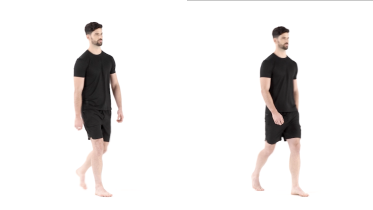 Brisk walking
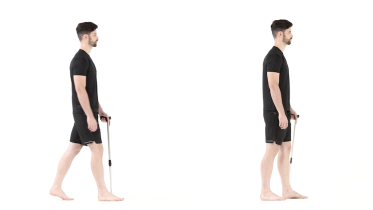 Walking with a cane
Related exercise programs
Warning signs
Get emergency help now
- Emergency: if chest pain, pressure or tightness does not ease quickly when you rest, spreads to your arm, neck, jaw, stomach or back, or comes with sweating, feeling sick, feeling light-headed or being short of breath, call emergency services straight away, as this can be a heart attack. If it eases quickly and none of these happen, get medical advice the same day, and do not exercise again until you have been checked.
- If you faint while exercising, call emergency services, even if you feel fine again quickly.
Get help today
- The knee is hot, red and swollen, or you have knee pain with a high temperature or feel hot, cold or shivery. Get medical advice the same day, and go to an emergency department if you feel very unwell. This can be a sign of infection in the joint, which needs treatment quickly.
- You cannot walk or put weight on the leg, whether or not there was a fall or injury, or you have very bad knee pain after a fall or injury, or very bad knee pain that came on suddenly with no injury at all. Get medical advice the same day. If the knee has changed shape, swelled up very quickly or you felt a pop or snap, or your foot turns cold, pale or blue or you have tingling or no feeling in the leg or foot, go to an emergency department straight away, and do not drive yourself.
- The knee locks and you cannot straighten it. Get medical advice the same day.
- The knee swells up with no clear reason, especially if you take medicine to thin your blood. Get medical advice the same day.
- A calf or thigh that is newly swollen or getting more swollen, warm, tender, red or darker than usual, has swollen veins that are sore to touch, or has a throbbing or cramping pain that does not fit your injury or condition, or that feels different from normal muscle soreness after exercise. This can be a sign of a blood clot (deep vein thrombosis), especially after surgery, an injury, time in a cast or boot, a long trip or a spell of being much less mobile than usual. Get medical advice the same day. If you are also short of breath or have chest pain, call emergency services.
- Pain at night or at rest that keeps getting worse. If you are being treated for cancer now, contact your cancer team the same day.
Book an appointment
- Pain at night or at rest that keeps getting worse. If you have had cancer, now or in the past, see your doctor sooner, within a day or two, and mention it, even if the pain is not getting worse. Do the same if you have knee pain and are losing weight without trying, even if it does not hurt at night.
- Pain at night or at rest that keeps getting worse. See your doctor within a few days.
- You have had a fall, even if you were not hurt, or you keep tripping, stumbling or feeling that your legs might give way. Book an appointment with your doctor within a few days and ask about a falls assessment. Tell them about every fall, even the ones where you were not hurt.
Common questions
How far should I walk with knee arthritis?
There is no set distance that suits everyone. Start with the amount you can walk on an ordinary day without the knee being worse the next morning, whether that is 5 minutes or 30. Many programs then build toward 10 to 20 minutes on most days, adding time before speed, and the WHO advises adults to aim for at least 150 minutes of moderate activity a week over time. Your physio will adjust this to suit your knee.
Is some knee pain while walking normal with arthritis?
Yes, a mild ache while you walk is common with knee osteoarthritis, and NICE notes that joint pain can increase when people first start exercising. It is usually fine if it settles by the next morning and is not building up from week to week. A sharp pain that makes you limp, or a knee that is more swollen the next day, means the walk was too long or too fast for now, so cut back to the last amount that settled.
What shoes are best for walking with knee arthritis?
Comfortable, stable shoes with some cushioning and support are a good choice. In a trial of people with knee osteoarthritis, stable supportive shoes eased knee pain on walking more than flat, flexible shoes over six months, and fewer people had side effects with them (Paterson and colleagues, 2021). No single brand or model has been shown to be best, so choose a pair that fits well and feels steady.
Is walking or cycling better for knee arthritis?
Both are good choices, and the better one is the one you will keep doing. NICE names general aerobic fitness as part of exercise for osteoarthritis without favoring one activity, and walking, cycling and swimming are all common ways to get it. Walking needs no equipment and trains the stamina you use every day on sidewalks and in stores. Plenty of people mix them, for example cycling on days the knee is grumbling and walking on the others.
References
- National Institute for Health and Care Excellence. Osteoarthritis in over 16s: diagnosis and management (NG226). 2022. https://www.nice.org.uk/guidance/ng226
- Loew L, Brosseau L, Wells GA, et al. Ottawa Panel evidence-based clinical practice guidelines for aerobic walking programs in the management of osteoarthritis. Archives of Physical Medicine and Rehabilitation. 2012;93(7):1269-1285. https://doi.org/10.1016/j.apmr.2012.01.024
- Lo GH, Vinod S, Richard MJ, et al. Association between walking for exercise and symptomatic and structural progression in individuals with knee osteoarthritis: data from the Osteoarthritis Initiative cohort. Arthritis and Rheumatology. 2022;74(10):1660-1667. https://doi.org/10.1002/art.42241
- Bricca A, Juhl CB, Steultjens M, Wirth W, Roos EM. Impact of exercise on articular cartilage in people at risk of, or with established, knee osteoarthritis: a systematic review of randomised controlled trials. British Journal of Sports Medicine. 2019;53(15):940-947. https://doi.org/10.1136/bjsports-2017-098661
- Paterson KL, Bennell KL, Campbell PK, et al. The effect of flat flexible versus stable supportive shoes on knee osteoarthritis symptoms: a randomized trial. Annals of Internal Medicine. 2021;174(4):462-471. https://doi.org/10.7326/M20-6321
- Kolasinski SL, Neogi T, Hochberg MC, et al. 2019 American College of Rheumatology/Arthritis Foundation guideline for the management of osteoarthritis of the hand, hip, and knee. Arthritis Care and Research. 2020;72(2):149-162. https://doi.org/10.1002/acr.24131
- Bull FC, Al-Ansari SS, Biddle S, et al. World Health Organization 2020 guidelines on physical activity and sedentary behaviour. British Journal of Sports Medicine. 2020;54(24):1451-1462. https://doi.org/10.1136/bjsports-2020-102955
Written and checked by the PocketPhysio editorial team. Last updated 2026-10-17.
This page is general education, not a diagnosis or a personal treatment plan. See a physiotherapist or doctor for advice about your own situation.