
Part of Knee osteoarthritis
Best exercise equipment for knee arthritis: what you actually need
Warning signs, and when to get help
Do you need to buy anything for knee arthritis exercise?
Very little, and often nothing. The staged knee osteoarthritis program on this site runs on a chair, a towel, a step and one resistance band. NICE recommends exercise tailored to the person, such as strengthening the muscles around the joint plus general aerobic fitness, and neither of those needs a gym.
The US guideline from the American College of Rheumatology and the Arthritis Foundation went further. It found the evidence too thin to recommend one type of exercise over another, and said the choice should rest on what people prefer and can get to (Kolasinski and colleagues, 2020). That is the honest answer to "which machine is best": the one you will still be using in three months.
What small equipment helps at home?
A sturdy chair
A dining chair without wheels, pushed against a wall, is the most useful piece of kit you own. You stand up from it and squat down to it, and its back is there to hold for balance. The sit to stand trains the movement you use every time you get out of a car or off the sofa, and you can make it harder by using a lower seat, with no new gear at all.
A step
The bottom stair at home works well, with the banister for support. An adjustable aerobic step, the kind sold for step classes, lets you raise the height in small stages, which a staircase cannot. The step up practices stairs directly, and it is in stage 3 of the program.
Resistance bands
A loop band or a long flat band costs little and covers a lot. You can anchor it to a table leg for terminal knee extension, or loop it round your ankle for a knee extension in sitting. Colors mark the strength, but one maker's green is not another's, so test the pull before you buy a set. Start lighter than you think you need.
Ankle weights and light dumbbells
Once the lying and sitting exercises feel easy, a little weight keeps them working. Choose an adjustable ankle weight that goes up in small steps, for example half a kilogram (about 1 lb) at a time. A light dumbbell or kettlebell held at your chest turns a squat into a goblet squat later on. A bag of rice of known weight does the same job while you decide whether you will keep it up.
None of the exercises below needs anything you have to buy except a band. If your balance is not steady, do the standing ones next to a kitchen counter or with a hand on the stair rail.
Exercises that can help
These four need only a chair, a step and a band. Many programs start with 2 to 3 sets of 5 to 10 sit to stands, 2 to 3 sets of 8 to 12 step ups on each leg, and 2 to 3 sets of 10 to 15 terminal knee extensions with a short hold. For the band knee extension, a light band is the usual start, at 2 sets of 10 to 15 slow reps on each leg, working up to 3 sets. Your physio will adjust this.
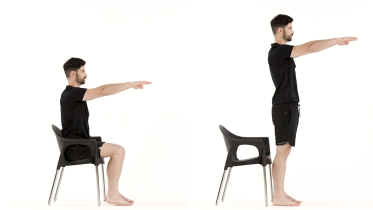 Sit to stand
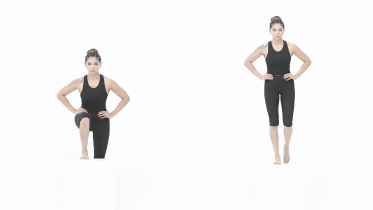 Step up
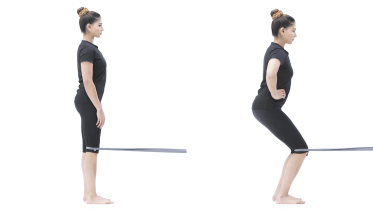 Terminal knee extension with band
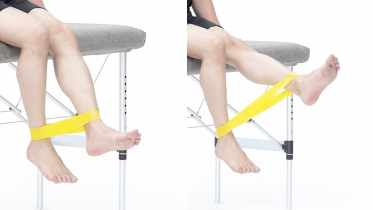 Seated knee extension with band
Which exercise machine is best for arthritic knees?
Stationary bike
This is the usual first choice, and there is some research behind it. German researchers fitted sensors inside the knee replacements of nine patients and found that riding an exercise bike, at every power level they tried, put less force through the joint than ordinary walking (Kutzner and colleagues, 2012). An arthritic knee is not a replaced one, so read that as a rough guide. On the clinical side, pooled trials of stationary cycling in knee osteoarthritis showed less pain afterwards, while stiffness and quality of life changed less clearly (Luan and colleagues, 2021).
Recumbent or upright comes down to comfort. A recumbent bike has a backrest and a lower step-through frame, which helps if your balance, back or hips are a problem. Saddle height and resistance matter more than the type, and both are set out in cycling and swimming for knee arthritis.
Elliptical cross trainer
Your feet stay on the pedals, so there is no landing, but you are standing and carrying your weight. That makes it a step between cycling and walking. No guideline singles it out, and the evidence for it in knee arthritis is thin, so treat it as a reasonable option rather than a proven one. Hold the handles until you feel steady on it.
Rowing machine
Rowing is a good all-body workout, but the knee bends a long way at the front of each stroke. A stiff arthritic knee often objects to that. If you like rowing, set the footplate so you can stop the slide short of a full bend. In clinic it is rarely the first machine a physio suggests for a sore knee.
Treadmill
A treadmill is walking with a handrail and an even surface, and walking is a staple of knee arthritis exercise. Keep it flat and steady at first. How far and how fast to walk is covered on is walking good for knee arthritis.
A pool
Water takes much of your weight off the knee. Cochrane reviewers who pooled the water exercise trials in hip and knee osteoarthritis judged the gain in pain and disability to be small but probably real by the end of a course (Bartels and colleagues, 2016). Equipment here means a swimsuit and pool access, and you do not need to swim: walking in chest-deep water or joining a gentle class in a warm pool counts. Swim where a lifeguard is on duty. If you feel dizzy or faint in the water, get out and sit down.
How do you choose the right equipment?
Ask three questions. Will you use it at least two or three times a week? Does it leave the knee no worse the next morning? Can you get on and off it safely?
A machine that passes all three is the right one for you, whatever it cost. Before buying anything large, try one out at a gym or community center for a couple of weeks.
With a heart condition or high blood pressure, check with your doctor before you start. If you have high blood pressure, breathe steadily through every repetition and never hold your breath. Stop at once for chest pain or pressure, dizziness or feeling faint, a racing or irregular heartbeat, or being far more out of breath than the effort should cause. If chest pain does not ease quickly with rest, call emergency services; the warning list below gives the full set of signs.
After a knee fracture or knee surgery, including a knee replacement, follow your surgeon's or physio's plan, and start these exercises only when they have cleared you. NICE advises that knee braces and supports are not routinely needed, and keeps them mainly for a knee that is unstable when exercise alone is not enough, so ask your physio before you buy one. For which exercises to change rather than drop, see exercises to avoid with knee arthritis.
Related exercise programs
Warning signs
Get emergency help now
- Emergency: if chest pain, pressure or tightness does not ease quickly when you rest, spreads to your arm, neck, jaw, stomach or back, or comes with sweating, feeling sick, feeling light-headed or being short of breath, call emergency services straight away, as this can be a heart attack. If it eases quickly and none of these happen, get medical advice the same day, and do not exercise again until you have been checked.
- Emergency: if you faint while exercising, call emergency services, even if you feel fine again quickly.
- Emergency: the knee has moved out of place, looks misshapen or is pointing at an odd angle, or you have tingling or no feeling in the knee, leg or toes, or your foot turns cold, pale or blue. Go to an emergency department straight away. Do not drive yourself: ask someone to drive you or call an ambulance.
- Emergency: the knee became very swollen very quickly, within a few hours of a twist, fall or blow, or you felt a pop or snap. Go to an emergency department straight away. Do not drive yourself: ask someone to drive you or call an ambulance.
Get help today
- Same day: the pain started with a fall, a twist or a blow to the knee, or you cannot put weight on the leg. Get medical advice the same day.
- Same day: the knee is locked, which means it is stuck bent and you cannot fully straighten it, even after gently trying to move it, or you cannot bend or straighten the leg at all. Get assessed the same day by a doctor, at urgent care or at an emergency department. A torn piece of meniscus can get caught in the joint and block it, and when a tear like this can be repaired, it should be done as early as possible. A knee that catches for a moment and then frees itself can happen with a meniscus tear. That is not the same as a locked knee, but tell your physio or doctor about it.
- Same day: the knee swells up with no clear reason, especially if you take medicine to thin your blood. Get medical advice the same day.
- Same day: the knee is hot, red and swollen, or you have knee pain with a high temperature or feel hot, cold or shivery. Get medical advice the same day, and go to an emergency department if you feel very unwell. This can be a sign of infection in the joint, which needs treatment quickly.
- Same day: a calf or thigh that is newly swollen or getting more swollen, warm, tender, red or darker than usual, has swollen veins that are sore to touch, or has a throbbing or cramping pain that does not fit your injury or condition, or that feels different from normal muscle soreness after exercise. This can be a sign of a blood clot (deep vein thrombosis), especially after surgery, an injury, time in a cast or boot, a long trip or a spell of being much less mobile than usual. Get medical advice the same day. If you are also short of breath or have chest pain, call emergency services.
- Same day: pain at night or at rest that keeps getting worse. If you are being treated for cancer now, contact your cancer team the same day.
Book an appointment
- Within a day or two: pain at night or at rest that keeps getting worse. If you have had cancer, now or in the past, see your doctor sooner, within a day or two, and mention it, even if the pain is not getting worse. Do the same if you have knee pain and are losing weight without trying, even if it does not hurt at night.
- Within a few days: pain at night or at rest that keeps getting worse. See your doctor within a few days.
Common questions
What is the best exercise machine for arthritic knees?
There is no single best one. The US guideline from the American College of Rheumatology and the Arthritis Foundation found no evidence to rank one type of exercise above another and advises choosing by preference and access (Kolasinski and colleagues, 2020). A stationary bike is the most common pick, because the knee carries little load on it and a review of trials found it eased pain (Luan and colleagues, 2021). A pool, an elliptical or a treadmill used for walking can all do the same job if you enjoy them more.
Is a recumbent bike or an upright bike better for knee arthritis?
Both work the knee in a similar way. A recumbent bike has a seat with a backrest and is easier to get on and off, which suits people with back pain, poor balance or stiff hips. An upright bike feels more like riding outdoors and takes up less floor space. Try both and pick the one you would happily sit on three times a week.
Is a treadmill bad for knee arthritis?
No. A treadmill is simply walking indoors with a handrail and a steady surface, and walking is one of the most common ways to get the aerobic exercise that osteoarthritis guidelines recommend. Start at an easy pace on the flat and judge it by how the knee feels the next morning. Add time before you add speed or slope.
Are ankle weights good for knee arthritis?
They can help once leg raises and knee extensions feel easy with no weight. Buy an adjustable one that goes up in small steps, such as half a kilogram (about 1 lb) at a time, rather than a fixed heavy pair. Use them for slow strength exercises rather than for walking or jogging. That is common physio practice rather than a tested rule: the extra weight swinging at the ankle with every step adds strain and can upset your balance.
References
- National Institute for Health and Care Excellence. Osteoarthritis in over 16s: diagnosis and management (NG226). 2022. https://www.nice.org.uk/guidance/ng226
- Kolasinski SL, Neogi T, Hochberg MC, et al. 2019 American College of Rheumatology/Arthritis Foundation Guideline for the Management of Osteoarthritis of the Hand, Hip, and Knee. Arthritis Care and Research. 2020;72(2):149-162. https://doi.org/10.1002/acr.24131
- Kutzner I, Heinlein B, Graichen F, et al. Loading of the knee joint during ergometer cycling: telemetric in vivo data. Journal of Orthopaedic and Sports Physical Therapy. 2012;42(12):1032-1038. https://doi.org/10.2519/jospt.2012.4001
- Luan L, Bousie J, Pranata A, Adams R, Han J. Stationary cycling exercise for knee osteoarthritis: a systematic review and meta-analysis. Clinical Rehabilitation. 2021;35(4):522-533. https://doi.org/10.1177/0269215520971795
- Bartels EM, Juhl CB, Christensen R, et al. Aquatic exercise for the treatment of knee and hip osteoarthritis. Cochrane Database of Systematic Reviews. 2016;(3):CD005523. https://doi.org/10.1002/14651858.CD005523.pub3
Written and checked by the PocketPhysio editorial team. Last updated 2026-10-16.
This page is general education, not a diagnosis or a personal treatment plan. See a physiotherapist or doctor for advice about your own situation.