
Strength training on GLP-1 medicines
What this topic is about
Weight that comes off quickly is never all fat. Part of it is fat-free mass, the label body scanners give to everything that is not fat: muscle, organs, bone mineral, plus the water you carry. Muscle is the part you can act on, and the way to act on it is resistance training, meaning work where a muscle has to push or pull against a load.
These pages stay on that one problem. They are written for adults already taking a prescribed weight loss or diabetes medicine, or about to start one, who want to know what to do on the gym floor or the living room carpet while the scale moves.
The medicines people mean by GLP-1
The names people type into a search box are semaglutide, sold as Wegovy, Ozempic and Rybelsus, and tirzepatide, sold as Mounjaro and Zepbound. Liraglutide, sold as Saxenda and Victoza, is the older medicine in the same family, and it is the one the exercise trials below happened to use. The NHS and MedlinePlus list those brand names, and all of them need a prescription.
Which medicine someone takes, at what dose, for how long, and what to do about any symptom is a matter for the prescriber. Nothing on this site recommends one over another.
No medicine advice here
There is a hard line on these pages. You will not find a dose, a schedule, a comparison, a way to handle a side effect, or a hint about starting, pausing or switching. On the stopping part, the NHS pages for semaglutide and tirzepatide both tell readers to talk to their doctor if they want to stop, and not to stop suddenly.
Your prescriber and your pharmacist have your history, your other medicines and your results in front of them. Take the medicine questions there and bring the training questions here.
Why muscle matters while the weight comes off
A narrative review in Diabetes Care set out the scale of it. Incretin-based medicines produce weight loss of 15 to 24 percent, with lean mass falling by roughly 10 percent, or about 6 kg (13 lb), which the authors compared to a decade or more of aging (Locatelli 2024). They propose resistance training as an addition to this treatment, and the fact that they are proposing it rather than reporting a trial of it tells you how new this question is.
The counterweight is worth reading too. In a JAMA viewpoint, Conte, Hall and Klein argued that the drop in fat-free mass is usually small against a person's starting point, smaller in relative terms than the drop in fat mass, and followed by better physical function, and they concluded that the recent worry about frailty or sarcopenia from these medicines is not supported by the data.
Both positions fit in the same clinic. Strength keeps you getting off low seats, carrying shopping up a flight of stairs and staying steady on a wet curb, and none of that is worth gambling on. Two or three sessions a week is a cheap way to hold onto it.
Why bone matters too
Bone is the quieter half of this topic. Jensen and colleagues followed 195 adults who had already lost weight on an 8-week low-calorie diet, then randomized them for a year to placebo, a supervised exercise program, liraglutide, or liraglutide plus the exercise. Hip density came down in every group over that year, which is what large weight loss usually does. It came down further with liraglutide alone than with placebo or with exercise alone: 0.013 g per square centimeter lower at the hip in both comparisons, and 0.019 g per square centimeter below placebo at the spine, where the placebo and exercise groups barely moved.
The group that combined exercise with the medicine was no different from placebo at either site. The authors concluded that combining the two was the most effective approach for weight loss that keeps bone health, since the medicine on its own reduced bone density at sites that matter more than exercise did, despite a similar amount of weight lost. Two cautions before you carry that across: the medicine was liraglutide, not semaglutide or tirzepatide, and the exercise program was mostly cycling and circuit work rather than a pure weights program. It is the best direct evidence there is, and it is not a perfect match for a person on a newer medicine.
How to use these pages
Read them in any order. If you want the evidence rather than the instructions, start with why muscle loss happens. If you want something to do this week, start with the strength plan for 2 to 3 times a week. Nothing in them replaces a program written for you by a physio who has watched you move.
Exercises that can help
These four show the pattern the rest of the topic builds on: a chair movement, a squat, a pull and a calf exercise. Sit to stand often starts at 2 to 3 sets of 5 to 10, the bodyweight squat at 2 to 3 sets of 8 to 12 a few days a week, the resistance band row at 2 to 3 sets of 10 to 15, and calf raises at 2 to 3 sets of 10 to 15 on both legs. Each page carries its own dose, precautions and stop signs. Your physio will adjust this.
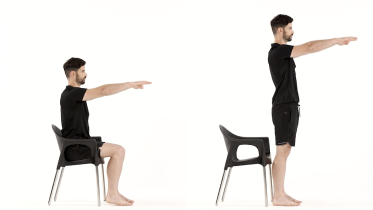 Sit to stand
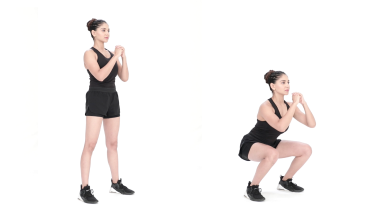 Squat
Squat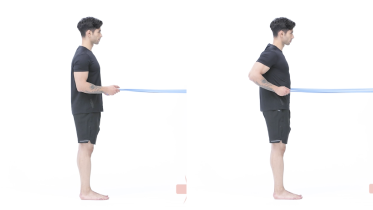 Resistance band row
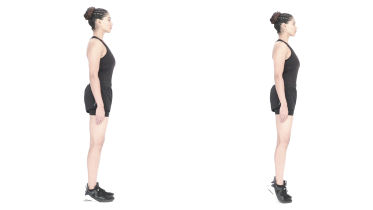 Calf raises
A word on safety before you start any of them. If you have high blood pressure, breathe steadily through every repetition and never hold your breath. With a heart condition or high blood pressure, check with your doctor before you start. If you have had a hip replacement, get the go-ahead from your surgeon or physio before you try sit to stand and the bodyweight squat, because standing up from a low seat and squatting deep both bend the hip past a right angle, and many surgeons ask you to avoid that for the first months after some operations. After a knee replacement, ask about the squat as well.
Stop any exercise for chest pain or pressure, dizziness or feeling faint, a racing or irregular heartbeat, or being far more out of breath than the effort should cause. If chest pain, pressure or tightness does not ease quickly when you rest, spreads to your arm, neck, jaw, stomach or back, or comes with sweating, feeling sick, feeling light-headed or being short of breath, call emergency services straight away, as this can be a heart attack. If it eases quickly and none of these happen, get medical advice the same day, and do not exercise again until you have been checked.
Check the band for nicks and tug the anchor before each row, and ask your physio first if you have had shoulder surgery or a dislocated shoulder. After an Achilles repair or ankle surgery, calf raises come in at the stage your surgeon's protocol sets.
When to see a physio (physical therapist)
Book an appointment if you are starting strength work for the first time and want the movements checked, if an old knee, back or shoulder problem flares when you load it, or if getting out of a chair and climbing stairs feel harder than they did before the weight started dropping. A physio can watch you squat, set the starting load and write the progression so you are not guessing.
Come sooner if strength is clearly going the wrong way, if you feel unsteady on your feet, or if any of the warning signs below apply. Anything about the medicine goes to the prescriber. A question about what to eat goes to a dietitian, and the page on protein and exercise basics explains why we send it there.
In this topic
- What happens to weight and muscle after stopping a GLP-1 medicine
What the withdrawal trials show about weight regain after stopping a GLP-1 medicine, what they did not measure, and why the strength habit matters.
- Strength exercises at home while losing weight on a GLP-1 medicine
A home strength program for keeping muscle while you lose weight on a GLP-1 medicine: six exercises, minimal kit, how to progress and low energy days.
- Strength training on a GLP-1 medicine when you are older
Why muscle, bone and balance matter more after 65 when weight is falling on a GLP-1 medicine, what helps, and when to get checked before you start.
- Protein and strength training on GLP-1 medicines: where the real advice comes from
Why protein matters alongside resistance training on a GLP-1 medicine, what the 2025 joint advisory says, and why we send you to a dietitian.
- A strength plan for 2 to 3 times a week
A simple full body strength plan for 2 to 3 sessions a week while you are losing weight, with sets, reps, progression and warning signs.
- Why muscle loss happens on GLP-1 medicines
What the trials show about lean mass and bone loss during fast weight loss on GLP-1 medicines, why it happens, and what reduces it.
Related exercise programs
See a doctor promptly if
- Emergency: if chest pain, pressure or tightness does not ease quickly when you rest, spreads to your arm, neck, jaw, stomach or back, or comes with sweating, feeling sick, feeling light-headed or being short of breath, call emergency services straight away, as this can be a heart attack. If it eases quickly and none of these happen, get medical advice the same day, and do not exercise again until you have been checked.
- Emergency: any sign of a stroke, even if it goes away. That means a face that droops on one side, an arm you cannot lift or keep up, slurred or muddled speech, weakness or numbness on one side of your body or face, sudden blurred vision, double vision or loss of sight, trouble swallowing, sudden dizziness with unsteadiness or falling over, a sudden severe headache, or a sudden fall where your legs give way but you do not black out (a drop attack). Call emergency services straight away.
- Emergency: sudden severe stomach pain together with pain spreading to your back, bloating that will not settle, a fast heartbeat, trouble breathing, or skin around your belly button, waist or upper outer thigh that looks blue or bruised (this can be harder to see on brown or black skin). Call emergency services or go to an emergency department, and do not drive yourself. If that sudden severe pain does not go away or keeps coming back, or comes with a high temperature or chills, without any of the signs above, get an urgent medical appointment or call your health service's urgent advice line the same day.
- Same day: dizziness or feeling faint during or after exercise, without any of the emergency signs above. Stop the exercises and get medical advice the same day. If you faint, it does not settle within a few minutes of sitting still, or you cannot stand or walk steadily, call emergency services.
- Same day: you blacked out or fainted, even for a moment. Get medical advice the same day. Call emergency services instead if the person cannot be woken within 1 minute, has not fully recovered or has trouble speaking or moving, has chest pain or a pounding, fluttering or irregular heartbeat, fainted while exercising or lying down, is shaking or jerking, or was badly hurt.
- Same day: shakiness, sweating, tingling lips, hunger, a pounding heartbeat, blurred vision, feeling weak or confusion during or after a session, if you take insulin or other diabetes medicines. These can be signs of low blood sugar, and the risk of it is higher when insulin or a sulfonylurea is taken alongside one of these medicines. Treat it the way your diabetes team has told you, then contact them or your prescriber the same day. If someone cannot be woken, cannot swallow safely or has a seizure, call emergency services.
- Same day: you cannot keep fluids down, you are being sick or have diarrhea that will not settle, you are peeing less than usual or your pee is dark yellow and strong smelling, you feel unusually tired, you feel dizzy when you stand up, or you are breathing quickly or your heart is racing. Contact your prescriber or get medical advice the same day, as these can be signs of dehydration. Call emergency services or go to an emergency department if your skin, lips or tongue look blue, gray, pale or blotchy (on brown or black skin this can be easier to see on the palms of the hands or soles of the feet), your skin feels cold, you are breathing fast or finding it hard to breathe, you are confused, or you are unusually sleepy or hard to wake.
- Same day: a calf or thigh that is newly swollen, warm, tender, red or darker than usual, has swollen veins that are sore to touch, or has a throbbing or cramping pain that does not fit your injury or condition, or that feels different from normal muscle soreness after exercise. This can be a sign of a blood clot (deep vein thrombosis), especially after surgery, an injury, time in a cast or boot, a long trip or a spell of being much less mobile than usual. Get medical advice the same day. If you are also short of breath or have chest pain, call emergency services.
- Same day: back pain after a minor fall or strain if you are older, have low bone density (osteoporosis) or have taken steroid tablets for a long time. Get medical advice the same day.
Common questions
Does Ozempic or Mounjaro make you lose muscle?
Some fat-free mass goes with any large weight loss, and these medicines are no exception. A narrative review in Diabetes Care put lean mass loss with incretin-based medicines at around 10 percent, or about 6 kg (13 lb), alongside total weight loss of 15 to 24 percent (Locatelli 2024). What that means for you is less settled: a JAMA viewpoint by Conte, Hall and Klein argued that the drop in fat-free mass is smaller in relative terms than the drop in fat, that physical function usually improves, and that the fear of frailty or sarcopenia from these medicines is not supported by the data. Training is still the sensible insurance. Anything about the medicine itself goes to your prescriber.
Do I have to lift weights while I am on a GLP-1 medicine?
Nobody has to, but the guidelines ask for muscle-strengthening work at moderate or greater intensity, covering all the major muscle groups, on 2 or more days a week for every adult (Bull 2020). Losing weight fast is a reason to take that part seriously rather than to skip it. It does not have to mean a gym: a chair, a step, a resistance band and your own body weight cover most of it. The weekly plan page in this topic sets out what a session looks like.
Should I stop the medicine to protect my muscle?
That is not a question this page will answer, and it is not one to settle alone. The NHS advice on both semaglutide and tirzepatide is to talk to your doctor if you want to stop and not to stop suddenly. Take the question to the prescriber or the service that supplies it, along with any worry about strength or weakness, and keep training while you wait for the appointment.
Is walking enough while I am losing weight?
Walking is worth doing and it is not a substitute. In the one-year trial by Jensen and colleagues, the group taking liraglutide without exercise lost more bone density at the hip and spine than the placebo or exercise groups, and it was the exercise that went with the better outcome. Walking loads the legs lightly and does very little for the upper body. Keep the walking, then add 2 or 3 strength sessions a week around it.
References
- NHS. Semaglutide: a medicine to manage type 2 diabetes or treat obesity. Page last reviewed 15 May 2026. https://www.nhs.uk/medicines/semaglutide/
- NHS. Tirzepatide: a medicine to manage type 2 diabetes and treat obesity. Page last reviewed 15 May 2026. https://www.nhs.uk/medicines/tirzepatide/
- MedlinePlus. Tirzepatide injection. AHFS Patient Medication Information. https://medlineplus.gov/druginfo/meds/a622044.html
- MedlinePlus. Liraglutide injection. AHFS Patient Medication Information. Last revised 15 December 2025. https://medlineplus.gov/druginfo/meds/a611003.html
- Locatelli JC, Costa JG, Haynes A, et al. Incretin-based weight loss pharmacotherapy: can resistance exercise optimize changes in body composition? Diabetes Care. 2024;47(10):1718-1730. doi:10.2337/dci23-0100
- Conte C, Hall KD, Klein S. Is weight loss-induced muscle mass loss clinically relevant? JAMA. 2024;332(1):9-10. doi:10.1001/jama.2024.6586
- Jensen SBK, Sorensen V, Sandsdal RM, et al. Bone health after exercise alone, GLP-1 receptor agonist treatment, or combination treatment: a secondary analysis of a randomized clinical trial. JAMA Network Open. 2024;7(6):e2416775. doi:10.1001/jamanetworkopen.2024.16775
- Bull FC, Al-Ansari SS, Biddle S, et al. World Health Organization 2020 guidelines on physical activity and sedentary behaviour. British Journal of Sports Medicine. 2020;54(24):1451-1462. doi:10.1136/bjsports-2020-102955
- World Health Organization. WHO guidelines on physical activity and sedentary behaviour. 2020. https://www.who.int/publications/i/item/9789240015128
- NHS. Acute pancreatitis. Page last reviewed 11 March 2026. https://www.nhs.uk/conditions/acute-pancreatitis/
- NHS. Low blood sugar (hypoglycaemia). Page last reviewed 3 August 2023. https://www.nhs.uk/conditions/low-blood-sugar-hypoglycaemia/
- NHS. Deep vein thrombosis (DVT). Page last reviewed 30 April 2026. https://www.nhs.uk/conditions/deep-vein-thrombosis-dvt/
- NHS. Symptoms of a stroke. https://www.nhs.uk/conditions/stroke/symptoms/
- NHS. Osteoporosis. https://www.nhs.uk/conditions/osteoporosis/
- NHS. Dehydration. Page last reviewed 1 May 2026. https://www.nhs.uk/conditions/dehydration/
- NHS. Fainting. Page last reviewed 17 August 2026. https://www.nhs.uk/symptoms/fainting/
Written and checked by the PocketPhysio editorial team. Last updated 2026-10-01.
This page is general education, not a diagnosis or a personal treatment plan. See a physiotherapist or doctor for advice about your own situation.