
Part of Strength training on GLP-1 medicines
Protein and strength training on GLP-1 medicines: where the real advice comes from
Where a physio stops and a dietitian starts
This is a physiotherapy site. We write exercise pages, and we do not write diet plans, calculate anyone's daily protein, or tell readers which products to buy. Those jobs belong to registered dietitians and to the doctor or nurse who prescribed your medicine.
So this page is narrower than most articles on the subject. It explains why food and training are linked, reports what the named guidelines say and marks where they stop being personal, then points you at the people who can do the rest.
Why protein and strength work belong together
Resistance training is the signal. Protein is the material. Neither does much for muscle without the other during a period of rapid weight loss, which is the situation these medicines create.
The training side has the stronger evidence. Pooling 6 randomized trials in older adults with obesity, adding resistance training to calorie restriction prevented 93.5 percent of the lean body mass loss that calorie restriction produced by itself (Sardeli 2018). The nutrition side has support of a different kind. A meta-analysis of 49 trials in healthy adults found that raising protein intake alongside resistance training added a modest extra gain in fat-free mass, about 0.30 kg (0.7 lb), and that the benefit flattened out at roughly 1.6 g per kg of body weight per day (Morton 2018).
Read the second finding carefully before you apply it. Those participants were healthy adults doing resistance training, not people losing a large share of their body weight on a prescription medicine, and the analysis was about total daily protein rather than about any particular drink or powder. How much of the weight lost on these drugs is muscle is a separate question, and it is still argued over in the literature (Conte 2024; Batsis 2026). The page on why muscle loss happens works through that evidence.
What the published guidance says, and what it does not
Three sets of numbers circulate in this area, and it helps to see where each one comes from.
The 2025 joint advisory from the American College of Lifestyle Medicine, the American Society for Nutrition, the Obesity Medicine Association and the Obesity Society reports that higher protein targets, such as 1.2 to 1.6 g per kg of body weight per day, have been proposed during active weight reduction (Mozaffarian 2025). A 2025 narrative review on nutrition and activity in the incretin era reports American College of Sports Medicine guidance of about 1.25 to 1.5 times the recommended dietary allowance, with at least 25 to 30 g of protein per meal (Barana 2025). The meta-analysis above puts the point of diminishing returns near 1.6 g per kg per day in healthy adults doing resistance training (Morton 2018).
The advisory adds a caveat that matters if you were about to reach for a calculator: in people with obesity it is unclear whether such targets should be worked out from actual body weight, from an adjusted or ideal weight, or from fat-free mass, and using actual weight can overestimate the requirement badly (Mozaffarian 2025).
Every one of those numbers is general guidance written for clinicians planning care across a population. None of them is a target for you, and none was produced by a trial that recruited people taking semaglutide or tirzepatide and measured what different protein intakes did to their muscle. The trial designed to test exactly that, LEAN-PREP, published its protocol in 2026 and has not reported results (Alawadhi 2026).
The same advisory sets out the rest of the picture in the same general terms: a structured exercise program with strength training at least 3 times weekly plus at least 150 minutes of moderate aerobic exercise, adequate fluids and fiber from foods, and attention to nutrients that may fall short, with supplementation considered where a clinician judges it necessary (Mozaffarian 2025). Across this topic the strength target is 2 to 3 days a week, 2 being the public health floor and 3 the advisory's aim. We are reporting that, not prescribing it.
Why none of these numbers is yours
A protein figure that suits one person can be wrong for the next. A dietitian setting one will want to know about your kidney and liver results, your diabetes if you have it, whether you are pregnant, any history of an eating disorder and every other medicine you take. None of that is in a web page. What you can swallow and keep down in a given week matters too, and on these drugs that shifts about.
This is why the advisory describes medical nutrition therapy as an individualized assessment with the counseling that follows it, rather than a leaflet (Mozaffarian 2025). It also quotes the Canadian guideline behind the referral: individualized nutrition therapy from a registered dietitian is recommended to improve body weight, waist measurement, blood sugar control, cholesterol and blood pressure. Direct evidence on pairing it with these medicines in particular is still thin, which the advisory says plainly.
Where to get advice that fits you
Ask the prescriber for a referral first, since many weight management services include a dietitian already. If you are arranging it yourself, these are the public directories run by the profession itself:
- United States: the Academy of Nutrition and Dietetics runs Find a Nutrition Expert, searchable by location, specialty, language and payment options.
- United Kingdom: the British Dietetic Association keeps a Find a dietitian directory of freelance and private practitioners, and a GP can also refer you on the NHS.
- Australia: Dietitians Australia lists Accredited Practising Dietitians, including those offering telehealth.
- Canada and New Zealand: go through your doctor or your national dietetic association, and check the practitioner is on the regulator's register.
Look for someone who works in obesity or weight management, and say at the first contact that you are taking one of these medicines, so they can plan the assessment around it.
There is one referral that should not wait for a routine appointment. The joint advisory states that anyone who screens positive for an eating disorder, or has a history of one, should be referred to an obesity medicine specialist and an eating disorder specialist (Mozaffarian 2025). If any of that applies, say so to your prescriber.
The training side, for reference
Protein supports resistance training rather than replacing it, so here is what the training part looks like. Common starting points are 2 to 3 sets of 8 to 12 for the goblet squat with a light weight or none at all, 2 to 3 sets of 8 to 15 for the bent-over band row, and 2 to 3 sets of 8 to 15 for knee push-ups, each a few days a week. Read each page for its own dose, precautions and stop signs, and let your physio set the numbers.
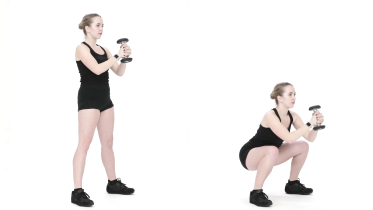 Goblet squat
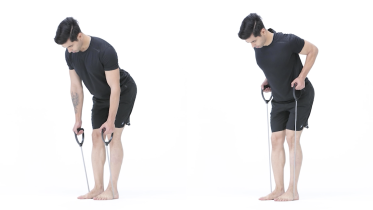 Bent-over band row
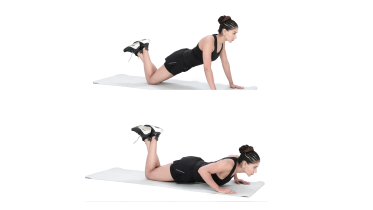 Knee push-ups
A few precautions go with these three. If you have had a hip or knee replacement, get the go-ahead from your surgeon or physio before you try goblet squats. A deep squat bends the hip well past a right angle, and many surgeons ask you to avoid that for the first months after some operations.
For the bent-over band row, check the band for nicks or thin spots and make sure both feet pin it down firmly, because a band that slips out from under a foot can flick up toward your face. If you have low bone density (osteoporosis), or your back is sore at the moment, ask your physio first, since leaning forward while you pull puts extra load through the spine. After shoulder surgery, check with your surgeon or physio before you add banded rows.
Kneeling on a hard floor presses on the kneecaps, so put a folded towel or a cushion under your knees for the push-ups. If your blood pressure is high or you have a heart problem, breathe out on each push and never hold your breath. Get your doctor's advice first if your blood pressure is not well controlled.
Stop any of them for chest pain or pressure, dizziness or feeling faint, a racing or irregular heartbeat, or being far more out of breath than the effort should cause. If chest pain, pressure or tightness does not ease quickly when you rest, spreads to your arm, neck, jaw, stomach or back, or comes with sweating, feeling sick, feeling light-headed or being short of breath, call emergency services straight away, as this can be a heart attack. If it eases quickly and none of these happen, get medical advice the same day, and do not exercise again until you have been checked.
The home program with a fuller set of exercises, the kit you need and how to progress is on the exercises at home page.
The questions we send elsewhere
Anything about the medicine goes to the prescriber or the pharmacist. That covers the dose, when to take it, whether to start, stop, pause or change it, how it compares with another one, and what to do about side effects. Never stop or change a prescribed medicine on your own, and never adjust it because of something you read on a website, including this one.
Anything that amounts to a personal nutrition plan goes to a registered dietitian. That covers your daily protein figure, meal patterns, whether you need a supplement and which one, and how to manage eating when your appetite has changed. We give no meal plans, no supplement recommendations and no personal targets, and any page that hands you those without knowing a single thing about you is guessing.
When to see a physio (physical therapist)
Come to a physio for the part we can actually measure. A first appointment can record your grip strength, time how long it takes you to rise from a chair 5 times and check your balance, so the same tests a few months later show whether your strength is holding while your weight comes down. That is a better guide than the number on the scale, which cannot tell fat from muscle.
Book sooner if a joint hurts during the exercises, if you have had surgery or have a heart, lung or balance problem that changes what is suitable, or if everyday tasks have started to feel heavier than they did. Bring the dietitian into the same conversation where you can. The two halves of this work better planned together than separately, and your prescriber is the person who ties them to the medicine.
Related exercise programs
See a doctor promptly if
- Emergency: if chest pain, pressure or tightness does not ease quickly when you rest, spreads to your arm, neck, jaw, stomach or back, or comes with sweating, feeling sick, feeling light-headed or being short of breath, call emergency services straight away, as this can be a heart attack. If it eases quickly and none of these happen, get medical advice the same day, and do not exercise again until you have been checked.
- Emergency: any sign of a stroke, even if it goes away. That means a face that droops on one side, an arm you cannot lift or keep up, slurred or muddled speech, weakness or numbness on one side of your body or face, sudden blurred vision, double vision or loss of sight, trouble swallowing, sudden dizziness with unsteadiness or falling over, a sudden severe headache, or a sudden fall where your legs give way but you do not black out (a drop attack). Call emergency services straight away.
- Emergency: sudden severe stomach pain together with pain spreading to your back, bloating that will not settle, a fast heartbeat, trouble breathing, or skin around your belly button, waist or upper outer thigh that looks blue or bruised (this can be harder to see on brown or black skin). Call emergency services or go to an emergency department, and do not drive yourself. If that sudden severe pain does not go away or keeps coming back, or comes with a high temperature or chills, without any of the signs above, get an urgent medical appointment or call your health service's urgent advice line the same day.
- Same day: dizziness or feeling faint during or after exercise, without any of the emergency signs above. Stop the exercises and get medical advice the same day. If you faint, it does not settle within a few minutes of sitting still, or you cannot stand or walk steadily, call emergency services.
- Same day: you blacked out or fainted, even for a moment. Get medical advice the same day. Call emergency services instead if the person cannot be woken within 1 minute, has not fully recovered or has trouble speaking or moving, has chest pain or a pounding, fluttering or irregular heartbeat, fainted while exercising or lying down, is shaking or jerking, or was badly hurt.
- Same day: shakiness, sweating, tingling lips, hunger, a pounding heartbeat, blurred vision, feeling weak or confusion during or after a session, if you take insulin or other diabetes medicines. These can be signs of low blood sugar, and the risk of it is higher when insulin or a sulfonylurea is taken alongside one of these medicines. Treat it the way your diabetes team has told you, then contact them or your prescriber the same day. If someone cannot be woken, cannot swallow safely or has a seizure, call emergency services.
- Same day: you cannot keep fluids down, you are being sick or have diarrhea that will not settle, you are peeing less than usual or your pee is dark yellow and strong smelling, you feel unusually tired, you feel dizzy when you stand up, or you are breathing quickly or your heart is racing. Contact your prescriber or get medical advice the same day, as these can be signs of dehydration. Call emergency services or go to an emergency department if your skin, lips or tongue look blue, gray, pale or blotchy (on brown or black skin this can be easier to see on the palms of the hands or soles of the feet), your skin feels cold, you are breathing fast or finding it hard to breathe, you are confused, or you are unusually sleepy or hard to wake.
- Same day: a calf or thigh that is newly swollen, warm, tender, red or darker than usual, has swollen veins that are sore to touch, or has a throbbing or cramping pain that does not fit your injury or condition, or that feels different from normal muscle soreness after exercise. This can be a sign of a blood clot (deep vein thrombosis), especially after surgery, an injury, time in a cast or boot, a long trip or a spell of being much less mobile than usual. Get medical advice the same day. If you are also short of breath or have chest pain, call emergency services.
- Within a few days: you are eating almost nothing, food has started to frighten or distress you, you are making yourself sick, or you are using laxatives or extra medicine to control your weight. Tell your prescriber within a few days and ask to be referred to an eating disorder specialist. Get medical advice the same day if you also feel faint, weak or unwell.
- Within a few days: you have been eating very little for weeks or months, or a blood test has flagged a low vitamin or mineral level. Speak to your prescriber within a few days and ask for a referral to a registered dietitian, who can check the nutrients most likely to fall short during rapid weight loss.
Common questions
How much protein should I eat while taking a GLP-1 medicine?
There is no number this page can give you, because the right one is set after an assessment rather than read off a website. What we can report is what the published guidance says. The 2025 joint advisory from four US professional bodies notes proposed intakes of 1.2 to 1.6 g per kg of body weight per day during active weight reduction (Mozaffarian 2025), and a 2025 narrative review cites separate guidance of roughly 1.25 to 1.5 times the recommended dietary allowance, with at least 25 to 30 g of protein per meal (Barana 2025). Both are general clinical guidance, not a personal target, and neither accounts for your kidney function, your other conditions or what you are actually able to eat. Take those figures to a registered dietitian or your own clinician and let them do the arithmetic for you.
Do I need a protein shake or a supplement?
We do not recommend supplements, and nothing on this page should be read as doing so. For context, a meta-analysis of 49 trials in healthy adults found that protein supplementation added a small amount on top of resistance training alone, about 0.30 kg (0.7 lb) of fat-free mass, above a point where extra protein added nothing further (Morton 2018). Those participants were not taking a weight loss medicine, and the finding is about total daily protein rather than about any particular product. Whether you need anything beyond food, and what, is a decision for a registered dietitian who has looked at what you are eating.
Will eating more protein on its own stop muscle loss?
No trial has answered that in people taking these medicines. The intervention with the clearest evidence during weight loss is resistance training: pooling 6 trials in older adults with obesity, adding it to calorie restriction prevented 93.5 percent of the lean mass loss that calorie restriction caused on its own (Sardeli 2018). The LEAN-PREP trial is testing resistance exercise and protein, separately and together, during semaglutide or tirzepatide treatment, and published only its protocol in 2026 (Alawadhi 2026). Until it reports, treat protein as the support act and the training as the main one.
Can a physio tell me what to eat?
Not in any personal sense, no. Physiotherapists are trained to assess and load the musculoskeletal system, and setting an individual nutrition plan sits with dietitians and doctors. The joint advisory describes medical nutrition therapy as an individualized assessment with counseling that follows it (Mozaffarian 2025), and that is a different piece of work from prescribing exercises. What a physio can do is measure your strength and function, then repeat the measurements to see whether the plan is holding.
What if I can barely eat anything at all?
That is a conversation for your prescriber, and it is worth having early rather than waiting for the next review. Across placebo-controlled trials these medicines cut energy intake by 16 to 39 percent (Mozaffarian 2025), and a very low intake sustained for months is the setting in which nutrient gaps appear. The advisory tells clinicians to watch for at-risk nutrients and to consider supplementation where it is needed, which is exactly the kind of judgment that needs a dietitian rather than a search result. The warning signs on this page cover the points at which to stop waiting.
Should I eat before or after a strength session?
We are not going to answer that one for you. Meal timing on these medicines runs into appetite, stomach symptoms and the medicine itself, and all three sit with your prescriber and a registered dietitian rather than with a physiotherapy page. What we can say is that nothing about when you eat changes the technique of the exercises, or the order of the movements. Set the training first, then take the timing question to the people who can answer it for you.
References
- Mozaffarian D, Agarwal M, Aggarwal M, et al. Nutritional priorities to support GLP-1 therapy for obesity: a joint advisory from the American College of Lifestyle Medicine, the American Society for Nutrition, the Obesity Medicine Association, and the Obesity Society. Obesity Pillars. 2025;15:100181. doi:10.1016/j.obpill.2025.100181
- Morton RW, Murphy KT, McKellar SR, et al. A systematic review, meta-analysis and meta-regression of the effect of protein supplementation on resistance training-induced gains in muscle mass and strength in healthy adults. British Journal of Sports Medicine. 2018;52(6):376-384. doi:10.1136/bjsports-2017-097608
- Sardeli AV, Komatsu TR, Mori MA, Gaspari AF, Chacon-Mikahil MPT. Resistance training prevents muscle loss induced by caloric restriction in obese elderly individuals: a systematic review and meta-analysis. Nutrients. 2018;10(4):423. doi:10.3390/nu10040423
- Barana L, De Fano M, Cavallo M, et al. Nutrition and physical activity in optimizing weight loss and lean mass preservation in the incretin-based medications era: a narrative review. Nutrients. 2025;18(1):131. doi:10.3390/nu18010131
- Alawadhi AA, Alroudhan D, Alsaeed DJ, et al. LEAN mass Preservation with Resistance Exercise and Protein during semaglutide and tirzepatide therapy (LEAN-PREP study): a protocol for a randomised controlled trial. BMJ Open. 2026;16(4):e116911. doi:10.1136/bmjopen-2026-116911
- Batsis JA, Gavras A, Gross DC, et al. Effect of incretin-based and nonpharmacologic weight loss on body composition: a systematic review. Annals of Internal Medicine. 2026;179(7):996-1013. doi:10.7326/annals-25-00478
- Conte C, Hall KD, Klein S. Is weight loss-induced muscle mass loss clinically relevant? JAMA. 2024;332(1):9-10. doi:10.1001/jama.2024.6586
- Academy of Nutrition and Dietetics. Find a Nutrition Expert. https://www.eatright.org/find-a-nutrition-expert
- British Dietetic Association. Find a dietitian. https://www.bda.uk.com/find-a-dietitian.html
- Dietitians Australia. Find a dietitian. https://dietitiansaustralia.org.au/find-dietitian
- NHS. Low blood sugar (hypoglycaemia). Page last reviewed 3 August 2023. https://www.nhs.uk/conditions/low-blood-sugar-hypoglycaemia/
- NHS. Dehydration. Page last reviewed 1 May 2026. https://www.nhs.uk/conditions/dehydration/
- NHS. Symptoms of a stroke. https://www.nhs.uk/conditions/stroke/symptoms/
- NHS. Acute pancreatitis. Page last reviewed 11 March 2026. https://www.nhs.uk/conditions/acute-pancreatitis/
- NHS. Deep vein thrombosis (DVT). Page last reviewed 30 April 2026. https://www.nhs.uk/conditions/deep-vein-thrombosis-dvt/
- NHS. Fainting. Page last reviewed 17 August 2026. https://www.nhs.uk/symptoms/fainting/
Written and checked by the PocketPhysio editorial team. Last updated 2026-10-01.
This page is general education, not a diagnosis or a personal treatment plan. See a physiotherapist or doctor for advice about your own situation.