
Part of Strength training on GLP-1 medicines
Why muscle loss happens on GLP-1 medicines
What the trials actually measured
Almost everything written about this rests on body scans, and a scan reports fat-free mass or lean soft tissue. That is a wider category than muscle: it takes in organs, body water and bone as well as the muscle fibers people are worried about. No scan tells you how much force those fibers can produce.
Keep that in mind and the headline numbers become easier to read. A narrative review in Diabetes Care described lean mass falling by around 10 percent, roughly 6 kg (13 lb), while incretin-based medicines produced 15 to 24 percent weight loss, a shift the authors likened to a decade or more of aging (Locatelli 2024). The SEMALEAN cohort followed 106 adults through 12 months on semaglutide and found lean mass down about 3 kg (6.6 lb) by month 7, then flat to month 12, while fat mass carried on falling to 18 percent below baseline.
Then the same cohort measured something else. Average grip strength went up by 4.5 kg (10 lb), and the proportion meeting the criteria for sarcopenic obesity fell from 49 percent at the start to 33 percent at a year. SEMALEAN is an observational cohort with no control group, so it cannot prove the medicine caused any of that. It does show that a falling number on a scan and a falling amount of strength are not the same event.
Why does the body lose muscle when energy is short?
Nothing here is peculiar to a GLP-1 medicine. Put any body in a large energy deficit and it draws on more than fat, which is why the effect turns up in ordinary dieting trials that involve no medicine at all. Sardeli and colleagues pooled six randomized trials of older adults with obesity on calorie restriction and found lean body mass falling in the diet-only groups.
A few things sharpen it during medical weight loss. The deficit is usually bigger and arrives faster than it would through diet alone, so there is less time to adapt. Appetite falls too, which usually means eating less protein as well as less of everything else, a matter for a dietitian rather than for this page.
The last one is the piece you control. Muscle keeps what it is regularly asked to do and lets go of what it is not, and most people losing weight fast do not add any new load to their week. Nothing in the daily routine tells the body that the tissue is still needed.
Bone comes down with it
Bone rarely gets mentioned in the same conversation, and it should. Jensen and colleagues ran the clearest test: 195 adults lost weight on an 8-week low-calorie diet, then spent a year randomized to placebo, a supervised exercise program, liraglutide, or liraglutide with the exercise.
Every group lost some hip density over the year, which is the usual price of a large weight loss. At the spine the fall landed on the liraglutide and combination groups, while placebo and exercise barely moved. At both sites the loss was bigger on liraglutide alone than on placebo or on exercise alone, and the two groups that trained ended up no different from placebo. Forearm density did not follow that pattern and did not differ between the four groups, so this was not a whole-skeleton story. The trial tested liraglutide with a program built mostly from indoor cycling and circuit work, and a year is a short window for bone, so treat it as a strong signal rather than a final answer for the newer medicines.
What reduces the loss
Load is the lever with the best evidence behind it. In the Sardeli meta-analysis, adding resistance training three times a week for 12 to 24 weeks prevented 93.5 percent of the lean body mass loss the diet caused, about 0.82 kg (1.8 lb), and the fat and total weight still came down as much as they did without it. Training did not slow the weight loss; it changed what the weight was made of.
Villareal and colleagues took 160 older adults with obesity through 6 months of a weight-management program plus aerobic exercise, resistance exercise or both, against a control group that had none of it. Physical function improved most in the combination group, while lean mass and hip bone density were held better by the resistance and combination programs than by aerobic exercise alone. That is the argument for doing both rather than picking a side.
The closest thing to a direct test sits in the trial above. Over its year, the exercise group gained lean mass, and the group that combined exercise with liraglutide held its lean mass while losing the most fat of anyone (Jensen 2024). The parent trial had already shown that pairing the medicine with exercise cut body fat percentage about twice as much as either treatment on its own, and kept off more weight than exercise alone (Lundgren 2021).
What none of this tells you is how much resistance training changes lean mass in someone taking semaglutide or tirzepatide. Locatelli and colleagues put the case for it and call for it to be added to treatment, which means the trial you would want to read has not reported. Training on the general guidelines is a reasonable bet in the meantime, and the strength plan for 2 to 3 times a week shows what that looks like.
Exercises that can help
These three load the movements that lose the most when you are shedding weight fast: a squat, a single leg pattern and an upper back pull. The goblet squat often starts with a light weight or none at all and 2 to 3 sets of 8 to 12, a few days a week, the split squat at 2 to 3 sets of 8 to 12 on each leg a few times a week, and the band pull-apart at 2 to 3 sets of 10 to 15 with a light band. Read each page for its own precautions and stop signs before you start. Your physio will adjust this.
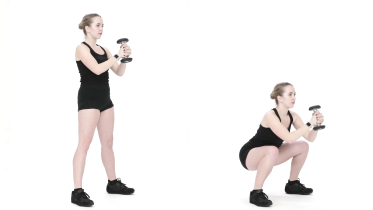 Goblet squat
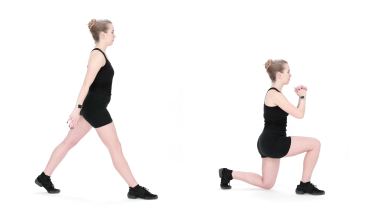 Split squat
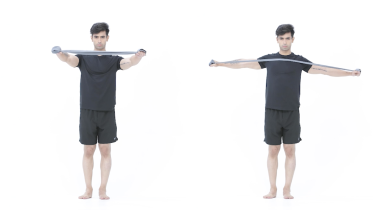 Band pull-apart
Take the first two or three weeks at a load that feels easy, even if you could do more, and let the technique settle before the weight goes up. If you have high blood pressure, breathe steadily through every repetition and never hold your breath.
If you have had a hip or knee replacement, get the go-ahead from your surgeon or physio before you try goblet squats. A deep squat bends the hip well past a right angle, and many surgeons ask you to avoid that for the first months after some operations. Sharp pain in a knee, hip or groin, or a knee that gives way, means stop that exercise for the day rather than work through it, and shorten the range on the split squat before you drop it altogether.
Run the band through your fingers and feel for nicks or tears before every pull-apart session. If you have had shoulder surgery, or the shoulder has dislocated or feels loose, ask your physio before you try it.
When to see a physio (physical therapist)
Get an appointment if you want the starting load set properly rather than guessed, if an old back, hip or shoulder problem starts complaining once you add weight, or if you want the everyday jobs measured so you can see whether they are holding up. Bring your training notes; they make the conversation much shorter. The 30-second chair stand test is one measure you can run yourself between appointments.
Go sooner if strength is visibly falling, if you have been told you have low bone density or have broken a bone easily in the past, or if any warning sign below applies. Surgery of any kind means your surgeon's plan comes first, and the medicine stays with the prescriber.
Related exercise programs
See a doctor promptly if
- Emergency: if chest pain, pressure or tightness does not ease quickly when you rest, spreads to your arm, neck, jaw, stomach or back, or comes with sweating, feeling sick, feeling light-headed or being short of breath, call emergency services straight away, as this can be a heart attack. If it eases quickly and none of these happen, get medical advice the same day, and do not exercise again until you have been checked.
- Emergency: any sign of a stroke, even if it goes away. That means a face that droops on one side, an arm you cannot lift or keep up, slurred or muddled speech, weakness or numbness on one side of your body or face, sudden blurred vision, double vision or loss of sight, trouble swallowing, sudden dizziness with unsteadiness or falling over, a sudden severe headache, or a sudden fall where your legs give way but you do not black out (a drop attack). Call emergency services straight away.
- Emergency: sudden severe stomach pain together with pain spreading to your back, bloating that will not settle, a fast heartbeat, trouble breathing, or skin around your belly button, waist or upper outer thigh that looks blue or bruised (this can be harder to see on brown or black skin). Call emergency services or go to an emergency department, and do not drive yourself. If that sudden severe pain does not go away or keeps coming back, or comes with a high temperature or chills, without any of the signs above, get an urgent medical appointment or call your health service's urgent advice line the same day.
- Same day: dizziness or feeling faint during or after exercise, without any of the emergency signs above. Stop the exercises and get medical advice the same day. If you faint, it does not settle within a few minutes of sitting still, or you cannot stand or walk steadily, call emergency services.
- Same day: you blacked out or fainted, even for a moment. Get medical advice the same day. Call emergency services instead if the person cannot be woken within 1 minute, has not fully recovered or has trouble speaking or moving, has chest pain or a pounding, fluttering or irregular heartbeat, fainted while exercising or lying down, is shaking or jerking, or was badly hurt.
- Same day: shakiness, sweating, tingling lips, hunger, a pounding heartbeat, blurred vision, feeling weak or confusion during or after a session, if you take insulin or other diabetes medicines. These can be signs of low blood sugar, and the risk of it is higher when insulin or a sulfonylurea is taken alongside one of these medicines. Treat it the way your diabetes team has told you, then contact them or your prescriber the same day. If someone cannot be woken, cannot swallow safely or has a seizure, call emergency services.
- Same day: you cannot keep fluids down, you are being sick or have diarrhea that will not settle, you are peeing less than usual or your pee is dark yellow and strong smelling, you feel unusually tired, you feel dizzy when you stand up, or you are breathing quickly or your heart is racing. Contact your prescriber or get medical advice the same day, as these can be signs of dehydration. Call emergency services or go to an emergency department if your skin, lips or tongue look blue, gray, pale or blotchy (on brown or black skin this can be easier to see on the palms of the hands or soles of the feet), your skin feels cold, you are breathing fast or finding it hard to breathe, you are confused, or you are unusually sleepy or hard to wake.
- Same day: a calf or thigh that is newly swollen, warm, tender, red or darker than usual, has swollen veins that are sore to touch, or has a throbbing or cramping pain that does not fit your injury or condition, or that feels different from normal muscle soreness after exercise. This can be a sign of a blood clot (deep vein thrombosis), especially after surgery, an injury, time in a cast or boot, a long trip or a spell of being much less mobile than usual. Get medical advice the same day. If you are also short of breath or have chest pain, call emergency services.
- Same day: back pain after a minor fall or strain if you are older, have low bone density (osteoporosis) or have taken steroid tablets for a long time. Get medical advice the same day.
- Within a few days: strength that is clearly going backwards, for example you need your hands to get out of a chair when you did not before, your grip gives out on jars and door handles, or you are stumbling on stairs. See a doctor or physio within a few days so someone can measure it rather than guess. Tell your prescriber as well, and do not change a medicine on your own.
Common questions
How much of the weight lost on semaglutide is muscle?
The figure people quote is usually lean mass, not muscle, and the two are not interchangeable. Locatelli and colleagues summarized lean mass loss with incretin-based medicines at about 10 percent, or roughly 6 kg (13 lb), against total weight loss of 15 to 24 percent. In the SEMALEAN cohort of 106 adults taking semaglutide for obesity, lean mass dropped by about 3 kg (6.6 lb) over the first 7 months and then held steady to 12 months while fat mass kept falling. Different populations and different scanners give different answers, which is part of why the debate is still live.
Is lean mass on a body scan the same as muscle?
No. Fat-free mass is everything in the body that is not fat, so it covers organs, body water and bone as well as skeletal muscle, and a scan cannot tell you how strong that muscle is. SEMALEAN makes the point neatly: lean mass fell, and over the same 12 months average grip strength rose by 4.5 kg (10 lb) and the share of the group meeting the criteria for sarcopenic obesity dropped from 49 percent to 33 percent. Mass and strength moved in opposite directions. That is why Conte, Hall and Klein argued in JAMA that the frailty worry attached to these medicines is not supported by the data.
Do GLP-1 medicines weaken your bones?
The one randomized trial that measured it found hip density falling in all four groups, and hip and spine density falling most on liraglutide alone, which ended below both placebo and exercise alone (Jensen 2024). The groups that trained ended level with placebo, and forearm density did not separate the groups at all. That trial used liraglutide, so it does not automatically describe semaglutide or tirzepatide, and bone was measured over a single year. Anyone already told they have low bone density should raise this with both the prescriber and a physio before the weight starts coming off fast.
Is muscle loss on these medicines worse than with ordinary dieting?
There is no clean head to head answer in the studies here, because the medicine trials and the diet trials were not run side by side. What the diet research does show is that calorie restriction alone costs lean mass in the same way: in six trials pooled by Sardeli and colleagues, older adults with obesity lost lean body mass on a reduced-calorie diet, and adding resistance training three times a week prevented 93.5 percent of it, about 0.82 kg (1.8 lb). Faster weight loss gives you less time to protect the muscle, which is the practical difference.
How would I know if I am losing muscle?
Not from the bathroom scale, and not reliably from a home body composition monitor. Watch the jobs instead: whether you still stand up from a low chair without your hands, whether stairs feel the same, whether your grip holds on a full kettle or a jar. A physio can measure grip strength and time you standing from a chair, and the 30-second chair stand test on this site gives you a number you can repeat every few months. Keeping a note of the weights and repetitions you manage each week is the simplest tracker there is.
References
- Locatelli JC, Costa JG, Haynes A, et al. Incretin-based weight loss pharmacotherapy: can resistance exercise optimize changes in body composition? Diabetes Care. 2024;47(10):1718-1730. doi:10.2337/dci23-0100
- Conte C, Hall KD, Klein S. Is weight loss-induced muscle mass loss clinically relevant? JAMA. 2024;332(1):9-10. doi:10.1001/jama.2024.6586
- Alissou M, Demangeat T, Folope V, et al. Impact of semaglutide on fat mass, lean mass and muscle function in patients with obesity: the SEMALEAN study. Diabetes, Obesity and Metabolism. 2026;28(1):112-121. doi:10.1111/dom.70141
- Jensen SBK, Sorensen V, Sandsdal RM, et al. Bone health after exercise alone, GLP-1 receptor agonist treatment, or combination treatment: a secondary analysis of a randomized clinical trial. JAMA Network Open. 2024;7(6):e2416775. doi:10.1001/jamanetworkopen.2024.16775
- Lundgren JR, Janus C, Jensen SBK, et al. Healthy weight loss maintenance with exercise, liraglutide, or both combined. New England Journal of Medicine. 2021;384:1719-1730. doi:10.1056/NEJMoa2028198
- Sardeli AV, Komatsu TR, Mori MA, Gaspari AF, Chacon-Mikahil MPT. Resistance training prevents muscle loss induced by caloric restriction in obese elderly individuals: a systematic review and meta-analysis. Nutrients. 2018;10(4):423. doi:10.3390/nu10040423
- Villareal DT, Aguirre L, Gurney AB, et al. Aerobic or resistance exercise, or both, in dieting obese older adults. New England Journal of Medicine. 2017;376(20):1943-1955. doi:10.1056/NEJMoa1616338
- Bull FC, Al-Ansari SS, Biddle S, et al. World Health Organization 2020 guidelines on physical activity and sedentary behaviour. British Journal of Sports Medicine. 2020;54(24):1451-1462. doi:10.1136/bjsports-2020-102955
- NHS. Semaglutide: a medicine to manage type 2 diabetes or treat obesity. Page last reviewed 15 May 2026. https://www.nhs.uk/medicines/semaglutide/
- NHS. Deep vein thrombosis (DVT). Page last reviewed 30 April 2026. https://www.nhs.uk/conditions/deep-vein-thrombosis-dvt/
- NHS. Symptoms of a stroke. https://www.nhs.uk/conditions/stroke/symptoms/
- NHS. Osteoporosis. https://www.nhs.uk/conditions/osteoporosis/
- NHS. Acute pancreatitis. Page last reviewed 11 March 2026. https://www.nhs.uk/conditions/acute-pancreatitis/
- NHS. Low blood sugar (hypoglycaemia). Page last reviewed 3 August 2023. https://www.nhs.uk/conditions/low-blood-sugar-hypoglycaemia/
- NHS. Dehydration. Page last reviewed 1 May 2026. https://www.nhs.uk/conditions/dehydration/
- NHS. Fainting. Page last reviewed 17 August 2026. https://www.nhs.uk/symptoms/fainting/
Written and checked by the PocketPhysio editorial team. Last updated 2026-10-01.
This page is general education, not a diagnosis or a personal treatment plan. See a physiotherapist or doctor for advice about your own situation.