
Part of Strength training on GLP-1 medicines
A strength plan for 2 to 3 times a week
Where the number 2 to 3 comes from
It is not a figure invented for people on weight loss medicines. The World Health Organization guidelines ask every adult for muscle-strengthening activity at moderate or greater intensity, working all the major muscle groups, on 2 or more days a week, and for adults aged 65 and over they add varied activity emphasizing balance and strength on 3 or more days (Bull 2020). The American College of Sports Medicine position stand puts each major muscle group at 2 to 3 days a week (Garber 2011), and the 2025 joint advisory on nutrition for GLP-1 therapy aims higher, at strength training at least 3 times weekly alongside at least 150 minutes of moderate aerobic exercise (Mozaffarian 2025). Across this topic the target is the same: 2 days is the floor, 3 is the aim.
The weight loss research lands in the same place by a different route. The six calorie restriction trials pooled by Sardeli and colleagues trained three times a week, and Villareal and colleagues used three sessions a week across six months in older adults who were dieting. Nobody has shown that people taking semaglutide or tirzepatide need something different, so the ordinary target stands until they do.
Two sessions protects the habit on a hard week, and three moves you forward faster. Either beats the fourth session you plan and never do.
The session, movement by movement
One session covers the whole body, and it is built from six patterns rather than six body parts. Squat, hip lift, push, pull, calf, step. Run them in that order and the big leg work happens while you are fresh.
A full session takes about 30 to 40 minutes once you know the movements, and much less in the first two weeks when the sets are short. Rest between sets until your breathing settles, usually 60 to 90 seconds, and longer if you need it. Repeat the same session 2 or 3 times a week rather than splitting the body across different days, which suits people who are training to keep tissue rather than to compete.
Leave at least one day between sessions. Monday and Thursday works, or Monday, Wednesday and Friday for three.
How hard each set should feel
Aim to end every set with about 2 repetitions left in you, at the point where a third one would start to look untidy. That is enough to give the muscle a reason to stay without turning each session into a test. Physios set intensity this way instead of testing a one-repetition maximum, which our guide to the FITT principle covers in more detail.
Soreness a day or two after a new exercise is normal and settles. Sharp pain during a movement is the signal to stop that exercise for the day. A joint that is more painful or swollen the morning after means the load was too big for now, so cut it and rebuild rather than abandoning the exercise.
Write down what you did. Two numbers per exercise, the load and the repetitions, take 10 seconds and turn the next month into a decision rather than a guess.
Making it harder, week by week
Change one thing at a time and keep it small. Work up the repetition range first, then add a set, then move to a harder version of the movement, and leave added weight until last. That order suits a home program because the weights people own jump in coarse steps, as our guide to exercise progression explains.
Each exercise page carries its own ladder. The chair squat gets harder as you take cushions off the seat, the incline push-up as you move from a counter to a chair to a lower bench, the step up as the step rises, the band row and the band pull-apart as you move to a firmer band or hold it further along. Calf raises move from both legs to one, and the glute bridge to a single leg version, when your physio says you are ready.
A sensible rhythm is to hold a level for two sessions that feel comfortable, then move up. If a step up costs you your form, drop back a rung and stay there a couple of weeks. Setting the whole thing up at home, with the kit and the easier starting points, is covered on the exercises at home page.
Where walking and the rest of the week fit
Strength work does not replace the aerobic side, and the guidelines want both. Keep the walking, the cycling or whatever you already enjoy, on the days between sessions. In the trial by Jensen and colleagues the program that went with the better bone result was built mostly from indoor cycling with circuit training added, so this is not a case of one type winning.
Balance deserves a slot too if you are over 65 or have felt unsteady, which is the 3 days a week the WHO guidelines ask of that age group. The balance and falls prevention program has those exercises with video.
Exercises that can help
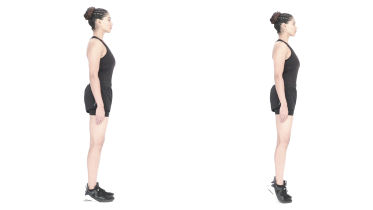
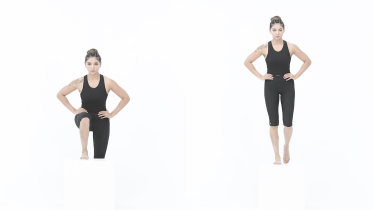
This is the session, in order. Chair squats often start at 2 to 3 sets of 8 to 12, the glute bridge at 2 to 3 sets of 10 to 12 with a short hold at the top, incline push-ups at 2 to 3 sets of 8 to 15 on 2 or 3 days a week, the resistance band row at 2 to 3 sets of 10 to 15, calf raises at 2 to 3 sets of 10 to 15 on both legs, and step ups at 2 to 3 sets of 8 to 12 on each leg. Open each page for the technique, the precautions and the stop signs before the first session. Your physio will adjust this.
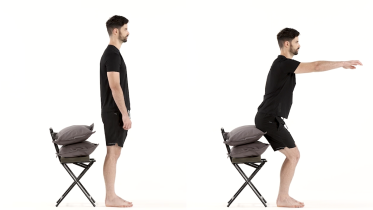 Chair squat
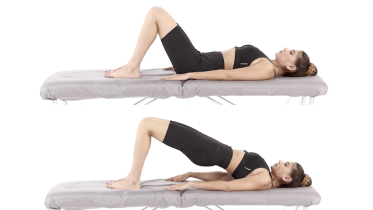 Glute bridge
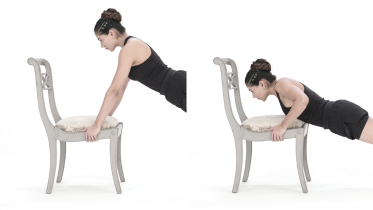 Incline push-ups
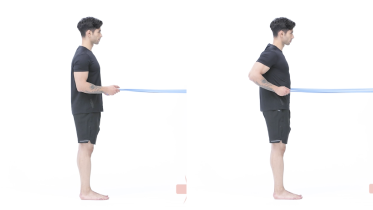 Resistance band row
 Calf raises
 Step up
Set the room up before the first set. Use a heavy chair with its back against a wall rather than a folding one, never a chair on wheels, and wear flat shoes that fit well and grip the floor, not socks, tights or bare feet. Keep a counter or a stair rail within reach for the chair squat and the step up.
If you have high blood pressure, breathe steadily through every repetition and never hold your breath. With a heart condition or high blood pressure, check with your doctor before you start. Stop any exercise for chest pain or pressure, dizziness or feeling faint, a racing or irregular heartbeat, or being far more out of breath than the effort should cause. If chest pain, pressure or tightness does not ease quickly when you rest, spreads to your arm, neck, jaw, stomach or back, or comes with sweating, feeling sick, feeling light-headed or being short of breath, call emergency services straight away, as this can be a heart attack. If it eases quickly and none of these happen, get medical advice the same day, and do not exercise again until you have been checked.
If you have had a hip replacement, get the go-ahead from your surgeon or physio before you try chair squats and step ups. A low seat makes the hip bend past a right angle, and many surgeons ask you to avoid that for the first months after some operations. After hip, knee or back surgery, the protocol from your surgical team decides when bridges and steps start. If you are pregnant and past the first three months, check with your physio before exercising flat on your back.
Check the band for nicks or tears and tug the anchor before each row, and ask your physio first if you have had shoulder surgery or a dislocated shoulder. After an Achilles repair or ankle surgery, calf raises begin at the point your surgeon's protocol sets, usually on both feet before one.
When to see a physio (physical therapist)
Book a session at the start if you have never lifted before, if you have an old knee, back, hip or shoulder problem, or if you would rather have someone set the six starting loads than work them out by trial and error. One appointment early usually saves several later. A physio can also turn this into a program that lives on your phone, with your own numbers on each exercise.
Come back if something hurts for more than a couple of sessions, if progress has stalled for a month, or if any warning sign below shows up. Surgery in the past year means your surgeon's plan comes first, and anything to do with the medicine belongs with the prescriber or pharmacist, not with your trainer or with this page.
Related exercise programs
See a doctor promptly if
- Emergency: if chest pain, pressure or tightness does not ease quickly when you rest, spreads to your arm, neck, jaw, stomach or back, or comes with sweating, feeling sick, feeling light-headed or being short of breath, call emergency services straight away, as this can be a heart attack. If it eases quickly and none of these happen, get medical advice the same day, and do not exercise again until you have been checked.
- Emergency: any sign of a stroke, even if it goes away. That means a face that droops on one side, an arm you cannot lift or keep up, slurred or muddled speech, weakness or numbness on one side of your body or face, sudden blurred vision, double vision or loss of sight, trouble swallowing, sudden dizziness with unsteadiness or falling over, a sudden severe headache, or a sudden fall where your legs give way but you do not black out (a drop attack). Call emergency services straight away.
- Emergency: sudden severe stomach pain together with pain spreading to your back, bloating that will not settle, a fast heartbeat, trouble breathing, or skin around your belly button, waist or upper outer thigh that looks blue or bruised (this can be harder to see on brown or black skin). Call emergency services or go to an emergency department, and do not drive yourself. If that sudden severe pain does not go away or keeps coming back, or comes with a high temperature or chills, without any of the signs above, get an urgent medical appointment or call your health service's urgent advice line the same day.
- Same day: dizziness or feeling faint during or after exercise, without any of the emergency signs above. Stop the exercises and get medical advice the same day. If you faint, it does not settle within a few minutes of sitting still, or you cannot stand or walk steadily, call emergency services.
- Same day: you blacked out or fainted, even for a moment. Get medical advice the same day. Call emergency services instead if the person cannot be woken within 1 minute, has not fully recovered or has trouble speaking or moving, has chest pain or a pounding, fluttering or irregular heartbeat, fainted while exercising or lying down, is shaking or jerking, or was badly hurt.
- Same day: shakiness, sweating, tingling lips, hunger, a pounding heartbeat, blurred vision, feeling weak or confusion during or after a session, if you take insulin or other diabetes medicines. These can be signs of low blood sugar, and the risk of it is higher when insulin or a sulfonylurea is taken alongside one of these medicines. Treat it the way your diabetes team has told you, then contact them or your prescriber the same day. If someone cannot be woken, cannot swallow safely or has a seizure, call emergency services.
- Same day: you cannot keep fluids down, you are being sick or have diarrhea that will not settle, you are peeing less than usual or your pee is dark yellow and strong smelling, you feel unusually tired, you feel dizzy when you stand up, or you are breathing quickly or your heart is racing. Contact your prescriber or get medical advice the same day, as these can be signs of dehydration. Call emergency services or go to an emergency department if your skin, lips or tongue look blue, gray, pale or blotchy (on brown or black skin this can be easier to see on the palms of the hands or soles of the feet), your skin feels cold, you are breathing fast or finding it hard to breathe, you are confused, or you are unusually sleepy or hard to wake.
- Same day: a calf or thigh that is newly swollen, warm, tender, red or darker than usual, has swollen veins that are sore to touch, or has a throbbing or cramping pain that does not fit your injury or condition, or that feels different from normal muscle soreness after exercise. This can be a sign of a blood clot (deep vein thrombosis), especially after surgery, an injury, time in a cast or boot, a long trip or a spell of being much less mobile than usual. Get medical advice the same day. If you are also short of breath or have chest pain, call emergency services.
Common questions
How many times a week should I strength train while losing weight?
Two days a week is the floor set by the World Health Organization guidelines, which ask adults for muscle-strengthening activity at moderate or greater intensity covering all the major muscle groups (Bull 2020). The American College of Sports Medicine puts each major muscle group at 2 to 3 days a week (Garber 2011), and the diet trials that held on to lean mass trained three times a week. Three is the better target if your week allows it. Adults aged 65 and over are asked for varied activity that works balance as well as strength on 3 or more days a week.
How many sets and repetitions should I do?
Most of the exercises in this session start at 2 to 3 sets of 8 to 15 repetitions, and each exercise page gives its own numbers rather than one rule for all of them. Judge the weight by the last repetition: it should be hard while the movement still looks the same as the first one. If you could have done five more, the load is light, and if your back is rounding or your knees are caving, it is heavy. Our guide to the FITT principle explains how physios set that level without testing a one-repetition maximum.
Can I build muscle while losing weight on these medicines?
Getting stronger is very likely; adding muscle in a large energy deficit is a different and harder question. Locatelli and colleagues note that supervised resistance training lasting more than 10 weeks can add around 3 kg (7 lb) of lean mass and about 25 percent to strength, though that comes from training studies rather than from people in the middle of medical weight loss. Their paper argues for adding resistance training to this treatment, which means the trial that would answer your question properly has not reported. Train for strength, judge it by what you can lift and what you can do, and treat extra muscle as a bonus.
What if I feel too tired or too full to train?
Shorten the session rather than cancel it. One set of each exercise still gives the muscle a reason to stay, and a 15 minute version done on the day beats a perfect hour that never happens. If feeling tired, full or unwell is wiping out most of your sessions, tell your prescriber or pharmacist, because that side of it is theirs and not ours. Never stop or change a medicine to make training easier.
Do I need a gym or dumbbells for this?
No. The session as written needs a sturdy chair, a wall or counter, one resistance band and a step, and every one of those exercises has an easier and a harder version on its own page. A gym helps later, once bodyweight versions stop feeling hard, because loading a squat or a row past your own weight is simpler with equipment. Start where you are and let the progression decide when you need more.
References
- Bull FC, Al-Ansari SS, Biddle S, et al. World Health Organization 2020 guidelines on physical activity and sedentary behaviour. British Journal of Sports Medicine. 2020;54(24):1451-1462. doi:10.1136/bjsports-2020-102955
- World Health Organization. WHO guidelines on physical activity and sedentary behaviour. 2020. https://www.who.int/publications/i/item/9789240015128
- Garber CE, Blissmer B, Deschenes MR, et al. American College of Sports Medicine position stand. Quantity and quality of exercise for developing and maintaining cardiorespiratory, musculoskeletal, and neuromotor fitness in apparently healthy adults: guidance for prescribing exercise. Medicine and Science in Sports and Exercise. 2011;43(7):1334-1359. doi:10.1249/MSS.0b013e318213fefb
- Locatelli JC, Costa JG, Haynes A, et al. Incretin-based weight loss pharmacotherapy: can resistance exercise optimize changes in body composition? Diabetes Care. 2024;47(10):1718-1730. doi:10.2337/dci23-0100
- Sardeli AV, Komatsu TR, Mori MA, Gaspari AF, Chacon-Mikahil MPT. Resistance training prevents muscle loss induced by caloric restriction in obese elderly individuals: a systematic review and meta-analysis. Nutrients. 2018;10(4):423. doi:10.3390/nu10040423
- Villareal DT, Aguirre L, Gurney AB, et al. Aerobic or resistance exercise, or both, in dieting obese older adults. New England Journal of Medicine. 2017;376(20):1943-1955. doi:10.1056/NEJMoa1616338
- Mozaffarian D, Agarwal M, Aggarwal M, et al. Nutritional priorities to support GLP-1 therapy for obesity: a joint advisory from the American College of Lifestyle Medicine, the American Society for Nutrition, the Obesity Medicine Association, and the Obesity Society. Obesity Pillars. 2025;15:100181. doi:10.1016/j.obpill.2025.100181
- Jensen SBK, Sorensen V, Sandsdal RM, et al. Bone health after exercise alone, GLP-1 receptor agonist treatment, or combination treatment: a secondary analysis of a randomized clinical trial. JAMA Network Open. 2024;7(6):e2416775. doi:10.1001/jamanetworkopen.2024.16775
- MedlinePlus. Tirzepatide injection. AHFS Patient Medication Information. https://medlineplus.gov/druginfo/meds/a622044.html
- NHS. Low blood sugar (hypoglycaemia). Page last reviewed 3 August 2023. https://www.nhs.uk/conditions/low-blood-sugar-hypoglycaemia/
- NHS. Semaglutide: a medicine to manage type 2 diabetes or treat obesity. Page last reviewed 15 May 2026. https://www.nhs.uk/medicines/semaglutide/
- NHS. Deep vein thrombosis (DVT). Page last reviewed 30 April 2026. https://www.nhs.uk/conditions/deep-vein-thrombosis-dvt/
- NHS. Symptoms of a stroke. https://www.nhs.uk/conditions/stroke/symptoms/
- NHS. Acute pancreatitis. Page last reviewed 11 March 2026. https://www.nhs.uk/conditions/acute-pancreatitis/
- NHS. Dehydration. Page last reviewed 1 May 2026. https://www.nhs.uk/conditions/dehydration/
- NHS. Fainting. Page last reviewed 17 August 2026. https://www.nhs.uk/symptoms/fainting/
Written and checked by the PocketPhysio editorial team. Last updated 2026-10-01.
This page is general education, not a diagnosis or a personal treatment plan. See a physiotherapist or doctor for advice about your own situation.