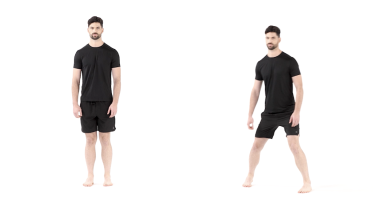
Standing IT band stretch
The standing IT band stretch works on the outside of the hip and thigh. You cross the leg you want to stretch behind the other one, lean your upper body toward the front leg and let your hips shift the other way. You need no mat or equipment. It often turns up in programs for runners and for people whose outer thigh feels tight.
How to do the standing it band stretch
- Stand tall with your feet together and your hands on your hips.
- Cross the leg you want to stretch behind the other one. Both feet stay flat on the floor, and both knees stay straight but not locked.
- Keep your chest and hips facing forward. Lean your upper body sideways, toward the side of the front leg.
- At the same time, let your hips move out the other way, toward the side of the back leg, until you feel a stretch along the outside of that hip and thigh.
- Hold and breathe slowly. Come back upright, uncross your legs and repeat on the other side.
What you should feel
A stretch along the outside of the hip and thigh of the back leg, sometimes reaching up into the side of your waist. Some people feel it high near the hip, others further down the thigh. Either is fine, as long as it is a stretch and not pain.
Common mistakes
- Turning the hips or chest to face sideways. Both should stay facing the front.
- Bending forward at the waist rather than leaning straight to the side.
- Leaning the upper body without letting the hips move out. The hip shift is what takes the stretch into the outer hip.
- Bouncing, or forcing the lean further than is comfortable.
How often
Holds of 20 to 30 seconds, done 2 or 3 times per side, once or twice daily, are a usual place to begin. Your physio will adjust this.
Stop and check with your physio if
- Pain over the bony point at the side of the hip, during the stretch or later that day.
- Pain, numbness or tingling running down the leg.
- You feel unsteady or close to losing your balance with your legs crossed.
From the clinic
With your legs crossed, your base is narrow and it is easy to wobble. Stand side-on to a wall or kitchen counter, with the leg you are stretching nearest to it, and rest that hand on it, so you can ease your hips toward the wall with more control. Feel very little? Cross the back leg a little further behind you, or let the hips travel a little further out. Some programs also roll the same area, as in IT band foam rolling.
Not everyone with outer hip pain should do this stretch. Crossing the leg and pushing the hip out squeezes the tendons at the side of the hip against the bone. That is why programs for greater trochanteric pain usually leave it out, so if the bony point of your hip is sore, ask your physio first. If you have had a hip replacement, get the go-ahead from your surgeon or physio before you try this exercise. Crossing one leg behind the other takes that leg across the middle of your body, and many surgeons ask you to avoid that for the first months after some operations.
Written and checked by the PocketPhysio editorial team. Last updated 2026-09-26.
This page is general education, not a diagnosis or a personal treatment plan. If you have pain, an injury or a health condition, see a physiotherapist or doctor before starting new exercises.