
Central sensitization and persistent pain: what it is and what helps
Warning signs, and when to get help
What is central sensitization?
Central sensitization is a change in how the nervous system handles pain signals. The International Association for the Study of Pain defines it as the pain-carrying nerve cells of the central nervous system becoming more responsive to their normal or subthreshold input. Translated, the pain system starts reacting more strongly than the incoming signal would account for. Woolf, whose 2011 paper is the one most often cited for the mechanism, describes it as an amplification of neural signaling within the central nervous system that produces pain hypersensitivity.
In the UK, Australia and New Zealand you will usually see it written central sensitisation, with an s. It is the same thing, and so is the shorter phrase many services use with patients, persistent pain.
Two features of the amplification matter to you more than the biology. An injury can set it going and the amplification can then outlast the injury, which is why pain carries on after the tissue has healed. And once the system is turned up, the threshold falls, so stimuli that should not hurt can hurt. Woolf describes both the drop in threshold and a widening of the area involved, in which input from uninjured tissue begins to produce pain. That describes pain somebody has already examined, so an area that has never hurt before is still a new symptom and still goes on the warning list at the end of this page.
Does this mean the pain is not real?
No, and this is worth being blunt about, because it is the question most people arrive with. Woolf's own sentence is that this does not mean the pain is not real, only that it is not being driven by a damaging stimulus. An amplified signal is a real signal, and amplification happens in a real nervous system.
Nor does it mean nobody can find anything. Health New Zealand's persistent pain page says plainly that pain is not a signal of damage to the body, and that chronic pain often reflects a problem with the pain system itself rather than damage in one part of the body. Something has been found: it is in the system that carries and interprets the signal, not in the knee or the back, and no scan of a knee or a back looks at that. That is an account of the pain you have already had examined. It is not a reason to turn down a test for something new.
The place where this goes wrong is when "your pain is central" gets heard as "stop telling me about it". That is not what it means, and the rest of this page spends as much time on what still needs checking as on what helps.
What it feels like
Descriptions vary, and no two people give the same list. The patterns that come up most often in clinic are these.
Pain that spreads beyond where it started, so a problem that began in one knee now takes in the other leg or the lower back. That belongs on this list once somebody has examined the spread. The first time your pain takes in an area that has never hurt, it goes on the same day route at the end of this page instead. One kind of new area does not wait even that long, because one knee taking in the other leg is also how pressure on the nerves at the base of the spine can start: pain, numbness, tingling or weakness in both legs, numbness or altered feeling around your genitals or bottom, or new trouble peeing or controlling your bladder or bowels is on the emergency list at the end of this page.
Pain that is out of proportion to the thing that set it off, so a short walk costs two days in the places that already hurt. Light pressure that hurts, such as a waistband, a bra strap, a seatbelt or a bedsheet.
Then the ones people are slower to mention, because they sound unlikely. Weather, noise or bright light making the pain worse with nothing physical having changed. Pain that moves around, among the places that have hurt before. Mornings worse than the day before would predict.
Along with the pain, many people report poor sleep, heavy fatigue and trouble concentrating or finding words. Those symptoms are part of the pattern the nociplastic pain criteria describe, not a separate problem you have invented, and naming them to your clinician is useful, not a distraction. What belongs there is the long-standing version of each, so fatigue that is new or has sharply worsened is a different matter, and so is weight coming off without your meaning it to, and both of those go to your doctor. Trouble finding words that comes on suddenly, or speech that turns slurred or muddled, is not the slow fog described here at all, and it is on the emergency list at the end of this page along with the other signs of a stroke. Night pain is the other one people file here: pain in one area at night that is constant, that no rest or change of position eases, and that keeps getting worse belongs on the warning list rather than on this one.
Everything above describes the pain you already have, as it was when someone last examined it. A symptom that is new to you does not join this list by resembling it. That matters most for the spreading, because spreading and moving around are both on the list, so the first time your pain takes in an area that has never hurt before it is easy to file it here and say nothing. Pain in a new place is on the warning list at the end of this page, at the same day, or straight away if the new place is both legs or anything to do with your bladder or bowels. A spread somebody has already looked at is not news, but an area that is new is.
Sensitization, the "syndrome" label and the questionnaire are three different things
These three get used as though they were one, including by sources that should know better, and keeping them apart is the quickest way to understand where the argument in this field actually is.
The mechanism is the best supported of the three. That nociceptive pathways can become sensitized, with a lowered threshold and a widened field, is accepted. The IASP has a formal definition for it.
The label is not a diagnosis. You will see the phrase central sensitization syndrome used as though it were one, and it has no agreed definition and no place in the main diagnostic systems. The closest thing to a formal description is nociplastic pain, which the IASP defines as pain arising from altered nociception without clear evidence of tissue damage activating peripheral nociceptors, and without disease or a lesion of the sensory nervous system to explain it. Kosek and colleagues published clinical criteria and a grading system for it, and Fitzcharles and colleagues, writing about regional pain of this kind, describe the criteria as a mechanistic explanation rather than a new diagnostic category, and say they still require validation. The IASP also notes that nociplastic and nociceptive pain can be present in the same person, which matters: this is not a label that cancels out an arthritic knee or a torn tendon.
The questionnaire measures something, and what it measures is disputed. The Central Sensitization Inventory asks about a long list of symptoms and scores them out of 100.
Two meta-analyses have asked what the score actually tracks. Adams and colleagues pooled 66 studies with 13,284 people and found the inventory correlated strongly with psychological measures such as depression, anxiety, stress, catastrophizing, sleep and fear of movement, but weakly or not at all with laboratory measures of nociceptive sensitivity, including pain thresholds, temporal summation and conditioned pain modulation. Their conclusion was that the inventory tracks psychological hypervigilance more closely than it tracks any increase in how responsive the pain-carrying nerve cells are. A later meta-analysis by Neblett and colleagues, who work on the inventory itself, pooled 33 studies with 3,314 people and did find statistically significant correlations between inventory scores and all five sensory testing methods, strongest for pressure pain threshold. Both reviews are real, both are recent, and they disagree.
What that leaves you with is simple enough. A score is a summary of what you reported, useful for tracking change over a course of treatment. It is not a measurement of your nervous system, it is not a diagnosis, and a high score explains no new symptom.
Why the pain spread, and why ordinary things hurt
The two findings Woolf sets out explain most of what puzzles people. The first is a reduction in threshold, which is why a stimulus that normally would not hurt now does: the IASP calls that allodynia, and a waistband or a bedsheet is the everyday version of it. The second is a widening of the area the system responds to, so that signals from tissue that was never injured start to produce pain, which is why a problem that began in one place does not stay there. That accounts for a spread somebody has looked at. An area that has never hurt before is a new symptom whatever this section explains, and it goes on the warning list at the end of this page, at the same day, or straight away if it takes in both legs or anything to do with your bladder or bowels.
Both are described as properties of the system, not of the tissue. That is the reason a scan of the sore area can come back clean while the pain carries on, and the reason a repeat scan of the same area rarely settles anything about the pain you already have. A scan asked for because something has changed is a different question, and the answer to it is not on this page.
It is also why the usual advice to rest the painful part does so little here. There is nothing wrong with resting a flare. The trouble is that a system set to protect you reads less movement as more need for protection, and the circle gets smaller. All of that is about pain you have had for months. A part you have just injured, a joint that is hot and swollen, a joint or a part that has been operated on and is newly painful, or a leg you cannot put weight on after a fall is rested and reported rather than pushed through, and each of those is on the warning list at the end of this page.
What does the evidence actually support?
Honest answer, and it is not the answer the sites selling programs give. The mechanism is well described. The treatment evidence is modest and mostly short term.
For exercise and physical activity in chronic pain, the Cochrane overview by Geneen and colleagues found favorable effects on pain severity and physical function that were mostly small to moderate and not consistent across the reviews, with variable effects on psychological function and quality of life, and it rated the overall quality of the evidence as low. It also found that exercise has few adverse events, and that the adverse events reported were mostly increased soreness or muscle pain that subsided after a few weeks. Only a quarter of the included studies reported adverse events at all, so read that as a weak reassurance, not a strong one. What did get reported was soreness rather than injury, which is the useful part for a sensitized system.
For explaining pain, which is where our pain neuroscience education guide goes into clinical detail, Siddall and colleagues pooled five trials with 460 people and found education plus exercise beat exercise alone in the short term, with pain about 2 points lower on a 0 to 10 scale at low certainty, and the most confidence in the reduction in fear of movement. Only a couple of trials followed anyone beyond 12 weeks.
NICE's guideline on chronic pain in the UK (NG193) advises offering a supervised group exercise program for chronic primary pain, tailored to the person's needs, preferences and abilities, and asks clinicians to discuss openly that symptoms are likely to fluctuate and flare, that a reason for the pain, or for a flare, may not be identified, that the pain may not improve or may get worse and may need ongoing management, and that quality of life can improve even if the pain does not. Those four points are a fair summary of what to expect, and two of them are about the pain you already have: the same guideline tells clinicians to offer a reassessment when symptoms change, and to re-evaluate the diagnosis if the presentation changes, so neither "a reason may not be identified" nor "the pain may get worse" is a reason to stop asking. Pain that is worse than it was is one of the changes that earns a reassessment. It is not a course you are supposed to absorb quietly because a guideline listed it among the possibilities.
The same guideline is specific about the rest of the menu, which is worth knowing before somebody sells you part of it. It says to consider acceptance and commitment therapy or cognitive behavioral therapy for pain, given by a clinician trained in it. It says to consider a single course of acupuncture or dry needling, within limits on who gives it, where, and no more than 5 hours of clinician time. It says not to offer TENS, ultrasound or interferential therapy, because there is no evidence of benefit.
On medicines, it says not to start opioids, paracetamol (acetaminophen), anti-inflammatories, gabapentinoids or benzodiazepines for chronic primary pain, while asking clinicians who find someone already on one of them to review it together rather than simply stop it: where it helps at a safe dose with few side effects, the guideline supports agreeing a plan to carry on safely. It does consider one kind of medicine for this pain, an antidepressant, after a full discussion of the benefits and harms, which in 2021 was an off-label use. Never stop or change a prescribed medicine on your own. That conversation belongs with whoever prescribed it.
What the evidence does not support is any claim to switch sensitization off, retrain a brain in a weekend, or cure persistent pain with an app. Where you meet that promise, it is a sales pitch rather than a finding.
How exercise helps when movement is what hurts
The reason to exercise a sensitized system is not that the muscles are weak, although they often are by the time someone gets here. It is that graded, predictable movement is how you find out what your body will take, instead of being told.
Two practical points come out of the research. The first is about harm: what these trials reported was soreness that settled rather than injury, with the caveat that only a quarter of them reported adverse events at all (Geneen and colleagues, 2017).
The second is about pain during the exercise itself, and whether it has to be avoided. That has been compared head to head. Smith and colleagues pooled seven trials with 385 people in 2017 and found a small short-term advantage for protocols that allowed painful exercise. The update of that review, with 16 trials, found no difference in pain or disability at any time point, wide confidence intervals, every trial at high risk of bias and the certainty of the evidence very low to low (Tran and colleagues, 2025).
What holds across both is the authors' own conclusion: pain during exercise may not need to be avoided for things to improve. So an ache is permitted. It is not the thing to aim for, and on the updated evidence nothing says pushing into pain works better. The permission covers the familiar pain of the problem you are treating and stops there: a pain that is new, in a new place, or unlike your usual pain is not a flare to work through. It does not reach a joint or a part that has been operated on either, where what counts as an acceptable ache is your surgical team's to set and not this page's. It stops the session and goes for advice on the timing the warning list at the end of this page gives it. If your own physio has told you to keep an exercise pain-free, follow that, because on the updated evidence nothing is lost by it.
The third point comes from how to decide when to do more. A review of exercise progression in back pain suggests that where pain behaves in a nociplastic way, with little consistent relationship to load, progressing on a planned schedule in small preset increments may suit better than waiting for the pain to give permission (Tuninetti and colleagues, 2025). Their own version of that schedule comes with guardrails, and the guardrails matter as much as the schedule: hold the amount where it is, or step back to the last amount that settled, if a flare is out of proportion or drags on, or if the movement itself starts to fall apart, and judge the session by how you are 24 to 48 hours later rather than by how it felt at the time. The authors are explicit that all of this is their reasoning rather than a trial result, and that the evidence is not yet enough to set progression standards. Even so, it fits what goes wrong in clinic: people with sensitized pain who progress by feel tend to do far too much on the good days and nothing at all on the bad ones.
How to use this program
Pick the stage that matches what you can do on an average day rather than a good one. If you are unsure, start at stage 1, and move up only when the current stage has been manageable for a week or two without setting off a flare. A stage is not a test and there is nothing in it to pass, so starting at stage 1 after years of this is a fair reading of your own history rather than a step backwards.
Every exercise page gives a typical starting dose, and with sensitized pain the right starting number is usually the lowest one on the page, or less. One set instead of three is a legitimate program. Where an exercise page gives a bigger number than the stage it sits in, the stage wins, and that applies to how often as much as to how many: several of these pages suggest once a day, most days, or a set repeated two or three times a day, written for a reader without sensitized pain, while the stages here put the stage 1 movements at once a day and the strength work on 2 or 3 days a week with a day in between. Each stage says this again where its own numbers are, because the exercise page is the one you will have open when you decide. Your physio or physical therapist will set the numbers and the steps with you, and will change them as things settle.
Set the step size in advance, before you find out how good a day you are having. A minute or two more walking, or a couple more repetitions, every week or two is a common way physios plan it. Write the plan down, then follow the plan rather than the pain. Following the plan does not mean adding to it through a worsening week: if the next morning, or the one after it, is not back to your usual level, hold the amount where it is instead of taking the next step, and go back to the last amount that settled overnight if that keeps happening. The plan governs your familiar pain and nothing else, so a symptom that is new to you stops the session and goes for advice on the timing the warning list at the end of this page gives it.
If you have high blood pressure, breathe steadily through every repetition and never hold your breath.
If you have fallen in the past year, feel unsteady on your feet, or take medicines that make you dizzy, keep a hand on a kitchen counter or a sturdy chair for the whole of the standing exercises, practice only when someone else is at home, and ask your doctor or physio about a falls check. Dizziness while you are actually doing them is not something to hold the counter through: stop, sit down, and get medical advice the same day before you practice again, which is the timing the warning list at the end of this page gives it. The standing ones here are marching on the spot, the calf raises, the sit to stands, the step ups and the standing hip abduction. For the walking, which you cannot do holding a counter, stay on ground you know and in good light to begin with, and keep using a stick or a frame if you have one.
If you live alone, that rule still stands, so plan around it rather than ignoring it. Do the standing exercises at your physio appointments or in a physio-led class rather than by yourself, keep to the seated and supported work of stages 1 and 2 when you are on your own, and ask your physio which of the standing exercises you may do alone. Keep your phone in a pocket rather than in another room, so you can reach it from the floor, and ask about an alarm you wear.
If you have had a hip or knee replacement, get the go-ahead from your surgeon or physio before you try the sit to stand exercises, marching on the spot, the calf raises, the glute bridge, standing hip abduction, step ups and bird dog. Some operations limit this kind of work for the first months, so the timing depends on your surgery. Rising from a seat bends the hip past a right angle, a high knee lift does the same, and drawing the knee in toward the elbow in bird dog bends it well past one. Many surgeons set a limit on how far the hip may bend, so find out what yours is. After a hip or knee replacement, kneeling may not be comfortable yet either, so ask before you get down onto hands and knees for bird dog. Ask the same people how far you may walk and how fast before you start the walking in stage 2.
After a knee fracture or knee surgery of any kind, including a replacement, follow your surgeon's or physio's plan for the sit to stands, the step ups and the calf raises, and start them only when they have cleared you. A bridge needs the knee bent to about 90 degrees before you lift, so if you have been given a limit on how far the knee may bend, leave the glute bridge out and ask your surgeon or physio whether the bend it needs is allowed yet.
After surgery on your spine, follow the plan from your surgical team rather than anything on this page, and get their go-ahead before the seated pelvic tilt, the glute bridge and bird dog. Protocols after a fusion or a decompression often limit bending, lifting and twisting for weeks or months, and only the team that operated can say where you are in that.
Whatever the operation was, your surgeon's and your surgical team's instructions come before this page, and nothing here replaces the post-operative review they have arranged for you.
Three of these exercises load a healing breastbone: the wall push-ups and the seated row with band in stage 2, and bird dog in stage 3. After recent heart or chest surgery, get your surgeon's or surgical team's okay before all three, because leaning your weight into your hands and pressing back off the wall loads the healing breastbone and the front of the chest. Pulling against a band pulls out across it, and in bird dog, with one arm lifted, your whole upper body weight goes through the other hand and shears across it. Only the team that wired it can clear loaded pulling. If the breastbone clicks, grinds, shifts or feels as if it is moving while you do any of them, stop, and contact your surgical team the same day.
The wall push-ups and bird dog also put your body weight through your wrists and hands. After a broken wrist, hand or forearm, or surgery on any of them such as a tendon repair, start either one only when your doctor, surgeon, physio or hand therapist says the bone or repair is ready for this, and follow their plan for how much to do.
After shoulder surgery, including a rotator cuff repair, or after a shoulder fracture or dislocation, follow your surgeon's or physio's plan for the backward shoulder rolls, the wall push-ups and the seated row with band, and do only the movements and range they have cleared. Rows with a band usually wait until later in rehab, and pressing your weight into a wall loads a healing tendon repair, so the check comes before either rather than after. After neck surgery or a broken collarbone, check with your surgeon or physio before the shoulder rolls. After a broken or dislocated elbow, or elbow surgery such as a tendon repair, start the wall push-ups only when your surgeon or physio has cleared you.
If you are pregnant and past the first three months, check with your physio before exercising flat on your back. If you have nobody to ask, do the breathing and the body scan sitting upright or propped instead of flat, which works just as well, and leave the glute bridge until you can ask.
The exercise program
The exercises below carry their own stop signs and precautions. Open the line under an exercise and read them before you try it.
Stage 1: A dose you could repeat tomorrow
For anyone whose pain flares whenever they try to exercise, and for anyone starting after a long gap. Slow breathing and the body scan give you something to do that costs nothing in pain, which matters on the days when the rest of the list is out of reach. Shoulder rolls and the seated pelvic tilt move stiff areas through a small, easy range. Short spells of marching on the spot are the first step toward walking. Set every number low enough that you could do the same again tomorrow, even if today was a bad day. As a general range, the breathing and the body scan take about 5 to 10 minutes and can be done most days, and the movements suit 1 to 2 sets of 5 to 10 slow repetitions, once a day. Some of the exercise pages below offer more than that, either a bigger number or the same set repeated two or three times a day, because they are written for a reader whose pain is not sensitized. Take the stage numbers rather than theirs. Your physio will adjust this.
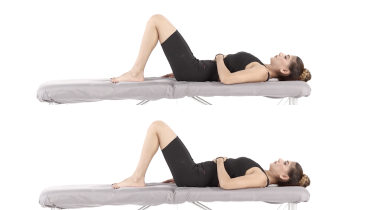 Diaphragmatic breathing
Stop signs and precautions for the diaphragmatic breathing
Before you start
- If lying flat makes you more short of breath, do not lie flat for this. Sit upright in a chair or prop yourself on pillows instead, which works just as well for learning the pattern. Being short of breath when you lie down, waking at night needing to sit up to breathe, more swelling in your ankles or legs, or gaining weight quickly over a few days are all reasons to get medical advice the same day rather than to practice through, because the NHS lists breathlessness when lying down among the reasons to get urgent advice.
- If you are pregnant and past the first three months, check with your physio before exercising flat on your back.
When to stop and get help
- Your fingers or the skin around your mouth start to tingle, or you feel light-headed or spaced out. This can mean you are breathing too fast or too deeply, so stop and let your breathing go back to normal. If it has not settled within a few minutes, get medical advice the same day. If you faint, or the numbness or tingling is on one side of your face or body, call emergency services, even if it goes away.
- You suddenly become short of breath, your chest feels tight or heavy, or you are far more short of breath than usual. Stop, rest and use your breathing control. Call emergency services if the breathlessness came on suddenly, your chest feels tight or heavy, your breathing does not go back to normal, you are gasping, choking or cannot get your words out, you have pain that spreads to your arms, back, neck or jaw, you feel suddenly confused or very drowsy, or your lips or skin turn very pale, blue or gray (on brown or black skin this can be easier to see on the palms of the hands). If everything settles quickly, get medical advice the same day before you do these exercises again.
- Chest pain or pressure, dizziness or feeling faint, a racing or irregular heartbeat, or being far more out of breath than the effort should cause.
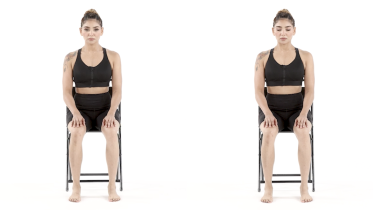 Body scan relaxation
Stop signs and precautions for the body scan relaxation
When to stop and get help
- Your fingers or the skin around your mouth start to tingle, or you feel light-headed or spaced out. This can mean you are breathing too fast or too deeply, so stop and let your breathing go back to normal. If it has not settled within a few minutes, get medical advice the same day. If you faint, or the numbness or tingling is on one side of your face or body, call emergency services, even if it goes away.
- You feel faint, dizzy or unwell. Open your eyes, stay seated and get medical advice if it does not pass quickly. If you faint while exercising, call emergency services, even if you feel fine again quickly.
- Upsetting thoughts, memories or feelings come up and keep building. Open your eyes, look around the room and stop for now, and talk to your doctor or therapist if it keeps happening.
- Chest pain or pressure, dizziness or feeling faint, a racing or irregular heartbeat, or being far more out of breath than the effort should cause.
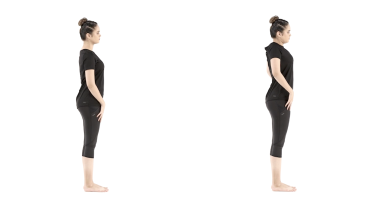 Backward shoulder rolls
Stop signs and precautions for the backward shoulder rolls
Before you start
- After shoulder or neck surgery, or a recent collarbone fracture, get the go-ahead from your surgeon or physio before you start.
When to stop and get help
- Sharp pain or a painful catch in the shoulder.
- Tingling or numbness spreading down your arm.
- Pins and needles in your arm or hand that do not go away after you stop, or part of your arm or hand goes numb. Get medical advice the same day. If one side of your face or body suddenly goes numb or weak, or your speech becomes slurred or muddled, call emergency services, even if it goes away.
- Dizziness or a headache that comes on as you move. If you faint while exercising, call emergency services, even if you feel fine again quickly.
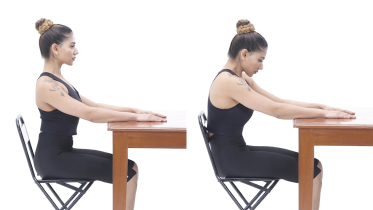 Seated pelvic tilt
Stop signs and precautions for the seated pelvic tilt
Before you start
- If you have had surgery on your spine in recent months, get the go-ahead from your surgical team or physio first.
- If you have osteoporosis or have had a fracture in your spine, keep the slouch small and ask your physio how far to go.
- If you are pregnant, check with your midwife or physio before you start.
When to stop and get help
- Pain travels into your buttock or leg, or numbness or tingling starts.
- You feel sharp or pinching pain in your lower back at either end of the movement.
- Numbness around your genitals or bottom, new trouble with your bladder or bowels, pain, tingling, numbness or weakness in both legs, or loss of feeling in one leg. Call emergency services or go to an emergency department straight away, and do not drive yourself.
- Your leg or foot gets weaker, for example your foot drags, catches on the ground or slaps down when you walk (foot drop). Get medical advice the same day. If the weakness is getting worse by the hour, go to an emergency department.
- You are pregnant and notice bleeding or fluid leaking from your vagina, regular painful tightenings, tummy pain that does not settle when you rest or comes with lower back pain, or a change in your baby's usual movements, such as moving less than usual. Stop and contact your midwife or maternity unit straight away. Do the same for a severe headache, problems with your vision such as blurring or flashing lights, pain just below your ribs, or sudden swelling of your face, hands or feet, which can be signs of pre-eclampsia. Call emergency services if the bleeding is heavy, the tummy pain is severe, bleeding or tummy pain comes with pain in your shoulder or feeling sick, faint or dizzy, or a headache comes on suddenly and is very severe.
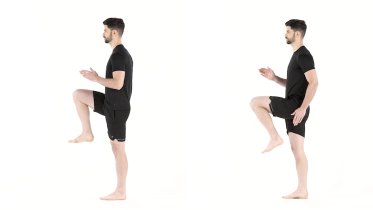 Marching on the spot
Stop signs and precautions for the marching on the spot
Before you start
- If you have had a hip replacement, get the go-ahead from your surgeon or physio before you try marching on the spot. A high knee lift can bend the hip past a right angle, and many surgeons ask you to avoid that for the first months after some operations.
When to stop and get help
- You feel dizzy, lightheaded, faint or sick, or the room seems to spin. Hold your support, sit down and get medical advice the same day before you practice again. If you faint, it does not settle within a few minutes of sitting still, your vision suddenly blurs or goes double, or you cannot stand or walk steadily, call emergency services.
- You feel unsteady or close to falling.
- Sharp pain in the hip, knee or lower back.
- Chest pain or pressure, dizziness or feeling faint, a racing or irregular heartbeat, or being far more out of breath than the effort should cause.
Stage 2: Walking, and light strength with support
Move up when stage 1 has been manageable on most days for a week or two and has not set off a flare. Walking becomes your main aerobic exercise, and the support in this stage is deliberate: the armrests, the wall and the lightest band all let you train a movement before you can do the harder version of it. Start the walk at a length you could manage on a bad day rather than a good one, which is usually shorter than people expect. Many programs add a minute or two of walking, or a couple of repetitions, every week or two once the last step has settled, and the strength work suits 1 to 3 sets of 8 to 15 repetitions on 2 or 3 days a week with a day in between. Some of the exercise pages below offer the same work once a day or on most days, which is more often than this stage intends, so take the stage numbers rather than theirs. Your physio will adjust this.
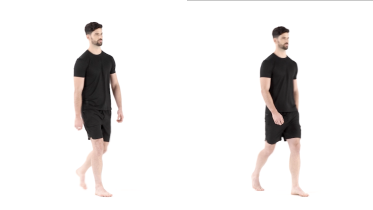 Brisk walking
Stop signs and precautions for the brisk walking
Before you start
- With a heart or lung condition, high blood pressure, or after a recent operation, ask your doctor or physio how much to walk and how fast before you start. If you are pregnant, check with your midwife or physio before you start.
When to stop and get help
- Chest pain or pressure, dizziness or feeling faint, a racing or irregular heartbeat, or being far more out of breath than the effort should cause.
- You feel dizzy, lightheaded, faint or sick, or the room seems to spin. Stop, sit down and get medical advice the same day before you exercise again. If you faint, it does not settle within a few minutes of sitting still, your vision suddenly blurs or goes double, or you cannot stand or walk steadily, call emergency services.
- A sharp pain in a foot, ankle, knee or hip that changes the way you walk.
- Aching, cramping or tightness in a calf, thigh or buttock that comes on at about the same walking distance every time and clears within a few minutes of standing still, and a doctor has not checked it yet. Keep the walk gentle and book an appointment with your doctor before you build up any further, as narrowed arteries in the legs (peripheral arterial disease) can cause this and are managed differently. If leg pain carries on while you are resting or in bed, or wakes you at night, get medical advice the same day. If a foot or leg suddenly turns cold, pale or blue, or suddenly becomes very painful, numb or weak, call emergency services and do not drive yourself, because the blood supply to the leg may be blocked and a leg that has gone numb or weak with it can be impossible to save if it is not treated within about six hours.
- Your calf or thigh becomes swollen, warm, tender, red or darker than usual, or has a throbbing or cramping pain that feels different from normal muscle ache. Stop and get medical advice the same day, as this can be a blood clot. If you are also short of breath or have chest pain, call emergency services.
- You feel unsteady on your feet or close to falling.
- You are pregnant and notice bleeding or fluid leaking from your vagina, regular painful tightenings, tummy pain that does not settle when you rest or comes with lower back pain, or a change in your baby's usual movements, such as moving less than usual. Stop and contact your midwife or maternity unit straight away. Do the same for a severe headache, problems with your vision such as blurring or flashing lights, pain just below your ribs, or sudden swelling of your face, hands or feet, which can be signs of pre-eclampsia. Call emergency services if the bleeding is heavy, the tummy pain is severe, bleeding or tummy pain comes with pain in your shoulder or feeling sick, faint or dizzy, or a headache comes on suddenly and is very severe.
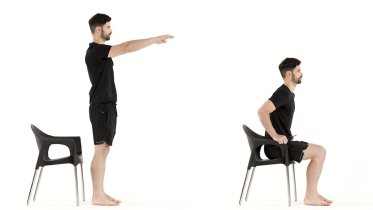 Sit to stand using armrests
Stop signs and precautions for the sit to stand using armrests
Before you start
- If you have had a hip replacement or other hip surgery, get the go-ahead from your surgeon or physio before you try sit to stand using armrests. Lowering into a chair and rising from it takes the hip beyond a right angle when the seat is low, and many surgeons ask you to avoid that for the first months after some operations.
- If knee pain builds as you go, or you have had knee surgery, check with your physio what seat height to use.
- If balance is a worry or you have fallen before, have someone nearby and place the chair next to a counter or wall you can reach once upright. If you have osteoporosis, set the chair up the same way, next to a counter or wall, though thin bones on their own are not a reason to wait until someone is at home before you stand up out of a chair. Wear flat shoes that fit well and grip the floor, not socks, tights or bare feet.
When to stop and get help
- You feel dizzy, lightheaded or faint as you get up. Sit back down and wait for it to pass. If it does not pass within a minute or two, or it keeps happening, get medical advice the same day before you practice again. If you faint, or it does not settle within a few minutes of keeping still, call emergency services. A drop in blood pressure on standing, or a side effect of a medicine, can cause this, so mention your medicines when you get advice.
- Your knee, hip or back hurts sharply, or a wrist or shoulder hurts as you push on the armrests.
- A leg buckles, or you feel close to falling.
- Chest pain or pressure, dizziness or feeling faint, a racing or irregular heartbeat, or being far more out of breath than the effort should cause.
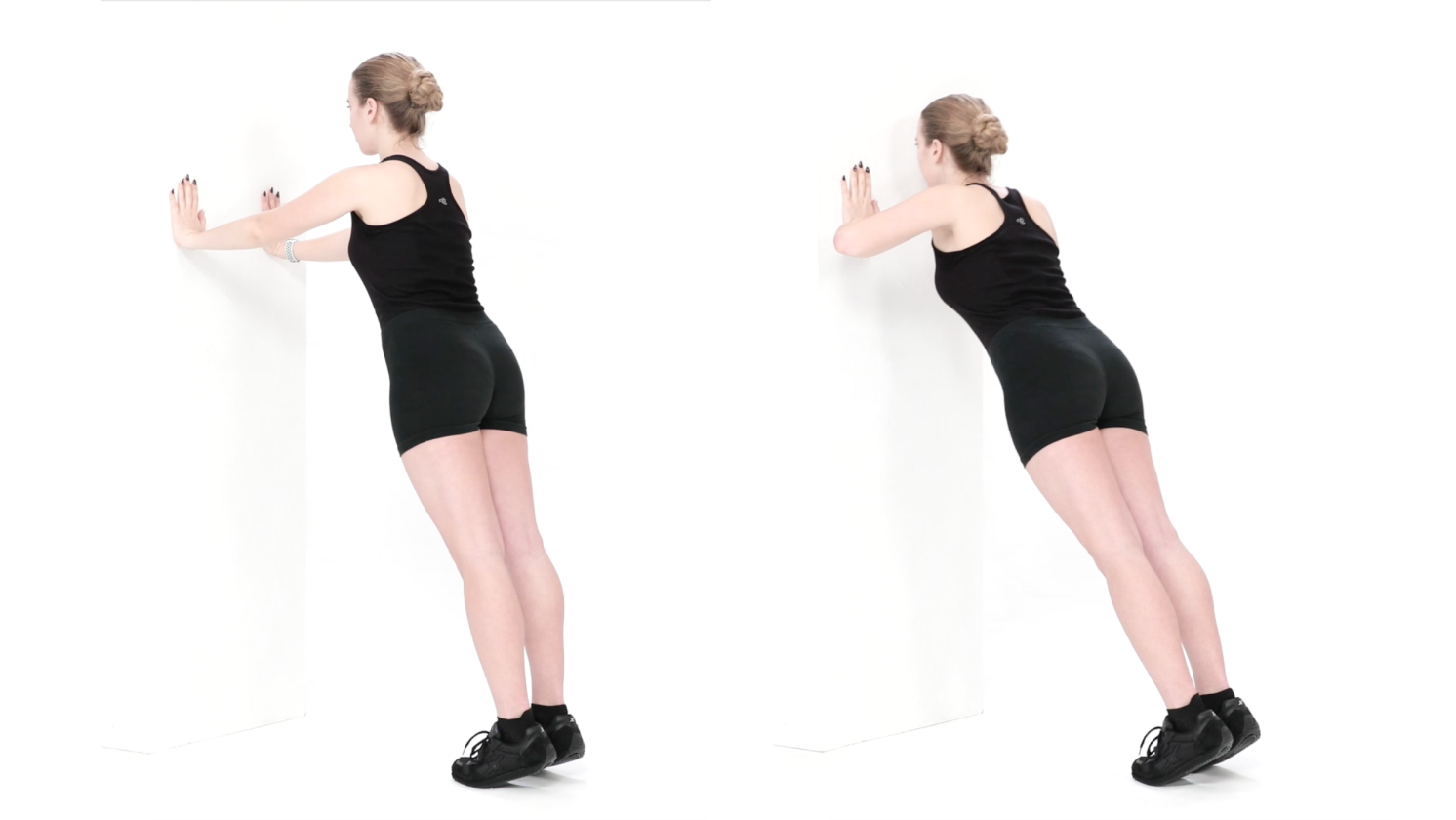 Wall push-ups
Stop signs and precautions for the wall push-ups
Before you start
- After a broken or dislocated elbow, or elbow surgery such as a tendon repair, follow your surgeon's or physio's plan, and start this exercise only when they have cleared you. If you have just hurt your arm and have severe pain or cannot move the elbow, do not exercise it. Go to an urgent care center or emergency department the same day. If you heard a snap or a crack at the moment of the injury, the arm looks a different shape or sits at an odd angle, a bone is showing, or your arm or hand tingles, feels numb or turns cold, pale or blue, go to an emergency department straight away or call emergency services, and do not drive yourself.
- After shoulder surgery, including a rotator cuff repair, or after a shoulder fracture or dislocation, follow your surgeon's or physio's plan, and do only the movements and range they have cleared. Many plans allow only passive movement at first, where the arm is moved for you and its muscles stay relaxed. Putting weight through your arms usually comes later, so check with your physio first.
- After recent heart or chest surgery, get your surgeon's or surgical team's okay first, because leaning your weight into your hands and pressing back off the wall loads the healing breastbone and the front of the chest. If the breastbone clicks, grinds, shifts or feels as if it is moving while you do it, stop, and contact your surgical team the same day.
When to stop and get help
- Sharp pain in the shoulder, elbow or wrist.
- Pain, numbness or tingling spreads down the arm.
- Pins and needles in your arm or hand that do not go away after you stop, or part of your arm or hand goes numb. Get medical advice the same day. If one side of your face or body suddenly goes numb or weak, or your speech becomes slurred or muddled, call emergency services, even if it goes away.
- Your feet start to slip on the floor.
- A sudden pop or tearing feeling in the shoulder that brings sharp pain, new weakness or trouble lifting the arm. Stop and contact your surgical team the same day, or get medical advice the same day if you have not had surgery.
- The shoulder feels as if it has slipped out of place, looks a different shape or suddenly locks so you cannot move the arm, or your hand turns cold, pale or blue. Go to an emergency department straight away, without driving yourself, and do not try to put the shoulder back in yourself.
- Chest pain or pressure, dizziness or feeling faint, a racing or irregular heartbeat, or being far more out of breath than the effort should cause.
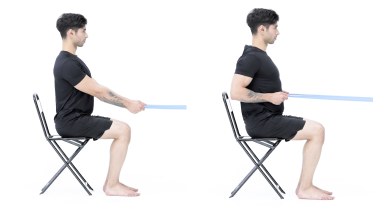 Seated row with band
Stop signs and precautions for the seated row with band
Before you start
- After shoulder surgery, rows with a band usually wait until later in rehab, so check with your surgeon or physio first.
- After heart or chest surgery, pulling against a band usually waits until your breastbone has had time to heal, so ask your surgeon or surgical team when to start: only the team that wired it can clear loaded pulling. If the breastbone clicks, grinds, shifts or feels as if it is moving while you do it, stop, and contact your surgical team the same day.
- If you have high blood pressure, breathe steadily through every repetition and never hold your breath.
- Do not lean forward to reach the band or twist to one side as you pull, and if you have had a fracture in your spine, check with your physio before you start.
When to stop and get help
- A sharp pain or catching feeling in your shoulder as you pull.
- Pain, tingling or numbness spreading down an arm.
- Pins and needles in your arm or hand that do not go away after you stop, or part of your arm or hand goes numb. Get medical advice the same day. If one side of your face or body suddenly goes numb or weak, or your speech becomes slurred or muddled, call emergency services, even if it goes away.
- A sudden pop or snap at the front of your elbow, sudden sharp pain there, or the muscle at the front of your upper arm bunches up or changes shape. Stop and go to an urgent care center or emergency department the same day, even if you can still bend the elbow, as this can be a torn biceps tendon.
- Chest pain or pressure, dizziness or feeling faint, a racing or irregular heartbeat, or being far more out of breath than the effort should cause.
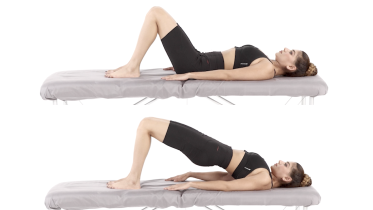 Glute bridge
Stop signs and precautions for the glute bridge
Before you start
- After hip, knee or back surgery, your surgeon's protocol decides when you can start bridges. Once you are past the first three months of pregnancy, check with your physio before exercising flat on your back.
- A bridge needs the knee bent to about 90 degrees before you lift, so if you have had knee surgery and been given a limit on how far the knee may bend, leave this one out and ask your surgeon or physio whether the bend it needs is allowed yet.
When to stop and get help
- You feel back pain rather than buttock work, even when you lift a little lower.
- Pain spreads down the leg or you get numbness or tingling.
- Your hamstrings (the back of the thighs) cramp. This is a common complaint with bridges, and bringing your feet a little closer to your bottom often eases it.
- Pain in the knee itself, or a knee that swells or is clearly more painful the next morning. The position holds the knee bent throughout, so after knee surgery stop and check with your surgeon or physio before you try it again.
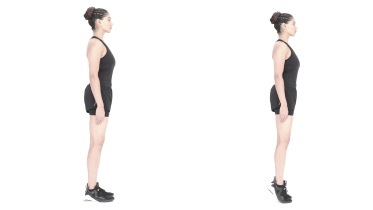 Calf raises
Stop signs and precautions for the calf raises
Before you start
- After an Achilles tendon repair or ankle surgery, calf raises usually come in at a set stage of your surgeon's protocol, often on both feet before one. Check with your physio before you start.
- After a knee or hip replacement, or other leg surgery, follow your surgeon's or physio's plan, and hold a counter or a sturdy chair back for the whole set. Rising onto your toes puts your weight forward onto a smaller base, which is where the balance goes.
When to stop and get help
- Sharp pain in the Achilles tendon, heel or arch.
- A sudden pop or snap at the back of your ankle or heel, a feeling that someone kicked you there, or sudden pain there after which you cannot push off or rise onto your toes on that leg. Stop, take the weight off that leg carefully and go to an urgent care center or emergency department the same day, even if you can still walk, as this can be a torn Achilles tendon.
- Achilles or heel pain that is clearly worse the next morning. Ease off and check with your physio.
- Your calf or thigh becomes swollen, warm, tender, red or darker than usual, or has a throbbing or cramping pain that feels different from normal muscle ache. Stop and get medical advice the same day, as this can be a blood clot. If you are also short of breath or have chest pain, call emergency services.
- Your ankle gives way, or you lose your balance.
- Since the fracture or cast, the foot or ankle is getting more painful rather than less, the skin becomes very sensitive to light touch, or the foot changes color, temperature, swelling or sweating compared with the other one, or looks shiny. See your doctor or physio as soon as you can, within a few days at most, as this can be complex regional pain syndrome (CRPS) and early treatment may help.
- You feel dizzy, lightheaded, faint or sick, or the room seems to spin. Stop, sit down and get medical advice the same day before you exercise again. If you faint, it does not settle within a few minutes of sitting still, your vision suddenly blurs or goes double, or you cannot stand or walk steadily, call emergency services.
- Chest pain or pressure, dizziness or feeling faint, a racing or irregular heartbeat, or being far more out of breath than the effort should cause.
Stage 3: Standing strength and longer walks
Move up when stage 2 feels routine and you are no worse the next morning or the morning after that. Standing up without using your hands, stepping up and standing hip work load one leg at a time, which is what makes stairs, kerbs and getting off a low chair easier. Bird dog is the slowest thing here and the most often rushed: shorten the reach until your back stops arching and your breathing stays normal. Change one thing a week, either the step height or the number of repetitions and never both. Usually 1 to 3 sets of 6 to 12 repetitions on 2 or 3 days a week, with the walk continuing on the days in between. Where an exercise page below offers more repetitions than that, or offers the work once a day, take the stage numbers rather than theirs. Your physio will adjust this.
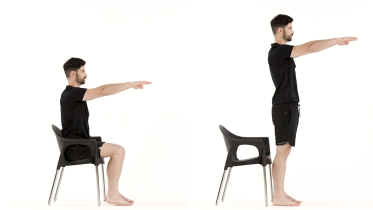 Sit to stand
Stop signs and precautions for the sit to stand
Before you start
- After a knee fracture or knee surgery, including a knee replacement, follow your surgeon's or physio's plan, and start this exercise only when they have cleared you.
- If you have had a hip replacement or other hip surgery, get the go-ahead from your surgeon or physio before you try sit to stand. Standing up from a low seat bends the hip past a right angle, and many surgeons ask you to avoid that for the first months after some operations. Ask them how high your seat should be. If you are pregnant, check with your midwife or physio before you start.
- Set up before the first stand: use a chair that will not slide, ideally with its back against a wall, and have someone nearby, or set the chair beside a kitchen counter you can reach, if you are not sure of your balance or you have fallen in the past year. Wear flat shoes that fit well and grip the floor, not socks, tights or bare feet.
When to stop and get help
- You feel dizzy, lightheaded or faint as you get up. Sit back down and wait for it to pass. If it does not pass within a minute or two, or it keeps happening, get medical advice the same day before you practice again. If you faint, or it does not settle within a few minutes of keeping still, call emergency services.
- Sharp pain in the knee, hip or lower back.
- Your knee gives way or you feel you might fall.
- Chest pain or pressure, dizziness or feeling faint, a racing or irregular heartbeat, or being far more out of breath than the effort should cause.
- You are pregnant and notice bleeding or fluid leaking from your vagina, regular painful tightenings, tummy pain that does not settle when you rest or comes with lower back pain, or a change in your baby's usual movements, such as moving less than usual. Stop and contact your midwife or maternity unit straight away. Do the same for a severe headache, problems with your vision such as blurring or flashing lights, pain just below your ribs, or sudden swelling of your face, hands or feet, which can be signs of pre-eclampsia. Call emergency services if the bleeding is heavy, the tummy pain is severe, bleeding or tummy pain comes with pain in your shoulder or feeling sick, faint or dizzy, or a headache comes on suddenly and is very severe.
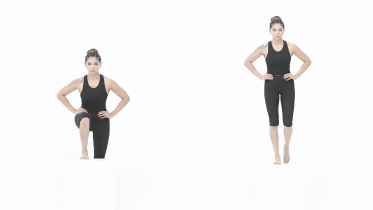 Step up
Stop signs and precautions for the step up
Before you start
- If you have had a hip or knee replacement, or other hip or knee surgery, get the go-ahead from your surgeon or physio before you try step ups. Some operations limit this kind of work for the first months, so the timing depends on your surgery. Your surgeon or physio will also tell you what step height is right for you.
- With a heart condition or high blood pressure, check with your doctor before you start.
- If you have fallen in the past year, have osteoporosis or feel unsteady on your feet, set the step beside a handrail, a kitchen counter or a sturdy chair back, keep one hand on it for every repetition, and ask your physio whether to start with step ups at all or to build up on a single stair first.
When to stop and get help
- You feel sharp pain in the knee or the knee gives way.
- Pain at the front of the knee builds with each rep.
- You feel dizzy, lightheaded, faint or sick, or the room seems to spin. Hold your support, sit down and get medical advice the same day before you practice again. If you faint, it does not settle within a few minutes of sitting still, your vision suddenly blurs or goes double, or you cannot stand or walk steadily, call emergency services.
- You feel unsteady enough that you might fall. Stop and sit down.
- Chest pain or pressure, dizziness or feeling faint, a racing or irregular heartbeat, or being far more out of breath than the effort should cause.
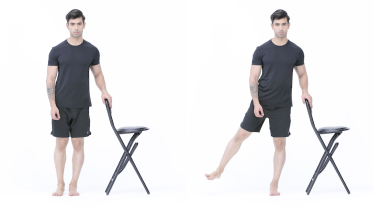 Standing hip abduction
Stop signs and precautions for the standing hip abduction
Before you start
- If you have had a hip replacement or other hip surgery, get the go-ahead from your surgeon or physio before you try standing hip abduction. Some operations limit this kind of work for the first months, so the timing depends on your surgery. Your surgical team will also tell you how far to lift.
When to stop and get help
- You feel sharp pain at the side of the hip, in the groin or in the lower back.
- You feel dizzy, lightheaded, faint or sick, or the room seems to spin. Hold your support, sit down and get medical advice the same day before you practice again. If you faint, it does not settle within a few minutes of sitting still, your vision suddenly blurs or goes double, or you cannot stand or walk steadily, call emergency services.
- You feel unsteady, even with the chair.
- Pain, numbness or tingling runs down the leg.
- Your calf or thigh is getting more swollen, or becomes warm, tender, red or darker than usual, or has a new throbbing or cramping pain. This can be a blood clot, especially after an operation, an injury, time in a cast, boot or brace, or a spell of being much less mobile than usual, and after an operation it can also be an infection. Stop and contact your medical team or get medical advice the same day. If you are also short of breath or have chest pain, call emergency services.
- Chest pain or pressure, dizziness or feeling faint, a racing or irregular heartbeat, or being far more out of breath than the effort should cause.
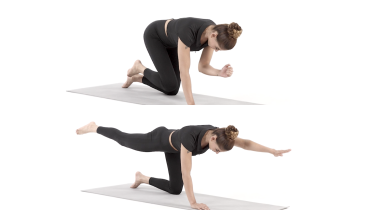 Bird dog
Stop signs and precautions for the bird dog
Before you start
- If you have had a hip replacement or other hip surgery, get the go-ahead from your surgeon or physio before you try bird dog. Lifting the leg takes the hip back behind the line of your body and drawing the knee in toward your elbow bends it well past a right angle, and many surgeons ask you to avoid that for the first months after some operations. After a hip or knee replacement, kneeling may not be comfortable yet either.
- After back surgery, keep to it until your surgeon and physio say bending the spine is fine.
- After a broken wrist, hand or forearm, or surgery on any of them such as a tendon repair, start only when your doctor, surgeon, physio or hand therapist says the bone or repair is ready to take weight through the arms, and follow their plan for how much to do.
- After recent heart or chest surgery, get your surgeon's or surgical team's okay first, because with one arm lifted, your whole upper body weight goes through the other hand, which shears across the healing breastbone. If the breastbone clicks, grinds, shifts or feels as if it is moving while you do it, stop, and contact your surgical team the same day.
When to stop and get help
- Your back hurts more during or after the exercise and it does not settle.
- You get pain running down your leg, or numbness or tingling.
- Your knees or wrists hurt from taking your weight. Ask your physio about padding under you or another position.
What to do this week, and on a flare day
Four things, and they are all small.
Pick your starting amount by asking what you could manage on your worst day this month and still repeat tomorrow. Start there even if the number looks absurd. The cost of starting too low is a slow start, and the cost of starting too high is a week lost.
Choose one thing to measure and a morning check. A one-line note each day of what you did and how the next two mornings went will tell you more about your own pattern in a month than any wearable, and two mornings rather than one is deliberate: 24 to 48 hours is the window the progression research uses, and plenty of people describe the cost of a session landing on the second day rather than the first. Pick a repeatable check, such as getting out of a chair or the first hundred steps of the day, and use the same one every time.
Write your flare plan now, while you are well. A flare plan is a smaller version of your program: the breathing, the body scan and one gentle movement. Write it out and keep it somewhere you will find it. The breathing and the body scan can be done lying down, and both work just as well sitting upright or propped, which is the version to use if lying flat on your back makes you more short of breath, or if you are pregnant past the first three months and have not asked your physio about lying flat. On a flare day the aim is to keep the number of sessions and cut the size of them, so that the habit survives the week.
Set your pain rule with the next two mornings in mind. Some ache during and after the exercises is usually acceptable if it is back to your usual level by the next morning, or the one after it, and is not climbing from week to week. The pain monitoring model guide sets out how physios put numbers on that, and for sensitized pain many of them start with a lower ceiling than the usual one: if yours has given you a tighter rule than this page, use hers, and if you have no physio to ask, take the lower ceiling as yours rather than the usual one, because the trial evidence says you give up nothing by it. The rule applies to the familiar pain of the problem you are treating and to nothing else. New pain, pain somewhere new, or anything on the warning list at the end of this page is not an acceptable ache, and it is not a flare. Nor does it apply to a joint or a part that has been operated on, where what counts as an acceptable ache is your surgical team's to set and not this page's.
Sleep, pacing and the things that turn the volume up
Sleep is worth more attention than it usually gets. Finan and colleagues reviewed the sleep and pain research and reported that in studies tracking people over short intervals, poor sleep was a stronger and more reliable predictor of next-day pain than pain was of that night's sleep. The direction of that is not settled, and they say so. It is still a reason to treat sleep as part of the treatment rather than as a symptom to put up with, and to raise it at your next appointment, because a sensitized system that is short of sleep is harder to settle.
Pacing is the other half. The pattern that costs people the most is the one everybody recognizes once it is named: a good day gets filled, and the next three are gone. Pacing means finding the amount you can manage on a bad day, doing roughly that on good days too, and increasing it in steps you decided in advance. It is dull by design.
Stress, a busy week and a bad night all turn the volume up, and NICE asks clinicians to explore how parts of life such as sleep and stressful events affect chronic pain. Knowing that is useful for planning around your own pattern. It is not a reason to attribute a new symptom to a bad week. A hard week can raise the pain you already have. It does not produce a new pain in a new place, new weakness, a fever or weight you did not mean to lose.
Can central sensitization be reversed?
The mechanism is reversible in principle. Woolf's description is of a prolonged but reversible increase in excitability, which is why clinicians talk about calming a sensitive system instead of fixing a broken part.
In practice, be careful with the word cure. The exercise evidence gives small to moderate, inconsistent gains in pain and function at low quality (Geneen and colleagues, 2017), and the education evidence gives short-term gains with little long-term data (Siddall and colleagues, 2022). The honest version is that most people can expect to do more than they do now, with less fear and fewer lost weeks, while still having some pain. NICE makes the same point from the clinical side, asking clinicians to be open that pain may not improve and that quality of life can improve even if it does not. What the same guideline does not do is treat that as the end of the matter, because it also asks for a reassessment when symptoms change.
Judged by what you can do, that is a result worth working for. Judged only by the pain score, it will feel like failure in week three, which is why the things worth writing down are the recovery time after a busy day, the gap between flares, and the number of days you managed the program. Keep noting the pain score as well, for its direction rather than its height. A level that climbs steadily week after week, instead of going up and down, is on the warning list at the end of this page, and it earns an appointment rather than more patience.
What still needs checking
This is the half of the page nobody else writes, and it exists because the explanation on this page is itself a reason some people stop reporting things.
Start with what the label covers. Sensitization is an explanation for pain that has already been examined. It says nothing about a symptom that has appeared since. Nothing on this page, and nothing your clinician said, means that the next new thing is also the nervous system.
A normal scan is not a permanent pass either. It described one area at one moment, and most of what matters on the warning list at the end of this page would not show on it anyway. If something has changed since you were last assessed, the question is not whether your old scan was clear.
If one of the painful parts has been operated on, that part has its own list of things that can go wrong, and this page explains none of them. A replacement can loosen, wear or become infected years after it went in. A repair or a reconstruction can come apart. The bone around an implant can crack in a fall you walked away from, and OrthoInfo says those fractures can happen at any point after the operation and that pain, swelling and not being able to put weight through the leg are the usual symptoms. Every one of those starts as pain, and pain is the thing this page has just told you not to read as damage.
So the rule for an operated part is narrower than the rule for the rest of you. New pain there, pain that had settled and has come back, pain building month by month, or a movement you could do before and suddenly cannot, goes to your surgical team rather than into your flare plan, each on the timing the warning list at the end of this page gives it. A normal temperature is not an all clear either: OrthoInfo's page on infection after a joint replacement says fever is no longer considered a sign of an infection after a joint replacement, and that the signs can be as little as mild redness and swelling. Nobody has applied this page's explanation to your implant, and nothing here was written with it in mind.
The hardest exit to close is the one built out of being disbelieved. Plenty of people reading this have been dismissed before and expect to be again, and deciding not to bother is a reasonable response to that history. It is also the thing most likely to cost you. The label is a reason to be re-examined when something changes, not a reason to be turned away, and the sentence that works at the desk is a plain one: this is different from my usual pain, it started on this date, and this is what has changed.
NICE tells clinicians to offer a reassessment if a person turns up with a change in symptoms, including a flare, and when that happens to review the plan and to consider investigating and managing any new symptoms, so you are asking for something the guideline already expects. It also tells them to recognize that a first diagnosis of chronic primary pain can change with time, and to re-evaluate it if the presentation changes. Nothing in it treats the label as final.
Red flags are not a perfect filter, and the people who wrote the main framework on them say so: Finucane and colleagues record that good evidence for the diagnostic accuracy of most red flags is absent. The point of the list at the end of this page is not that it catches everything. It is that none of it is explained by a sensitive nervous system.
Reporting a change is not the same as asking for a cure. It is how the small number of things that need treating actually get found, and most of them are easier to treat early, so the reason to go is the same whether or not anyone can do much about your usual pain.
So, the short version. A flare of your familiar pain settles over days and is managed with your flare plan. A new symptom gets examined. If you are not sure which one you have, that uncertainty is itself the reason to ask.
Persistent pain services in Australia and New Zealand
If you are in Australia or New Zealand, the phrase to use with your clinician is persistent pain, because it is what the services are called.
In Australia, healthdirect says a doctor can refer you to a pain management program, run at a pain clinic, and that most major public hospitals have one. In New Zealand, Health New Zealand says that if your pain is complex your healthcare provider may refer you to pain management services. In both countries the usual way in is a referral rather than booking yourself in, so the appointment to make is with your GP or physio, with a request for referral as the thing you are asking for. Healthdirect adds that these programs run privately in Australia as well as in public hospitals.
In the USA, Canada and the UK the same kind of service usually goes by another name, such as a pain clinic, a pain management program or a pain rehabilitation program. Your doctor or physical therapist can tell you what runs locally and what getting in takes, and it is a fair question to ask at an ordinary appointment. What is worth knowing before you ask is the shape of these programs: they treat with exercise, education and pacing taught over a course of weeks, rather than with a procedure, which is also why they are usually run as a group.
When to see a physio or doctor
See a physio if every attempt at exercise sets off a flare, if you do not know where to start, or if pain is stopping you doing everyday things. A program that gets adjusted by someone who can see you works better than a program you abandon in week two, and NICE recommends supervised group exercise for chronic primary pain, so it is worth asking whether a physio-led class or a pain program runs near you.
See your doctor if your pain has changed, if your mood is low or you are struggling to cope, or if sleep has become the main problem. Low mood and anxiety are common alongside persistent pain and are treatable in their own right. Common is not a reason to wait: thoughts of suicide or of harming yourself are on the warning list below, and they need help the same day.
Anything on the warning list below has its own timing, from an emergency call to an appointment in a few days. Pain in one place at night that nothing eases, a new pain after a fall, and anything with weakness, numbness, fever or unplanned weight loss are the ones people most often sit on, and they are the ones not to sit on. If night pain is your main problem and you want to think it through first, our page on knee pain at night works through what makes night pain ordinary and what makes it worth a call, and the same reasoning applies to other joints.
For physiotherapists
Three points for anyone using this page with a patient.
Separate the mechanism from the label and the questionnaire out loud, because patients arrive with all three merged. The honest account of the Central Sensitization Inventory, disagreement included, lands better than a score presented as a result, and the two meta-analyses in the references take opposite views of what the instrument measures.
Where irritability is high and load and pain are poorly related, consider time-contingent progression in small preset increments. That is what Tuninetti and colleagues propose, and they label it as reasoning rather than as a trial finding.
Screen before you reassure, every time. The explanation on this page lowers the threshold at which a patient decides a new symptom is not worth mentioning, which makes the reassessment conversation part of the treatment rather than an afterthought. Our red flags guide covers the screening side, and the pain neuroscience education guide covers delivery, including why reassurance given before a screen is the wrong way round.
Warning signs
Get emergency help now
- Emergency: any sign of a stroke, even if it goes away. That means a face that droops on one side, an arm you cannot lift or keep up, slurred or muddled speech, weakness or numbness on one side of your body or face, sudden blurred vision, double vision or loss of sight, trouble swallowing, sudden dizziness with unsteadiness or falling over, a sudden severe headache, or a sudden fall where your legs give way but you do not black out (a drop attack). Call emergency services straight away.
- Emergency: if chest pain, pressure or tightness does not ease quickly when you rest, spreads to your arm, neck, jaw, stomach or back, or comes with sweating, feeling sick, feeling light-headed or being short of breath, call emergency services straight away, as this can be a heart attack. If it eases quickly and none of these happen, get medical advice the same day, and do not exercise again until you have been checked.
- Emergency: pain, tingling, numbness or weakness in both legs, numbness or altered feeling around your genitals or bottom, or new trouble peeing or controlling your bladder or bowels. The same applies if you lose feeling in one leg. Call emergency services or go to an emergency department straight away, and do not drive yourself. These can be signs of pressure on the nerves at the base of the spine (cauda equina syndrome).
- Emergency: new problems walking, for example your legs feel stiff, heavy or weak or you have become unsteady on your feet, new trouble controlling your bladder or bowels, or hands that suddenly become clumsy, for example you can no longer do up buttons. Call emergency services straight away. These can be signs of pressure on the spinal cord in the neck.
- Emergency: you have had cancer, now or in the past, and your back or neck pain feels like a tight band around your body, or you have new or worsening pain spreading down an arm or leg, weakness, numbness, pins and needles or a loss of feeling in your arms or legs, trouble walking, or trouble controlling your bladder or bowels. Those symptoms count on their own, with or without back or neck pain. Call your cancer team's emergency number straight away, or go to an emergency department if you do not have one or cannot get through, and do not drive yourself. This can be cancer pressing on the spinal cord (metastatic spinal cord compression), which needs treatment straight away.
Get help today
- Same day: pain in a new place, pain that feels different in kind from your usual pain, or new weakness, numbness or pins and needles anywhere. Get medical advice the same day, and go to an emergency department if weakness is getting worse by the hour. Sensitization is an explanation for the pain you have already had examined. It does not explain anything new, and having been given the label does not retire a single warning sign on this page.
- Same day: your pain is severe and came on suddenly, it is getting worse quickly rather than climbing slowly, or new or worsening pain comes with a high temperature or feeling hot, cold or shivery. Any of those counts in a place that has hurt before as much as in a new one. Get medical advice the same day rather than waiting to find out whether it behaves like a flare.
- Same day: a leg or foot that is getting weaker, for example your foot drags, catches on the ground or slaps down when you walk (foot drop). Get medical advice the same day. If the weakness is getting worse by the hour, go to an emergency department.
- Same day: pain that started after a fall, an injury, a new illness or a spell of feeling generally unwell. Get medical advice the same day and say when it started and what happened, rather than treating it as part of your usual pain. If you cannot walk or put weight on a leg after a fall, go to an emergency department.
- Same day: a joint is hot, red and swollen, or you have joint pain with a high temperature or feel hot, cold or shivery. Get medical advice the same day, and go to an emergency department if you feel very unwell. This can be a sign of infection in the joint, which needs treatment quickly.
- Same day: at any time after a joint replacement, even years later, new pain or new stiffness in the replaced joint, with or without a high temperature or feeling hot, cold or shivery, or a replaced joint that becomes hot, red or swollen, which counts on its own. Contact your surgical team or get medical advice the same day. A new joint can become infected long after the operation, and that needs treating quickly. A normal temperature is not an all clear: OrthoInfo says fever is no longer considered a sign of an infection after a joint replacement, that the symptoms can range from mild redness and swelling up to life-threatening septic shock and sometimes there are none at all, and it lists increased pain or stiffness in a previously well-functioning joint among them. So do not wait for a temperature, and do not file new pain in a replaced joint under a sensitive nervous system until your surgical team has heard about it.
- Same day: a calf or thigh that is newly swollen or getting more swollen, warm, tender, red or darker than usual, has swollen veins that are sore to touch, or has a throbbing or cramping pain that does not fit your injury or condition, or that feels different from normal muscle soreness after exercise. This can be a sign of a blood clot (deep vein thrombosis), especially after surgery, an injury, time in a cast or boot, a long trip or a spell of being much less mobile than usual. Get medical advice the same day. If you are also short of breath or have chest pain, call emergency services.
- Same day: after an operation or a repair, a movement you could do before and suddenly cannot, often after a pop, a tearing feeling or a stumble, or a part that had been working well and has stopped working. Stop the exercises, keep your weight off it if it is a leg, and contact your surgical team the same day. If you cannot reach them that day, go to an emergency department. A repair can come apart, and that is a surgical question rather than a flare of sensitized pain.
- Same day: back pain after a minor fall or strain if you are older, have low bone density (osteoporosis) or have taken steroid tablets for a long time. Get medical advice the same day.
- Same day: hands that have slowly become clumsy, for example trouble doing up buttons or dropping things, or numbness in both hands. Get medical advice the same day. These can be signs of pressure on the spinal cord in the neck (cervical myelopathy). If the clumsiness or numbness gets worse quickly, call emergency services straight away.
- Same day: pain or tingling in both arms at the same time, rather than in one. Get medical advice the same day. This can also be a sign of pressure on the spinal cord in the neck.
- Same day: dizziness or feeling faint during or after exercise, without any of the emergency signs above. Stop the exercises and get medical advice the same day. If you faint, it does not settle within a few minutes of sitting still, or you cannot stand or walk steadily, call emergency services.
- Same day: your fingers or the skin around your mouth start to tingle, or you feel light-headed or spaced out. This can mean you are breathing too fast or too deeply, so stop and let your breathing go back to normal. If it has not settled within a few minutes, get medical advice the same day. If you faint, or the numbness or tingling is on one side of your face or body, call emergency services, even if it goes away.
- Same day: thoughts of suicide or of harming yourself, even if you do not plan to act on them. Get urgent help the same day from your GP or NHS 111 in the UK, and you can also talk to Samaritans on 116 123. If you have harmed yourself or feel you may be about to, call emergency services or go to an emergency department straight away.
- Same day: pain in one area at night that is constant, that no rest or change of position eases at all, and that keeps getting worse. If you are being treated for cancer now, contact your cancer team the same day.
- Same day: pain in one area at night that is constant, that no rest or change of position eases at all, and that keeps getting worse. If you have had cancer, now or in the past, or you have lost weight without trying, get medical advice the same day. This applies even if the pain is not getting worse.
- Same day: losing weight without trying. If you also have new back or neck pain, get medical advice the same day.
Book an appointment
- Within a day or two: losing weight without trying. See your doctor within a day or two and mention it.
- Within a few days: one or more joints become swollen, for example in your hands, wrists or feet, often with stiffness that is worst in the morning. See your doctor within a few days, as swollen joints point to a different cause, such as rheumatoid arthritis, which is best treated early.
- Within a few days: your usual pain has changed its pattern, for example it has settled in one place, it no longer varies with what you do or how you slept, or it is climbing steadily week after week instead of going up and down. See your doctor within a few days and ask to be examined again rather than putting the change down to a sensitive nervous system. Make the appointment as soon as you can see the change rather than waiting more weeks to be sure of it. Use the faster routes on this list instead if the climb is quick rather than steady, or if it comes with a fever, weight you did not mean to lose, night pain that nothing eases, or anything new in your legs, bladder or bowels.
- Within a few days: pain in one area at night that is constant, that no rest or change of position eases at all, and that keeps getting worse. See your doctor within a few days.
- Within a few days: pain in a joint or limb you have had operated on that had settled and has come back, pain there that is building month by month, or new or worsening pain when you put your weight through an operated leg. Contact your physio or surgical team within the next few days rather than waiting for your next routine appointment. The parts of a new joint can loosen or wear over the years, and new pain on weight bearing is also how a crack in the bone around an implant first shows itself, so this is found by examining and scanning the joint rather than by waiting to see. None of it is explained by a sensitive nervous system.
Common questions
What is central sensitization?
It is the name for the nervous system becoming more responsive to pain signals. The International Association for the Study of Pain defines it in terms of the pain-carrying nerve cells of the central nervous system becoming more responsive to their normal or subthreshold input, which in plain words means the system reacts more strongly than the incoming signal would predict. Woolf describes the same thing as an amplification of neural signaling within the central nervous system that produces pain hypersensitivity, and notes that this amplification can be triggered by an injury and then outlast it. In the UK, Australia and New Zealand it is usually spelled central sensitisation.
Does central sensitization mean the pain is not real?
No. Woolf puts it directly in the paper most often cited for the mechanism: this does not mean the pain is not real, only that it is not being driven by a damaging stimulus. The signal is amplified somewhere in the system, and an amplified signal is still a signal. Health New Zealand says the same thing from the other direction on its persistent pain page, that pain often reflects a problem with the pain system itself rather than damage in a particular part of the body. Nothing about this explanation implies that the pain is imagined, exaggerated or a psychiatric matter, and nothing about it means a new symptom should be ignored.
How is central sensitization diagnosed?
It is not, in the sense people usually mean. The IASP definition carries a note saying the term can only be applied when both the input and the output of the part of the nervous system being studied are known, and that in the clinic sensitization can only be inferred indirectly, from findings such as hyperalgesia or allodynia. There is no scan and no blood test for it. That is not the same as there being nothing worth testing: tests still do their ordinary job of ruling other things in and out, which is why a symptom that is new to you gets investigated rather than explained. What clinicians can do is describe the pattern: Kosek and colleagues published clinical criteria and a grading system for nociplastic pain, which is the pain type the mechanism is thought to produce, and Fitzcharles and colleagues set out how those criteria work, needing pain that is regional rather than confined to one discrete spot, has run for at least three months, and cannot be fully explained by nociceptive or neuropathic pain, together with pain hypersensitivity found on examination, for a possible classification. A probable one adds a history of sensitivity to touch, pressure, movement or temperature, and symptoms such as sensitivity to sound, light or smells, disturbed sleep, fatigue or trouble thinking clearly. Those criteria are a description of a pattern, and their authors say they still need validating.
What does a Central Sensitization Inventory score mean?
It is a screening questionnaire, not a test. Mayer and colleagues developed it in 2012 as a way to measure how many of a long list of symptoms a person reports. The widely used cut-off of 40 out of 100 comes from Neblett and colleagues in 2013, who studied 121 people referred to a multidisciplinary pain center, 89 of whom met criteria for one or more of these syndromes, and found that a score of 40 best separated that group of 89 from 129 people who were not patients, with 81 percent sensitivity and 75 percent specificity. Two things follow. A number that sorts groups reasonably well still misplaces plenty of individuals, and a cut-off drawn in a pain clinic population does not mean the same thing when you fill the form in at home. What the score measures is also contested, which the section on the mechanism, the label and the questionnaire covers. Whatever the number is, it explains no symptom that is new to you.
Can central sensitization be reversed?
The mechanism is described as reversible. Woolf's account is of a prolonged but reversible increase in excitability, which is why clinicians talk about calming a sensitive system rather than repairing a broken one. That is not the same as a promise that the pain will go. In trials of exercise for chronic pain the average improvements in pain and function were small to moderate, inconsistent between reviews, and the overall quality of the evidence was low (Geneen and colleagues, 2017). Many people get a good deal of their life back while still having some pain, and that is a real result rather than a consolation prize. Calming a system is not the same as having nothing left worth examining, so a symptom that is new to you still gets looked at on its own terms.
Should exercise hurt if my pain is central?
Some ache during and after exercise is usually acceptable, and it is not a sign of damage. It has been tested directly, by comparing exercise that allows pain with exercise kept pain-free. Smith and colleagues pooled seven trials with 385 people in 2017 and found a small short-term benefit for the painful protocols. The updated version of that review, now 16 trials, found no difference in pain or disability in the short, medium or long term, with every trial at high risk of bias and the certainty very low to low (Tran and colleagues, 2025). What survives both is that pain during exercise does not have to be avoided for you to improve, so it is permitted rather than required. The check that matters is the next morning and the one after it: back to your usual level means the amount was right, and if it is not, hold the amount where it is rather than taking the next planned step. Our pain monitoring model guide sets out one way physios put numbers on that. The rule covers the familiar pain of the problem you are treating, and nothing else. A new pain, a pain in a new place, or anything on the warning list is not an acceptable ache. Nor is it the rule for a joint or a part that has been operated on, where what counts as an acceptable ache is your surgical team's to set and not this page's. It stops the session and goes for advice on the timing the warning list at the end of this page gives it. If your own physio has told you to keep an exercise pain-free, follow that, because on the updated evidence nothing is lost by it.
Is this the same as fibromyalgia?
No, although they overlap. Fibromyalgia is a diagnosis with criteria, and it needs pain to be widespread across the body. Central sensitization is a proposed mechanism that can sit behind pain in one knee, one back or everywhere, and behind conditions that are nothing to do with the muscles and joints. Pain confined to one small spot is worth saying out loud as the exception: the clinical criteria for nociplastic pain, the pain type this mechanism is thought to produce, need pain that is regional rather than one discrete point, so a single sore spot is a reason to have that spot examined rather than to settle on this explanation for it. That last part is not a licence to explain away a new symptom somewhere else in the body. New trouble with your bladder or bowels, new chest pain and new stomach pain get looked at on their own terms, and two of those are on the emergency list on this page. If your pain is spread across the body, our fibromyalgia program will fit you better. If it stays in one area, the program for that area is the better starting point, for example the low back pain program.
References
- International Association for the Study of Pain. IASP terminology: central sensitization, nociplastic pain, hyperalgesia, allodynia. https://www.iasp-pain.org/resources/terminology/
- Woolf CJ. Central sensitization: implications for the diagnosis and treatment of pain. Pain. 2011;152(3 Suppl):S2-S15. doi:10.1016/j.pain.2010.09.030 Full text: https://pmc.ncbi.nlm.nih.gov/articles/PMC3268359/
- Kosek E, Clauw D, Nijs J, et al. Chronic nociplastic pain affecting the musculoskeletal system: clinical criteria and grading system. Pain. 2021;162(11):2629-2634. doi:10.1097/j.pain.0000000000002324
- Fitzcharles MA, Cohen SP, Clauw DJ, Littlejohn G, Usui C, Hauser W. Chronic primary musculoskeletal pain: a new concept of nonstructural regional pain. Pain Reports. 2022;7(5):e1024. doi:10.1097/PR9.0000000000001024
- Mayer TG, Neblett R, Cohen H, et al. The development and psychometric validation of the central sensitization inventory. Pain Practice. 2012;12(4):276-285. doi:10.1111/j.1533-2500.2011.00493.x
- Neblett R, Cohen H, Choi Y, et al. The Central Sensitization Inventory (CSI): establishing clinically significant values for identifying central sensitivity syndromes in an outpatient chronic pain sample. The Journal of Pain. 2013;14(5):438-445. doi:10.1016/j.jpain.2012.11.012
- Adams GR, Gandhi W, Harrison R, van Reekum CM, Wood-Anderson D, Gilron I, Salomons TV. Do central sensitization questionnaires reflect measures of nociceptive sensitization or psychological constructs? A systematic review and meta-analyses. Pain. 2023;164(6):1222-1239. doi:10.1097/j.pain.0000000000002830
- Neblett R, Sanabria-Mazo JP, Luciano JV, et al. Is the Central Sensitization Inventory (CSI) associated with quantitative sensory testing (QST)? A systematic review and meta-analysis. Neuroscience and Biobehavioral Reviews. 2024;161:105612. doi:10.1016/j.neubiorev.2024.105612
- Geneen LJ, Moore RA, Clarke C, Martin D, Colvin LA, Smith BH. Physical activity and exercise for chronic pain in adults: an overview of Cochrane Reviews. Cochrane Database of Systematic Reviews. 2017;(4):CD011279. doi:10.1002/14651858.CD011279.pub3
- Smith BE, Hendrick P, Smith TO, et al. Should exercises be painful in the management of chronic musculoskeletal pain? A systematic review and meta-analysis. British Journal of Sports Medicine. 2017;51(23):1679-1687. doi:10.1136/bjsports-2016-097383
- Tran I, Gibbs MT, Yu N, Powell JK, Smith BE, Jones MD. Effectiveness of Painful Versus Nonpainful Exercise on Pain Intensity, Disability, and Other Patient-Reported Outcomes in Adults With Chronic Musculoskeletal Pain: An Updated Systematic Review With Meta-Analysis. Journal of Orthopaedic and Sports Physical Therapy. 2025;55(8):1-11. doi:10.2519/jospt.2025.13253
- Siddall B, Ram A, Jones MD, Booth J, Perriman D, Summers SJ. Short-term impact of combining pain neuroscience education with exercise for chronic musculoskeletal pain: a systematic review and meta-analysis. Pain. 2022;163(1):e20-e30. doi:10.1097/j.pain.0000000000002308
- Finan PH, Goodin BR, Smith MT. The association of sleep and pain: an update and a path forward. The Journal of Pain. 2013;14(12):1539-1552. doi:10.1016/j.jpain.2013.08.007
- Tuninetti A, Barbari V, Storari L, et al. Therapeutic exercise progression in patients with nonspecific low back pain: a systematic review. Journal of Pain Research. 2025;18:6397-6407. doi:10.2147/JPR.S539160
- Finucane LM, Downie A, Mercer C, et al. International Framework for Red Flags for Potential Serious Spinal Pathologies. Journal of Orthopaedic and Sports Physical Therapy. 2020;50(7):350-372. doi:10.2519/jospt.2020.9971
- National Institute for Health and Care Excellence. Chronic pain (primary and secondary) in over 16s: assessment of all chronic pain and management of chronic primary pain (NG193). 2021. https://www.nice.org.uk/guidance/ng193
- National Institute for Health and Care Excellence. Metastatic spinal cord compression in adults (NG234). 2023. https://www.nice.org.uk/guidance/ng234
- Healthdirect Australia. Chronic pain. Last reviewed March 2025. https://www.healthdirect.gov.au/chronic-pain
- Health New Zealand Te Whatu Ora. Chronic (persistent) pain. https://www.healthnz.govt.nz/conditions-treatments/brain-and-nerves/chronic-persistent-pain
- NHS. Sciatica. Page last reviewed 3 December 2024. https://www.nhs.uk/conditions/sciatica/
- NHS. Help for suicidal thoughts. Page last reviewed 26 April 2024. https://www.nhs.uk/mental-health/feelings-symptoms-behaviours/behaviours/help-for-suicidal-thoughts/
- American Academy of Orthopaedic Surgeons. Infection after joint replacement. OrthoInfo. https://www.orthoinfo.org/en/diseases--conditions/joint-replacement-infection/
- American Academy of Orthopaedic Surgeons. Fracture after total knee replacement. OrthoInfo. https://www.orthoinfo.org/en/diseases--conditions/fracture-after-total-knee-replacement/
- El-Ansary D, LaPier TK, Adams J, et al. An evidence-based perspective on movement and activity following median sternotomy. Physical Therapy. 2019;99(12):1587-1601. doi:10.1093/ptj/pzz126
- NHS. Complications of a hip replacement. Page last reviewed 6 March 2024. https://www.nhs.uk/tests-and-treatments/hip-replacement/complications-of-a-hip-replacement/
Written and checked by the PocketPhysio editorial team. Last updated 2026-11-02.
This page is general education, not a diagnosis or a personal treatment plan. See a physiotherapist or doctor for advice about your own situation.