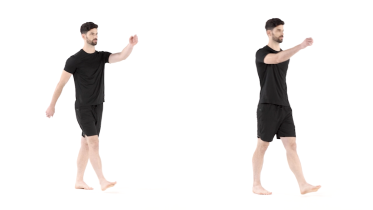
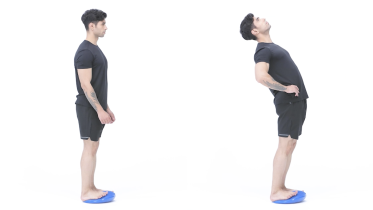
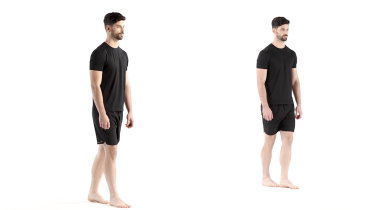
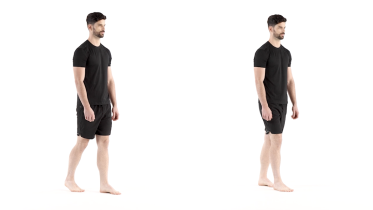
Standing with feet together
Standing with your feet together is one of the simplest balance exercises: you stand tall beside a support with your feet side by side and touching, and hold still. Bringing the feet together narrows the base you balance on, so your ankles and hips have to make small corrections to keep you upright. Physios often use it as the first position in a standing balance program, before semi-tandem and tandem stance.
How to do the standing with feet together
- Choose a support you can touch without leaning, such as the kitchen counter or a heavy chair that stays put. The video uses a folding chair, but one that cannot collapse is the safer choice at home. Wear flat shoes that fit well and grip the floor, not socks, tights or bare feet.
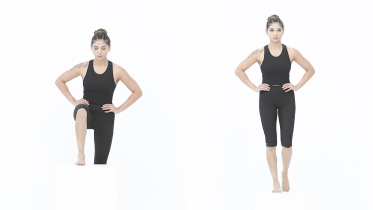
- Stand tall and let your arms hang loose. Bring your feet in until they touch along their inside edges, or get them as close as you comfortably can.
- Look at a fixed point straight ahead at eye level, and let your weight settle evenly over both feet.
- Hold the position without touching the support if you can. If you sway too far, rest your fingertips on it until you feel steady again, then carry on.
- When your hold time is up, step your feet apart and rest for a few breaths before the next one.
What you should feel
A slight sway forward and back or from side to side, with the muscles around your ankles making small, constant corrections. Many people find it easy within a few sessions. That is usually the sign to move on to a harder position.
Common mistakes
- Standing with a small gap between the feet, so the base stays wide.
- Gripping the support for the whole hold, so your hand does the balancing instead of your legs.
- Watching your feet rather than a point ahead of you.
- Bracing your knees straight and tight, or forgetting to breathe.
How often
Try 3 to 5 holds each session, working up from about 10 seconds toward 30, once or twice a day. The voice guide says to hold for as long as you can, but end each hold while you still feel in control. Your physio will adjust this.
Stop and check with your physio if
- You feel dizzy, lightheaded, faint or sick, or the room seems to spin. Hold your support, sit down and get medical advice the same day before you practice again. If you faint, it does not settle within a few minutes of sitting still, your vision suddenly blurs or goes double, or you cannot stand or walk steadily, call emergency services.
- You sway so far that you have to grab the support to stay on your feet.
From the clinic
In the video the man stands with the chair right beside him and never touches it. Treat that as the goal. For the first few sessions, let one hand hover just above the support, and clear anything you could trip on, such as a loose rug or a trailing cable. If you have fallen in the past year, feel unsteady when you walk, or take medicines that make you drowsy or lightheaded, have another adult at home while you practice, and bring up falls at your next physio or doctor visit. If standing still has been getting harder over weeks or months for no clear reason, book a check with your doctor soon, as a slow change in balance can have a cause that needs treating.
A sudden loss of balance is different. Call emergency services straight away for any sign of a stroke, even if it goes away: sudden dizziness with unsteadiness or falling over, a face that droops on one side, an arm you cannot lift or keep up, slurred or muddled speech, weakness or numbness on one side of your body or face, sudden blurred vision, double vision or loss of sight, or a sudden severe headache.
Feet together with your eyes open is usually where standing balance work begins. Once you can hold it steadily for the full time your program sets without touching the support, the next positions are often semi-tandem stance and then tandem stance. Doing this same position with your eyes shut, as in standing balance with eyes closed, is a much bigger jump. Leave it until your physio suggests it.
Written and checked by the PocketPhysio editorial team. Last updated 2026-09-26.
This page is general education, not a diagnosis or a personal treatment plan. If you have pain, an injury or a health condition, see a physiotherapist or doctor before starting new exercises.